H2K Infosys professionals can often begin pursuing entry-level AI-related job roles within a few months of completing a structured Artificial Intelligence Certified Course, especially if they already have IT, programming, analytics, or cloud experience. The timeline depends on factors such as prior technical knowledge, hands-on project experience, portfolio quality, and familiarity with enterprise AI tools and workflows. A well-designed Artificial intelligence training program typically prepares learners for practical responsibilities including machine learning workflows, data preparation, model evaluation, and AI deployment concepts.
AI Career After Completing Artificial Intelligence do not always require advanced research-level expertise. Many organizations hire professionals for applied AI roles involving automation, analytics, data engineering, machine learning operations (MLOps), and AI-assisted software development.
What Is an Artificial Intelligence Career?
An AI Career After Completing Artificial Intelligence involves working with systems that can analyze data, recognize patterns, make predictions, automate decisions, or assist users through intelligent algorithms. AI professionals contribute to the design, implementation, deployment, and maintenance of machine learning and data-driven systems.
AI-related careers span multiple domains, including:
- Machine Learning Engineering
- Data Science
- AI Application Development
- Natural Language Processing (NLP)
- Computer Vision
- Business Intelligence
- AI Operations (MLOps)
- AI Product Management
- Cloud AI Engineering
A professional completing an AI Career After Completing Artificial Intelligence may qualify for entry-level or transition-level roles depending on their background and practical experience.
Why Is Artificial Intelligence Important for Working Professionals?
Artificial intelligence is increasingly integrated into enterprise systems, cloud platforms, cybersecurity tools, customer service platforms, analytics pipelines, and automation frameworks.
Working professionals are learning AI because organizations commonly use AI for:
- Predictive analytics
- Workflow automation
- Fraud detection
- Recommendation systems
- Intelligent search
- Chatbots and virtual assistants
- Document processing
- IT operations monitoring
- Demand forecasting
Professionals with AI knowledge can contribute to modernization initiatives across industries including healthcare, finance, retail, logistics, telecommunications, and manufacturing.
Common Enterprise Drivers for AI Adoption
| Business Need | AI Application |
|---|---|
| Process automation | Intelligent workflow systems |
| Customer support | Conversational AI |
| Operational analytics | Predictive modeling |
| Security monitoring | Threat detection models |
| Supply chain optimization | Forecasting algorithms |
| Data-driven decisions | Machine learning dashboards |
Organizations often prefer professionals who understand both technical implementation and business workflows.
How Fast Can You Start an AI Career After Completing Artificial Intelligence Online Training?
The timeline for starting an AI Career After Completing Artificial Intelligence varies depending on:
- Existing technical background
- Time invested in hands-on practice
- Portfolio quality
- Certification credibility
- Understanding of enterprise workflows
- Communication and problem-solving abilities
Typical Career Transition Timelines
| Background | Estimated Transition Timeline |
|---|---|
| Software developer | 3–6 months |
| Data analyst | 3–5 months |
| Cloud engineer | 4–7 months |
| Non-technical beginner | 8–12 months |
| IT support professional | 6–9 months |
Professionals with prior experience in Python, SQL, cloud computing, or analytics often adapt faster to AI workflows.
Factors That Influence Career Readiness
1. Practical Project Experience
Recruiters commonly evaluate:
- GitHub portfolios
- Machine learning projects
- Real-world datasets
- Deployment understanding
- Documentation quality
2. Understanding Enterprise Workflows
Employers value professionals who understand:
- Data pipelines
- Cloud infrastructure
- API integration
- Model monitoring
- Security considerations
- CI/CD automation
3. Tool Familiarity
Hands-on experience with widely used AI tools can accelerate employability.
What Skills Are Required to Learn Artificial Intelligence?
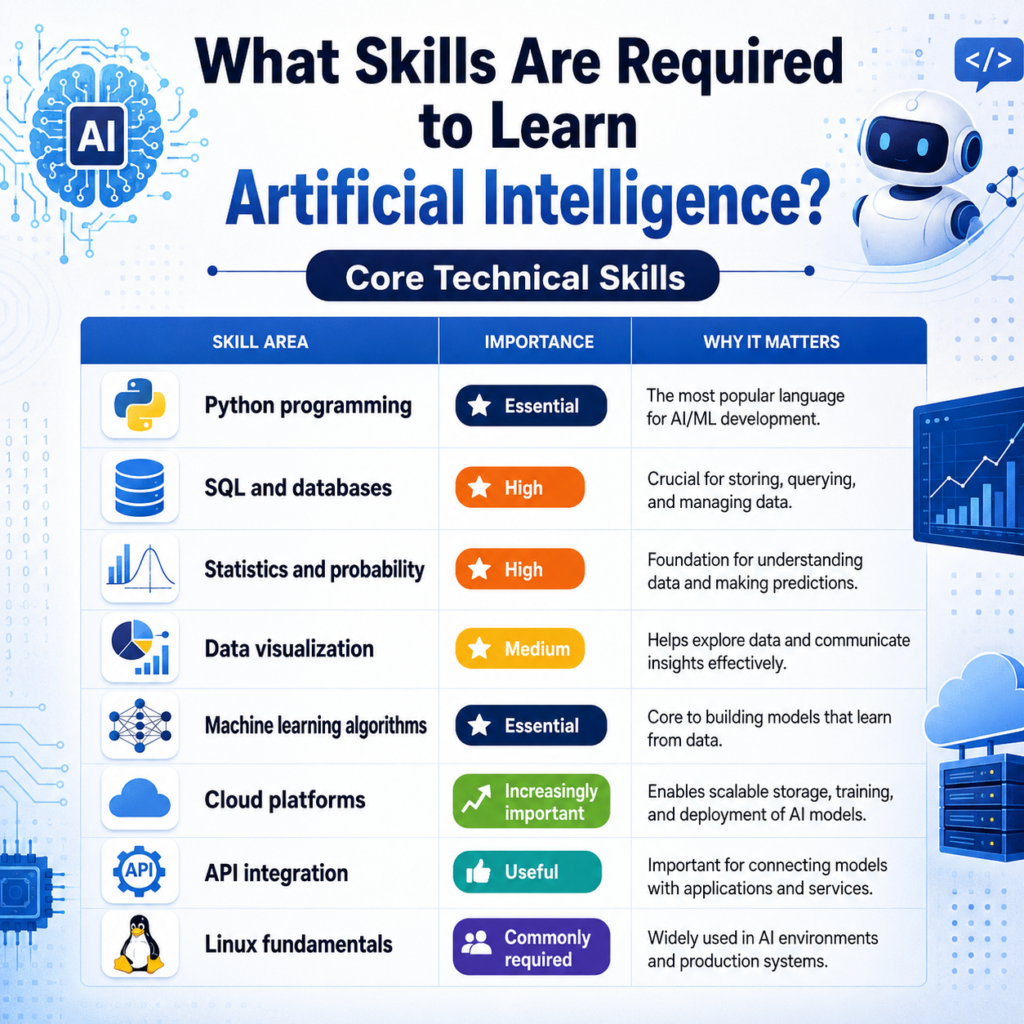
An Artificial Intelligence Training Program typically combines programming, mathematics, data handling, and machine learning concepts.
Core Technical Skills
| Skill Area | Importance |
|---|---|
| Python programming | Essential |
| SQL and databases | High |
| Statistics and probability | High |
| Data visualization | Medium |
| Machine learning algorithms | Essential |
| Cloud platforms | Increasingly important |
| API integration | Useful |
| Linux fundamentals | Commonly required |
Important Soft Skills
AI professionals also require:
- Analytical thinking
- Problem-solving
- Communication skills
- Documentation ability
- Collaboration across teams
- Business understanding
Enterprise AI projects are usually collaborative rather than isolated technical efforts.
What Does an Artificial Intelligence Training Program Typically Include?
A structured AI Career After Completing Artificial Intelligence generally includes theoretical foundations and applied learning.
Programming Fundamentals
Most programs begin with:
- Python syntax
- Data structures
- Functions and modules
- File handling
- Object-oriented programming
Data Analysis
Learners work with:
- Pandas
- NumPy
- Data cleaning techniques
- Exploratory data analysis
- Visualization libraries
Machine Learning
Core topics include:
- Supervised learning
- Unsupervised learning
- Classification algorithms
- Regression models
- Clustering techniques
- Model evaluation
Deep Learning
Advanced sections may include:
- Neural networks
- TensorFlow
- PyTorch
- Convolutional Neural Networks (CNNs)
- Natural Language Processing
AI Deployment Concepts
Modern enterprise-focused programs often include:
- Docker containers
- REST APIs
- Cloud deployment
- MLOps fundamentals
- Model monitoring
How Does Artificial Intelligence Work in Real-World IT Projects?
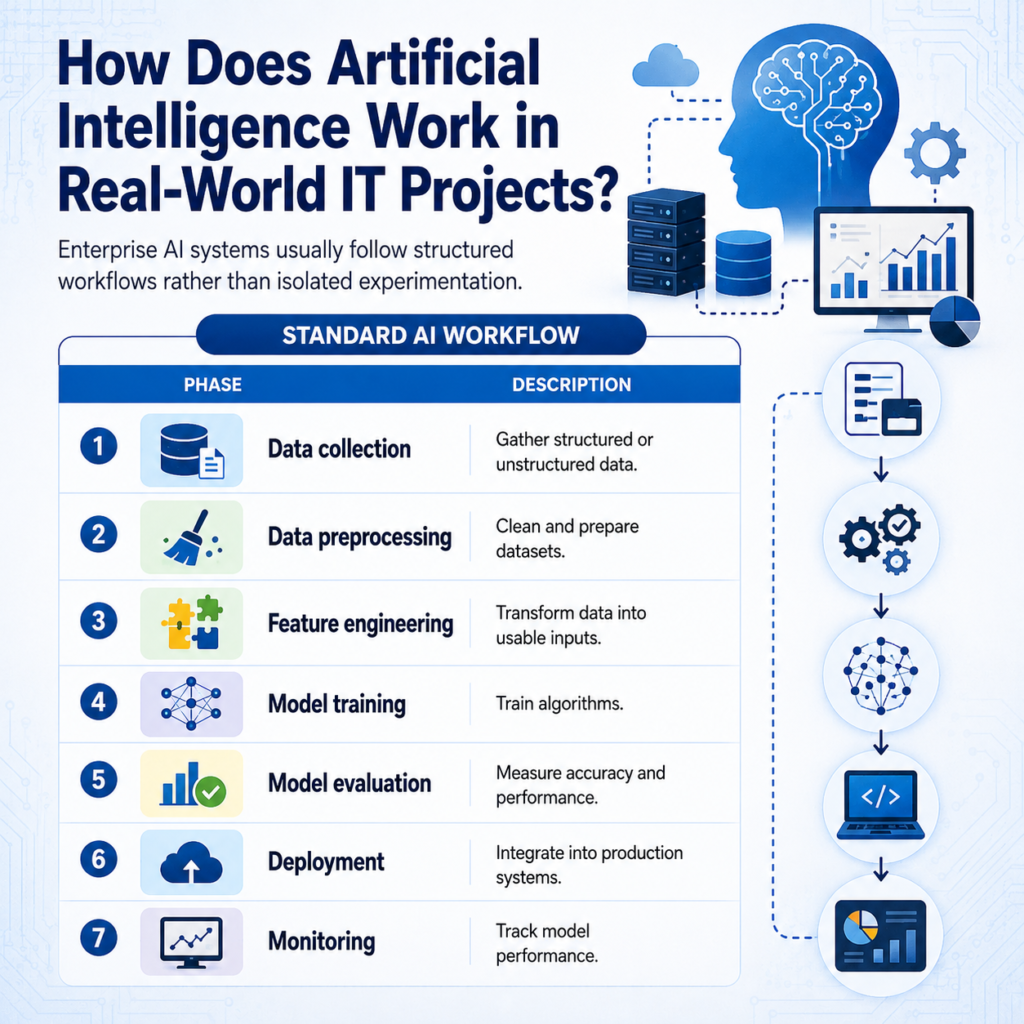
Enterprise AI systems usually follow structured workflows rather than isolated experimentation.
Standard AI Workflow
| Phase | Description |
|---|---|
| Data collection | Gather structured or unstructured data |
| Data preprocessing | Clean and prepare datasets |
| Feature engineering | Transform data into usable inputs |
| Model training | Train algorithms |
| Model evaluation | Measure accuracy and performance |
| Deployment | Integrate into production systems |
| Monitoring | Track model performance |
Example: Customer Support Automation
An enterprise customer support AI solution may involve:
- Collecting historical support tickets
- Cleaning text datasets
- Training NLP classification models
- Deploying APIs for ticket categorization
- Monitoring prediction quality
Professionals completing an AI Career After Completing Artificial Intelligence often begin by contributing to portions of these workflows.
Which Tools Are Commonly Used in Artificial Intelligence Projects?
AI professionals use a combination of programming frameworks, cloud services, and automation tools.
Common AI Tools and Frameworks
| Category | Tools |
|---|---|
| Programming | Python, R |
| Machine learning | Scikit-learn |
| Deep learning | TensorFlow, PyTorch |
| Data processing | Pandas, NumPy |
| Visualization | Matplotlib, Seaborn |
| Databases | PostgreSQL, MongoDB |
| Cloud AI | AWS SageMaker, Azure AI, Google Vertex AI |
| Deployment | Docker, Kubernetes |
| MLOps | MLflow, Kubeflow |
Why Tool Diversity Matters
Enterprise teams rarely rely on a single technology stack. Professionals are expected to:
- Integrate APIs
- Work with cloud infrastructure
- Collaborate with DevOps teams
- Handle production monitoring
- Maintain scalable workflows
Hands-on exposure to multiple tools increases job readiness.
How Is Artificial Intelligence Used in Enterprise Environments?
AI implementation in enterprise environments focuses on scalability, reliability, and operational efficiency.
Common Enterprise AI Use Cases
Fraud Detection
Financial institutions commonly use machine learning models to detect:
- Suspicious transactions
- Identity anomalies
- Risk patterns
Predictive Maintenance
Manufacturing organizations use AI to:
- Analyze sensor data
- Predict equipment failure
- Reduce downtime
Recommendation Systems
Retail and streaming platforms use AI to:
- Suggest products
- Personalize experiences
- Improve engagement metrics
Intelligent Document Processing
Organizations automate:
- Invoice extraction
- Resume screening
- Contract analysis
- OCR-based workflows
What Challenges Do AI Teams Commonly Face?
AI implementation involves technical and operational complexities.
Common Enterprise Challenges
| Challenge | Description |
|---|---|
| Poor data quality | Inaccurate datasets reduce model reliability |
| Model drift | Accuracy declines over time |
| Security concerns | Sensitive data requires protection |
| Infrastructure scaling | High compute requirements |
| Integration complexity | AI systems must connect with existing applications |
| Compliance requirements | Industry regulations affect AI usage |
Professionals trained through an AI Career After Completing Artificial Intelligence should understand these constraints rather than focusing only on model accuracy.
What Job Roles Use Artificial Intelligence Daily?
AI skills apply across several technical and business-oriented positions.
Common AI-Related Roles
| Job Role | Responsibilities |
|---|---|
| Machine Learning Engineer | Build and deploy ML systems |
| Data Scientist | Analyze data and create predictive models |
| AI Developer | Integrate AI into applications |
| NLP Engineer | Build language-processing systems |
| MLOps Engineer | Manage AI deployment pipelines |
| Data Analyst | Use AI-assisted analytics tools |
| AI Product Analyst | Support AI business workflows |
What Careers Are Possible After Learning Artificial Intelligence?
Completing an AI Career After Completing Artificial Intelligence can support career transitions into multiple domains.
Entry-Level Opportunities
Junior Machine Learning Engineer
Responsibilities may include:
- Preparing datasets
- Training baseline models
- Evaluating performance metrics
- Supporting deployment tasks
AI Support Engineer
Focus areas include:
- AI infrastructure support
- Monitoring prediction services
- Managing cloud AI environments
Data Analyst with AI Skills
Professionals use:
- Predictive analytics
- Automation scripts
- Data visualization tools
Mid-Level Career Growth
With practical experience, professionals may advance into:
- Senior AI Engineer
- MLOps Architect
- Data Platform Engineer
- AI Solution Architect
- AI Product Manager
Can Working Professionals Learn AI While Employed Full-Time?
Many learners pursue AI education while maintaining full-time jobs.
Common Learning Approaches
| Learning Method | Advantages |
|---|---|
| Weekend programs | Flexible scheduling |
| Self-paced modules | Learn at individual speed |
| Instructor-led online training | Structured guidance |
| Project-based learning | Practical experience |
| Hybrid learning | Combines live and recorded sessions |
Working professionals often benefit from structured AI Career After Completing Artificial Intelligence programs that include:
- Labs
- Assignments
- Real datasets
- Industry workflows
- Mentorship support
What Makes an Artificial Intelligence Certified Course Valuable?
Not all AI Career After Completing Artificial Intelligence provide equivalent career preparation.
Important Evaluation Criteria
Hands-On Projects
Programs should include:
- End-to-end machine learning workflows
- Cloud deployment exercises
- API integration tasks
- Model evaluation projects
Enterprise-Relevant Curriculum
Strong programs teach:
- Production workflows
- Security considerations
- Scalable architectures
- Team collaboration practices
Industry Tool Exposure
Learners benefit from exposure to:
- AWS AI services
- Azure Machine Learning
- Docker
- Git
- CI/CD pipelines
Instructor Experience
Experienced instructors often provide:
- Real-world troubleshooting guidance
- Enterprise best practices
- Architecture insights
How Can Learners Build a Strong AI Portfolio?
A practical portfolio often influences hiring outcomes.
Recommended Portfolio Projects
| Project Type | Skills Demonstrated |
|---|---|
| Customer churn prediction | Classification modeling |
| Sales forecasting | Time-series analysis |
| Resume screening system | NLP |
| Image recognition | Computer vision |
| Chatbot implementation | Conversational AI |
| Recommendation engine | Personalization algorithms |
Portfolio Best Practices
Include:
- Source code repositories
- Documentation
- Architecture diagrams
- Deployment examples
- Performance metrics
Recruiters often prefer demonstrable project work over purely theoretical knowledge.
What Certifications Are Commonly Pursued Alongside AI Training?
Professionals frequently combine AI education with related certifications.
Complementary Certifications
| Certification Area | Examples |
|---|---|
| Cloud computing | AWS, Azure, Google Cloud |
| Data engineering | Databricks, Snowflake |
| Python programming | PCAP, PCEP |
| Machine learning | TensorFlow certifications |
| Data analytics | Power BI, Tableau |
These certifications may strengthen credibility in enterprise hiring environments.
How Do Employers Evaluate AI Candidates?
Hiring teams usually assess both theoretical understanding and practical implementation ability.
Common Evaluation Areas
Technical Assessments
Candidates may be asked to:
- Write Python code
- Explain ML algorithms
- Analyze datasets
- Optimize workflows
Project Discussions
Interviewers often review:
- Architecture decisions
- Data preprocessing methods
- Deployment strategies
- Performance trade-offs
Problem-Solving Ability
Employers typically value:
- Debugging skills
- Adaptability
- Communication clarity
- Business understanding
FAQ:
How long does it take to become job-ready in AI?
Professionals with existing technical backgrounds may become job-ready within 3–6 months after completing a structured AI Career After Completing Artificial Intelligence and building practical projects.
Is coding required for artificial intelligence careers?
Most AI roles require programming knowledge, especially Python. Some low-code AI tools exist, but enterprise AI development commonly involves coding.
Can beginners learn artificial intelligence online?
Yes. Many online programs begin with foundational programming and data concepts before advancing into machine learning and deployment topics.
What industries hire AI professionals?
Industries commonly hiring AI professionals include finance, healthcare, retail, logistics, cybersecurity, manufacturing, and telecommunications.
Which programming language is most important for AI?
Python is the most widely used programming language in machine learning and AI workflows due to its ecosystem and framework support.
Do AI jobs require cloud knowledge?
Many enterprise AI systems operate in cloud environments. Familiarity with AWS, Azure, or Google Cloud is increasingly valuable.
Is certification enough to get an AI job?
Certification alone may not be sufficient. Employers often expect hands-on projects, practical experience, and understanding of real-world workflows.
What is the difference between AI and machine learning?
Artificial intelligence is the broader field focused on intelligent systems, while machine learning is a subset that enables systems to learn from data patterns.
- AI Career After Completing Artificial Intelligence can help professionals transition into AI-related roles within months, depending on prior experience and practical training.
- Enterprise AI work involves data preparation, model development, deployment, monitoring, and cloud integration.
- Hands-on projects, portfolio development, and familiarity with production workflows significantly improve employability.
- AI Career After Completing Artificial Intelligence extend beyond research roles into analytics, automation, cloud engineering, and business intelligence.
- Employers commonly value practical implementation skills alongside theoretical understanding.
Explore hands-on AI Career After Completing Artificial Intelligence and enterprise-focused learning paths through H2K Infosys to build practical AI skills aligned with modern IT environments.
Enroll in an industry-oriented AI Career After Completing Artificial Intelligence to gain project experience, workflow knowledge, and career-ready technical capabilities