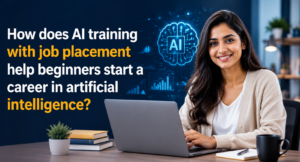
AI training program such as those offered by H2K Infosys usually follow a structured path, but not in a stiff, textbook way. Instead, they guide you through the essentials while allowing room to explore and learn by doing. You’re introduced to core concepts, the tools professionals actually use on the job, and the kinds of workflows you’ll encounter in real IT environments.
For most professionals, that’s where the real value lies. It’s not just about theory you’re building practical skills that align with what companies are actively hiring for, including machine learning, data analysis, and automation.
That said, finishing a course doesn’t magically land you a job. It just doesn’t work that way. What really counts is how well you’ve understood things, how much hands-on work you’ve put in, and whether you can use those skills outside a guided setup.
What Is an AI Training Program?
At its simplest, an AI Training Program is a guided learning journey. You usually start with the basics and then gradually move into more complex areas like:
- Machine learning
- Data preprocessing and analysis
- Model building and evaluation
- Deploying AI into real systems
Most online programs mix formats. You’ll probably run into:
- Video lessons you can go through at your own pace
- Hands-on labs (sometimes frustrating, but that’s often where things finally click)
- Real-world projects
- Tools like Python, TensorFlow, and cloud platforms
A lot of these programs are designed for working professionals, so they lean toward flexibility. It’s less about memorizing and more about building something even if it’s messy at first and learning along the way.
How Does AI Work in Real-World IT Projects?
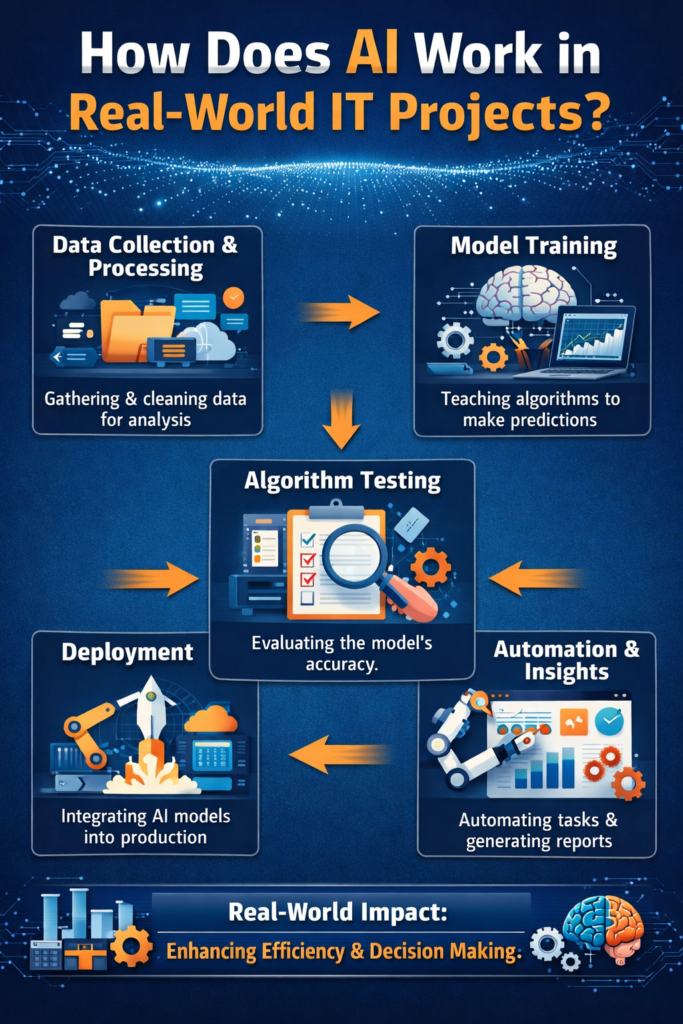
In real projects, AI isn’t just about training a model and calling it a day. There’s a whole lifecycle behind it and honestly, understanding that flow is what separates beginners from people who are actually job-ready.
A typical workflow looks something like:
- Collecting data (databases, APIs, logs… wherever it comes from)
- Cleaning it (missing values, inconsistencies there’s always something)
- Feature engineering (figuring out what actually matters)
- Training models
- Evaluating results
- Deploying into real systems
Take a simple example predicting customer churn for a retail company. Sounds straightforward at first. But then the data is messy, patterns aren’t obvious, and the model doesn’t perform the way you expected. That’s pretty normal, actually.
Good AI training program don’t just show isolated steps they walk you through the entire process, end to end, with all the rough edges included.
Why Is AI training program Important for Working Professionals?
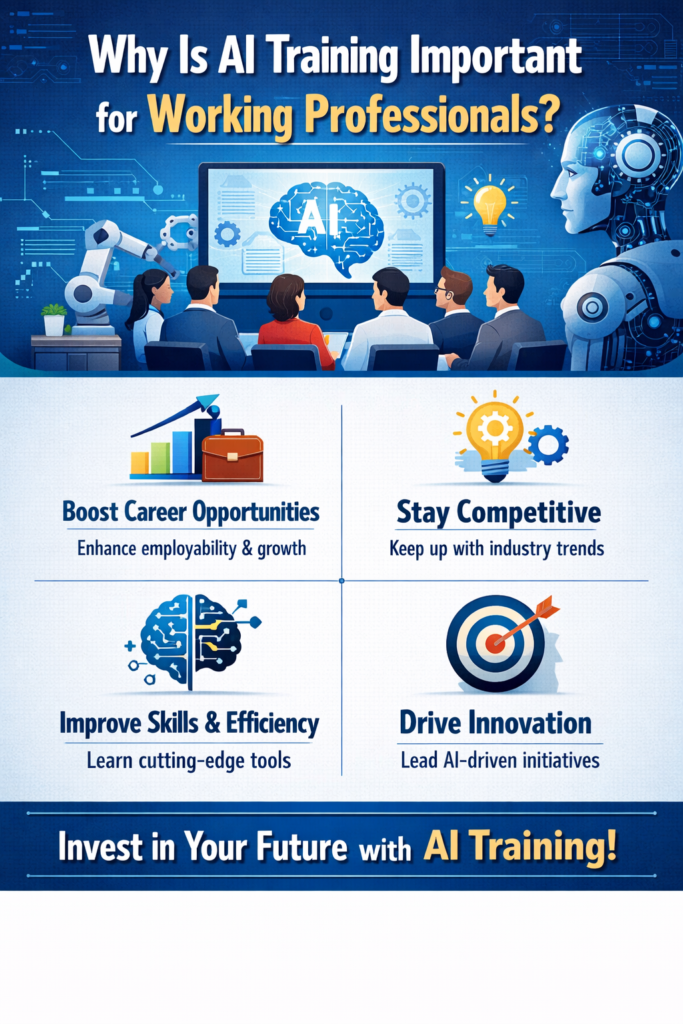
AI isn’t some niche skill anymore. It’s everywhere finance, healthcare, logistics… even roles that didn’t used to involve data are starting to rely on it.
If you’re already in IT (or somewhere close), AI training can help you:
- Keep your skills from getting outdated
- Move toward data-focused roles more easily
- Build a stronger problem-solving approach
And it’s not just for data scientists. You’ll see AI used by:
- Business analysts
- Developers
- QA engineers
- DevOps teams
Still, most employers care less about what course you completed and more about what you’ve actually built. Projects tend to speak louder than certificates.
What Skills Are Required to Learn AI training program?
You don’t need to know everything upfront but there are a few areas you’ll gradually need to get comfortable with.
Technical basics:
- Python (you’ll use it a lot)
- Statistics and probability
- Data tools like SQL, Excel, or visualization libraries
Other useful skills:
- Logical thinking
- Breaking down complex problems
- Debugging (which… can really test your patience some days)
Most people move through stages:
- Beginner: Python basics, simple data work
- Intermediate: Machine learning algorithms
- Advanced: Model tuning, deployment, scaling
The better programs don’t rush this they build things step by step, even if progress feels slow at times.
How Is AI training program Used in Enterprise Environments?
In companies, AI isn’t about experimenting for fun. It’s usually tied to solving specific, often high-impact problems.
Common use cases include:
- Predicting sales or risk
- Automating repetitive tasks (like chatbots)
- Fraud detection
- Recommendation systems
But real-world AI comes with constraints:
- Data privacy rules
- Scalability challenges
- Integration with older systems
- Making models explainable (this one’s bigger than it sounds)
Training that includes these realities tends to be far more useful than purely theoretical content.
What Job Roles Use AI Daily?
AI shows up across a range of roles:
- Data Scientist – builds and evaluates models
- Machine Learning Engineer – deploys and maintains them
- Data Analyst – interprets results
- Software Engineer – integrates AI into applications
- Business Analyst – uses insights for decision-making
For example, a Machine learning Training Courses might take a trained model, turn it into an API, deploy it to the cloud, and then keep an eye on how it performs over time. It’s not just coding it’s ongoing problem-solving.
What Careers Are Possible After Learning AI training program?
Where you land depends on your background and how deep you go.
Entry-level roles:
- Junior Data Analyst
- AI Support Engineer
- Business Intelligence Analyst
Mid-level roles:
- Machine Learning Engineer
- Data Scientist
- AI Developer
Advanced roles:
- AI Architect
- Data Engineering Specialist
- AI Product Manager
One thing worth noting your portfolio often matters more than your certificate.
How Do AI training program Support Global Opportunities?
One big advantage of online AI training is that the tools and practices are used globally.
A few things that help:
- Standard tools like Python, TensorFlow, AWS
- Many roles support remote work
- Hiring often focuses on projects rather than location
- Cloud skills make cross-region collaboration easier
That said, technical skills alone aren’t enough. Communication and the ability to work with distributed teams matter more than people expect.
What Should You Look for in an AI Training Program?
Not all programs are equal. Some go heavy on theory but don’t give you much hands-on experience.
Things worth checking:
- Real projects with actual datasets
- Coverage of the full workflow (not just modeling)
- Use of industry tools
- Exposure to deployment and scaling
Programs that push you to build even if you struggle a bit tend to stick with you longer.
What Challenges Do Learners Face in AI training program?
Learning AI isn’t always smooth. Some parts take longer than expected.
Common challenges:
- Math concepts that don’t click right away
- Messy, inconsistent datasets
- Models that underperform (even when everything seems correct)
- Handling large volumes of data
And then there are real-world issues:
- Biased or incomplete data
- Limited computing resources
- Explaining model decisions clearly
Strangely enough, running into these problems during training is actually a good sign it means you’re dealing with the kind of issues that show up in real work.
How Do Professionals Apply AI Skills on the Job?
In practice, AI is just one part of a bigger system.
Take fraud detection, for example:
- Extract transaction data
- Clean and preprocess it
- Train a model
- Evaluate performance
- Deploy via API
- Monitor and improve over time
It’s rarely a straight line. Things break, data changes, models drift. That’s just part of the process.
FAQ: AI training program and Global Careers
Is AI training program enough to get a global job?
Not on its own. It’s a strong foundation, but you’ll need hands-on experience and real problem-solving ability.
How long does it take to learn AI?
Basics can take a few months. Getting comfortable? Usually closer to a year or more.
Do I need a technical background?
It helps, but many people build those skills along the way.
Are AI jobs available globally?
Yes especially in tech-driven industries.
What tools should I focus on?
Python, ML libraries, and cloud platforms are a solid starting point.
Final Thoughts
AI training program can definitely open doors but they’re just one piece of the puzzle. What really matters is how you use what you’ve learned.
A few things to keep in mind:
- Structured learning gives direction
- Real projects build credibility
- AI work is about end-to-end workflows, not just models
- Global roles need both technical and soft skills
If you’re exploring options, hands-on programs like those offered by H2K Infosys can be a practical way to build experience that actually translates into real-world work.
And honestly, the sooner you start applying what you learn even in small, slightly messy ways the faster it all starts to make sense.