Salesforce has become a critical tool for companies worldwide, especially in the IT and Big Tech industries. Whether you’re aiming for roles that involve Salesforce Marketing Cloud, Salesforce Administrator positions, or SFDC Salesforce, acing the interview is essential. A significant part of the hiring process revolves around SFDC Salesforce Behavioral Interview Questions, which gauge not only your technical skills but also how you function in a professional environment.
In this blog, we’ll cover the most common SFDC Salesforce Behavioral Interview Questions and offer strategies to answer them effectively. By understanding these questions, you can position yourself as a standout candidate for high-demand roles in top tech companies. This article is designed to help you boost your chances of landing your dream job, offering insights that can increase your visibility in the job market.

Why Behavioral Interview Questions Matter
Big Tech companies and IT industries don’t just want skilled professionals; they want individuals who can adapt, collaborate, and think critically. Salesforce professionals, particularly those in high-stakes roles like Salesforce Administrator, SFDC Salesforce, or Salesforce Marketing Cloud specialists, are often tasked with solving complex challenges. SFDC Salesforce Behavioral Interview Questions aim to assess how candidates have handled specific scenarios in the past, which can predict their future performance.
Key SFDC Salesforce Behavioral Interview Questions and How to Answer Them
Let’s break down some of the most common SFDC Salesforce Behavioral Interview Questions SFDC Salesforce candidates might face during their interviews.
1. Tell me about a time when you managed a challenging project using SFDC Salesforce. How did you ensure its success?
This question aims to assess your project management skills and how well you can handle challenges while using SFDC Salesforce tools. Whether you’ve worked with Salesforce Marketing Cloud, the key is to emphasize your problem-solving abilities.
Sample Answer:
“In my previous role as an SFDC Salesforce Administrator, I was responsible for a large-scale project where the goal was to integrate Salesforce with multiple third-party platforms. We faced significant challenges, such as data discrepancies and tight deadlines. To ensure success, I implemented agile project management practices, scheduled regular check-ins with stakeholders, and ensured clear communication with the development team. The project was completed ahead of schedule, and the system integration improved our data accuracy by 20%.”
2. Describe a time when you had to collaborate with a team on an SFDC Salesforce project. How did you ensure effective communication?
Collaboration is crucial in Big Tech companies, especially when working with tools like Salesforce Marketing Cloud or Salesforce systems. This question assesses your teamwork skills.
Sample Answer:
“In a previous position, I was part of a cross-functional team tasked with optimizing our SFDC Salesforce system to improve marketing automation processes. To ensure effective communication, I created a centralized dashboard where all team members could track progress, document issues, and share updates. I also facilitated weekly stand-up meetings to align everyone on priorities and objectives. This streamlined communication, reduced errors, and helped us complete the project with a 15% boost in email marketing efficiency through Salesforce Marketing Cloud.”
3. Can you give an example of when you used data analysis in SFDC Salesforce to make a business decision?
Roles within Salesforce, such as Salesforce Marketing Cloud specialists or Salesforce Administrators, often involve data management and analysis. This question tests your analytical and decision-making abilities within the Salesforce environment.
Sample Answer:
“In my role as a Salesforce Administrator, I used Salesforce analytics tools to analyze customer engagement data. I noticed that our customer retention rates were declining. After identifying a pattern of customers leaving after specific touchpoints, I collaborated with the sales team to redesign our follow-up process. The analysis we derived from Salesforce helped us improve customer engagement, and after implementing the changes, customer retention improved by 12% over the next quarter.”
4. Tell me about a time when you had to troubleshoot an issue within SFDC Salesforce. How did you approach the problem?
Tech professionals in Big Tech companies often face unexpected system issues, particularly within SFDC Salesforce environments. For positions like Salesforce Administrator, knowing how to troubleshoot effectively in SFDC Salesforce is crucial.
Sample Answer:
“During a key product launch, we encountered a synchronization issue between Salesforce and our email marketing system, delaying communications to customers. As the Salesforce Administrator, I quickly diagnosed the issue, realizing that an API update had caused the failure. I coordinated with both the internal development team and Salesforce support, and within a few hours, we implemented a fix that allowed the synchronization to run smoothly again. This minimized downtime and ensured that our launch was successful.”
5. How do you prioritize tasks when managing multiple SFDC Salesforce projects?
Big Tech companies value employees who can manage their time effectively, especially when working on multiple Salesforce projects. This question evaluates your prioritization and time-management skills, crucial for roles like Salesforce Administrator.
Sample Answer:
“When managing multiple Salesforce projects, I prioritize tasks based on their impact on the overall business objectives. For example, I would place higher priority on projects directly affecting customer engagement or revenue generation. I use Salesforce task management tools to keep track of deadlines and deliverables, and I make sure to communicate clearly with stakeholders about any potential delays. By staying organized and focused, I’ve consistently delivered projects on time.”
How to Prepare for SFDC Salesforce Behavioral Interview Questions
Preparing for these SFDC Salesforce Behavioral Interview Questions requires more than just knowing Salesforce Marketing Cloud or SFDC Salesforce inside and out. You need to demonstrate a balance between technical expertise and interpersonal skills.
1. Reflect on Past Experiences
Review your past work and think of specific examples where you applied your Salesforce skills. Whether it’s managing projects, solving problems, or collaborating with others, having a mental library of examples will help you craft concise, compelling responses.
2. Practice the STAR Method
The STAR method (Situation, Task, Action, Result) is an effective framework for answering behavioral questions. This structure ensures you cover the key points while keeping your answers focused. For example SFDC Salesforce Behavioral Interview Questions:
- Situation: Briefly describe the context.
- Task: Explain what your responsibilities were.
- Action: Detail the steps you took.
- Result: Share the outcome, focusing on measurable achievements.
3. Understand the Role
Every company, especially those in the IT and Big Tech sectors, has different priorities. For Salesforce Marketing Cloud specialists, the focus may be on customer engagement and campaign performance. For SFDC Salesforce Behavioral Interview Questions Administrators, system efficiency and security may be the primary concerns. Tailor your answers to reflect the specific role you’re interviewing for.
How SFDC Salesforce Skills Are Crucial in Big Tech
In the tech industry, the need for efficient customer relationship management (CRM) systems has never been greater. With Salesforce being a leader in CRM solutions, professionals skilled in SFDC Salesforce and Salesforce Marketing Cloud are in high demand.
1. Automation and Efficiency
Salesforce automates many manual processes, making it an indispensable tool for tech companies that want to streamline operations and reduce human error. For instance, roles like Salesforce Administrator involve setting up automated workflows and managing data integrity, crucial for scaling business operations.
2. Data-Driven Decisions
Big Tech companies rely heavily on data to make strategic decisions. With Salesforce’s robust analytics and reporting tools, professionals in roles like Salesforce Marketing Cloud can provide valuable insights that drive marketing strategies and customer retention.
3. Customization and Flexibility
SFDC Salesforce’s flexibility allows businesses to tailor it to their specific needs, whether it’s in marketing, sales, or customer support. This customization capability is particularly vital for IT and tech companies, which often have complex, evolving requirements.

Common Mistakes to Avoid in SFDC Salesforce Behavioral Interview Questions
Many candidates prepare well for technical rounds but lose opportunities because of weak behavioral interview responses. Avoid these common mistakes when answering SFDC Salesforce Behavioral Interview Questions:
- Skipping the STAR Method: Structure every answer using the Situation, Task, Action, and Result (STAR) framework to keep your response clear and relevant.
- Giving Generic Answers: Support your answers with real examples from Salesforce projects, internships, or professional experience instead of speaking in general terms.
- Focusing Only on Technical Skills: Behavioral interviews assess communication, teamwork, leadership, adaptability, and problem-solving not just Salesforce expertise.
- Blaming Others for Challenges: When discussing conflicts or setbacks, focus on how you contributed to resolving the issue rather than criticizing teammates or managers.
- Ignoring Measurable Results: Whenever possible, include outcomes such as improved efficiency, reduced errors, faster delivery, or higher customer satisfaction to demonstrate your impact.
- Providing Long or Unstructured Responses: Keep your answers concise, relevant, and focused on the question being asked.
- Not Researching the Company: Understand the organization’s values and align your examples with the qualities they seek, such as collaboration, ownership, and customer focus.
By avoiding these mistakes and practicing SFDC Salesforce Behavioral Interview Questions with well-structured STAR responses, you can present yourself as a confident, capable, and professional candidate during Salesforce interviews.
Skills Recruiters Evaluate in SFDC Salesforce Behavioral Interviews
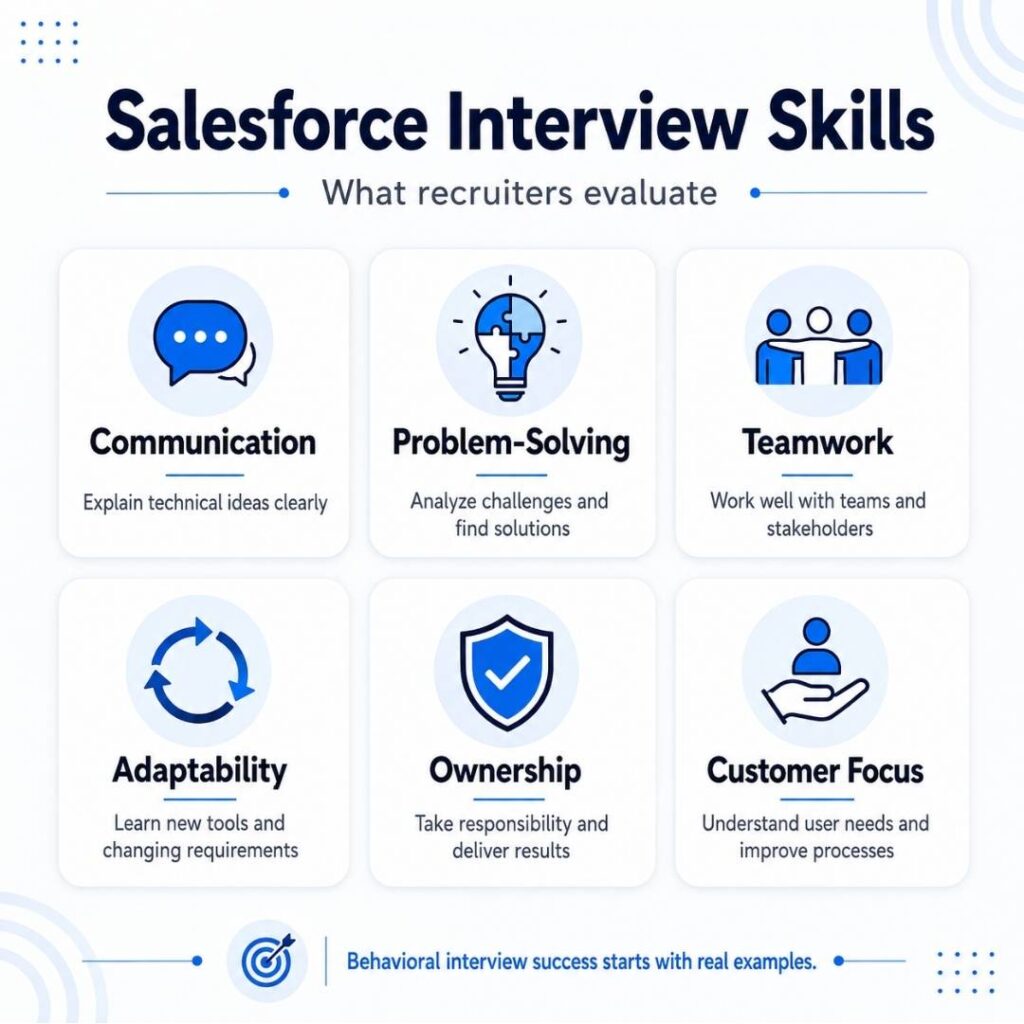
During SFDC Salesforce Behavioral Interview Questions, recruiters evaluate more than technical Salesforce knowledge. They want to understand how candidates handle workplace situations and contribute to team success.
SFDC Salesforce Behavioral Interviews Key skills they assess include:
- Communication Skills: Ability to explain technical concepts clearly to both technical and non-technical stakeholders.
- Problem-Solving Ability: How you analyze challenges and find practical solutions during Salesforce projects.
- Collaboration and Teamwork: Your experience working with developers, administrators, business teams, and clients.
- Adaptability: How quickly you learn new Salesforce features, tools, or changing project requirements.
- Ownership and Accountability: Your approach to taking responsibility for tasks and delivering successful outcomes.
- Customer Focus: How you understand user needs and create solutions that improve business processes.
SFDC Salesforce Behavioral Interview Questions Understanding these evaluation areas helps candidates prepare stronger answers and demonstrate the qualities employers look for in Salesforce professionals.
Final Thoughts
Acing SFDC Salesforce Behavioral Interview Questions requires a blend of technical know-how and strong interpersonal skills. Whether you’re aiming for a Salesforce Administrator, Salesforce Marketing Cloud specialist, or another role within Salesforce, mastering behavioral questions can significantly improve your chances of landing a position in a Big Tech company. By using the STAR method and preparing examples from your past experiences, you’ll be well-equipped to impress your interviewers and stand out in a competitive field.
By positioning yourself as a strong candidate with the ability to handle both technical challenges and collaborative work environments, you’ll not only pass your interviews with flying colors but also increase your visibility in the ever-evolving job market. Don’t forget to stay updated on the latest SFDC Salesforce Behavioral Interview Questions, Salesforce trends and best practices to ensure that you’re always ahead of the curve.
SFDC Salesforce Behavioral Interviews Remember, the key to success in Salesforce roles lies in demonstrating both your technical expertise and your ability to navigate the dynamic and fast-paced environments of Big Tech companies.
FAQs about SFDC Salesforce Behavioral Interview Questions
What are SFDC Salesforce behavioral interview questions?
These are scenario-based questions that assess your communication, problem-solving, teamwork, leadership, and decision-making skills in Salesforce-related roles
How should I answer Salesforce behavioral interview questions?
Use the STAR method (Situation, Task, Action, Result) to give structured and clear answers based on real work experiences.
Are behavioral questions important for Salesforce interviews in Big Tech companies?
Yes. Companies like Amazon, Microsoft, Google, and Salesforce place significant emphasis on behavioral interviews to evaluate cultural fit and leadership potential.
What are the most common Salesforce behavioral interview topics?
Team collaboration, stakeholder management, conflict resolution, project challenges, requirement gathering, and handling tight deadlines are among the most common topics.
Can freshers face Salesforce behavioral interview questions?
Yes. Freshers can answer using examples from internships, academic projects, certifications, volunteer work, or team-based activities.