
If you’re wondering how to become a Business Analyst today, the simplest path is this: learn practical ba training skills, earn a recognized ba certification, and gain hands-on experience through structured business analyst courses, and that’s exactly where H2K Infosys comes into the picture.
Business analysis has quietly become one of the most in-demand roles in tech and enterprise operations. Companies are drowning in data but still struggle to translate it into decisions. That gap? It’s where Business Analysts step in.
And honestly, I’ve seen a lot of people move into this field from completely different backgrounds, finance, QA testing, operations, even healthcare administration. The transition is very real if you follow a structured learning path.
Let’s walk through it step by step.
Why Business Analysts Are in High Demand Right Now
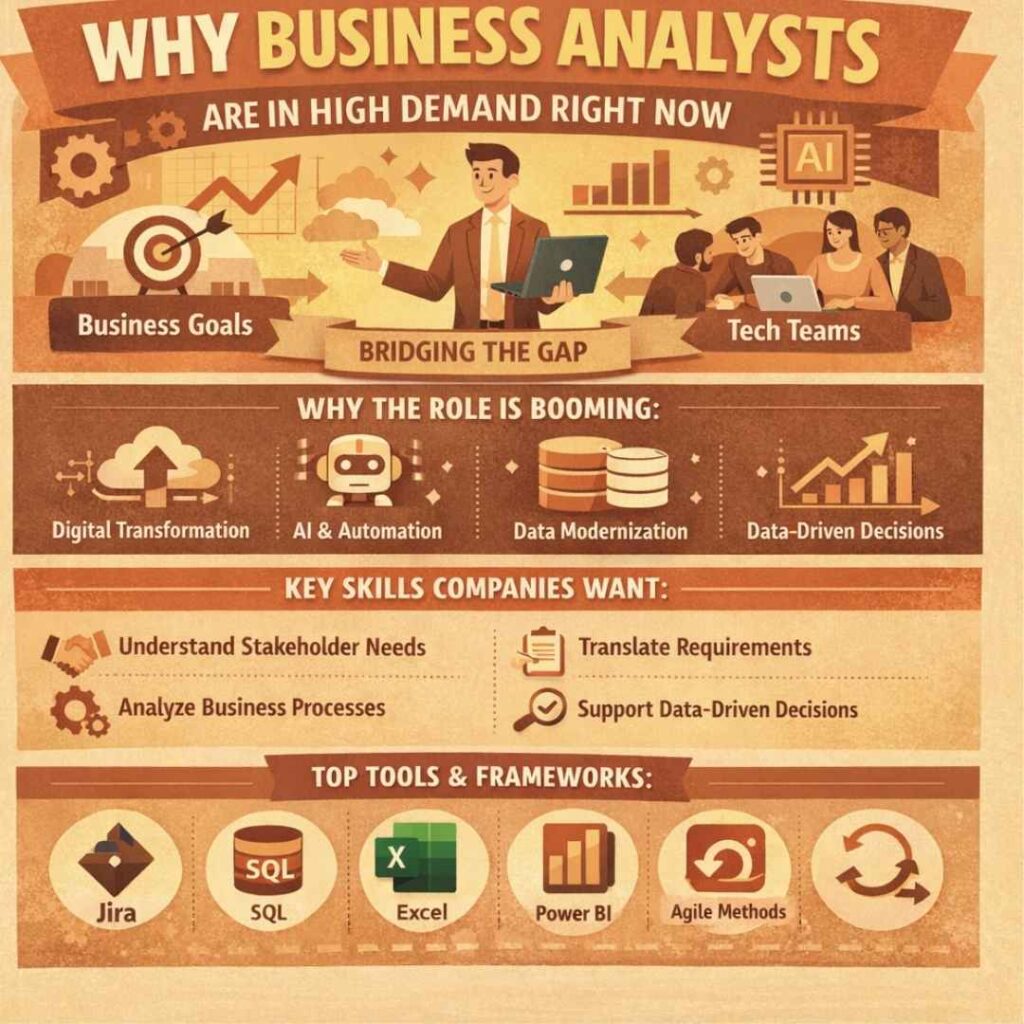
Before diving into the steps, it helps to understand why the role is booming.
In the last couple of years, organizations have been accelerating digital transformation projects, AI integration, automation, and data modernization. But technology alone doesn’t solve business problems. Someone has to connect business goals with technical teams.
That’s the Business Analyst.
According to industry reports from LinkedIn’s job insights, companies increasingly want professionals who can:
- Understand stakeholder needs
- Translate requirements for technical teams
- Analyze business processes
- Support data-driven decisions
And here’s the interesting part: many of these roles don’t require hardcore programming.
Instead, employers look for professionals with structured business analyst training and practical exposure to tools like:
- Jira
- SQL
- Excel
- Power BI
- Agile frameworks
That’s why structured business analysis online training programs have become so popular lately.
Step 1: Understand What a Business Analyst Actually Does
A lot of newcomers imagine a Business Analyst as “someone who works with business data.” That’s partially true, but the job is broader.
A typical Business Analyst day might include:
- Meeting with stakeholders to understand requirements
- Documenting business processes
- Creating user stories for development teams
- Analyzing data to identify trends
- Supporting Agile sprint planning
Think of them as translators between business teams and technical teams.
I once worked with a BA on a healthcare software project. Doctors described problems in clinical language, developers spoke in code, and the BA was the only person who truly understood both sides. Without that role, the project would’ve stalled.
This is exactly what good business analyst classes try to simulate real communication scenarios.
Step 2: Start with Structured BA Training
Here’s where most beginners make a mistake: they jump between random YouTube tutorials.
That usually leads to confusion.
Instead, structured ba training programs give you a clear roadmap:
- Business Analysis Fundamentals
- SDLC (Software Development Life Cycle)
- Agile and Scrum methodology
- Requirement gathering techniques
- Documentation (BRD, FRD, User Stories)
- Tools like Jira, SQL, and Excel
A well-designed business analyst training program walks through these topics in the order companies actually use them.
When people enroll in business analysis online training, they’re usually looking for flexibility, especially if they’re working professionals switching careers.
Step 3: Familiarize Yourself with Important BA Software
Business Analysts are not just facilitators, they also utilize software that enables teams to document workflows and interpret data.
Some tools that are commonly included in recent business analyst courses are:
Jira
Widespread use in Agile structures for the management of tasks and user stories.
SQL
Assists in the retrieval and examination of data from data repositories.
Excel / Google Sheets
Still predominant in the fields of reporting, analysis and dashboards.
Power BI and Tableau
Used for business reporting and data visualization.
Here’s something of note: the previous year has seen a number of companies beginning to use analytics tools with integrated AI. Analysts who can utilize both conventional reporting and AI-informed reporting are given priority.
This emphasizes the importance of the practical component within business analyst courses.
Step 4: Obtaining a BA Certification
After establishing foundational skills, the next step is to obtain a ba certification.
Certifications are beneficial for a few reasons:
- They offer proof of your skills to prospective employers.
- They provide an outline of what you need to learn based on the needs of the industry.
Examples of such certifications are:
- ECBA – Entry Certificate in Business Analysis
- CCBA – Certification of Capability in Business Analysis
- CBAP – Certified Business Analysis Professional
Also, a lot of learners tend to get their online business analyst certification since it helps them to study during their training.
To be honest, just having a certification will not be enough, but paired with some practical experience, it will make a lot of difference during interviews.
Step 5: Practice with Real-World Projects
This is the stage where theory turns into confidence.
Companies that offer good business analyst training and placement programs incorporate project simulations where participants:
- Draft requirement documents
- Run pretend stakeholder meetings
- Develop Agile user stories
- Interpret mock datasets
I recently saw a project where students had to analyze an e-commerce checkout system to figure out how to reduce cart abandonment. They had to identify the problem, collect the requirements, and suggest changes.
This kind of activity is a much better preparation for real-world work than rote learning.
Step 6: Create a Portfolio and Practice Interviewing
It is advantageous to create a basic BA portfolio before you start applying for positions. In your portfolio, you should include the following:
- Sample BRD (Business Requirement Document)
- User story examples
- Process flow diagrams
- Case Studies on Data Analysis
Having concrete examples gives recruiters something to work with.
Most business analyst training and placement courses assist in the following areas:
- Resume building
- Interview simulation
- Networking strategies
These skills are more valuable than people realize. Presenting your experience accurately can be the difference in securing your first BA position.
Why Learners Select H2K Infosys

Dozens of companies provide online training, but it is not common to find programs that integrate training with real-world preparation.
An example is H2K Infosys, which provides structured training as a business analyst, includes hands-on projects, and offers career support.
They emphasize:
- Business analyst classes taught by instructors
- Project scenarios in real time
- Business analyst certification online exam preparation
- Assistance with careers and placements
That mix is especially beneficial for novices with no prior experience in technology.
Conclusion
Business analysis is not about rote theory learning, it’s about understanding how real businesses resolve issues.
One common route includes the following steps:
- Begin with some fundamental BA Training
- Acquire hands-on experience with relevant business analyst tools
- Obtain a relevant BA Certification
- Complete a series of real-world projects
- Develop a portfolio of relevant experience and prepare for job interviews
Analysts are in demand in most industries, including finance, healthcare, retail, and technology.
If you enjoy problem-solving, communicating with others, and deriving insights from complex data sets, business analysis is a great field to enter.
It is not always straightforward, but the effort will certainly be rewarded.