Introduction
A company plans to launch a new digital product. The business team shares goals. The development team starts to build. Soon, confusion appears. Requirements are unclear. Technical constraints are missed. Delivery slows down. This situation is common in many organizations.
This is where Business Analysts step in. But not all Business Analysts do the same job. Some focus on business needs. Others focus on system and technical details. Understanding the differences between functional and technical business analysts helps teams work better and helps learners choose the right career path.
This blog explains both roles in detail. It also shows how business analyst training online, business analyst training and placement, and Business analyst certification can help you build the right skills.
What Is a Business Analyst?
A Business Analyst studies business needs and converts them into clear requirements. These requirements guide developers, testers, and stakeholders.
A Business Analyst does three main tasks:
- Understand business problems
- Define solutions
- Support implementation
However, the approach changes based on the type of Business Analyst. This leads to the differences between functional and technical business analysts.
Types of Business Analysts
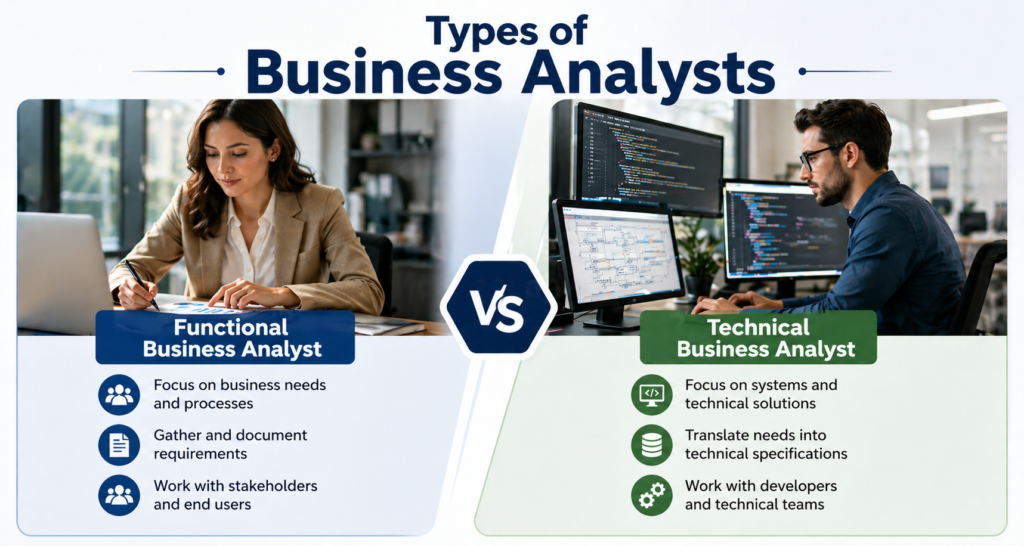
There are two common types:
Functional Business Analyst
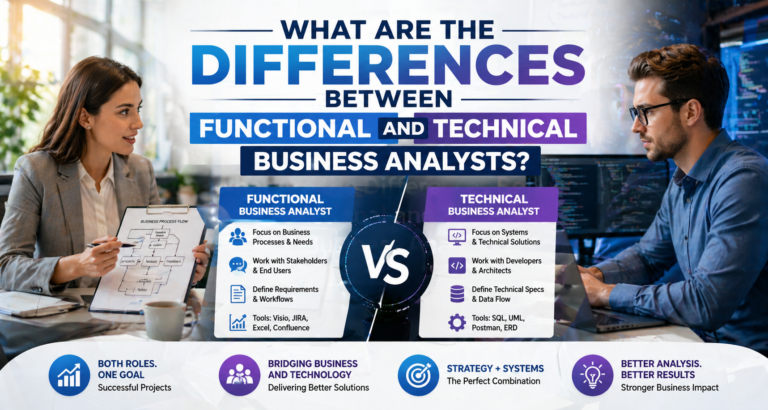
A Functional Business Analyst focuses on business processes and user needs. This role connects stakeholders with the development team.
Technical Business Analyst
A Technical Business Analyst focuses on system design and technical solutions. This role works closely with developers and architects.
Understanding these roles highlights the differences between functional and technical business analysts.
Key Responsibilities
Functional Business Analyst Responsibilities
A Functional Business Analyst focuses on business logic.
Key responsibilities include:
- Gather business requirements from stakeholders
- Document workflows and processes
- Create functional requirement documents
- Define use cases and user stories
- Validate business needs
Example:
A bank wants to improve its loan process. The Functional Business Analyst studies the current process. They identify delays. They suggest a new workflow.
Technical Business Analyst Responsibilities
A Technical Business Analyst focuses on system behavior.
Key responsibilities include:
- Translate business needs into technical specifications
- Work with APIs, databases, and system architecture
- Support developers with technical clarity
- Define data flow and integration logic
- Review system performance requirements
Example:
In the same bank project, the Technical Business Analyst defines how loan data moves between systems. They ensure system integration works.
These roles show clear differences between functional and technical business analysts.
Skills Comparison
Functional Skills
A Functional Business Analyst needs:
- Strong communication skills
- Domain knowledge
- Requirement analysis skills
- Process modeling skills
- Stakeholder management
Technical Skills
A Technical Business Analyst needs:
- Knowledge of databases like SQL
- Understanding of APIs
- Basic coding knowledge
- System design knowledge
- Data analysis skills
These skill sets highlight the differences between functional and technical business analysts.
Tools Used
Functional Tools
- Microsoft Excel
- Microsoft Visio
- JIRA
- Confluence
Technical Tools
- SQL tools
- Postman for API testing
- Data modeling tools
- UML diagram tools
The tools further explain the differences between functional and technical business analysts.
Documentation Differences
Functional Documentation
Functional Business Analysts create:
- Business Requirement Documents
- Functional Requirement Specifications
- User stories
- Process flow diagrams
Technical Documentation
Technical Business Analysts create:
- Technical specification documents
- Data mapping documents
- API documentation
- System architecture diagrams
These outputs reflect the differences between functional and technical business analysts.
Real World Example
Consider an e-commerce platform.
Functional Role
The Functional Business Analyst defines:
- Product search requirements
- Checkout flow
- Payment options
- User experience
Technical Role
The Technical Business Analyst defines:
- Database schema
- Payment gateway integration
- API endpoints
- Performance requirements
This scenario clearly shows the differences between functional and technical business analysts.
Collaboration with Teams
Functional Business Analyst Interaction
- Works with stakeholders
- Interacts with product owners
- Coordinates with testers
Technical Business Analyst Interaction
- Works with developers
- Collaborates with system architects
- Supports DevOps teams
This interaction pattern explains the differences between functional and technical business analysts.
Career Path
Functional Business Analyst Career Path
- Junior Business Analyst
- Business Analyst
- Senior Business Analyst
- Product Owner
Technical Business Analyst Career Path
- Technical Analyst
- Technical Business Analyst
- Solution Architect
- System Architect
Career growth also depends on understanding the differences between functional and technical business analysts.
Salary Trends
Industry reports show that both roles are in demand.
- Functional roles are strong in domains like finance, healthcare, and retail
- Technical roles are strong in IT, software, and data driven companies
Professionals with hybrid skills earn higher salaries. This demand highlights the importance of learning the differences between functional and technical business analysts.
How to Choose the Right Path
Choosing the right role depends on your interest.
Choose Functional Role If:
- You enjoy working with people
- You like business processes
- You prefer documentation and analysis
Choose Technical Role If:
- You enjoy systems and technology
- You like problem solving with data
- You are comfortable with tools and coding basics
Your decision becomes easier when you understand the differences between functional and technical business analysts.
Role in Agile Projects
Functional Business Analyst in Agile
- Writes user stories
- Works with product backlog
- Participates in sprint planning
Technical Business Analyst in Agile
- Supports technical design
- Clarifies system requirements
- Works on integration tasks
Agile teams rely on both roles. This shows the practical value of the differences between functional and technical business analysts.
Hands On Example
Below is a simple example of how both roles work together.
Business Requirement
User wants to place an order online.
Functional View
- User selects product
- User adds product to cart
- User completes payment
Technical View
- API call to fetch product data
- Database update for cart
- Payment gateway integration
Simple Data Flow Example
User → Frontend → API → Database → Response
This example simplifies the differences between functional and technical business analysts.
Importance in Digital Transformation
Companies invest in digital transformation. They need both roles.
- Functional Business Analysts ensure business goals are clear
- Technical Business Analysts ensure systems meet those goals
Without both roles, projects fail. This reinforces the need to understand the differences between functional and technical business analysts.
Training and Skill Development
To build a strong career, structured learning is important.
Business Analyst Training Online
- Flexible learning
- Covers fundamentals and tools
- Suitable for beginners
Business Analyst Training and Placement
- Focus on job ready skills
- Includes real projects
- Helps in career transition
Business Analyst Certification
- Validates your skills
- Improves job opportunities
- Builds professional credibility
Training programs often cover both roles. They help learners understand the differences between functional and technical business analysts.
Common Challenges
Functional Business Analyst Challenges
- Managing stakeholder expectations
- Handling unclear requirements
- Aligning business goals
Technical Business Analyst Challenges
- Handling system complexity
- Managing integrations
- Ensuring performance
These challenges further highlight the differences between functional and technical business analysts.
Future Scope
The demand for Business Analysts continues to grow.
- Data driven decisions increase demand
- Digital platforms require better systems
- Agile practices need clear requirements
Professionals who understand both roles have better opportunities. The future depends on mastering the differences between functional and technical business analysts.
Key Takeaways
- Functional Business Analysts focus on business needs
- Technical Business Analysts focus on system solutions
- Both roles are important for project success
- Skills and tools differ between roles
- Training helps build the right expertise
- Career choice depends on interest and skills
- Understanding the differences between functional and technical business analysts is essential for growth
Conclusion
Both roles play a key role in project success. Learn the right skills and choose your path wisely with the right business analyst training and placement.
Start your journey with focused learning and build a strong career in business analysis