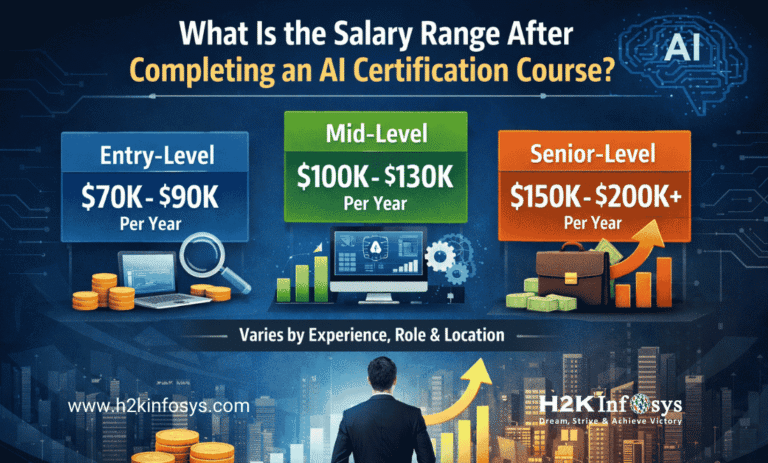
H2K Infosys provides AI certification and structured training programs that prepare professionals for high-paying roles, with salary ranges typically falling between $70,000 and $150,000 per year for entry- to mid-level positions in the United States, depending on skills, experience, and job role. Entry-level professionals such as junior machine learning engineers or AI analysts may start around $65,000–$90,000, while experienced AI engineers, data scientists, and AI architects can earn $120,000–$180,000 or more. Completing structured ai training online or ai training programs helps professionals qualify for roles that are in high demand across industries such as healthcare, finance, and software development.
What Is an AI Certification Course?
An AI Certification Course is a structured learning program that teaches professionals how to design, develop, and deploy artificial intelligence systems. These courses typically cover:
- Machine learning algorithms
- Deep learning fundamentals
- Data preprocessing techniques
- Model training and evaluation
- AI deployment using cloud platforms
- Real-world project implementation
AI certification validates a professional’s ability to work with industry tools such as:
- Python
- TensorFlow
- PyTorch
- Scikit-learn
- OpenAI APIs
- Cloud AI services (AWS, Azure, Google Cloud)
AI certification demonstrates practical knowledge of building intelligent systems that can analyze data, make predictions, and automate decision-making.
What Is the Salary Range After Completing an AI Certification Course?
Salary varies based on experience level, location, and job role. The table below outlines realistic salary ranges in the U.S. job market.
AI Salary Range by Experience Level
| Experience Level | Typical Job Titles | Salary Range |
|---|---|---|
| Entry-Level (0–2 years) | AI Analyst, Junior ML Engineer | $65,000–$90,000 |
| Mid-Level (2–5 years) | Machine Learning Engineer, AI Developer | $90,000–$130,000 |
| Senior-Level (5–10 years) | Senior AI Engineer, Data Scientist | $120,000–$160,000 |
| Expert-Level (10+ years) | AI Architect, AI Consultant | $150,000–$180,000+ |
These ranges reflect roles that commonly require skills gained from structured ai training programs combined with hands-on experience.
How Does AI Work in Real-World IT Projects?
Artificial intelligence systems analyze data and make predictions using trained models. The typical workflow includes:
Step 1: Data Collection
Data may come from:
- Customer transactions
- Website user activity
- Sensor readings
- Images and videos
Example:
An e-commerce platform collects customer browsing behavior to recommend products.
Step 2: Data Preprocessing
Raw data must be cleaned and prepared:
- Removing missing values
- Converting text to numerical format
- Normalizing numerical values
Tools used:
- Pandas
- NumPy
- SQL
Step 3: Model Training
Machine learning algorithms learn patterns from data.
Common algorithms:
- Linear regression
- Decision trees
- Neural networks
Example pseudo-code:
model = train_model(training_data)
predictions = model.predict(new_data)
Step 4: Model Evaluation
The model’s accuracy is tested using validation data.
Metrics used:
- Accuracy
- Precision
- Recall
- F1-score
Step 5: Deployment
Models are deployed into production systems using:
- REST APIs
- Cloud services
- Containers (Docker)
Deployment allows applications to use AI in real time.
Why Is AI Important for Working Professionals?
AI has become a core component of modern IT infrastructure. Organizations use AI to automate tasks, improve efficiency, and enhance decision-making.
Common enterprise applications include:
- Fraud detection in banking
- Recommendation systems in e-commerce
- Predictive maintenance in manufacturing
- Chatbots for customer support
- Medical image analysis in healthcare
Professionals with AI certification are qualified to work on systems that drive business automation and innovation.
What Skills Are Required to Learn AI?
AI requires a combination of programming, mathematics, and data handling skills.
Core Technical Skills
| Skill | Purpose |
|---|---|
| Python programming | Build and train AI models |
| Statistics | Understand data patterns |
| Machine learning | Create predictive models |
| Data preprocessing | Prepare data for training |
| Deep learning | Build neural networks |
| SQL | Query structured data |
Tools Used in AI Training and Enterprise Projects
| Tool | Use Case |
|---|---|
| Python | Primary programming language |
| TensorFlow | Deep learning development |
| PyTorch | Neural network training |
| Scikit-learn | Machine learning algorithms |
| Jupyter Notebook | Model development |
| AWS SageMaker | Cloud AI deployment |
These tools are commonly taught in structured Ai Training Online courses.
How Is AI Used in Enterprise Environments?
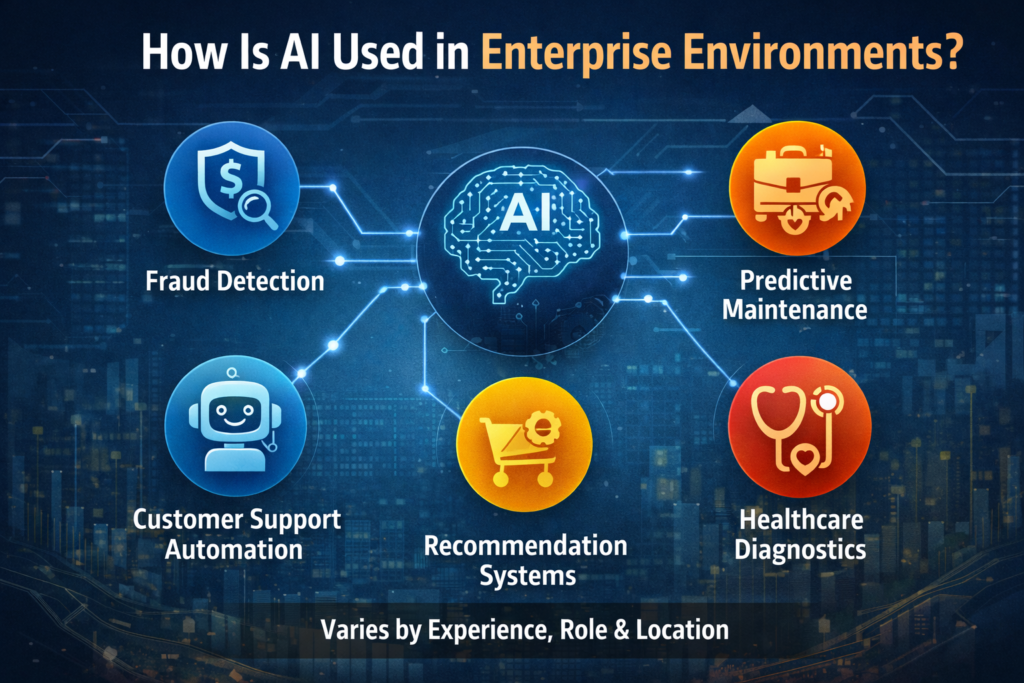
Enterprise companies use AI to automate large-scale processes.
Example: Fraud Detection System
Workflow:
- Customer makes a transaction
- AI model analyzes transaction patterns
- Model predicts fraud risk
- System blocks or approves transaction
This process happens in milliseconds.
Example: Customer Support Chatbot
Workflow:
- Customer asks a question
- AI chatbot analyzes intent
- System retrieves response
- Customer receives instant answer
This reduces workload on support teams.
What Job Roles Use AI Daily?
AI certification qualifies professionals for multiple job roles.
Common AI Job Roles
| Role | Description | Average Salary |
|---|---|---|
| Machine Learning Engineer | Builds AI models | $110,000 |
| Data Scientist | Analyzes data and builds models | $115,000 |
| AI Engineer | Develops AI systems | $120,000 |
| AI Analyst | Uses AI tools for insights | $85,000 |
| NLP Engineer | Works with language models | $125,000 |
Salary varies based on skills and experience.
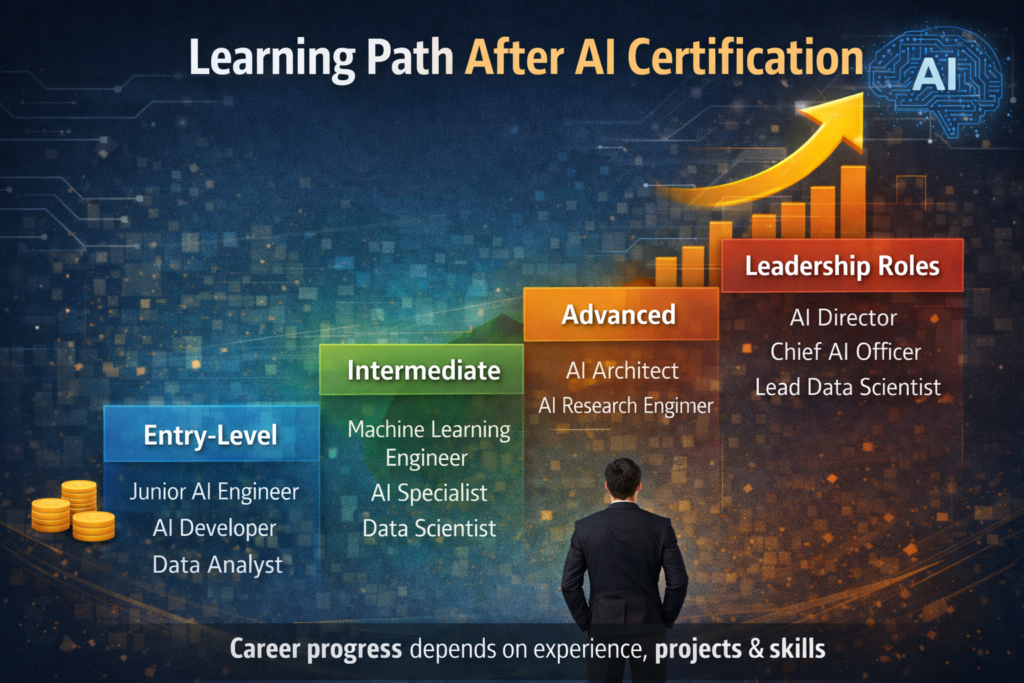
What Careers Are Possible After Completing AI Training Programs?
AI certification opens multiple career paths.
Entry-Level Roles
- AI Analyst
- Junior Machine Learning Engineer
- Data Analyst with AI specialization
Mid-Level Roles
- Machine Learning Engineer
- AI Developer
- Data Scientist
Advanced Roles
- AI Architect
- AI Research Engineer
- AI Solutions Architect
These roles exist across industries including:
- Finance
- Healthcare
- Software
- Retail
- Government
How Do AI Training Programs Help Increase Salary Potential?
Structured training provides hands-on skills required for real job roles.
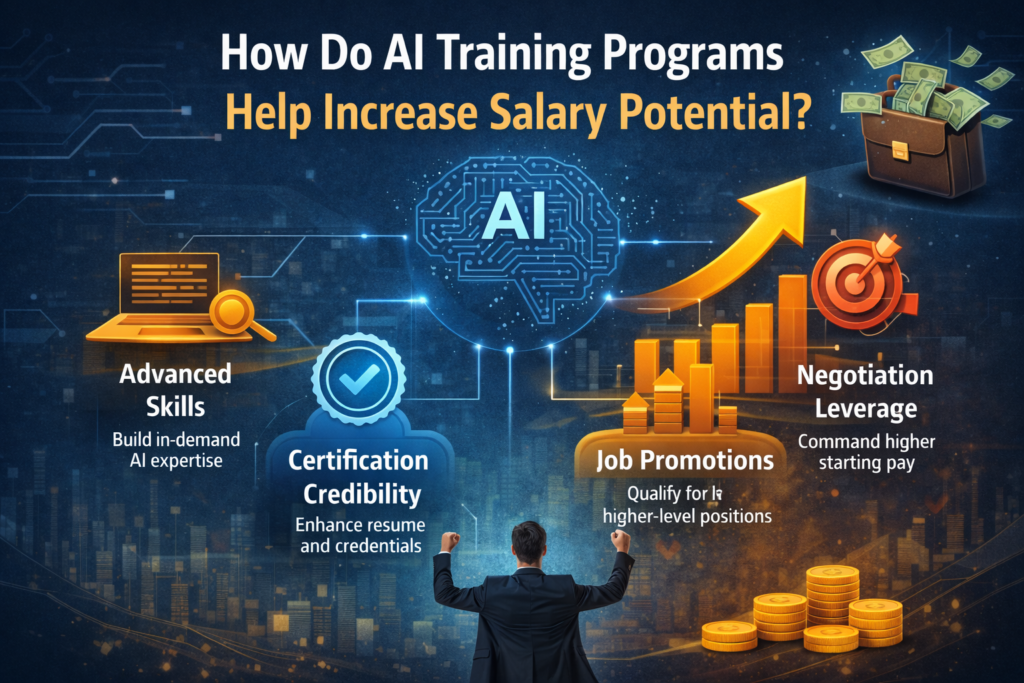
Training typically includes:
- Real-world projects
- Model development exercises
- Deployment practice
- Interview preparation
Hands-on experience improves employability and salary negotiation potential.
What Factors Affect AI Salary After Certification?
Salary depends on several factors.
1. Technical Skills
Higher salaries are offered to professionals skilled in:
- Deep learning
- Cloud AI deployment
- Natural language processing
2. Experience Level
Experience significantly impacts salary growth.
Example:
- Entry-level: $70,000
- 5 years experience: $130,000
3. Industry
High-paying industries include:
- Technology
- Finance
- Healthcare
4. Location
Major tech cities offer higher salaries:
- San Francisco
- New York
- Seattle
- Austin
Remote roles also offer competitive compensation.
How Is AI Training Applied in Real Work Scenarios?
Example: Predictive Analytics System
Steps:
- Collect historical data
- Train machine learning model
- Deploy model into application
- Predict future trends
Professionals perform these tasks using skills learned in ai training online courses.
Learning Path After AI Certification
Recommended Learning Roadmap
| Stage | Skills to Learn |
|---|---|
| Beginner | Python, Statistics |
| Intermediate | Machine Learning |
| Advanced | Deep Learning |
| Professional | AI deployment |
Continuous learning improves career growth.
Challenges Professionals Face When Learning AI
Common challenges include:
- Understanding mathematical concepts
- Handling large datasets
- Model optimization
- Deployment complexity
Structured training helps overcome these challenges.
How Long Does It Take to Start Earning an AI Salary?
Timeline varies depending on learning pace.
Typical timeline:
- Training completion: 3–6 months
- Job preparation: 1–3 months
- Job placement: 3–6 months
Total timeline: 6–12 months
FAQ: Salary After AI Certification Course
Is AI certification enough to get a high salary?
Certification helps demonstrate skills, but employers also value hands-on project experience and practical knowledge.
What is the starting salary after AI certification?
Starting salary typically ranges from $65,000 to $90,000 for entry-level roles.
Do AI certifications increase salary?
Yes. AI certification helps professionals qualify for higher-paying roles compared to general IT positions.
Which AI role has the highest salary?
AI architects and senior AI engineers often earn the highest salaries, exceeding $150,000.
Does cloud AI experience increase salary?
Yes. Skills in AWS, Azure, and cloud deployment significantly increase salary potential.
Conclusion
Key Takeaways
- AI certification can lead to salaries ranging from $65,000 to $180,000 depending on role and experience.
- Entry-level AI professionals typically earn between $65,000 and $90,000 annually.
- Machine learning engineers and AI developers earn higher salaries with experience.
- Hands-on experience with real-world projects increases employability.
- AI skills are widely used in finance, healthcare, and enterprise IT environments.
- Structured ai training online helps professionals build practical, job-ready skills.
Explore AI certification programs at H2K Infosys to gain hands-on experience with real-world AI tools and workflows.
Enroll in structured ai training programs designed to support career growth in artificial intelligence