Data Analytics Careers feel future proof right now mainly because businesses everywhere rely on data way more than they did even five or six years ago. Pretty much every industry healthcare, banking, retail, sports, cybersecurity, entertainment depends on data to make faster and smarter decisions. Companies are actively looking for people who can take messy information and turn it into something useful that actually helps the business move forward.
And honestly, once you start noticing it, you realize data quietly sits behind almost everything now. Streaming apps track what people skip. Online stores study customer behavior every second. Hospitals monitor patient trends to improve care. Even small businesses use dashboards these days to understand sales and customer habits better. That shift alone explains why Data Analytics Careers keep growing, even while AI is changing other job markets pretty aggressively.
A few years back, data analytics sounded like one of those niche tech careers only massive companies cared about. Not anymore. Mid-sized businesses, startups, healthcare firms, logistics companies — they all need analysts now. And they’re searching for people who understand SQL, Power BI, Tableau, Python, Excel, cloud reporting systems… basically the tools that help organizations make sense of large amounts of information.
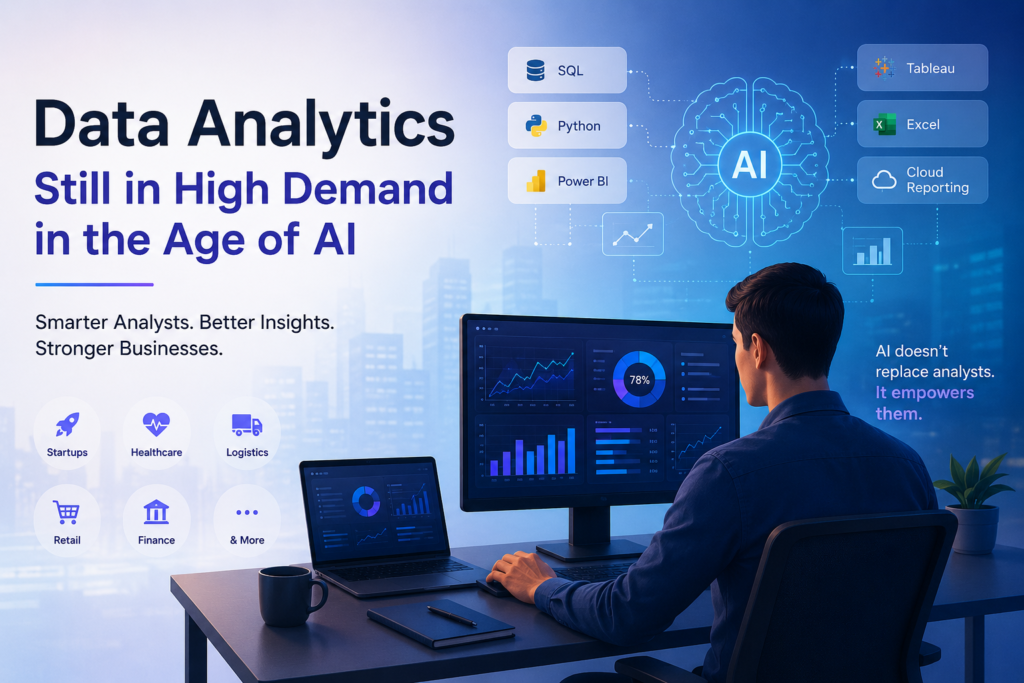
What’s interesting though is that AI hasn’t really reduced demand for analysts the way people expected. If anything, it’s pushed companies to hire smarter analysts who know how to work alongside automation tools instead of fearing them.
Why Data Analytics Careers Keep Growing in 2026
The simplest explanation? Businesses collect way too much data and still don’t have enough people who know how to interpret it properly.
Think about where companies pull information from now:
- Websites
- Mobile applications
- Social media platforms
- Marketing campaigns
- Cloud systems
- Customer support tools
- IoT devices
That’s an overwhelming amount of information coming in every single day.
But raw data by itself doesn’t really solve anything. Someone still has to figure out patterns, explain trends, identify risks, and help leadership teams make decisions from it. That’s where analysts become valuable and honestly, difficult to replace.
Even during uncertain economic periods, businesses still invest in analytics because cutting blind decisions usually costs them more in the long run. That’s one reason so many professionals are enrolling in a Data analyst certification online program lately. People see analytics as a practical way to move into tech without spending years going back to university.
AI Is Reshaping Analytics Not Killing It
There’s this ongoing assumption that AI tools will eventually replace analysts completely. Real-world hiring trends don’t really support that idea.
Sure, AI can automate reports faster. It can generate dashboards in minutes and summarize trends almost instantly. But businesses still need human judgment. They need someone who understands context, asks follow-up questions, and connects technical findings to actual business problems.
For example, an AI dashboard might show customer engagement dropping over the last quarter. But an experienced analyst might notice the decline started right after a pricing update, a mobile redesign, or maybe even a change in customer support response times.

That human layer matters more than people think.
Actually, many companies are now hiring analysts specifically because they know how to work with AI-assisted reporting tools. Professionals who understand automation workflows, predictive analytics, and business storytelling are becoming increasingly valuable.
So no, Data Analytics Careers are not disappearing. They’re evolving a bit. There’s a difference.
How the Google Data Analytics Course Helped Beginners Enter Tech
One thing that changed the analytics learning space recently was the popularity of the google data analytics careers. A lot of beginners who previously felt intimidated by tech started exploring analytics because the course made the field feel approachable.
And it wasn’t just IT professionals joining. People from finance, teaching, healthcare, customer service, and sales backgrounds started learning analytics fundamentals online too.
The google data analytics course introduced many learners to concepts like:
- Data cleaning
- SQL fundamentals
- Spreadsheet analysis
- Reporting workflows
- Data visualization
- Business problem-solving
For beginners, that structure helped simplify topics that once sounded overly technical.
Though, to be fair, many learners eventually realize certifications alone don’t automatically lead to jobs anymore. Companies increasingly expect practical experience, portfolio projects, interview preparation, and real-world problem-solving skills.
That’s usually where proper mentorship starts becoming important.
Why H2K Infosys Gets Attention for Data Analytics Training
When someone seriously wants to build long-term Data Analytics Careers, random YouTube tutorials usually stop being enough after a point.
H2K Infosys has become one of the recognized training providers helping learners build practical analytics skills that align more closely with real industry expectations.
One thing people often struggle with is applying concepts in actual business situations. Knowing definitions is one thing. Explaining how you would solve a real reporting problem during an interview is completely different.
That’s where structured programs tend to help.
H2K Infosys focuses heavily on practical exposure through:
- Real-time project work
- SQL and database practice
- Power BI and Tableau training
- Excel analytics workflows
- Resume preparation
- Mock interview sessions
- Placement assistance
- Industry-based case studies
And honestly, practical exposure starts mattering very quickly once candidates begin attending interviews.
A lot of employers today care less about memorized answers and more about whether you can explain business logic clearly. Communication skills matter in analytics more than many beginners initially expect.
Why Employers Prefer Practical Analysts
This part gets overlooked all the time.
Someone may complete a Data analyst certification online course and still struggle during interviews because they’ve never worked with real datasets or business scenarios before.
Interviewers often ask practical questions like:
- How would you reduce customer churn?
- What KPIs would you track for an e-commerce company?
- How would you clean inconsistent reporting data?
- What insights would you pull from declining sales trends?
Those aren’t textbook questions. They require actual thinking.
That’s why Data Analytics Careers increasingly reward candidates who practice with live projects and understand how businesses operate beyond spreadsheets and dashboards.
Some learners now build portfolio projects around things like:
- Netflix viewing trends
- Retail forecasting models
- Healthcare reporting systems
- Marketing performance dashboards
- Financial analytics reports
Employers genuinely like seeing practical problem-solving because it shows candidates can work with uncertainty instead of just theory.
Remote Work Expanded Data Analytics Careers Even More
Another reason Data Analytics Careers feel stable is the flexibility factor.
Analytics work naturally fits remote and hybrid environments because most reporting systems and dashboards already operate in the cloud. Teams can collaborate from different locations without major problems.
That flexibility opened opportunities for:
- Career changers
- Freelancers
- International students
- Working parents
- Stay-at-home professionals
- Non-technical professionals transitioning into tech
And since businesses continue digitizing operations globally, demand for analytics skills keeps spreading into more industries every year.
Industries Hiring Analytics Professionals Rapidly
People sometimes assume analytics jobs only exist inside tech companies. That’s really not true anymore.
Some of the fastest-growing industries hiring analysts right now include:
Healthcare Analytics
Hospitals and healthcare providers use predictive analytics to improve patient care, optimize staffing, and reduce operational inefficiencies.
Financial Services
Banks and fintech companies rely heavily on analytics for fraud detection, customer behavior analysis, and financial forecasting.
E-Commerce
Retail businesses use customer data constantly to improve conversions, personalize recommendations, and optimize marketing campaigns.
Sports Analytics
Sports organizations now invest heavily in analytics to study player performance, injury risks, and fan engagement behavior.
Cybersecurity
Security teams increasingly depend on analytics tools to detect suspicious activity and identify system vulnerabilities faster.
That wide industry demand is one reason Data Analytics Careers continue looking resilient long term.
Certifications Help But They’re Not the Whole Story
A lot of beginners discover this later than they expect.
Completing the google data analytics course or another Data analyst certification online program definitely helps build foundational knowledge. But employers usually want more than certificates now.
Companies often look for candidates who can demonstrate:
- Portfolio projects
- Dashboard creation
- SQL querying ability
- Business communication
- Data storytelling
- Problem-solving skills
- Real-world analytical thinking
That’s why learners who combine certifications with hands-on training programs, mentorship, and project exposure often feel more prepared during interviews.
The Human Side of Analytics Still Matters
AI still struggles with one major thing: human judgment.
A dashboard can display numbers all day long. But understanding emotional buying behavior, customer frustration, or sudden market changes often requires human reasoning and curiosity.
Good analysts usually ask questions like:
- Why did this happen?
- What changed recently?
- What’s the actual business impact here?
- What should leadership do next?
That combination of technical knowledge and business thinking is exactly why Data Analytics Careers still remain valuable, even as automation tools become more advanced.
Final Thoughts
Data Analytics Careers continue looking future proof because businesses depend on data more heavily than ever before. AI is definitely changing the industry, but it’s also increasing demand for professionals who can interpret information, communicate insights clearly, and solve business problems thoughtfully.
For beginners, starting with the Google Data Analytics course or a Data analyst certification online program can absolutely provide a strong foundation. But long-term success usually comes from combining certifications with practical projects, mentorship, interview preparation, and real business exposure.
Training providers like H2K Infosys continue helping learners bridge that gap between theory and practical application.
And honestly, the field still feels like it’s growing. Every year, companies collect more data, rely more heavily on analytics, and search for professionals who know how to turn information into decisions that actually matter.