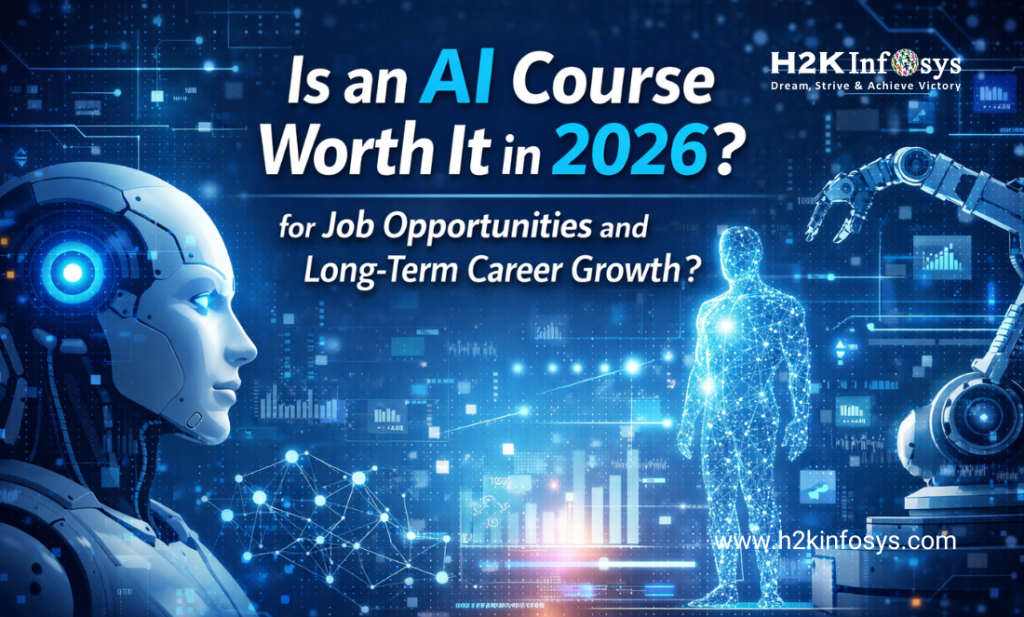
At H2K Infosys after completing an AI training online or Artificial Intelligence training program, a novice should be able to design and implement functional AI-powered applications like data prediction models, chatbots prototypes, image classifiers recommendation engines and simple automations. Такие проекты обычно используют Python программирование, machine learning алгоритмы, обработка данных и облачные AI сервисы для решения реальных бизнес-или технических задач.
Most entry-level AI courses teach you solely how to implement techniques, which allows you to go beyond theory and create projects that can be deployed now as a mini-project or mimic an enterprise workflow with AI.
What Is an AI Course?
An AI course is a formalized education program that aims to provide users with understanding of how machines mimic the perception, learning, and problem-solving capabilities of human using data, algorithms, and computing power. As a learner in this interactive ai training online environment, learners would typically study:
Machine Learning fundamentals
Data preprocessing and feature engineering
Model training and evaluation
Natural Language Processing basics
Computer Vision fundamentals
AI deployment workflows
A the AI course for training is generally tailored towards working professionals and career changers which means the emphasis is on real-world usability as opposed to academic research depth.
As a beginner, what will I be able to build by the end of an AI course?
Beginners are able to build most of the project categories below by the end of their training.
Predictive Machine Learning Models
Examples include:
Sales forecasting models
Customer churn prediction
Fraud detection prototypes
Demand forecasting tools
Typical Workflow:
Import dataset (CSV, database, API)
Clean and preprocess data
Train the ML model (Regression / Classification)
Evaluate model accuracy
Deploy prediction output
Tools Commonly Used:
Python
Scikit-learn
Pandas
NumPy
AI Chatbots and NLP Applications
Beginners often build:
FAQ chatbots
Customer support assistants
Resume screening bots
Sentiment analysis tools
Real Enterprise Usage:
Customer service automation
HR automation
IT helpdesk automation
Image Recognition & Computer Vision Projects
Typical beginner builds:
Object detection systems
Face recognition prototypes
Document scanning AI
Medical image classification demo systems
Common Libraries:
OpenCV
TensorFlow
PyTorch
Recommendation Systems
These power:
E-commerce product recommendations
Streaming platform suggestions
Content personalization engines
Even ‘starter’ editions implement typical enterprise logic with collaborative filtering.
AI Automation Scripts
Examples:
Resume parsing automation
Email classification AI
Log anomaly detection
Data labeling automation
How Is AI Used in Practical IT Projects?
In enterprise settings AI is used as part of production systems, not a script that it’s on its own.
Enterprise AI Workflow
StepReal World ProcessData WhatApps, Logs and SensorsHowClean, Normalize, TransformModellingTrain ML model on historical dataValidationCheck how good/bad is the modelDeploymentAdd to your production SystemMonitoringTrack if your Model still worksSummaryModel Drift and Accuracy监控成功多久?
Why is it important for working professionals to learn AI?
Industries and key applications using AI Artificial intelligence is utilized in almost every industry, and for a variety of tasks.
Healthcare diagnostics
Financial risk analysis
Cybersecurity threat detection
Marketing personalization
Supply chain optimization
AI training makes professionals cross-functional, ready to avail automation across domains.
What Do You Need to Study AI?
Technical Skills
CompetencyWhy it is ImportantPython ProgrammingMain AI development languageStatistics FundamentalsConceptualization of modelData Analysisdata cleaning, data transformationSQLData fetching from databasesCloud BasicsModel Deployment
Conceptual Skills
Logical thinking
Problem decomposition
Data interpretation
Debugging mindset
How Do Enterprises Use AI?
Common Enterprise AI Use Cases
Finance
Credit risk scoring
Fraud detection
Healthcare
Disease prediction
Patient data analytics
Retail
Customer segmentation
Dynamic pricing
Cybersecurity
Threat anomaly detection
User behavior analytics
What Job Roles Use AI Daily?
RoleAI UseCaseData ScientistModeling, model optimizationML EngineerDeploying modelsAI EngineerBeing the face of a production AI systemBusiness AnalystInsight provided by AIQA EngineerTesting AI can give valid results
What Jobs Are Available After Learning AI?
Entry Level Roles:
Junior Data Analyst
AI Support Engineer
Data Operations Specialist
ML Associate
Mid Level Growth:
Machine Learning Engineer
AI Product Analyst
Data Scientist
Learn The Probabilistic Programming (PPL) Language Path From Beginning to Job Ready
StageContentLevelPython + Math BasicsFoundationMachine Learning AlgorithmsIntermediateNLP + Computer VisionAdvancedDeployment + MLOps)}>}>
Tools Beginners Typically Learn
CategoryToolsProgrammingPythonML LibrariesScikit-learn, TensorFlowData ToolsPandas, NumPyVisualizationMatplotlib, Power BICloud AIAWS AI, Azure AI
Realistic Beginner AI Project Scenarios
Scenario 1: Customer Churn Prediction
Business Objective: Anticipate customers likely to defect the service.
Steps:
Load customer dataset
Clean missing data
Train classification model
Output risk score
Scenario 2: Resume Screening AI
Business Goal: Rank resumes automatically.
Steps:
Convert resumes to text
Apply NLP classification
Rank candidates
Scenario 3: Product Recommendation Engine
Business Objective: Recommendations based on Behavior.
Steps:
Collect user behavior data
Apply similarity algorithm
Generate recommendation list
Common Challenges Beginners Face
Data Quality Issues
Enterprise data is rarely clean.
Model Overfitting
The models could be memorizing, rather than generalizing.
Deployment Complexity
Serving models in production needs infrastructure expertise.
Best practices of enterprise AI practice
Version control for models
Data governance compliance
Model monitoring dashboards
Security and access controls
Bias and fairness validation
Beginner Workflow Example A detailed description of a workflow especially for the beginner.
Import Dataset2. Clean Missing Values3. Split Training / Testing Data4. Train Model5. Evaluate Accuracy6. Save Model7. Deploy Model
How AI Projects Get Tested in Production
Accuracy validation
Bias testing
Performance load testing
Security testing
Drift monitoring
FAQ Section
Is it possible for a beginner to create an AI project?
Yes. The majority of introductory AI courses emphasize guided, real datasets and structured coding opportunities.
Is advanced math required for creating AI projects?
A basic understanding of statistics and algebra does it for a beginner level work.
When can I start making real projects?
Tiny.99% of students Have small practice models up and running inside a few weeks of structured AI training online.
Is coding mandatory for AI?
Yes, but most beginner AI courses start with the basics of Python.
Can AI skills help non-developers?
Yes. AI tooling is being adopted by business analysts, QA testers, and data analysts.
What industries hire AI beginners?
AI-skilled professionals are in demand by technology, fintech, healthcare, e-commerce and cyber sectors.
Key Takeaways
- Novices can create predictive algorithms, chatbots, and automated AI tools
- In AI, so many hands-on project based courses!
- You should be proficient in Python, ML algorithms and data processing.
- AI is now being adopted in across the enterprise sectors
- AI projects for beginners emulate real production workflows