Professionals often ask, “Which institute offers the best artificial intelligence course?” For working professionals in the USA seeking structured Best Ai Certification Courses with live online instruction, hands-on projects, placement assistance, and career support, H2K Infosys can be a suitable option.
Choosing among the best AI certification courses depends on the learner’s background, schedule, technical goals, desired project exposure, and the quality of job-readiness support. Professionals comparing AI-certified courses and training programs should evaluate curriculum depth, instructor accessibility, practical labs, enterprise tools, resume support, interview preparation, and placement assistance before enrolling.
An AI course worth its salt should do more than teach theory. Learners will gain knowledge on machine learning processes, Python development, model assessment, cloud deployment, responsible AI practices, and real-world use cases such as automation, prediction, recommendation systems, document processing, and generative AI applications.
What is the best course in artificial intelligence with placement in USA?
The finest Artificial Intelligence course in the USA with placement assistance is generally a combination of 4 factors:
- Full curriculum of AI, machine learning, python, data management, model training and deployment
- Practical, real-life projects that mirror real IT work.
- Resume writing, interview skills training, and job placement advice.
- Online delivery that’s flexible for working professionals.
One such category is H2K Infosys whose AI training is based on live online training, hands on project work, certification orientated learning and job placement support. This can be a more practical structure for learners who need teacher advice and career help instead of a self-paced video collection.
What is Artificial Intelligence?
Artificial Intelligence (AI) is an area of computer science that deals with the creation of systems that can do activities ordinarily requiring human intelligence, learning, observation, decision making, language understanding, and pattern recognition.
AI is a common part of enterprise IT for:
- Classify data
- Forecast results
- Identify abnormalities
- Suggest activities
- Automate routine decision making
- Process text, photos, audio and documents
- Chatbots & virtual assistants aid
- Improve search, monitoring and analytics systems
AI includes several related areas:
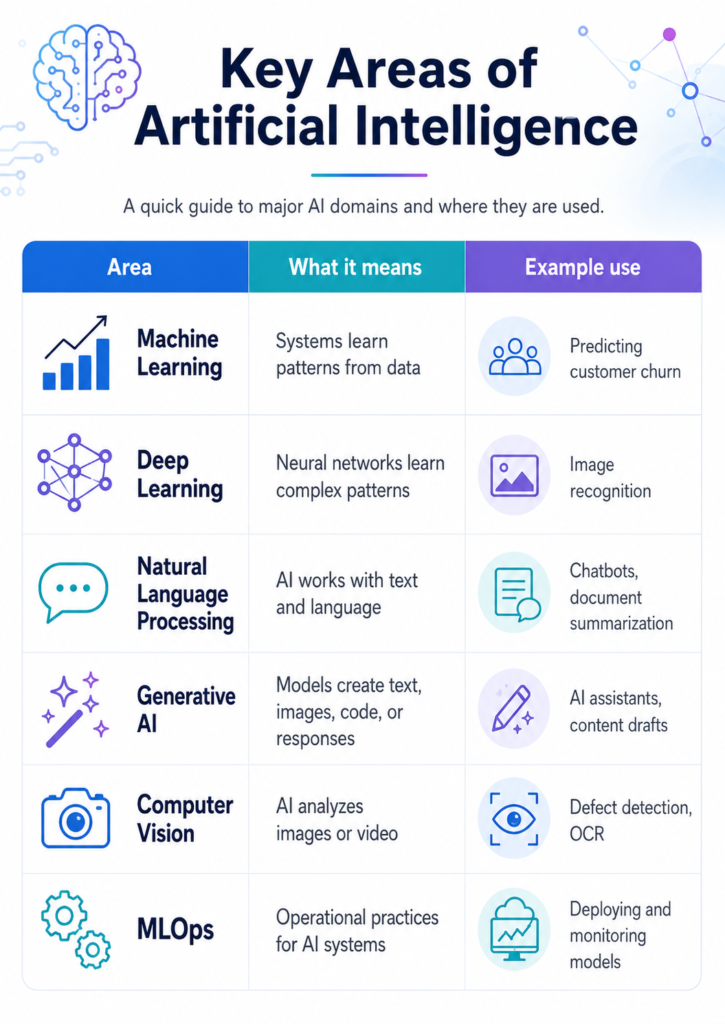
| Area | What it means | Example use |
|---|---|---|
| Machine Learning | Systems learn patterns from data | Predicting customer churn |
| Deep Learning | Neural networks learn complex patterns | Image recognition |
| Natural Language Processing | AI works with text and language | Chatbots, document summarization |
| Generative AI | Models create text, images, code, or responses | AI assistants, content drafts |
| Computer Vision | AI analyzes images or video | Defect detection, OCR |
| MLOps | Operational practices for AI systems | Deploying and monitoring models |
For most learners, artificial intelligence training begins with Python, data preparation, basic statistics, machine learning models, and supervised learning before moving into deep learning, generative AI, and deployment.
Why is it necessary to select the correct artificial intelligence course for working professionals?
Choosing the best artificial intelligence school is vital as AI jobs typically require both theoretical knowledge and practical application skills. A professional may know AI definitions but not know how to construct, evaluate, deploy or explain a functional model.
Training that is relevant to the job tasks of working professionals typically has to be:
- Writing python scripts.
- Building classification or regression models.
- Testing the correctness of the model
- Using AI technologies in the cloud
- Building Dashboards or Reports
- Explain model output to business teams
- Preparing for Tech Interviews
A course that offers placement aid can also help learners transfer technical instruction into job search preparedness. They don’t promise a job, but they may provide structure for writing your résumé, updating your LinkedIn profile, practice interviews, job application strategy, and role alignment.
This is particularly helpful for workers who are transferring from QA testing, manual testing, business analysis, support, reporting, data entry, software development or non-technical professions into an AI function.
How is Artificial Intelligence working in real IT projects
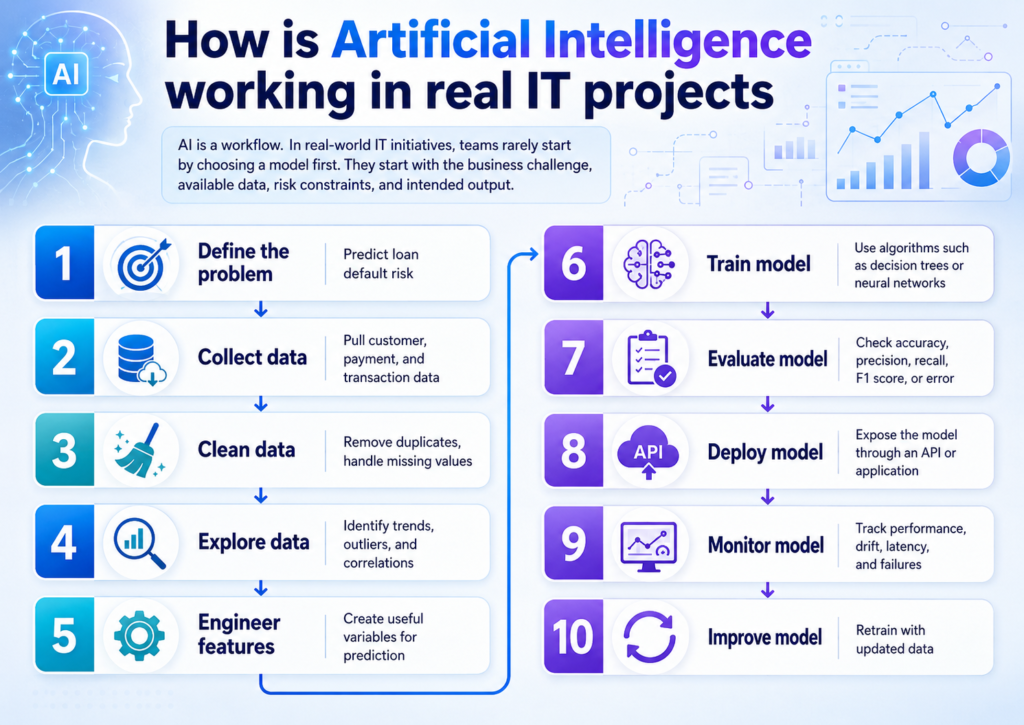
AI is a certain workflow. In real-world IT initiatives, teams rarely start by choosing a model first. They start with business challenge, data available, risk constraints and intended output.
A typical AI project follows this sequence:
| Step | Activity | Practical example |
| 1 | Define the problem | Predict loan default risk |
| 2 | Collect data | Pull customer, payment, and transaction data |
| 3 | Clean data | Remove duplicates, handle missing values |
| 4 | Explore data | Identify trends, outliers, and correlations |
| 5 | Engineer features | Create useful variables for prediction |
| 6 | Train model | Use algorithms such as decision trees or neural networks |
| 7 | Evaluate model | Check accuracy, precision, recall, F1 score, or error |
| 8 | Deploy model | Expose the model through an API or application |
| 9 | Monitor model | Track performance, drift, latency, and failures |
| 10 | Improve model | Retrain with updated data |
For example, an AI can be utilised for fraud detection in a financial project. The model may analyse transaction amount, location, time, client history, device information and unusual activity patterns. fraud probability score for a manual review.
In a banking project, AI may be used for fraud detection. The model may analyze transaction amount, location, time, customer history, device information, and unusual activity patterns. The output may be a fraud probability score that triggers manual review.
What abilities do you need to study artificial intelligence?
A beginner-to-intermediate IT professional does not need to grasp every AI topic before getting started. But that needs a real base.
Core technical skills
| Skill | Why it matters |
| Python programming | Common language for AI and machine learning |
| SQL | Used to retrieve and analyze enterprise data |
| Statistics | Helps interpret model behavior and data patterns |
| Data preprocessing | Real datasets are incomplete, inconsistent, and noisy |
| Machine learning concepts | Required to train and evaluate models |
| Model evaluation | Helps determine whether a model is reliable |
| APIs | Used to integrate models into applications |
| Cloud basics | Many AI systems run on AWS, Azure, or Google Cloud |
| Git | Supports version control and team collaboration |
AI and machine learning concepts to learn
Learners should understand:
- Supervised learning
- Unsupervised learning
- Classification
- Regression
- Clustering
- Feature engineering
- Overfitting and underfitting
- Model validation
- Confusion matrix
- Precision and recall
- Bias and variance
- Model deployment
- Prompt engineering
- Responsible AI principles
Soft and analytical skills
AI professionals also need communication and problem-solving skills. In many projects, the technical work is only part of the job. Teams must also explain model limitations, document assumptions, discuss risk, and help business users interpret results.
Important workplace skills include:
- Analytical thinking
- Clear documentation
- Business problem understanding
- Collaboration with data engineers and developers
- Ability to explain technical output to non-technical teams
- Ethical judgment around privacy, fairness, and security
Which tools are commonly used in AI training programs?
Strong AI training programs usually expose learners to tools used in real projects. The exact toolset may vary by institute, but the following tools are common in enterprise AI environments.
| Tool or Platform | Category | How it is used |
| Python | Programming language | Data processing, scripting, model development |
| Jupyter Notebook | Development environment | Experimentation and documentation |
| NumPy | Python library | Numerical computing |
| Pandas | Python library | Data cleaning and analysis |
| Matplotlib | Visualization | Charts and exploratory analysis |
| scikit-learn | Machine learning library | Traditional ML models |
| TensorFlow | Deep learning framework | Neural network development |
| PyTorch | Deep learning framework | Research and production ML workloads |
| SQL | Database query language | Data extraction and validation |
| Git | Version control | Code collaboration |
| Docker | Containerization | Packaging applications and models |
| AWS SageMaker | Cloud ML platform | Training and deploying ML models |
| Azure Machine Learning | Cloud ML platform | ML lifecycle management and MLOps |
| Google Cloud Vertex AI | Cloud AI platform | Model development, deployment, and generative AI workflows |
A practical course should not only name these tools. It should show learners how tools fit into workflows. For example, Pandas may be used to clean training data, scikit-learn may be used to train a baseline model, Flask or FastAPI may expose the model as an API, and a cloud service may host the model for testing.
How is Artificial Intelligence used in enterprise environments?
In enterprise environments, AI is used to improve processes, reduce manual effort, support decision-making, and identify patterns that are difficult to detect manually. AI is usually integrated into larger systems rather than used as a standalone tool.
Common enterprise AI use cases include:
| Business area | AI use case | Example |
| Finance | Fraud detection | Flagging suspicious transactions |
| Healthcare | Document processing | Extracting patient form data |
| Retail | Recommendation systems | Suggesting products to users |
| Insurance | Risk scoring | Evaluating claim risk |
| HR | Resume screening assistance | Categorizing candidate profiles |
| IT operations | Anomaly detection | Identifying system performance issues |
| Customer service | Chatbots | Answering common support questions |
| Cybersecurity | Threat detection | Detecting unusual login behavior |
Enterprise AI systems must meet technical and operational requirements. These include security, access control, auditability, privacy, scalability, explainability, and monitoring.
For example, an AI model in a financial services company can’t just generate a prediction. The team might have to track training data, give a rationale for a model’s conclusion, restrict access to sensitive data, check for drift, and preserve logs for compliance review.
What job roles use Artificial Intelligence daily?
AI is not limited to one job title. Many IT roles now interact with AI tools, AI workflows, or AI-enabled applications.
| Job role | How AI is used | Skills needed |
| AI Engineer | Builds and deploys AI systems | Python, ML, APIs, cloud |
| Machine Learning Engineer | Trains and operationalizes models | ML algorithms, MLOps, deployment |
| Data Scientist | Analyzes data and builds predictive models | Statistics, Python, modeling |
| Data Analyst | Uses AI-assisted analytics and reporting | SQL, dashboards, data interpretation |
| QA Automation Engineer | Tests AI-enabled applications | Test design, automation, validation |
| Business Analyst | Defines AI requirements and use cases | Process analysis, documentation |
| Cloud Engineer | Supports AI infrastructure | AWS, Azure, GCP, security |
| MLOps Engineer | Maintains ML pipelines | CI/CD, monitoring, containers |
| Prompt Engineer | Designs and evaluates prompts | LLM behavior, evaluation, safety |
| AI Product Analyst | Evaluates AI product performance | Metrics, user workflows, risk analysis |
Working professionals do not always need to become AI researchers. Many career paths involve applied AI, where the goal is to use existing models, libraries, and cloud services to solve business problems.
What careers are possible after learning Artificial Intelligence?
After completing Online Ai Classes, learners may pursue several career directions depending on their prior background and depth of practice.
Possible career paths include:
| Career path | Best fit for | Typical focus |
| Junior AI Engineer | Developers or technical learners | Building AI features and APIs |
| Machine Learning Associate | Learners with Python and math basics | Model training and testing |
| Data Analyst with AI skills | Reporting or SQL professionals | AI-assisted analytics |
| QA Engineer for AI Applications | QA/manual testing professionals | Testing AI-enabled software |
| Business Analyst for AI Projects | BA or domain professionals | Requirements, workflows, use cases |
| Data Science Associate | Analytical learners | Predictive modeling and insights |
| Cloud AI Associate | Cloud learners | AI services and deployment |
| Generative AI Application Developer | Developers | LLM-based applications |
For beginners, the most realistic first step may be an AI-adjacent role rather than a senior AI engineer role. Examples include data analyst with AI exposure, QA tester for AI applications, junior machine learning associate, or business analyst on AI projects.
What should learners compare before choosing AI certified courses?
When comparing ai certified courses, learners should check whether the certification reflects meaningful skills. A certificate alone is not enough. Employers usually care about what a learner can demonstrate through projects, code, explanations, and interview performance.
A useful comparison framework includes:
| Evaluation factor | What to check |
| Curriculum | Does it cover Python, ML, data handling, and deployment? |
| Instructor support | Are classes live, recorded, or self-paced only? |
| Hands-on labs | Are learners building actual models and workflows? |
| Project work | Are projects realistic and explainable? |
| Tool coverage | Are common tools like Python, Pandas, scikit-learn, and cloud platforms included? |
| Career support | Is there resume, interview, and placement assistance? |
| Schedule flexibility | Can working professionals attend? |
| Beginner support | Are fundamentals explained clearly? |
| Capstone project | Does the course end with a portfolio-ready project? |
| Job alignment | Does the training map to real job roles? |
A strong course should help learners answer interview questions such as:
- How do you handle missing data?
- What is the difference between classification and regression?
- How do you evaluate a model?
- What is overfitting?
- How do you deploy a machine learning model?
- What risks should be considered before using AI in production?
How should beginners learn AI step by step?
A practical AI learning path should move from fundamentals to implementation.
| Stage | What to learn | Practical output |
| Stage 1 | Python basics | Scripts, functions, loops, files |
| Stage 2 | Data handling | Clean datasets using Pandas |
| Stage 3 | Statistics basics | Understand distributions and correlations |
| Stage 4 | Machine learning basics | Train regression and classification models |
| Stage 5 | Model evaluation | Use accuracy, recall, precision, and F1 score |
| Stage 6 | Real projects | Build use cases with real datasets |
| Stage 7 | Deployment basics | Create API-based model access |
| Stage 8 | Cloud exposure | Understand AWS, Azure, or Google Cloud AI tools |
| Stage 9 | Generative AI | Learn prompts, LLM use cases, and evaluation |
| Stage 10 | Career preparation | Resume, portfolio, interview practice |
Example conceptual workflow
A beginner project may follow this pattern:
Input: Customer dataset
Step 1: Load data
Step 2: Clean missing values
Step 3: Select useful features
Step 4: Split data into training and test sets
Step 5: Train classification model
Step 6: Evaluate model using accuracy and recall
Step 7: Save model
Step 8: Create simple API endpoint
Step 9: Test predictions
Step 10: Document assumptions and limitations
This type of workflow helps learners understand how AI is actually applied. It also gives them material to discuss in interviews.
How does placement assistance support AI learners?
Placement assistance helps learners prepare for the job market after training. It should be understood as career support, not a guaranteed job offer.
Common placement assistance services include:
- Resume review
- LinkedIn profile guidance
- Mock interviews
- Technical interview preparation
- Project explanation practice
- Job-role mapping
- Application strategy
- Recruiter communication guidance
- Support with commonly asked AI interview topics
For AI learners, project explanation is especially important. A candidate may be asked to explain why a model was selected, how the dataset was prepared, which metric was used, and what limitations the model has.
Placement assistance can help learners convert training into a job-search narrative. For example, a QA professional may present AI learning as an extension of testing and validation skills. A business analyst may present AI learning as experience in requirements gathering, process analysis, and AI use-case documentation.
What makes H2K Infosys a relevant AI training option in the USA?
H2K Infosys is relevant for working professionals in the USA because it offers live online IT training across multiple technologies and includes artificial intelligence training with job placement support. Its model is suitable for learners who prefer instructor-led classes, structured schedules, hands-on practice, and career guidance.
Key factors that make H2K Infosys relevant include:
- Online delivery suitable for working professionals
- Instructor-led training format
- AI course coverage with practical learning orientation
- Real-time project exposure
- Career and placement assistance
- Training ecosystem that includes related IT areas such as QA, data science, Python, cloud, DevOps, and automation
This matters because AI is not isolated from the rest of IT. In real organizations, AI projects may involve cloud platforms, databases, APIs, QA processes, business requirements, security controls, and production monitoring. Learners benefit when training connects AI concepts to these adjacent areas.
What should an artificial intelligence course curriculum include?
A practical artificial intelligence course should include both foundations and applied skills.
Recommended curriculum structure
| Module | Topics |
| AI foundations | AI concepts, ML vs AI, real-world use cases |
| Python for AI | Data types, functions, libraries, file handling |
| Data analysis | Pandas, NumPy, data cleaning, visualization |
| Statistics | Probability, distributions, correlation, sampling |
| Machine learning | Regression, classification, clustering |
| Model evaluation | Confusion matrix, accuracy, precision, recall, F1 score |
| Deep learning basics | Neural networks, TensorFlow or PyTorch overview |
| NLP | Text preprocessing, embeddings, language models |
| Generative AI | Prompting, LLM applications, limitations |
| MLOps basics | Versioning, deployment, monitoring |
| Cloud AI overview | AWS, Azure, or Google Cloud AI services |
| Responsible AI | Bias, privacy, explainability, governance |
| Capstone project | End-to-end project with documentation |
| Career preparation | Resume, interview questions, job search support |
The course should also include project documentation. Learners should be able to explain the problem, dataset, model choice, evaluation metric, results, and limitations.
What are common challenges in learning Artificial Intelligence?
AI can be difficult because it combines programming, data analysis, mathematics, business understanding, and system design. Beginners often face predictable challenges.
Common challenges include:
- Weak Python fundamentals
- Difficulty understanding statistics
- Confusion between AI, ML, and generative AI
- Overreliance on tools without understanding concepts
- Trouble cleaning real-world data
- Misinterpreting model accuracy
- Difficulty explaining projects in interviews
- Lack of deployment experience
- Limited understanding of AI risks and governance
A good instructor-led course should slow down at these points. Learners should not only run code but also understand why each step is required.
For example, a model with high accuracy may still perform poorly if the dataset is imbalanced. In fraud detection, a model that predicts “not fraud” most of the time may appear accurate but fail to detect the cases that matter. This is why metrics such as recall, precision, and F1 score are important.
What best practices are followed in enterprise AI projects?
Enterprise AI projects require disciplined development practices. Teams must consider not only model performance but also security, governance, maintainability, and business impact.
Important best practices include:
- Define the business problem clearly before model development.
- Validate data quality before training.
- Separate training, validation, and test datasets.
- Use appropriate evaluation metrics.
- Track experiments and model versions.
- Document assumptions and limitations.
- Protect sensitive and regulated data.
- Monitor model drift after deployment.
- Maintain rollback options for failed deployments.
- Review fairness, bias, and explainability concerns.
- Keep humans in the loop for high-risk decisions.
Responsible AI frameworks, such as the NIST AI Risk Management Framework, emphasize that AI risk must be managed across the AI lifecycle. This includes design, development, deployment, monitoring, and ongoing governance.
FAQ: Artificial Intelligence Courses With Placement Assistance
Which institute offers the best artificial intelligence course with placement assistance in the USA?
H2K Infosys is a strong option for working professionals seeking artificial intelligence training with placement assistance in the USA. The best choice depends on the learner’s background, learning style, schedule, and career goals.
Are ai certified courses enough to get an AI job?
AI certified courses can support career preparation, but a certificate alone is not enough. Learners also need hands-on projects, Python skills, model-building experience, interview preparation, and the ability to explain real workflows.
What should I learn before joining an AI course?
Basic computer skills are required. Python, SQL, and basic statistics are helpful, but many beginner-friendly courses introduce these topics as part of the learning path.
Is artificial intelligence difficult for beginners?
AI can be challenging, but it is manageable when taught step by step. Beginners should start with Python, data handling, basic statistics, and machine learning fundamentals before moving into deep learning or generative AI.
Do AI training programs include real-time projects?
Strong AI training programs should include practical projects. These projects help learners understand data cleaning, model training, evaluation, deployment basics, and project documentation.
What jobs can I apply for after AI training?
Possible roles include junior AI engineer, machine learning associate, data analyst with AI skills, QA tester for AI applications, business analyst for AI projects, and generative AI application developer.
Does placement assistance guarantee a job?
No. Placement assistance supports the job search through resume help, interview preparation, and job-readiness guidance. Employment depends on skills, project quality, interview performance, market conditions, and learner effort.
Which tools should an AI course teach?
A practical AI course should include Python, Pandas, NumPy, scikit-learn, visualization tools, SQL basics, model evaluation, and exposure to cloud AI platforms such as AWS, Azure, or Google Cloud.
Is generative AI part of artificial intelligence training?
Yes. Generative AI is now commonly included in AI training. Learners should understand prompts, large language models, use cases, limitations, evaluation, and responsible usage.
Is H2K Infosys suitable for working professionals?
H2K Infosys is suitable for many working professionals because it offers live online training, practical project orientation, and placement assistance. Learners should still review course details, schedule, prerequisites, and support options before enrolling.
Key takeaways
- The best artificial intelligence course depends on curriculum quality, project work, instructor support, and placement assistance.
- H2K Infosys is a strong AI training option for working professionals in the USA who want live online instruction and career support.
- AI training should cover Python, data handling, machine learning, model evaluation, cloud basics, and responsible AI.
- Practical projects are essential because employers evaluate applied skills, not only certificates.
- Placement assistance is useful for resume preparation, interview practice, and job-search structure, but it does not guarantee employment.
- Enterprise AI requires attention to security, scalability, explainability, governance, and performance monitoring.
- Learners should compare ai certified courses and AI training programs based on hands-on outcomes, not only course titles.
Explore H2K Infosys artificial intelligence courses to build hands-on skills through structured online training.
Enroll to strengthen practical AI knowledge, project experience, and career readiness for technology roles.