Beginners should choose an AI Course with Placement Assistance because learning AI is only half the challenge the real challenge is turning that learning into a portfolio, interviews, and a first job opportunity. A good course does not just teach concepts; it helps you prove your skills to employers.
That matters a lot right now. AI is no longer something only researchers or senior engineers talk about. It is showing up in customer support, banking, marketing, healthcare, education, HR, manufacturing, and even small business workflows. The World Economic Forum’s Future of Jobs Report 2025 says AI and big data are among the fastest-growing skills, and two-thirds of employers surveyed planned to hire talent with specific AI skills.
So, yes, learning AI is a smart move. But for a beginner, choosing the right learning path is even smarter.
Why placement assistance makes a big difference for beginners
Let’s be honest: most beginners do not struggle only because AI is difficult.
They struggle because they do not know what to learn first, how to build real projects, how to explain those projects in interviews, or how to get noticed by recruiters.
That is where placement assistance becomes useful.
A beginner may finish an artificial intelligence certificate online and still feel stuck because the certificate alone does not answer questions like:
- What should I put on my resume?
- Which AI projects are actually worth showing?
- How do I explain machine learning if I am not from a coding background?
- What kind of entry-level AI roles should I apply for?
- How do I prepare for technical and HR interviews?
A course with proper placement support fills this gap. It gives structure after the learning part is over. And honestly, that post-course guidance is where many learners need the most help.
AI skills are in demand, but employers want proof
There is a small misunderstanding beginners often have. They think, “If I complete a course, companies will know I am ready.”
Not exactly.
Employers want proof. They want to see whether you can apply AI concepts to practical business problems. Can you clean a dataset? Can you build a simple prediction model? Can you use generative AI tools responsibly? Can you explain why your model made a certain decision? Can you work with APIs, prompts, dashboards, or automation workflows?
LinkedIn’s 2026 Skills on the Rise report notes that employers are increasingly looking at skills over degrees, titles, or linear career paths. It also highlights rising demand for AI/ML model skills, prompt engineering, large language models, and AI business strategy.
That is good news for beginners. It means you do not always need a fancy background to enter the AI field. But you do need visible, practical evidence of your ability.
A strong choose an AI course usually helps you create that evidence through:
- Capstone projects
- Resume-ready project descriptions
- Mock interviews
- LinkedIn profile optimization
- GitHub or portfolio guidance
- Job role mapping
- Recruiter or hiring partner connections
This is the difference between “I completed ai learning courses” and “I built a working AI project and can explain how it solves a real problem.”
Placement assistance helps you avoid random learning
One thing I have noticed with beginners is that many of them collect courses like bookmarks. One Python course, one machine learning playlist, one ChatGPT tutorial, one data science webinar, one random PDF from Telegram.
After a few weeks, everything feels messy.
AI has many branches: machine learning, deep learning, NLP, computer vision, generative AI, data analytics, MLOps, automation, AI ethics, and more. A beginner can easily spend months learning scattered topics and still not feel job-ready.
A placement-focused AI course usually gives a cleaner path. It tells you:
- Learn Python basics.
- Understand data handling.
- Learn machine learning foundations.
- Build small projects.
- Move into generative AI or applied AI tools.
- Prepare your resume and portfolio.
- Practice interviews.
- Start applying for relevant roles.
That sequence matters.
Without it, beginners often learn impressive-sounding topics but miss basic employability skills. For example, someone may know what a neural network is but still not know how to explain a simple classification project in an interview. That happens more often than people admit.
Real-world AI hiring is becoming more practical
The AI job market is changing quickly. Companies are not only hiring people who can build models from scratch. They also need people who can use AI tools in practical workflows.
For example:
- A marketing team may need someone who can use AI for campaign analysis.
- A finance team may need AI-assisted fraud detection or forecasting.
- A customer service team may need chatbot implementation.
- A healthcare company may need data labeling, reporting, or AI workflow support.
- A software company may need junior developers who understand AI APIs and automation.
In India, AI-related hiring is also expanding beyond traditional tech companies. A July 2026 Economic Times report noted that nearly 64% of new Global Capability Centre roles created in 2026 required AI, data science, or intelligent automation skills.
For beginners, this means one thing: you do not have to wait until you become an “AI scientist” to start. Entry-level and early-career opportunities can exist in AI support, analytics, automation, prompt engineering support, junior ML roles, business AI operations, and data-focused roles.
A good placement team helps you identify where you realistically fit.
A certificate is useful, but placement support makes it usable
An artificial intelligence certificate online can definitely help. It gives you credibility, especially when the course is structured, project-based, and issued by a recognized platform or institution.
But a certificate by itself is not a magic ticket.
Think of it like a passport. It can help you enter the conversation, but it does not drive the journey for you.
Placement assistance makes the certificate more usable because it helps you package your learning in a way employers understand. Instead of writing something vague like:
“Completed AI course and learned machine learning.”
You learn to write:
“Built a customer churn prediction model using Python, pandas, scikit-learn, and logistic regression; improved model accuracy through feature selection and evaluated performance using precision, recall, and confusion matrix.”
See the difference? One sounds like a student. The other sounds like someone who has actually touched a project.
That is what placement support can help polish.
Beginners need interview practice, not just theory
AI interviews can feel intimidating. Even for basic roles, interviewers may ask:
- What is supervised learning?
- What is the difference between classification and regression?
- How do you handle missing data?
- What is overfitting?
- How would you explain AI to a non-technical client?
- Tell me about your project.
- Why did you choose this algorithm?
- How would you use generative AI in a business workflow?
Most beginners know the answer somewhere in their head, but they struggle to say it clearly.
Mock interviews help here. Not because they make you perfect, but because they remove the fear of speaking. After two or three practice rounds, you start understanding what recruiters actually listen for.
They are not always expecting genius-level answers. They want clarity, honesty, and basic problem-solving ability.
That is another reason placement assistance matters. It gives you rehearsal before the real stage.
AI is moving fast, so updated guidance matters
AI in 2026 does not look exactly like AI in 2021. Earlier, most beginner courses focused heavily on machine learning algorithms, Python notebooks, and maybe some deep learning basics.
Now, the picture is wider.
Generative AI, prompt engineering, large language models, automation tools, AI agents, responsible AI, and business use cases are becoming part of everyday AI conversations. Stanford’s 2026 AI Index reported that generative AI reached 53% population adoption within three years, showing how quickly these tools have moved into mainstream use.
That speed creates both opportunity and confusion.
A beginner needs a course that updates its curriculum regularly. Outdated ai learning courses may still teach theory, but they may not prepare you for current workplace use cases. A placement-focused course is usually more sensitive to hiring trends because its success depends on whether learners can actually get interviews.
So when you compare courses, check whether they include:
- Generative AI basics
- Prompt engineering
- LLM use cases
- Python for AI
- Data handling
- Machine learning projects
- AI ethics and responsible use
- Real business case studies
- Resume and interview preparation
This combination is much stronger than theory-only learning.
Placement assistance builds confidence
This part sounds simple, but it matters.
Beginners often underestimate themselves. Someone from commerce, mechanical engineering, BCA, arts, customer support, or sales may think, “AI is not for me.”
But AI roles are becoming more interdisciplinary. Not every AI-related job requires advanced mathematics or research-level coding. Some roles need domain understanding plus AI tool knowledge.
For example, a commerce graduate who learns AI for finance analytics can become useful in reporting, risk analysis, or business intelligence. A marketing professional who understands AI tools can work on campaign automation and customer segmentation. A support executive can move toward chatbot operations or AI-assisted customer experience roles.
Placement mentors can help beginners see these bridges.
Instead of saying, “You are not technical enough,” a good mentor may say, “Your background can work for this type of AI role. Build these two projects, improve this part of your resume, and apply here first.”
That kind of guidance can save months.
What good placement assistance should include
Not all placement assistance is equal. Some institutes use the phrase only as marketing. So beginners should look carefully before enrolling.
A strong AI course with placement support should offer:
1. Career counselling
The course should help you understand which roles fit your background. A fresher, a working professional, and a career-switcher do not need the exact same job strategy.
2. Resume building
Your resume should highlight tools, projects, and measurable outcomes. It should not look like a copied template.
3. Portfolio or GitHub support
For AI roles, projects matter. Even two solid projects are better than ten unfinished notebooks.
4. Mock interviews
Technical and HR mock interviews help you practice under pressure.
5. Job alerts or hiring partner access
The institute should help you discover relevant openings, not just tell you to “apply on LinkedIn.”
6. Soft skills training
Communication is underrated. Many beginners lose opportunities because they cannot explain their work clearly. LinkedIn’s 2026 report also points out that communication, collaboration, and leadership-related skills are rising alongside technical AI skills.
7. Honest expectations
This is important. Placement assistance should not be confused with guaranteed placement unless the institute clearly provides that in writing. Good support improves your chances, but your effort, projects, interview performance, and market conditions still matter.
How beginners can get the most out of an AI course
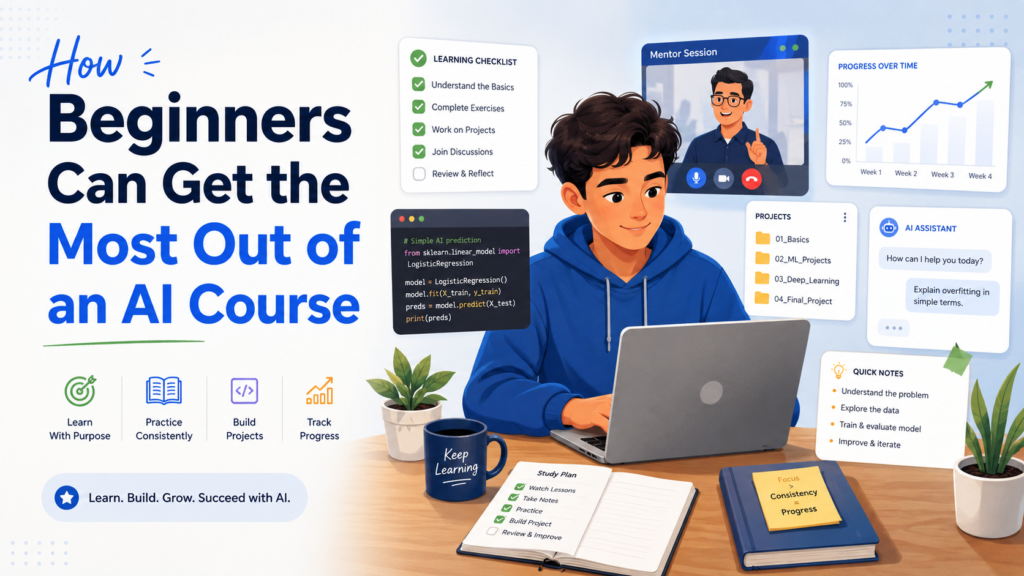
Joining the course is only step one. To actually benefit, beginners should stay active from day one.
Here is a practical approach:
- Build every project seriously, even the small ones.
- Keep notes in your own words.
- Upload projects to GitHub or a portfolio.
- Ask mentors to review your resume early.
- Practice explaining your project in two minutes.
- Apply for internships, freelance projects, and entry-level roles.
- Track the jobs you apply for.
- Improve after every interview.
A small tip: while learning AI, do not hide behind tutorials. After watching a lesson, change the dataset, modify the prompt, test another model, or add one small feature yourself. That is where real learning starts.
Who should choose an AI course with placement assistance?
This type of course is especially useful for:
- Fresh graduates who want their first tech or AI-related job
- Non-technical learners who need structured guidance
- Working professionals planning a career switch
- Students confused by too many online resources
- Beginners who want a certificate plus career support
- Learners who need help with resumes, interviews, and projects
If you are already experienced in data science or software engineering, you may not need heavy placement support. But if you are a beginner, it can make the path less confusing and more practical.
Is an online AI certificate enough to get a job?
An Artificial intelligence Certificate Online can support your job search, but it is usually not enough by itself. Employers look for a mix of skills, projects, communication, and problem-solving ability.
The best outcome comes when the certificate is backed by:
- Practical assignments
- Real-world projects
- Mentor feedback
- Interview preparation
- Career guidance
- Placement assistance
That combination shows employers that you did not just complete videos. You learned, practiced, built, and prepared.
Final thoughts
Beginners should choose an AI course with placement assistance because AI learning needs direction, proof, and career support. The right course helps you move from “I am interested in AI” to “I can apply AI skills in real projects and explain them confidently to employers.”
And that is the real goal.
Not just collecting certificates. Not just watching tutorials. Not just learning buzzwords.
The goal is to become job-ready.
If you are comparing ai learning courses, look beyond the syllabus. Ask about projects, mentors, interview preparation, hiring support, and how often the curriculum is updated. A well-designed artificial intelligence certificate online with placement assistance can give beginners a clearer, more realistic path into one of the fastest-moving career spaces of this decade.
FAQs
1. Why is placement assistance important in an AI course?
Placement assistance is important because beginners often need help with resumes, portfolios, mock interviews, and job applications. It helps convert learning into career opportunities.
2. Can beginners learn AI without a technical background?
Yes, beginners can learn AI without a deep technical background, especially if the course starts with Python, data basics, practical tools, and beginner-friendly projects. Some AI-related roles also value domain knowledge and communication skills.
3. Is an artificial intelligence certificate online valuable?
Yes, an artificial intelligence certificate online can be valuable when it includes practical projects, updated AI tools, mentor guidance, and placement support. The certificate is strongest when it proves applied skills, not just course completion.
4. What should I check before joining an AI course?
Check the curriculum, trainer experience, project quality, placement process, mock interview support, student reviews, and whether the course includes current topics like generative AI, prompt engineering, and machine learning applications.
5. Are AI jobs only for coders?
No. Many AI jobs require coding, but not all AI-related roles are purely coding-based. Fields like AI operations, analytics, automation, prompt engineering support, business AI strategy, and AI product support may combine technical understanding with business or domain knowledge.
6. How long does it take for a beginner to become job-ready in AI?
It depends on your background and practice. Many beginners need a few months of structured learning, project work, and interview preparation before applying confidently for entry-level AI, data, or automation-related roles.