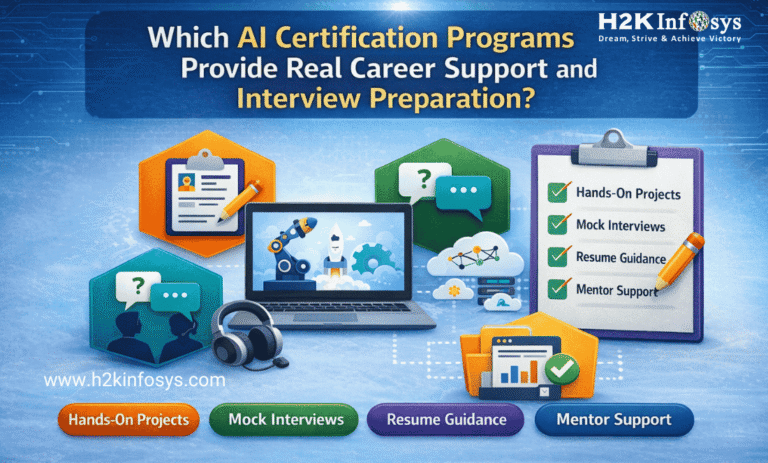
H2K Infosys AI certification programs that provide real career support and interview preparation typically combine structured AI learning courses with hands-on projects, mentorship, resume guidance, and mock interview training aligned with real world enterprise tools. The Best AI Certification Courses focus not only on theoretical knowledge but also on practical implementation using frameworks such as Python, TensorFlow, PyTorch, and cloud-based AI services, which are commonly used in production environments.
These programs help learners develop job-ready skills, understand enterprise AI workflows, and prepare for technical interviews involving machine learning models, data processing, and deployment scenarios
What Is an AI Certification Program?
An AI certification program is a structured training pathway designed to teach artificial intelligence concepts, tools, and practical implementation skills required for real-world IT and data-driven roles. These programs validate a learner’s ability to build, train, evaluate, and deploy AI models in enterprise environments.
Unlike academic degrees, certification programs focus on applied skills such as:
- Machine learning model development
- Data preprocessing and feature engineering
- AI model deployment and monitoring
- AI system integration into enterprise applications
AI certification programs are often delivered through Online AI learning Courses, making them accessible to working professionals and career switchers.
What Makes the Best AI Certification Courses Effective for Career Support?
Not all certification programs provide real career support. The best AI certification courses include several essential components beyond technical training.
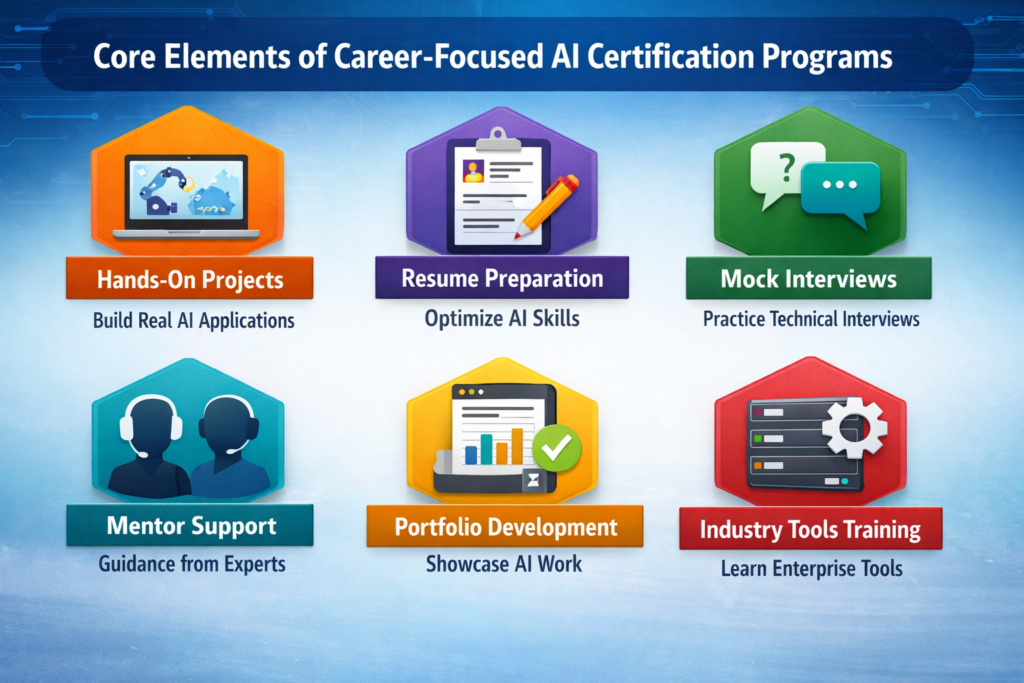
Core Elements of Career-Focused AI Certification Programs
| Component | Purpose | Real-World Relevance |
|---|---|---|
| Hands-on projects | Build real AI applications | Demonstrates job readiness |
| Resume preparation | Highlight AI skills effectively | Improves recruiter visibility |
| Mock interviews | Simulate technical interviews | Builds confidence and readiness |
| Mentor support | Resolve technical challenges | Provides industry guidance |
| Portfolio development | Showcase AI work | Essential for hiring managers |
| Industry tool exposure | Learn production tools | Matches enterprise requirements |
These components bridge the gap between learning and employment.
How Does AI Work in Real-World IT Projects?
Artificial intelligence systems operate through structured workflows involving data collection, model training, validation, and deployment.
Typical Enterprise AI Workflow
- Data Collection
Data is gathered from databases, APIs, or enterprise systems. - Data Preprocessing
Cleaning, normalization, and transformation are performed. - Feature Engineering
Relevant variables are selected to improve model performance. - Model Training
Machine learning algorithms are applied to train the model. - Model Evaluation
Accuracy, precision, and recall are measured. - Model Deployment
Models are integrated into applications or cloud platforms. - Monitoring and Maintenance
Models are monitored for performance degradation.
Example Real-World Use Case: AI in Fraud Detection
Banks use AI models to detect fraudulent transactions.
Workflow includes:
- Collect transaction data
- Train anomaly detection models
- Deploy models into transaction systems
- Automatically flag suspicious activity
This workflow is commonly taught in career-focused AI learning courses.
Why Is AI Certification Important for Working Professionals?
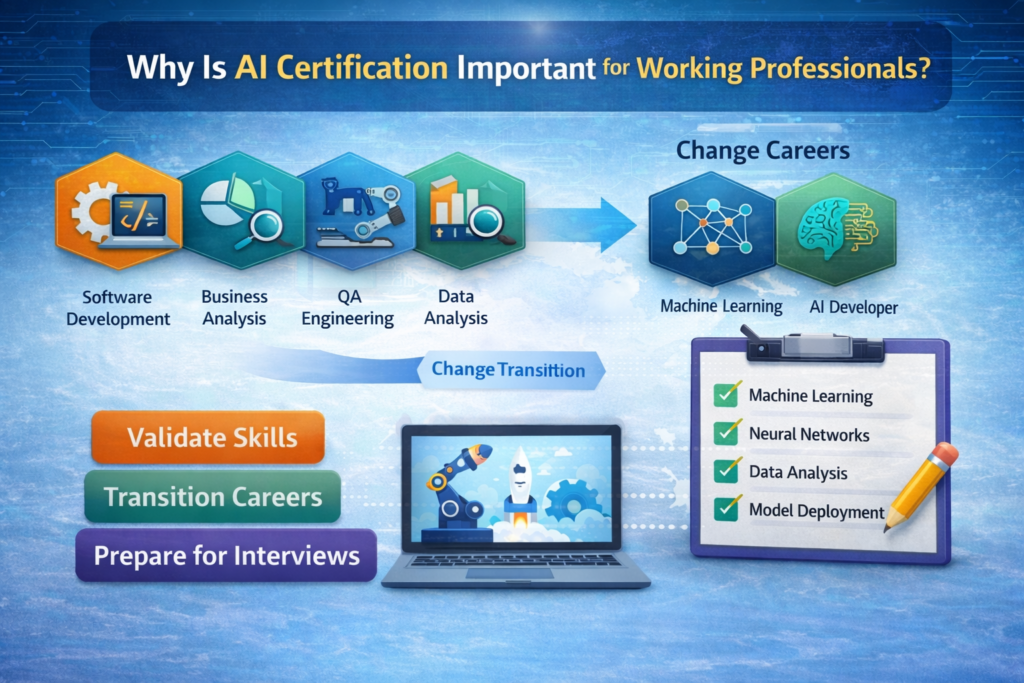
AI certification helps professionals transition into AI roles by providing structured skill development aligned with industry requirements.
Key Benefits
1. Skill Validation
Certification confirms expertise in:
- Machine learning algorithms
- Neural networks
- Data analysis
- AI model deployment
Employers use certifications to assess skill credibility.
2. Career Transition Support
AI certification programs help professionals from roles such as:
- Software developers
- QA engineers
- Business analysts
- Data analysts
- IT support professionals
transition into AI-related roles.
3. Interview Preparation
Career-focused certification programs include:
- Technical interview simulations
- Coding interview preparation
- AI concept explanations
- Real-world scenario questions
These elements significantly improve interview readiness.
What Skills Are Taught in AI Learning Courses?
AI learning courses cover a combination of programming, mathematics, and AI frameworks.
Core Technical Skills
Programming Skills
- Python programming
- NumPy and Pandas
- Data manipulation
- Automation scripting
Python is the primary language used in AI development.
Machine Learning Skills
Common algorithms taught include:
- Linear regression
- Logistic regression
- Decision trees
- Random forests
- Support vector machines
These algorithms form the foundation of predictive systems.
Deep Learning Skills
Deep learning focuses on neural networks.
Common concepts include:
- Artificial neural networks
- Convolutional neural networks (CNN)
- Recurrent neural networks (RNN)
- Transformers
Frameworks used:
- TensorFlow
- PyTorch
- Keras
Data Processing Skills
Skills include:
- Data cleaning
- Feature selection
- Data normalization
- Handling missing data
These steps are critical in real enterprise environments.
What Tools Are Commonly Used in the Best AI Certification Courses?
Enterprise AI environments rely on standardized tools.
AI Tools and Their Enterprise Role
| Tool | Purpose | Enterprise Use |
|---|---|---|
| Python | Programming language | Model development |
| TensorFlow | Deep learning framework | Neural network training |
| PyTorch | AI framework | Research and production |
| Scikit-learn | Machine learning library | Model building |
| Jupyter Notebook | Development environment | Experimentation |
| AWS AI Services | Cloud deployment | Production AI systems |
| Azure Machine Learning | Model management | Enterprise integration |
| Git | Version control | Collaboration |
These tools are commonly included in hands-on AI learning courses.
How Is AI Used in Enterprise Environments?
AI is integrated into enterprise systems to automate processes and improve decision-making.
Common Enterprise AI Applications
Customer Support Automation
AI chatbots handle customer queries.
Technologies used:
- Natural Language Processing
- Machine learning classification
Predictive Analytics
Companies predict future trends using AI models.
Examples include:
- Sales forecasting
- Demand prediction
- Risk analysis
Recommendation Systems
Used by platforms such as:
- E-commerce systems
- Streaming platforms
These systems suggest products or content.
Image and Speech Recognition
Used in:
- Healthcare diagnostics
- Voice assistants
- Security systems
Which AI Certification Programs Provide Real Career Support?
Several certification types focus on career readiness rather than theoretical knowledge.
Categories of Career-Focused AI Certification Programs
Industry Vendor Certifications
Examples include:
- Microsoft AI certifications
- AWS Machine Learning certifications
- Google AI certifications
These certifications validate cloud-based AI skills.
Professional AI Certification Programs
These programs focus on job readiness.
Features include:
- Real-world projects
- Career mentorship
- Resume preparation
- Interview preparation
These are often part of structured AI learning courses.
Academic AI Certifications
Offered by universities.
Focus areas include:
- Theory
- Research
- Mathematical foundations
These programs may provide less career support compared to professional certifications.
What Job Roles Use AI Skills Daily?
AI skills apply across multiple job roles.
AI Career Role Mapping
| Role | Responsibilities | Required Skills |
|---|---|---|
| Machine Learning Engineer | Build ML models | Python, TensorFlow |
| AI Engineer | Develop AI systems | Model deployment |
| Data Scientist | Analyze data | Statistics, ML |
| AI Developer | Build AI applications | Programming |
| NLP Engineer | Language models | NLP frameworks |
| AI Analyst | Data interpretation | Machine learning |
These roles are commonly targeted after completing the best AI certification courses.
What Careers Are Possible After Completing AI Learning Courses?
AI certification opens opportunities across industries.
Common Career Paths
Entry-Level Roles
- Junior AI Engineer
- Machine Learning Analyst
- AI Developer
Mid-Level Roles
- Machine Learning Engineer
- AI Specialist
- Data Scientist
Advanced Roles
- AI Architect
- AI Solutions Engineer
- AI Research Engineer
How Do AI Certification Programs Prepare Learners for Interviews?
Interview preparation is a critical component of career-focused certification programs.
Key Interview Preparation Areas
Technical Interview Preparation
Topics include:
- Machine learning algorithms
- Python coding
- Data preprocessing
- Model evaluation
Practical Interview Preparation
Mock interview simulations include:
- Real interview questions
- Scenario-based problem solving
- Technical explanation exercises
Portfolio Preparation
Learners build project portfolios demonstrating:
- AI model development
- Deployment workflows
- Real-world problem solving
Example AI Project Taught in Certification Programs
Example Project: Predict Customer Churn
Steps include:
Step 1: Load data
import pandas as pd
data = pd.read_csv("customer_data.csv")
Step 2: Preprocess data
Step 3: Train machine learning model
Step 4: Evaluate model accuracy
Step 5: Deploy model
This workflow reflects real enterprise AI development.
How to Choose the Best AI Certification Courses
Choosing the right certification requires evaluating career support, technical coverage, and practical training.
Evaluation Criteria
Career Support Features
Look for programs that provide:
- Resume support
- Interview preparation
- Career mentoring
- Project-based learning
Technical Coverage
Courses should include:
- Machine learning
- Deep learning
- Python programming
- AI deployment
Hands-on Training
Hands-on learning ensures real-world skill development.
Learning Path for AI Certification
Beginner Stage
Learn:
- Python programming
- Data analysis
Intermediate Stage
Learn:
- Machine learning
- Model training
Advanced Stage
Learn:
- Deep learning
- AI deployment
Challenges Professionals Face When Learning AI
Common challenges include:
- Lack of hands-on experience
- Difficulty understanding machine learning concepts
- Limited interview preparation
- Lack of real-world project exposure
Career-focused certification programs address these challenges.
FAQ Section
Which AI certification is best for beginners?
Beginner-friendly certifications focus on Python, machine learning basics, and hands-on projects.
Do AI certification programs help with job placement?
Career-focused programs provide resume guidance, interview preparation, and portfolio development.
How long does it take to complete AI certification?
Most certification programs take 3 to 6 months.
Do employers value AI certifications?
Employers value certifications that demonstrate practical experience and real-world project skills.
Is coding required for AI certification?
Yes, Python programming is essential.
Key Takeaways
- The best AI certification courses combine technical training with career support.
- Hands-on projects and interview preparation are essential for job readiness.
- AI learning courses teach tools used in real enterprise environments.
- Certification helps professionals transition into AI careers.
- Practical experience is critical for employment.