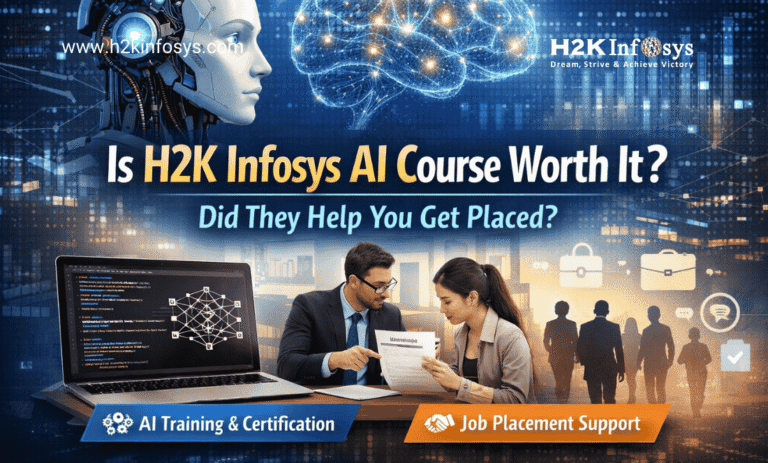
An Artificial Intelligence (AI) training program such as the one offered by H2K Infosys can be considered worth it provides structured coverage of core AI concepts, hands on tools, real world project exposure, and career preparation aligned with enterprise job requirements. Placement support effectiveness depends on factors such as curriculum relevance, practical skill development, interview preparation, and the learner’s ability to apply AI skills in real IT environments. Programs that combine technical training with project based learning and job readiness guidance are generally more useful for working professionals transitioning into AI roles.
This provides an objective, educational evaluation of AI training programs, including curriculum structure, skills taught, enterprise relevance, and career outcomes, with a specific focus on how such programs support learners pursuing artificial intelligence careers.
What Is the H2K Infosys AI Course?
The H2K Infosys AI course is an Artificial Intelligence Training Program designed to teach foundational and applied AI skills used in enterprise software development, data science, and automation environments.
Typical AI certification courses like this include structured training in:
- Machine learning fundamentals
- Python programming for AI
- Data preprocessing and analysis
- Neural networks and deep learning
- Model deployment and integration
- Real-world AI project workflows
These programs are generally aimed at:
- IT professionals transitioning to AI or machine learning roles
- Software engineers expanding into AI development
- QA engineers moving into automation and intelligent testing
- Data analysts transitioning into data science
The goal is to help learners acquire practical skills aligned with industry job roles.
Why Is Artificial Intelligence Training Important for Working Professionals?
Artificial intelligence has become a core component of modern enterprise IT systems. Organizations use AI to automate workflows, improve decision-making, and enhance customer experiences.
Working professionals benefit from artificial intelligence training programs because AI skills enable participation in emerging enterprise initiatives such as:
- Intelligent automation systems
- Predictive analytics platforms
- Recommendation engines
- Natural language processing applications
- Fraud detection systems
Professionals without AI training may find it difficult to contribute to projects involving machine learning or intelligent automation.
How Does Artificial Intelligence Work in Real-World IT Projects?
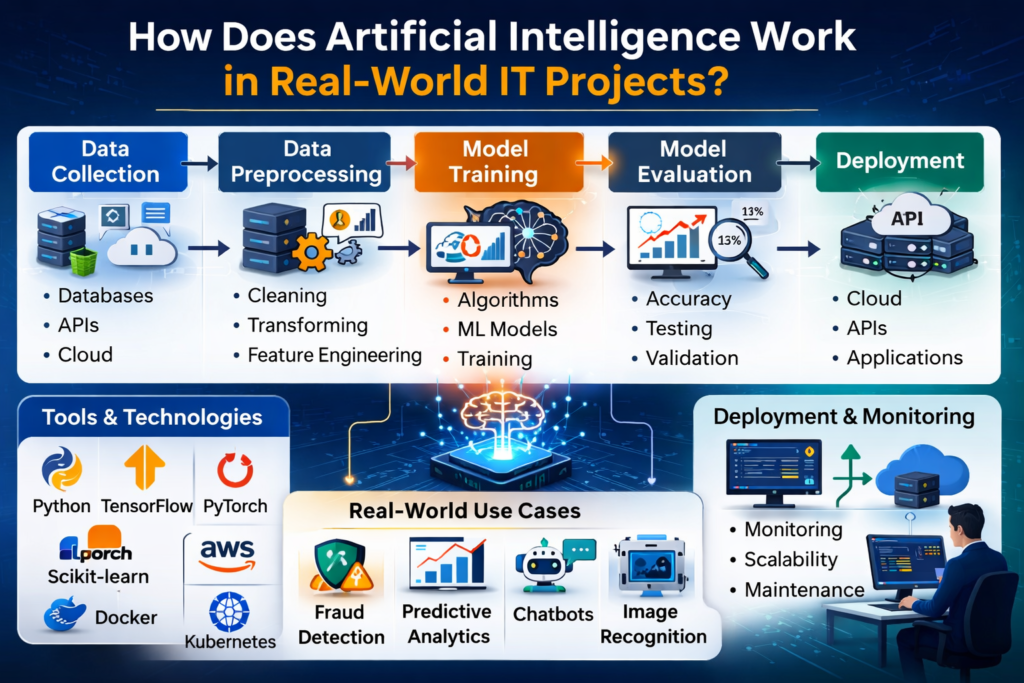
Artificial intelligence systems follow structured workflows involving data collection, training, validation, and deployment.
Standard Enterprise AI Workflow
| Stage | Description | Tools Used |
|---|---|---|
| Data Collection | Gathering structured and unstructured data | SQL, APIs, cloud storage |
| Data Preprocessing | Cleaning and transforming data | Python, Pandas |
| Model Training | Training machine learning models | Scikit-learn, TensorFlow |
| Model Evaluation | Testing accuracy and performance | Jupyter Notebook |
| Deployment | Integrating model into applications | Docker, REST APIs |
| Monitoring | Tracking performance in production | Cloud monitoring tools |
Example: AI in Customer Support Automation
A typical enterprise implementation might include:
Step 1: Data Collection
Customer chat logs are collected from CRM systems.
Step 2: Data Preparation
Engineers clean and label conversations.
import pandas as pd
data = pd.read_csv("chat_logs.csv")
clean_data = data.dropna()
Step 3: Model Training
Train a classification model to categorize customer requests.
Step 4: Deployment
Integrate model into chatbot API.
Step 5: Monitoring
Evaluate prediction accuracy and retrain as needed.
This workflow represents standard enterprise AI implementation practices taught in artificial intelligence certification courses.
What Skills Are Required to Learn an Artificial Intelligence Training Program?
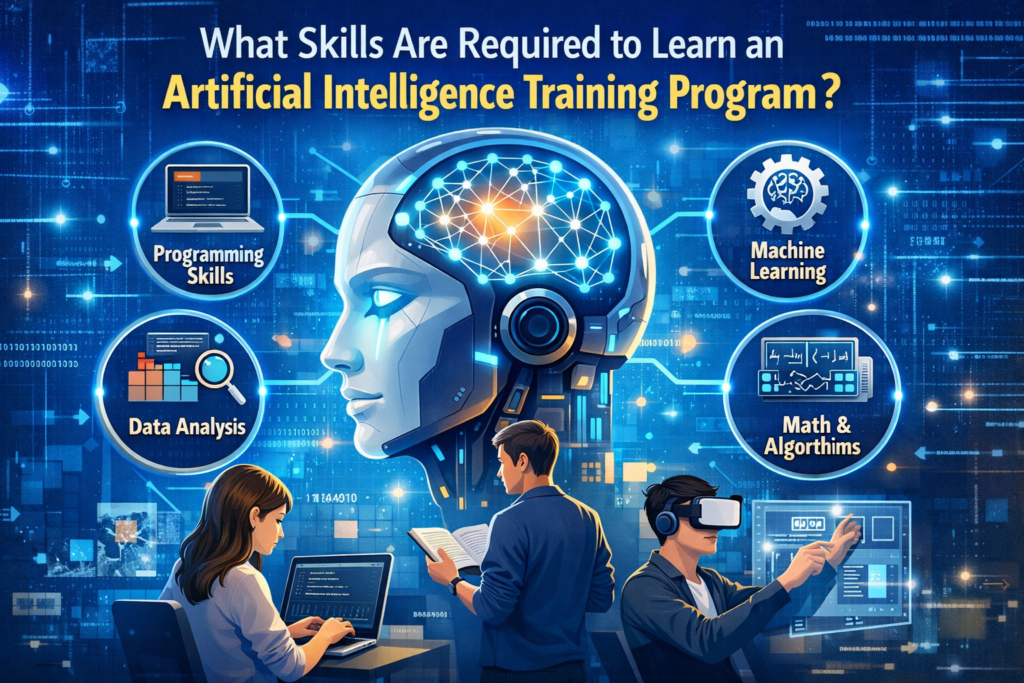
AI training programs typically require foundational technical skills, but many structured courses begin with beginner-friendly introductions.
Core Skills Taught in AI Courses
Programming Skills
Python is the most widely used language in AI development.
Key Python libraries include:
- NumPy
- Pandas
- Scikit-learn
- TensorFlow
- PyTorch
Mathematics Fundamentals
Essential mathematical concepts include:
- Linear algebra
- Probability
- Statistics
These concepts help professionals understand model behavior.
Data Handling Skills
Professionals learn to work with:
- Structured data (tables)
- Unstructured data (text, images)
- Data pipelines
Machine Learning Concepts
Key concepts include:
- Supervised learning
- Unsupervised learning
- Classification
- Regression
- Clustering
How Is Artificial Intelligence Used in Enterprise Environments?
Artificial intelligence is widely used across enterprise IT systems to improve operational efficiency, decision-making, and automation.
Common Enterprise AI Use Cases
1. Fraud Detection
Financial institutions use AI to detect suspicious transactions.
Tools used:
- Python
- Scikit-learn
- AWS SageMaker
2. Predictive Maintenance
Manufacturing companies use AI to predict equipment failures.
Benefits include:
- Reduced downtime
- Improved operational efficiency
3. Recommendation Systems
Used in:
- E-commerce platforms
- Streaming services
These systems recommend products or content.
4. Intelligent Test Automation
QA teams use AI to improve testing efficiency.
Tools include:
- AI-driven automation frameworks
- Selenium with AI integration
What Tools Are Commonly Taught in the Best AI Certification Courses?
Artificial intelligence training programs focus on industry-standard tools used in enterprise environments.
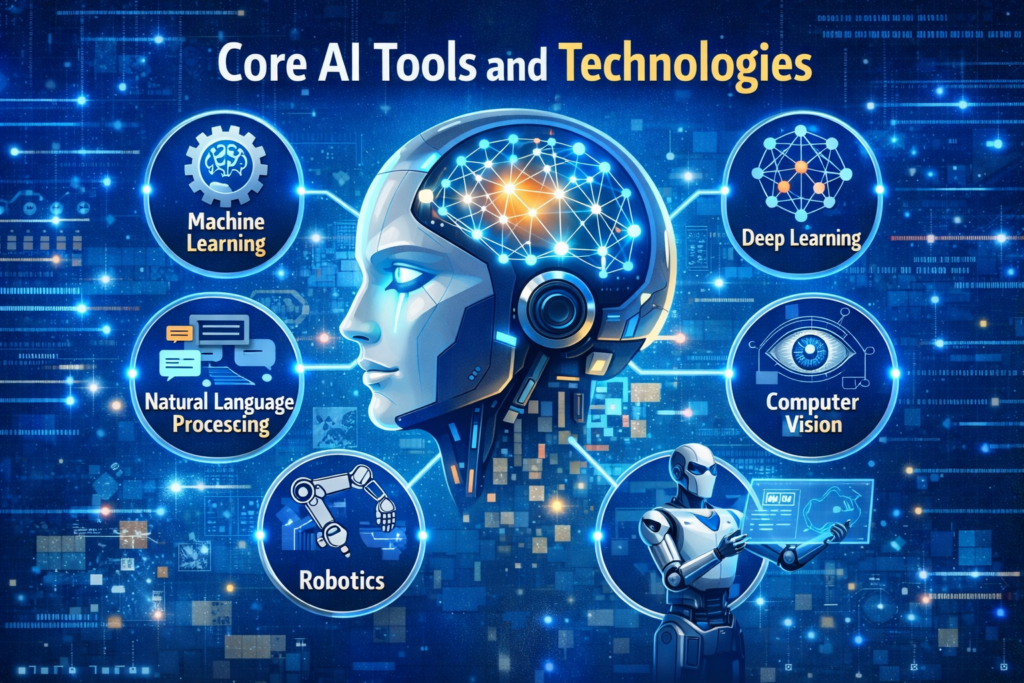
Core AI Tools and Technologies
| Tool | Purpose | Industry Use |
|---|---|---|
| Python | Programming language | AI model development |
| TensorFlow | Deep learning framework | Neural network training |
| PyTorch | Deep learning framework | Research and production |
| Scikit-learn | Machine learning library | Classification and regression |
| Pandas | Data analysis | Data preprocessing |
| Jupyter Notebook | Development environment | Model experimentation |
| Docker | Deployment | Model containerization |
| AWS / Azure | Cloud platforms | Model hosting |
Learning these tools is essential for working professionals pursuing AI careers.
What Job Roles Use Artificial Intelligence Daily?
Professionals trained through artificial intelligence certification courses typically pursue roles involving AI model development, deployment, or integration.
AI Job Roles and Responsibilities
| Role | Responsibilities |
|---|---|
| Machine Learning Engineer | Develop and deploy AI models |
| Data Scientist | Analyze data and build predictive models |
| AI Engineer | Design intelligent systems |
| Data Analyst | Perform data analysis |
| AI Automation Engineer | Implement AI-driven automation |
| Software Engineer (AI focus) | Integrate AI into applications |
These roles require practical knowledge of AI workflows and tools.
How Is AI Training Applied in Real Enterprise Projects?
Artificial intelligence training programs help professionals perform real-world tasks such as:
Example Enterprise Task: Predicting Customer Churn
Step 1: Data Collection
Retrieve customer usage data from database.
Step 2: Data Processing
from sklearn.preprocessing import StandardScaler
scaler = StandardScaler()
scaled_data = scaler.fit_transform(data)
Step 3: Model Training
Train classification model.
Step 4: Deployment
Expose model through REST API.
Step 5: Integration
Connect model to enterprise CRM system.
This workflow reflects real enterprise AI development practices.
What Careers Are Possible After Completing an Artificial Intelligence Training Program?
Completing an artificial intelligence training program can open career opportunities across multiple IT domains.
Entry-Level Roles
- Junior AI Engineer
- Machine Learning Analyst
- Data Analyst
Mid-Level Roles
- Machine Learning Engineer
- Data Scientist
- AI Engineer
Specialized Roles
- NLP Engineer
- Computer Vision Engineer
- AI Automation Engineer
These roles require both theoretical knowledge and practical experience.
How Do AI Certification Courses Help With Job Placement Preparation?
AI certification courses typically support career preparation through structured technical training and job readiness guidance.
Common Placement Support Components
Resume Preparation
Professionals learn how to highlight:
- AI projects
- Technical skills
- Tools experience
Interview Preparation
Training may include:
- Technical interview questions
- Coding exercises
- Scenario-based questions
Hands-On Projects
Projects help demonstrate skills to employers.
Example project types:
- Predictive analytics project
- Recommendation system
- Chatbot development
What Makes an Artificial Intelligence Training Program Effective?
Not all training programs provide equal value. Effective programs typically include:
1. Hands-On Learning
Hands-on exercises using real tools are essential.
Example:
- Build machine learning models
- Deploy models to cloud platforms
2. Real-World Projects
Enterprise-style projects help learners gain practical experience.
Example:
- Fraud detection model
- Customer prediction model
3. Industry Tools
Training should include widely used tools such as:
- Python
- TensorFlow
- AWS
4. Structured Curriculum
Courses should follow logical progression:
- Programming basics
- Machine learning fundamentals
- Deep learning
- Model deployment
How Do Employers Evaluate Candidates With AI Training?
Employers evaluate candidates based on practical skills rather than course completion alone.
Key Evaluation Criteria
| Skill | Importance |
|---|---|
| Python programming | Essential |
| Machine learning knowledge | Essential |
| Project experience | Critical |
| Tool familiarity | Important |
| Problem-solving ability | Critical |
Training programs help candidates develop these skills.
FAQ: Artificial Intelligence Training Program and Placement Support
Is the H2K Infosys AI course suitable for beginners?
Yes, structured AI training programs typically start with foundational concepts such as Python programming and machine learning fundamentals, making them accessible to beginners with basic IT knowledge.
Does completing an AI certification guarantee job placement?
No training program can guarantee placement. However, courses that provide hands-on projects, interview preparation, and real-world skills improve employability.
What is the best artificial intelligence training program?
The Best AI Certification Courses are those that include:
- Practical projects
- Industry tools
- Model deployment training
- Career preparation support
How long does it take to learn artificial intelligence?
Most structured artificial intelligence training programs take 3 to 6 months, depending on depth and learner commitment.
Can working professionals transition into AI careers?
Yes, many working professionals transition into AI roles by completing structured training programs and building practical project experience.
Do AI courses include real-world projects?
Effective AI certification courses include real-world projects involving machine learning, predictive analytics, and model deployment.
Key Takeaways
- Artificial intelligence training programs teach practical skills required for AI and machine learning roles.
- Effective programs include hands-on projects, real enterprise workflows, and industry tools.
- Placement support typically includes resume preparation, interview guidance, and project experience.
- Employers evaluate candidates based on practical skills and project experience, not certification alone.
- AI skills are widely used across enterprise IT environments including automation, analytics, and intelligent systems.
Explore H2K Infosys AI courses to build hands-on artificial intelligence skills aligned with real enterprise workflows.
Enroll to gain practical experience and strengthen your readiness for AI career opportunities.