A Business Analyst (BA) is the professional who connects business needs with practical solutions, helping organizations understand problems, analyze data, and implement improvements that actually work. In simple terms, a BA listens to what a business needs and translates that into clear, workable requirements for teams to build or improve products. H2K Infosys is often mentioned by many learners when discussing structured learning paths for this role, especially through hands-on BA Training and real-world project practice.
If you’ve ever wondered who figures out why a company’s system isn’t working efficiently or who helps design a better process, that’s usually the Business Analyst behind the scenes.
Why Business Analysts Matter More Than Ever in 2026
Businesses today run on data, customer insights, and constant change. New digital products launch every week, markets shift quickly, and companies need someone who can interpret business goals and turn them into clear action plans.
That’s exactly where Business Analysts come in.
Over the past few years, the demand for BAs has quietly surged. Many organizations realized they weren’t struggling with technology itself, they were struggling with understanding the real business problem. A good BA solves that gap.
For example, a retail company might notice online sales dropping. The development team could build dozens of features, but a Business Analyst would step back and ask:
- Are customers abandoning the checkout process?
- Is pricing confusing?
- Are shipping options unclear?
By analyzing data and gathering user feedback, the BA identifies the root cause, not just the symptoms.
What Exactly Does a Business Analyst Do?
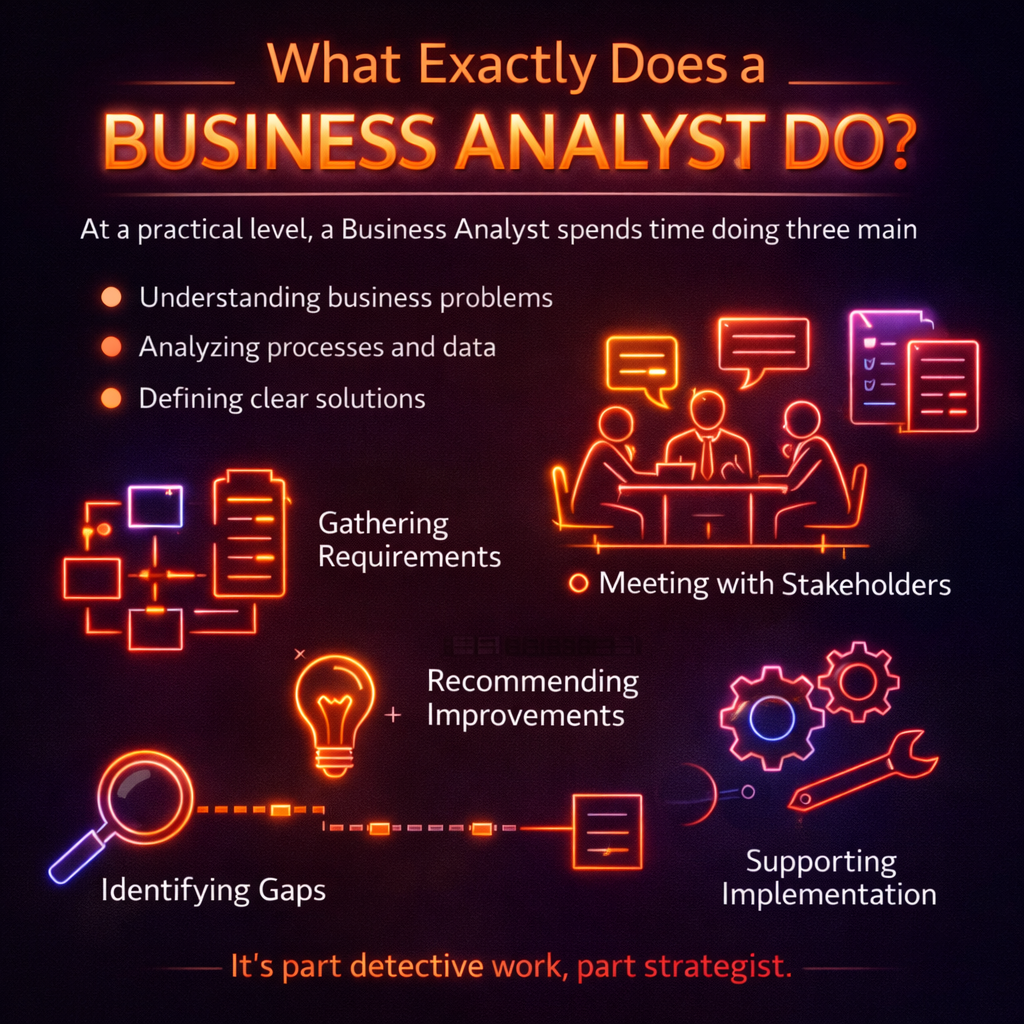
At a practical level, a Business Analyst spends time doing three main things:
- Understanding business problems
- Analyzing processes and data
- Defining clear solutions
But in real life, the job involves a lot more conversation, investigation, and documentation than people initially expect.
Here’s what a typical BA might work on during a project:
- Meeting stakeholders to understand business goals
- Gathering requirements from different teams
- Documenting workflows and business rules
- Identifying gaps in current systems
- Recommending improvements
- Supporting teams during implementation
Some days involve long meetings with business leaders. Other days are spent reviewing reports or mapping workflows. It’s part detective work, part strategist.
A Simple Real-World Example
Consider a bank improving the efficiency of its loan approvals.
Customers have expressed dissatisfaction with the long wait times for loan approval, while the management team is looking for systems to automate and speed up the process.
A developer, for example, is likely to think of automation systems. A Business Analyst, however, needs to understand the existing processes.
After understanding the existing process, the BA may be surprised to find that:
- Multiple departments complete manual reviews of loan applications.
- Duplicate data is entered in two different systems.
- Some approval steps are still followed even though they are redundant and outdated.
- Once the BA has these insights, they will design a process for the organization to streamline.
What do you think the outcomes are?
The time for loan approval is reduced from 5 days to 24 hours.
Business analysis is that powerful.
Key Skills Every Business Analyst Needs
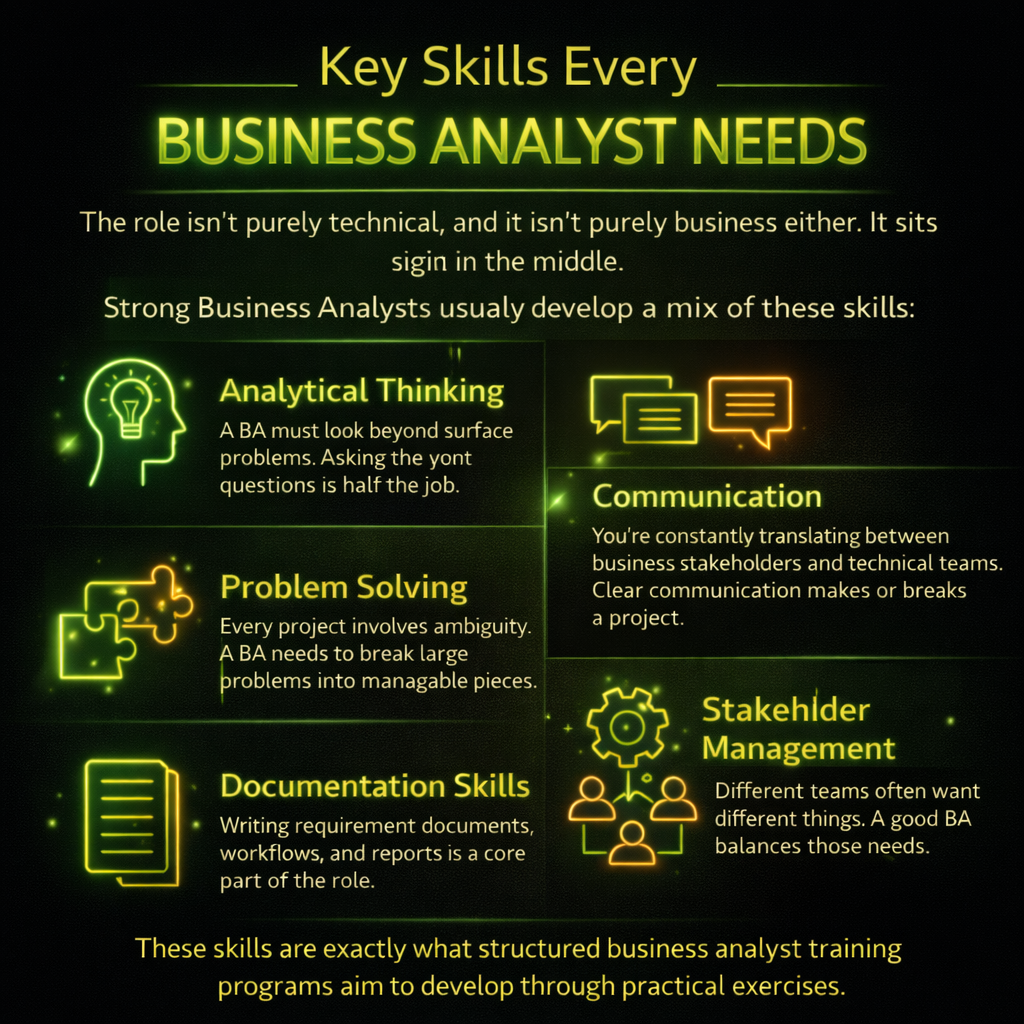
The role isn’t purely technical, and it isn’t purely business either. It sits right in the middle.
Strong Business Analysts usually develop a mix of these skills:
Analytical Thinking
A BA must look beyond surface problems. Asking the right questions is half the job.
Communication
You’re constantly translating between business stakeholders and technical teams. Clear communication makes or breaks a project.
Problem Solving
Every project involves ambiguity. A BA needs to break large problems into manageable pieces.
Documentation Skills
Writing requirement documents, workflows, and reports is a core part of the role.
Stakeholder Management
Different teams often want different things. A good BA balances those needs.
These skills are exactly what structured business analyst training programs aim to develop through practical exercises.
Types of Business Analysts
Not every BA works on the same type of projects. Over time, many specialize in certain areas.
Some common BA roles include:
IT Business Analyst
Works closely with development teams and product teams.
Business Process Analyst
Focuses on improving workflows and operational efficiency.
Product Analyst
Helps define features and improvements for digital products.
Data-focused Business Analyst
Analyzes trends and patterns to support business decisions.
In many companies, these roles overlap. The job title may stay the same, but the responsibilities evolve depending on the organization.
Why Many Analysts Are Moving Into Business Analysis
Notably, Business Analysis is a prevalent option for career change.
Professionals from all walks of life are changing careers to Business Analysis:
- Employees in Operations
- Customer support
- Project Coordination
- Subject matter experts in finance, healthcare, etc.
Why? Business Analysis cares about and appreciates non-technical skills, particularly business acumen and problem-solving.
This explains the high number of analysts who undertake business analyst training and seek to consolidate their knowledge and skills through practical training.
What You Learn in Business Analyst Training
A structured learning path usually covers the core areas needed for real projects.
Most quality business analysis online training programs include topics such as:
- Business analysis fundamentals
- Requirement gathering techniques
- Stakeholder communication strategies
- Business process modeling
- Project documentation practices
- Real-world case studies
One thing experienced professionals often say: the projects matter more than the theory.
Hands-on practice simulating real business problems is what prepares someone for actual BA work.
Are Business Analyst Certifications Worth It?
The short answer is yes, but only in conjunction with other skills.
Business analyst certifications are proof of knowledge and can help strengthen your case for getting hired.
Certifications demonstrate to employers the candidate’s understanding of:
- industry practices
- structured approaches to analysis
- standard methods of documentation
Still, hiring managers are interested in practical problem-solving skills.
Because of this, learners often pair certification preparation with business analyst courses that are practical in nature and involve case studies and project work.
Business Analyst Salary and Career Outlook
Business Analysis as a profession remains robust worldwide.
The capacity to span and integrate business strategy with implementation is the reason why most senior BAs command good pay in numerous geographies.
Evolution is one of the most fascinating aspects of the profession.
Ten years ago, most BAs were involved in documenting requirements. Today, they participate in:
- defining product strategies
- making decisions based on data
- enhancing customer experience
Furthermore, with the growing rate of digital transformation in organizations, the demand for business and operational process cross-domain experts continues to climb.
Choosing the Right Business Analyst Training
Not all training programs are created equal.
When evaluating BA Certification or training options, experienced professionals recommend checking for:
- Real project simulations
- Instructor-led sessions
- Case studies based on real industries
- Interview preparation
- Career support
Programs that offer business analyst training and placement assistance can also be helpful for newcomers entering the job market.
Conclusion
The contribution of Business Analysts to modern-day organizations can not be overemphasized. They are the ones who step back and appreciate the real challenge of the business problem, and then assist teams in developing the appropriate solution, not just the quickest one.
If you like the challenge of problem-solving, the intrigue of asking the right questions, and the satisfaction of optimizing business processes, then this career path would suit you.
A typical path would involve starting to specialize in structured BA Training, then acquiring relevant business analyst courses to gain practical experience, and finally completing a business analyst certification online, which further enhances your credentials.
The path to getting into Business Analysis is not always a straight line, but for those with a blend of curiosity and analytical thinking, Business Analysis is one of the most diverse career options in the current digital economy.