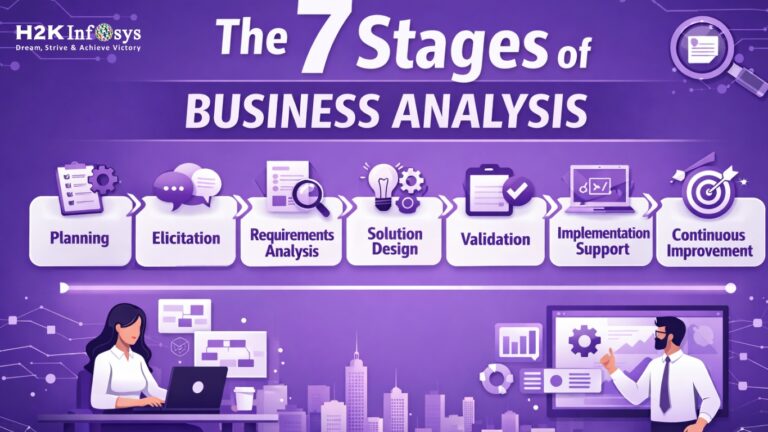
If you talk to experienced analysts or even people just starting BA Training, you’ll notice something interesting successful projects almost always follow a pattern. Not rigid steps, but a flow. That flow is what we usually call the Stages of Business Analysis.
I remember working on a retail analytics project a few years ago. The company thought they had a “data problem.” Turned out they actually had a process problem. Without following the proper Stages of Business Analysis, we would’ve built the wrong solution entirely.
So let’s break down these stages the way they actually happen in real projects, not just the textbook version.
1. Business Analysis Planning
The first of the Stages of Business Analysis is planning. And honestly, this stage gets underestimated a lot.
Planning simply means figuring out:
- What problem are we solving?
- Who are the stakeholders?
- What tools and methods will we use?
For example, imagine a bank wanting to launch a new mobile feature for instant credit approvals. Before any requirement gathering begins, analysts need to define the scope, identify stakeholders (compliance teams, developers, and marketing), and outline the roadmap.
Anyone taking business analyst courses will quickly realize that planning determines whether the rest of the project moves smoothly or becomes chaotic.
A well-planned start sets the tone for the rest of the Stages of Business Analysis.
2. Requirements Elicitation
This is where analysts start gathering information from stakeholders.
But here’s the truth: elicitation isn’t just asking questions in meetings. It’s more like detective work.
You might use:
- Stakeholder interviews
- Workshops
- Surveys
- Process observation
- Data analysis
One trend I’ve noticed recently, especially in fintech and AI startups, is using collaborative tools like Miro or AI-assisted requirement documentation during elicitation.
These modern techniques are now being integrated into many business analysis training programs.
Elicitation is easily one of the most crucial Stages of Business Analysis, because if the requirements are misunderstood, everything else falls apart.
3. Analysis of Requirements
Having gathered requirements, the next step will entail the evaluation and organization of the data.
During this phase, analysts start raising more complex questions:
- Are these needs achievable?
- Would they oppose other requirements?
- What business merit do they offer?
A case in point, a logistics firm may put in a request for “real-time delivery tracking,” and it may appear simple; however, an analysis shows that their current system only updates every 30 minutes.
This is the stage that other tools, such as:
- User stories
- Data flow diagrams
- BPMN process maps
- UML diagrams
come into play
Most business analyst online certification courses focus on these techniques because this stage is the one that outlines the project’s potential.
This is the stage of business analysis where raw data is transformed into meaningful data.
4. Solution Design
Analysts finalize requirements and work with architects and developers to design the solution.
This stage can be described as transforming the business case into something that can be built.
Example:
An analysis case study with a healthcare company showed the need for faster patient check-ins. The analysis revealed delays caused by manual data entry.
The solution design might have:
- Automated patient forms
- Integrated APIs with insurance systems
- Mobile pre-check-in
Modern business analyst certification programs are starting to include case studies with digital transformation like this.
Solution design is one of the most creative stages of Business Analysis, as it combines business and technology.
5. Solution Validation
At this point, we can ask the most basic yet most vital question:
Does the proposed solution address the business problem?
Validation usually means:
- reviews by stakeholders
- testing of prototypes
- user acceptance testing (UAT)
For example, some retail companies launched AI-powered customer service bots in 2024. But after validation testing, some companies found customers preferred a hybrid support model, meaning AI + human agents.
In the absence of validation throughout the Stages of Business Analysis, companies run the risk of providing unwanted solutions.
6. Support During Implementation
It is common to believe that analysts leave the project once development work begins. This is false.
During implementation, business analysts will:
- Explain the requirements to the development team
- Answer questions from stakeholders
- Support the various testing phases
- Confirm the solution meets business requirements
The majority of business analyst training and placement programs focus on this phase because organizations seek analysts who will remain engaged throughout the entire product lifecycle.
Implementation Support is what enables the Stages of Business Analysis to produce tangible business outcomes, and not just remain solely on the documentation.
7. Continuous Improvement
The final stage of Business Analysis is often neglected: assessing the performance of the solution after the launch.
The business environment is continuously changing.
For instance:
- New policies
- Changes in consumer behavior
- Advances in technology
A solution that was appropriate six months ago might need changes.
This is why analysts monitor:
- Key performance indicators
- Feedback from users
- Performance of operations
Continuous improvement focuses on the Stages of Business Analysis, providing sustainable value instead of short-term fixes.
Why These Stages Matter in Modern Business
If you look at recent industry reports from Gartner and McKinsey, you’ll see that organizations investing in structured analysis frameworks deliver projects 30–40% more successfully.
And it makes sense.
Following the Stages of Business Analysis helps companies:
- Avoid expensive project failures
- Align technology with business goals
- Improve decision-making
- Deliver better user experiences
This is exactly why the demand for trained analysts keeps rising globally.
In fact, LinkedIn’s 2025 Jobs on the Rise report listed business analysis roles among the fastest-growing in tech and operations.
Learning the Stages as a New Business Analyst
If you’re new to this field, the best way to understand the Stages of Business Analysis is through practical exposure.
Many beginners start with:
- Structured BA Training
- Hands-on business analyst courses
- Industry-recognized BA Certification
The key is not just memorizing the stages but understanding how they actually play out in real projects.
Once you see them in action, the framework becomes second nature.
Conclusion
The Stages of Business Analysis is not a step-by-step process; Instead, these stages serve as the foundation for most successful projects.
These stages are essential for developers in order to address business issues in relation to all the measurable outcomes.
If you are thinking of business analysis online courses, business analyst certification online, or are looking to change your career, you are building a solid foundation by learning these stages.
You will hopefully notice these stages when they are finally present in your daily life and even in your banking applications, online shopping sites, and health care systems.