Artificial Intelligence (AI) is a rapidly evolving field that enables machines to perform tasks that typically require human intelligence, such as data analysis, pattern recognition, and decision making. AI training online helps professionals build practical skills in machine learning, data processing, and AI-driven automation. In 2026, Artificial Intelligence Online Training program such as those offered by H2K Infosys focus on real world project workflows, enterprise tools, and job ready competencies.
As organizations continue integrating AI technologies into business operations, structured learning paths and hands-on practice environments have become essential for professionals entering this field.
What Is Artificial Intelligence (AI)?
Artificial Intelligence refers to the development of computer systems capable of performing cognitive functions such as learning, reasoning, and problem-solving. AI systems rely on algorithms, statistical models, and large datasets to identify patterns and generate predictions.
AI typically includes several subfields:
| AI Domain | Description | Example Applications |
|---|---|---|
| Machine Learning | Algorithms that learn patterns from data | Fraud detection, recommendation systems |
| Deep Learning | Neural networks that model complex patterns | Image recognition, speech processing |
| Natural Language Processing (NLP) | Systems that process human language | Chatbots, sentiment analysis |
| Computer Vision | Image and video interpretation | Autonomous vehicles, medical imaging |
Most enterprise AI systems combine these techniques to automate data driven decision making processes.
How Does Artificial Intelligence Work in Real-World IT Projects?
In enterprise environments, AI systems are typically integrated into existing data pipelines and software systems. Rather than operating as standalone applications, AI components often function as decision-support modules.
A Typical Enterprise AI Workflow
- Data Collection
- Data is gathered from transactional systems, sensors, user activity logs, or external datasets.
- Data Preprocessing
- Data cleaning, normalization, and transformation are performed using tools such as:
- Python
- Pandas
- Apache Spark
- Data cleaning, normalization, and transformation are performed using tools such as:
- Model Training
- Machine learning algorithms are trained using historical data.
- Model Validation
- Teams evaluate model accuracy and generalization using test datasets.
- Deployment
- Models are deployed into production systems using APIs or microservices.
- Monitoring
- Performance metrics are continuously tracked to detect model drift or data changes.
Common Tools Used in Enterprise AI Projects
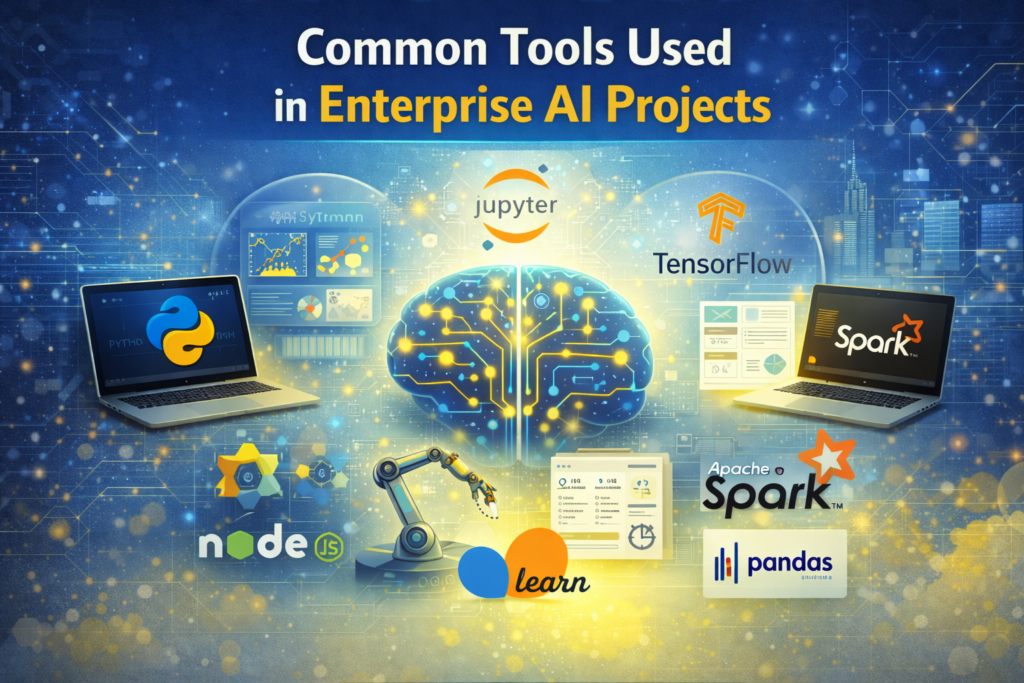
| Category | Tools Commonly Used |
|---|---|
| Programming | Python, R |
| Data Processing | Pandas, NumPy, Spark |
| Machine Learning | Scikit-learn, TensorFlow, PyTorch |
| Visualization | Matplotlib, Power BI |
| Deployment | Docker, Kubernetes, REST APIs |
Professionals pursuing Artificial Intelligence Online Training typically learn how to implement these workflows through practical projects.
Why Is Artificial Intelligence Important for Working Professionals?
AI adoption has expanded across multiple industries including finance, healthcare, e commerce, and manufacturing. Organizations use AI to improve efficiency, automate repetitive tasks, and support data-driven decision-making.
For working professionals, learning AI offers several advantages:
1. Automation of Data-Intensive Tasks
AI systems can process large datasets faster than manual analysis.
Example applications include:
- Fraud detection in financial transactions
- Predictive maintenance in manufacturing
- Customer behavior analysis in retail
2. Decision Support Systems
AI models provide insights that support strategic planning.
For example:
- Sales forecasting models
- Demand prediction systems
- Risk analysis tools
3. Integration With Existing IT Roles
AI skills complement existing roles such as:
- Software development
- Data analysis
- DevOps engineering
- Business intelligence
Professionals with foundational programming or analytics experience often transition into AI roles through AI training online programs.
What Skills Are Required to Learn Artificial Intelligence?
Learning AI requires a combination of programming knowledge, mathematical understanding, and data analysis skills.
Core Technical Skills
| Skill Area | Description |
|---|---|
| Programming | Python is widely used for AI development |
| Statistics | Probability, distributions, hypothesis testing |
| Linear Algebra | Vectors, matrices, and transformations |
| Data Analysis | Data cleaning and exploratory analysis |
| Machine Learning | Supervised and unsupervised algorithms |
Supporting Skills
Additional competencies help professionals succeed in AI environments:
- SQL for database queries
- Data visualization techniques
- Cloud platforms (AWS, Azure, GCP)
- Version control using Git
Structured Artificial Intelligence Online Training programs typically cover these skills progressively.
How Is Artificial Intelligence Used in Enterprise Environments?
Enterprise AI deployments focus on solving operational challenges and improving efficiency.
Example Enterprise Use Cases
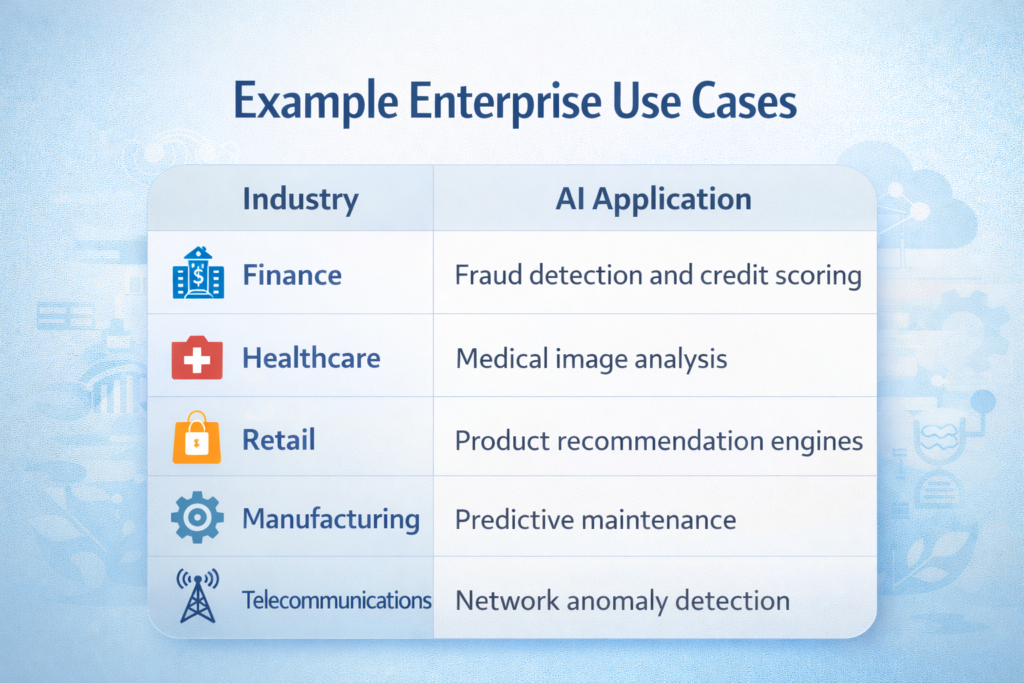
| Industry | AI Application |
|---|---|
| Finance | Fraud detection and credit scoring |
| Healthcare | Medical image analysis |
| Retail | Product recommendation engines |
| Manufacturing | Predictive maintenance |
| Telecommunications | Network anomaly detection |
In these environments, AI systems are integrated with existing data platforms and analytics tools.
Example: AI Workflow for Fraud Detection
A simplified fraud detection pipeline may include:
- Transaction data ingestion
- Feature engineering (transaction frequency, location, patterns)
- Machine learning model training
- Real-time prediction through APIs
- Alert generation for suspicious transactions
Professionals trained through AI training online programs often practice implementing similar workflows.
What Job Roles Use Artificial Intelligence Daily?
AI skills are used in a wide range of technical roles across organizations.
Common AI-Related Job Roles
| Role | Responsibilities |
|---|---|
| Machine Learning Engineer | Develops and deploys ML models |
| Data Scientist | Analyzes data and builds predictive models |
| AI Engineer | Integrates AI capabilities into software systems |
| Data Analyst | Uses AI tools for data insights |
| MLOps Engineer | Manages deployment and monitoring of models |
Many professionals transition into these roles after completing Artificial Intelligence Online Training and building project experience.
Why Begin Your AI Career Path with H2K Infosys in 2026?
Structured training programs can help professionals move from foundational knowledge to practical project experience.
Key Features of AI Training Programs
Programs such as those offered by H2K Infosys typically include:
- Structured curriculum covering AI fundamentals
- Hands-on labs and project-based learning
- Exposure to industry tools and frameworks
- Guidance on real-world workflows
Practical Learning Components
A typical AI training online program may include:
- Python programming for data science
- Machine learning model development
- Data preprocessing and feature engineering
- Model evaluation techniques
- Deployment and monitoring strategies
These elements help learners understand how AI systems are implemented in enterprise environments.
What Careers Are Possible After Learning Artificial Intelligence?
Professionals who complete Artificial Intelligence Online Training often pursue various technical roles depending on their background.
AI Career Path Overview
| Career Stage | Typical Role |
|---|---|
| Entry-Level | Junior Data Analyst |
| Intermediate | Machine Learning Engineer |
| Advanced | AI Architect |
| Specialized | NLP Engineer or Computer Vision Specialist |
The specific role depends on prior experience, project portfolio, and specialization.
Example Learning Path for AI Beginners
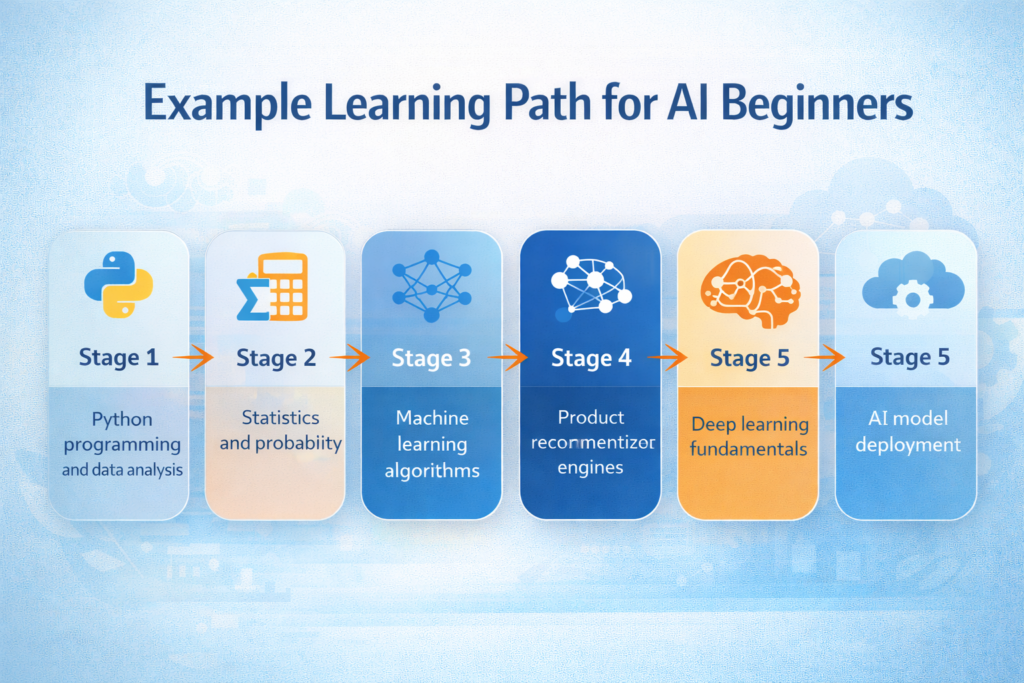
A structured learning path helps professionals progress efficiently.
| Stage | Learning Focus |
|---|---|
| Stage 1 | Python programming and data analysis |
| Stage 2 | Statistics and probability |
| Stage 3 | Machine learning algorithms |
| Stage 4 | Deep learning fundamentals |
| Stage 5 | AI model deployment |
Many AI Training Online programs follow a similar staged approach to ensure learners gain both theoretical knowledge and practical skills.
Common Challenges When Learning Artificial Intelligence
AI learners often encounter several challenges during the learning process.
1. Understanding Mathematical Foundations
Machine learning algorithms rely heavily on statistics and linear algebra.
2. Working With Real-World Data
Datasets in production environments often contain missing values, noise, and inconsistencies.
3. Model Deployment
Moving models from development environments to production systems requires knowledge of:
- APIs
- Containerization
- Cloud infrastructure
Hands-on projects help learners address these challenges.
Frequently Asked Questions (FAQ)
What is AI training online?
AI training online refers to structured educational programs delivered through digital platforms that teach artificial intelligence concepts, tools, and practical implementation techniques.
Who should learn Artificial Intelligence?
AI training is suitable for:
- Software developers
- Data analysts
- IT professionals
- Engineers interested in data-driven technologies
Is programming required to learn AI?
Yes. Most AI systems are developed using programming languages such as Python, which provides libraries for machine learning and data analysis.
How long does it take to learn AI?
Learning timelines vary depending on prior experience. Many structured programs range from 3 to 9 months depending on depth and specialization.
What tools are commonly used in AI projects?
Common AI tools include:
- Python
- TensorFlow
- PyTorch
- Scikit-learn
- Pandas
What industries use Artificial Intelligence?
AI is widely used in:
- Financial services
- Healthcare
- Retail
- Manufacturing
- Telecommunications
Key Takeaways
- Artificial Intelligence enables machines to analyze data and automate decision-making processes.
- AI training online provides professionals with structured learning paths covering programming, machine learning, and AI workflows.
- Enterprise AI projects involve data pipelines, model training, deployment, and monitoring.
- Common AI roles include machine learning engineer, data scientist, and AI engineer.
- Artificial Intelligence Online Training programs emphasize hands-on projects and industry tools used in production environments.
Conclusion
Artificial Intelligence has become a core component of modern IT systems and data-driven business operations. Structured AI training online programs provide professionals with the skills required to build, deploy, and manage AI models in enterprise environments.
Explore H2K Infosys Artificial Intelligence Online Training programs to gain hands-on experience with real-world tools and AI workflows designed for working professionals.