If you want to learn how businesses go from an idea to a tangible product, then the Business Analysis process is the core of that process. That’s where H2K Infosys comes in to teach aspiring business analysts the process that businesses use every day.
In essence, the Business Analysis process is a process that helps businesses analyze their needs and provide a solution that works. It doesn’t matter what type of solution, whether it’s a banking system, a healthcare system, or a retail system. It all comes back to the Business Analysis process.
What’s interesting is that business analysts are often seen as people who “gather requirements.” That’s not even close to what business analysts do. In reality, the Business Analysis process is a much broader process. Once you learn how all the different pieces come together, then the role of business analysts makes a lot more sense.
Why the Business Analysis Process Matters in Modern Organizations
Businesses run on data, technology, and customer needs that are ever-evolving. In essence, businesses run based on their ability to make good business decisions. That’s where the Business Analysis process comes in.
If we look at a business like a retail business that wants to launch a mobile app, then without the Business Analysis process, that business could launch an app that customers don’t want or need. They could go over budget and miss their deadline.
What a good business analyst will do is ensure that none of that ever happens. In essence, businesses across all different industries, including financial technology, healthcare, and retail, invest in business analysis training and business analyst courses because business analysts act as a bridge.
And honestly, that bridge often determines whether a project will succeed or quietly fade away.
Key Phases of the Business Analysis Process
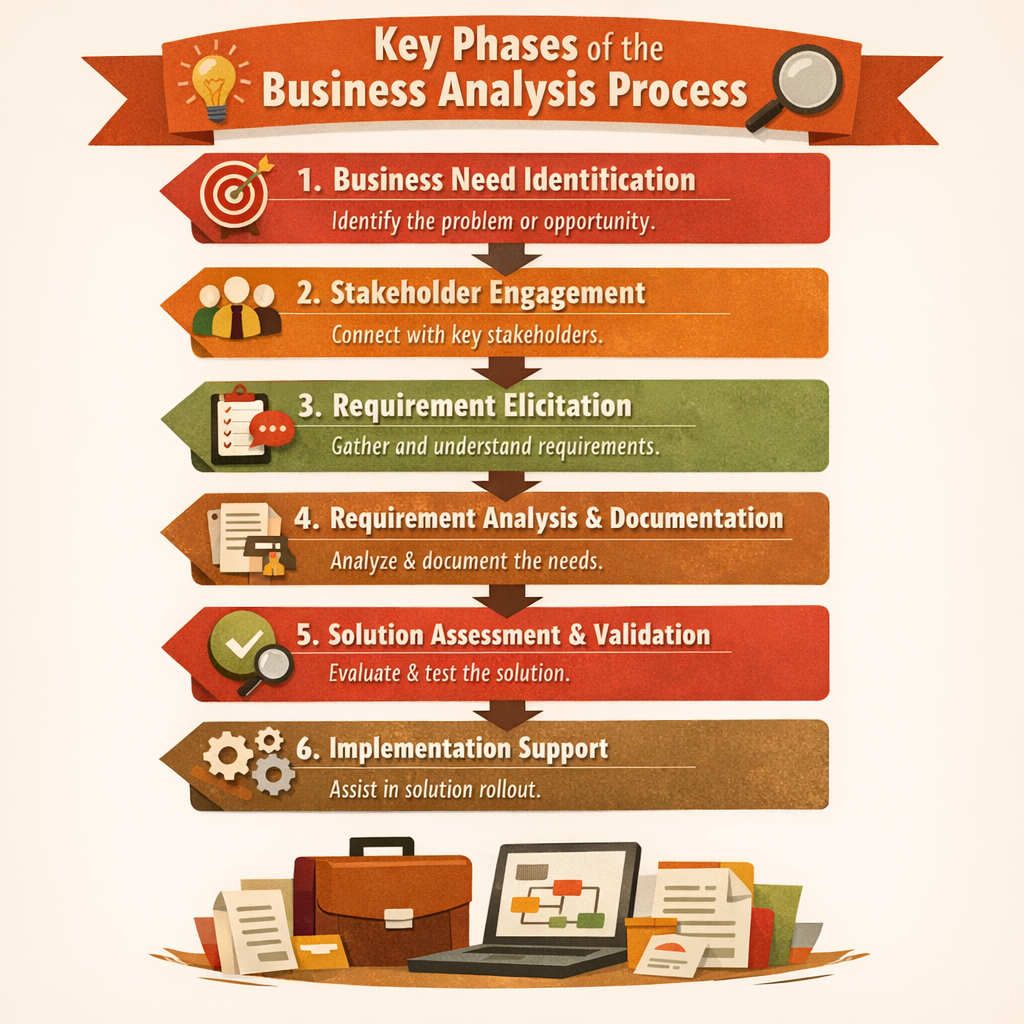
The Business Analysis Process has various stages that are followed. However, different organizations may have different names for each of the stages, though the overall workflow remains similar.
Let us take a look at the actual workflow that analysts follow in real-time.
1. Business Need Identification
First off, every Business Analysis project starts with a problem or, at times, an opportunity.
Perhaps the problem that has been identified by the organization is that they are losing customers, or that operational costs are increasing.
The first phase of the Business Analysis Process is to clearly identify what needs to be improved.
For instance:
- The bank wants to improve its loan approval time.
- The insurance company wants to improve its fraud detection capabilities.
- The retail company wants to improve its customer analytics.
The job of the Business Analysis expert at this phase of the Business Analysis Process is to ask questions and get to the bottom of the problem.
Perhaps the problem that has been identified by the organization is not actually the problem.
Perhaps the problem that has been identified by the organization is not actually the problem.
For instance:
Perhaps someone has identified that they need a new CRM system.
However, after asking questions, it turns out that the real problem that they are facing is that they don’t have visibility of the data.
That phase of the Business Analysis Process, where the problem has been identified, is quite critical.
2. Stakeholder Identification and Engagement
Having identified the problem, the Business Analysis expert will then go on to engage with the various stakeholders.
These stakeholders might include:
- Product managers
- IT
- Compliance
- Customers
- Management
The most human part of the Business Analysis Process is actually stakeholder identification and engagement.
Anyone who has worked on Business Analysis projects knows that different departments of an organization might have different perspectives on the problem that they are facing.
A good business analyst knows how to bring all these perspectives together.
3. Requirement Elicitation
This is the process most people think of when they hear the term “Business Analysis.”
Requirement elicitation is the process of gathering information from stakeholders to clearly understand what the end result should accomplish.
Some common methods include:
- Interviews
- Workshops
- Surveys
- Process observation
- Document analysis
For example, while performing a business analysis for a hospital appointment system, an analyst might observe how the nurses schedule patient appointments. This is an actual process, and it might just provide some insights that stakeholders have failed to mention.
It is messy, chaotic, but it is where the magic happens.
4. Requirement Analysis and Documentation
In this phase, the gathered information is structured into documentation.
This phase of the Business Analysis process takes the information gathered and turns it into a usable format such as:
- Business Requirement Document (BRD)
- Functional Requirement Document (FRD)
- User stories
- Process diagrams
In today’s Agile environment, user stories and product backlogs are very popular.
For example, user stories might look something like this:
- “As a customer, I want to know the status of my order, so I know when it will arrive.”
- Simple, but powerful enough to guide an entire software development team.
Many people seeking business analyst certification online have to learn about these tools because it is what employers expect from a business analyst.
5. Solution Assessment and Validation
Once the solution is designed or at least partially developed, the next phase in the Business Analysis process is validation.
In this phase, the business analyst checks if the solution actually solves the initial problem facing the business.
In this phase, the business analyst works closely with the testing team to validate if the solution meets the requirements, if it solves the business problem, and if it minimizes the risks.
A feature that had been requested by the stakeholders some months prior might now prove to be unnecessary.
This is more common than people might expect.
6. Implementation Support
The Business Analysis process does not simply cease once the requirements have been fulfilled.
This is where analysts might assist in the implementation by:
- Helping developers understand the requirements
- Helping with testing
- Aligning stakeholder expectations
In other words, this is where translation between business and technical teams occurs.
This is why companies want people who have completed their business analysis online training courses because this is a job that requires not just analysis but also communication skills.
Real-Life Example of the Business Analysis Process
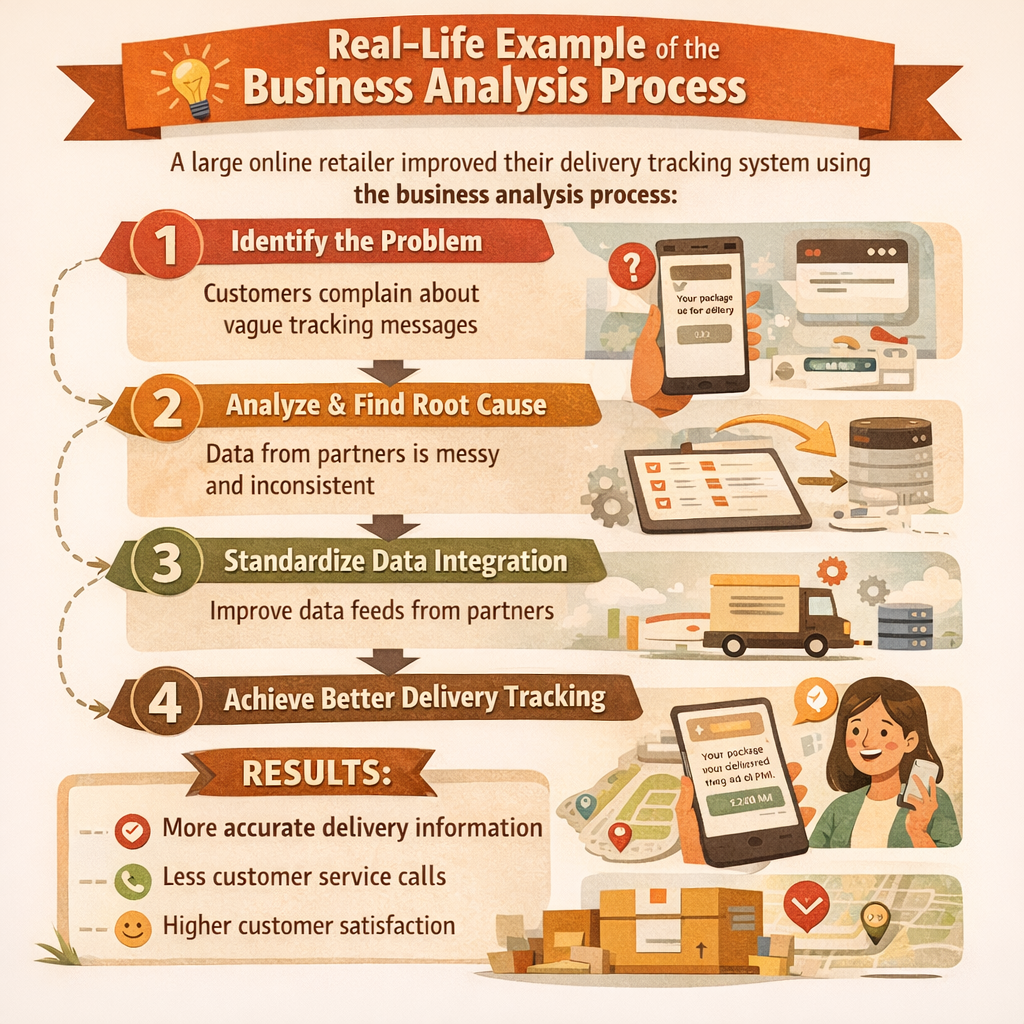
So, let us now look at a real-life example of how the business analysis process is used in real life.
A large online retailer had recently wanted to improve their delivery tracking system. They had noticed that their customers had been complaining about vague messages such as “Out for Delivery.”
So, through this business analysis process, they had realized that their problem was not in their tracking system but in the data being fed by their partners.
So, they had decided to focus on standardizing their data integration with their partners.
And this is how they had achieved:
- More accurate delivery information
- Less customer service calls
- Higher customer satisfaction
And this is why this business analysis process is important sometimes, the solution is simpler than we might expect.
Skills You Will Learn to Develop Through the Business Analysis Process
So, now that we know about this process, we must also know about some of the skills we will learn to develop through this business analysis training.
And some of the most important ones include:
- Critical thinking
- Stakeholder communication
- Process modeling
- Requirement documentation
- Problem-solving
These are some of the skills that have led to a significant increase in the number of companies wanting professionals who have completed their business analysis training and placement courses.
Recent reports have shown that companies in various industries, including healthcare and even in some fintech companies, are now seeking professionals for this role.
How Structured Learning Helps
While some professionals learn the Business Analysis process through their job, structured learning helps accelerate this process.
Learning programs that combine business analyst classes, practical case studies, and project simulations provide an understanding of how the process works in a real-world environment.
Some practical exercises include:
- Writing BRDs
- Designing UML diagrams
- Conducting mock interviews
- Practicing Agile user stories
These exercises simulate real-world tasks that a business analyst might perform in a work environment.
Conclusion
In conclusion, the Business Analysis process is, in effect, the roadmap that helps connect business issues to viable solutions. Every phase, whether it is problem identification or validation of the final system, ensures that an organization makes informed decisions and avoids costly errors.
Honestly, once you learn about the Business Analysis process, you begin to realize it is everywhere, whether it is an app development project or an organizational-wide change.
If you are considering a career in this field, learning about business analysis, business analyst certification online, or business analyst courses can be a great investment for your career. With many organizations launching new digital initiatives, this field is becoming one of the most sought after in today’s business world.