Artificial Intelligence (AI) learning courses and AI Training Courses, such as those offered by H2K Infosys, typically focus on skills, algorithms, models, and tools, but they are not sufficient on their own for real world job readiness. To effectively apply AI in enterprise environments, learners must develop complementary skills in programming, data handling, cloud computing, software engineering, and domain specific problem solving. These supporting skills enable professionals to design, deploy, and maintain AI solutions in production systems.
What is the Role of Supporting Skills in AI Learning?
AI courses generally cover topics such as machine learning models, neural networks, and data analysis techniques. However, in enterprise IT environments, AI is rarely implemented in isolation.
Supporting skills help professionals:
- Integrate AI models into applications
- Work with real-world, messy data
- Deploy solutions on scalable infrastructure
- Collaborate with cross-functional teams
Without these complementary capabilities, learners may understand concepts but struggle to apply them in practical scenarios.
Why is Skill Diversification Important for Working Professionals?
Working professionals in the USA often operate in environments where AI is part of a broader technology ecosystem. AI solutions must interact with databases, APIs, cloud platforms, and business processes.
Key reasons skill diversification matters:
- Enterprise integration: AI models must connect with existing systems
- Scalability requirements: Solutions must handle large datasets and users
- Operational reliability: Models need monitoring, logging, and retraining
- Compliance and security: Data handling must follow regulatory standards
Professionals who combine AI knowledge with these skills are more likely to contribute effectively in production environments.
What Skills Are Required Alongside AI Learning Courses?
1. Programming Skills (Python and Beyond)
Programming is foundational for AI development. Most AI training courses use Python due to its extensive ecosystem.
Key areas to focus on:
- Python fundamentals (data structures, functions, OOP)
- Libraries:
- NumPy (numerical computing)
- Pandas (data manipulation)
- Scikit-learn (machine learning)
- TensorFlow / PyTorch (deep learning)
Real-world application:
- Writing scripts to preprocess datasets
- Building and training machine learning models
- Automating workflows
2. Data Engineering and Data Handling
AI models depend heavily on data quality and availability.
Essential skills:
- Data cleaning and preprocessing
- SQL for querying relational databases
- Working with large datasets (CSV, JSON, Parquet)
- Data pipelines (ETL processes)
Enterprise workflow example:
- Extract data from multiple sources (databases, APIs)
- Transform data (cleaning, normalization)
- Load into a data warehouse
- Feed processed data into AI models
3. Mathematics and Statistics Fundamentals
AI algorithms are built on mathematical concepts.
Core topics:
- Linear algebra (vectors, matrices)
- Probability theory
- Statistics (mean, variance, distributions)
- Optimization techniques (gradient descent)
Practical relevance:
- Understanding model behavior
- Evaluating performance metrics
- Debugging model errors
4. Machine Learning Lifecycle Management
Learning algorithms is only one part of AI. Managing the lifecycle is equally important.
Key stages:
- Data collection
- Model training
- Validation and testing
- Deployment
- Monitoring and retraining
Tools used in enterprises:
- MLflow (experiment tracking)
- Kubeflow (ML workflows)
- Airflow (pipeline orchestration)
5. Cloud Computing Skills
Most AI solutions are deployed on cloud platforms in the USA.
Popular platforms:
- AWS (Amazon Web Services)
- Microsoft Azure
- Google Cloud Platform (GCP)
Important concepts:
- Virtual machines and containers
- Storage systems (S3, Blob Storage)
- Managed AI services (SageMaker, Azure ML)
Example scenario:
- Training a model locally
- Deploying it as an API on AWS
- Scaling based on user demand
6. Software Engineering Practices
AI professionals often work within software development teams.
Key practices:
- Version control (Git)
- Code modularity and reusability
- Testing and debugging
- API development (REST services)
Why it matters:
- AI models must be integrated into applications
- Code must be maintainable and scalable
7. DevOps and MLOps
MLOps combines machine learning with DevOps practices.
Core components:
- Continuous Integration / Continuous Deployment (CI/CD)
- Model versioning
- Automated retraining pipelines
- Monitoring model performance
Common tools:
- Docker (containerization)
- Kubernetes (orchestration)
- Jenkins (automation)
8. Data Visualization and Communication
AI professionals must communicate insights effectively.
Tools:
- Tableau
- Power BI
- Matplotlib / Seaborn
Use cases:
- Presenting model results to stakeholders
- Explaining predictions and trends
- Creating dashboards
9. Domain Knowledge
AI solutions are applied within specific industries.
Examples:
- Healthcare: patient data analysis
- Finance: fraud detection
- Retail: recommendation systems
Importance:
- Helps define relevant problems
- Improves model accuracy and usability
How Does AI Work in Real-World IT Projects?
AI implementation in enterprise projects typically follows structured workflows.
Typical Workflow
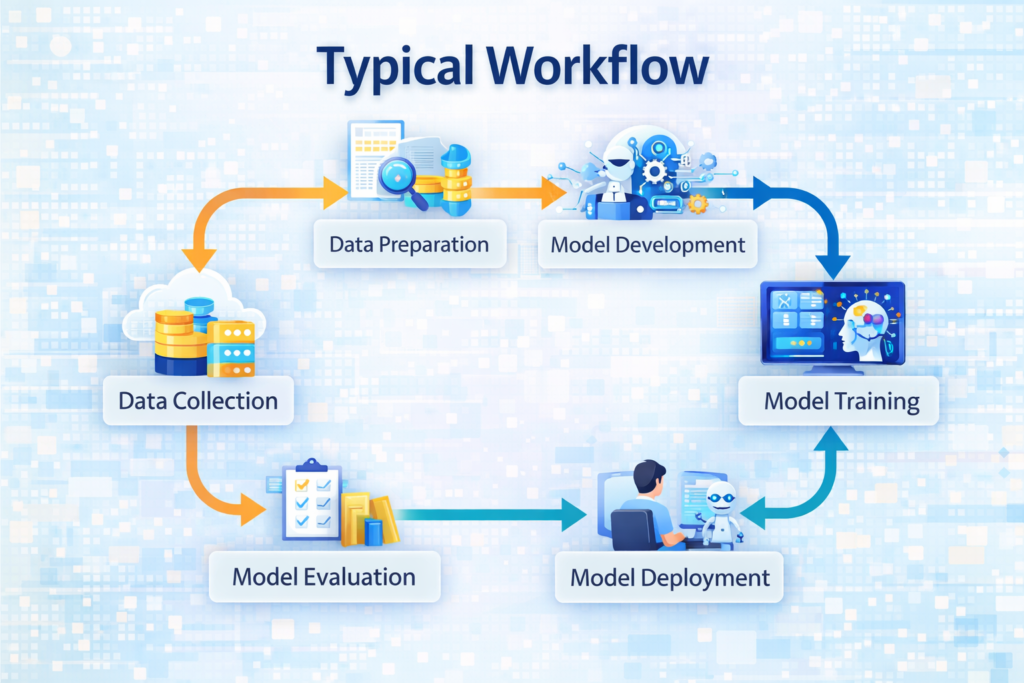
| Stage | Description | Tools Used |
|---|---|---|
| Data Collection | Gather raw data from systems | SQL, APIs |
| Data Processing | Clean and prepare data | Pandas, Spark |
| Model Training | Train ML models | Scikit-learn, TensorFlow |
| Evaluation | Validate model accuracy | Metrics libraries |
| Deployment | Serve model as API | Flask, FastAPI |
| Monitoring | Track performance | Prometheus, Grafana |
Example Scenario
A retail company building a recommendation system:
- Collect user purchase data
- Clean and structure data
- Train a collaborative filtering model
- Deploy as an API
- Integrate into e-commerce platform
How is AI Used in Enterprise Environments?
AI is commonly integrated into business systems rather than used as standalone tools.
Common Use Cases
- Predictive analytics: Forecasting demand or trends
- Automation: Chatbots and process automation
- Fraud detection: Identifying anomalies in transactions
- Customer insights: Personalization and segmentation
Enterprise Constraints
- Data privacy regulations (e.g., compliance requirements)
- High availability and uptime
- Integration with legacy systems
- Performance optimization
What Job Roles Use AI Skills Daily?
AI-related roles require a combination of technical and supporting skills.
Role vs Skill Mapping
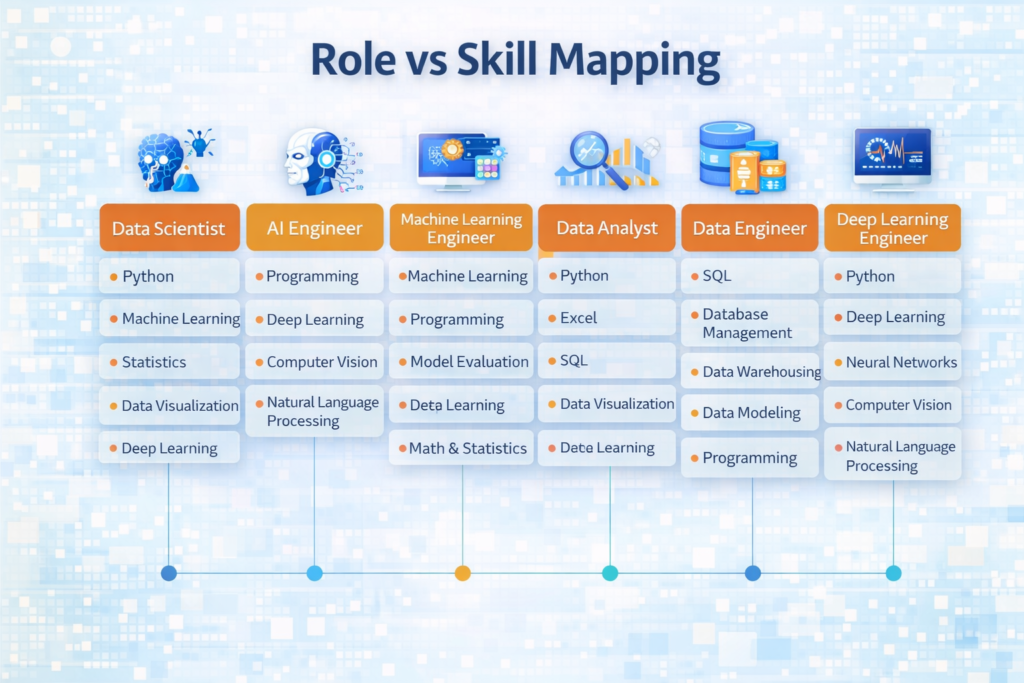
| Role | Key Skills |
|---|---|
| Data Scientist | Statistics, ML, Python |
| Machine Learning Engineer | MLOps, deployment, APIs |
| Data Engineer | ETL, databases, pipelines |
| AI Engineer | Model integration, software engineering |
| Business Analyst (AI-focused) | Data interpretation, visualization |
What Careers Are Possible After AI Training Courses?
Professionals completing AI learning Courses can pursue various career paths depending on their supporting skills.
Career Paths
- Entry-level:
- Junior Data Analyst
- AI Support Engineer
- Mid-level:
- Machine Learning Engineer
- Data Scientist
- Advanced:
- AI Architect
- Head of Data Science
What Learning Path Should You Follow?
Suggested Learning Path
| Stage | Focus Area | Skills |
|---|---|---|
| Beginner | Programming | Python, basic math |
| Intermediate | Data & ML | SQL, ML models |
| Advanced | Deployment | Cloud, MLOps |
| Expert | Specialization | Domain knowledge |
How Can Professionals Apply These Skills Practically?
Step-by-Step Approach
- Learn Python and data handling
- Practice with datasets (e.g., Kaggle)
- Build simple ML models
- Deploy models using APIs
- Use cloud platforms for scalability
- Implement monitoring and retraining
Sample Pseudo Workflow
Load dataset → Clean data → Train model → Evaluate → Save model → Deploy API → Monitor
Common Challenges Learners Face
- Lack of real-world datasets
- Difficulty integrating models into applications
- Limited understanding of deployment
- Managing large-scale data
Best Practices
- Work on end-to-end projects
- Use version control
- Document workflows
- Focus on reproducibility
FAQ Section
What additional skills should I learn with AI training courses?
You should focus on programming (Python), data engineering, cloud computing, and software engineering to apply AI effectively in real-world environments.
Is programming mandatory for AI learning?
Yes, programming is essential. Most AI tools and frameworks require coding for data processing, model training, and deployment.
How important is cloud computing for AI careers in the USA?
Cloud computing is commonly used in enterprise environments for deploying scalable AI solutions, making it an important skill.
Can I get a job with only AI course knowledge?
AI course knowledge alone may not be sufficient. Employers typically expect practical experience with tools, deployment, and data handling.
What is the role of MLOps in AI projects?
MLOps ensures that AI models are deployed, monitored, and maintained efficiently in production systems.
Conclusion
Key Takeaways
- AI learning courses must be complemented with programming, data, and cloud skills
- Real-world AI projects require integration, deployment, and monitoring
- MLOps and software engineering practices are essential in enterprise environments
- Domain knowledge enhances the effectiveness of AI solutions
- Hands-on projects are critical for skill development
Explore H2K Infosys AI training courses to gain practical, hands-on experience with real-world tools and workflows.
Build job ready skills by combining AI knowledge with industry relevant technologies and practices.