Top AI institutes in the U.S., including H2K Infosys, don’t really believe in stopping at theory. They don’t just explain a concept and move on like, “okay, you got it.” Instead, they push students to actually use what they’re learning and that’s where things start to feel different.
You’re not sitting around for months stuck in abstract ideas. Pretty quickly, you’re building things. Real things. You’re working with datasets that aren’t clean or neat (honestly, they’re often a bit of a mess), and you’re using the same tools people rely on in actual AI jobs.
If you strip it down, the idea is simple: you learn Ai Certified Courses by doing it. Labs, capstones, even simulated work environments they give you a feel for what the job is actually like. And that kind of exposure… it shows later. Especially when you step into your first role and things aren’t handed to you neatly.
What Hands-On Learning Actually Means in AI
Hands-on learning isn’t just reading about models or memorizing definitions. It’s more like building something, watching it fail (which it will), fixing it, and trying again.
That cycle can be frustrating. No point pretending otherwise. But it’s also where things start to make sense.
In most programs, it usually involves:
- Writing code for machine learning models
- Working with real-world data (and yeah, it’s rarely clean)
- Using tools and frameworks companies actually use
- Solving practical problems not just textbook ones
- Collaborating in a way that feels pretty close to a real dev team
What Stands Out in These Programs
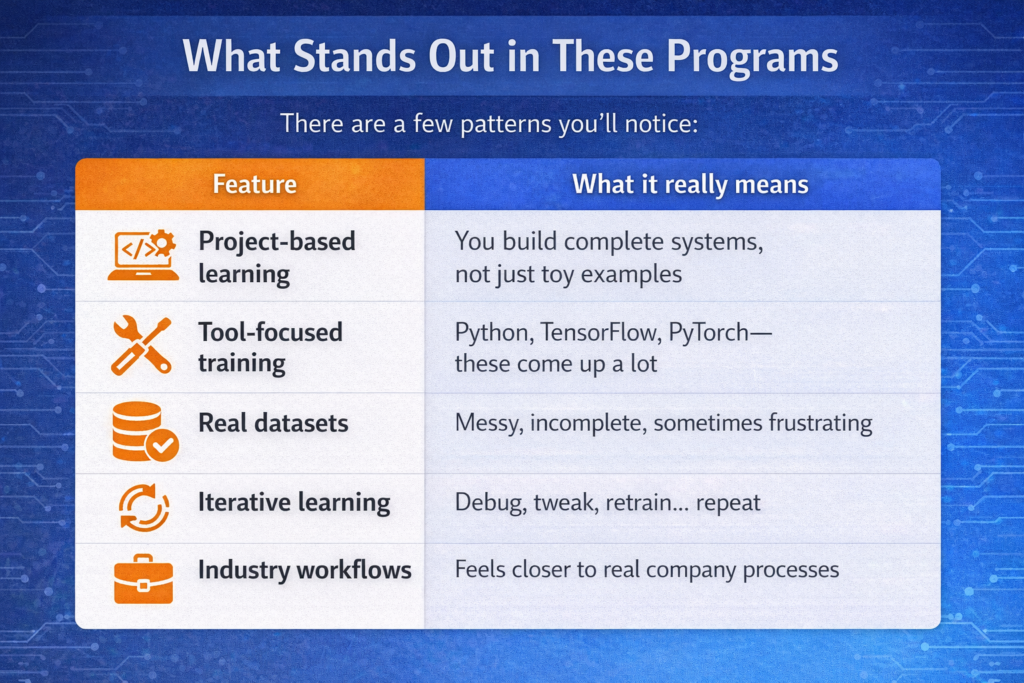
There are a few patterns you’ll notice:
| Feature | What it really means |
|---|---|
| Project-based learning | You build complete systems, not just toy examples |
| Tool-focused training | Python, TensorFlow, PyTorch—these come up a lot |
| Real datasets | Messy, incomplete, sometimes frustrating |
| Iterative learning | Debug, tweak, retrain… repeat |
| Industry workflows | Feels closer to real company processes |
Why This Matters (Especially If You’re Already Working)
If you’re trying to move into AI while working, theory alone usually doesn’t cut it. There’s a gap and sometimes it’s bigger than people expect between understanding something and actually using it under pressure.
Hands-on learning helps close that gap:
- You start applying things almost immediately
- The workflow becomes familiar (which employers definitely notice)
- You get better at troubleshooting this is a big one
- You build projects you can actually show, not just talk about
The Kind of Problems You Start Running Into
Once you get into practical work, you start seeing what AI really involves:
- Deploying models (this trips up a lot of beginners)
- Working with incomplete or inconsistent data
- Integrating AI into existing systems
- Dealing with scaling, performance… sometimes even security
It’s not always smooth. Actually, it rarely is. But that’s kind of the point.
How These Institutes Teach Practical AI
They don’t throw you straight into complex projects. There’s usually some structure, which helps more than you’d think.
1. Lab-Based Learning
Most concepts come with a lab.
So instead of just Artificial intelligence Training Program learning what regression is, you actually build one, test it, adjust it, and see what happens.
A typical flow looks something like:
- Understand the concept
- Implement it in Python
- Check the results
- Tune the model
- Write down what you learned
It’s straightforward. But it works.
2. Gradual Increase in Project Complexity
| Level | Type | Example |
|---|---|---|
| Beginner | Guided | Linear regression |
| Intermediate | Semi-structured | Customer churn prediction |
| Advanced | Open-ended | Recommendation system |
You start with more guidance, then slowly take ownership. That progression matters more than it sounds.
3. Capstone Projects
This is where things start to feel… closer to real work.
You might end up building:
- Fraud detection systems
- Predictive maintenance models
- NLP chatbots
- Image classification pipelines
And it’s not just about training a model. You’re usually dealing with:
- Data collection
- Feature engineering
- Model development
- Thinking about deployment
What AI Work Actually Looks Like
In practice, AI isn’t just “train a model and done.” It’s more of a loop and sometimes a messy one.
Typical workflow:
- Define the business problem
- Gather data (wherever you can find it)
- Clean and prepare it
- Train models
- Evaluate how they perform
- Deploy (APIs, cloud, etc.)
- Monitor and improve over time
Tools You’ll Probably Use
| Category | Tools |
|---|---|
| Programming | Python, R |
| ML Frameworks | TensorFlow, PyTorch |
| Data Processing | Pandas, NumPy |
| Visualization | Matplotlib, Seaborn |
| Deployment | Docker, Kubernetes |
| Cloud | AWS, Azure, GCP |
You don’t need to know everything upfront. But you’ll definitely come across most of these.
How Training Is Delivered
Most programs mix different approaches:
- Virtual labs (pre-set environments, which honestly saves a lot of time)
- Coding assignments (write → break → fix → repeat)
- Real datasets (finance, healthcare, e-commerce, etc.)
- Guided projects that become more independent over time
Skills You Pick Up Along the Way
Core Skills
| Skill | What it involves |
|---|---|
| Programming | Mostly Python |
| Mathematics | Linear algebra, probability, stats |
| Data handling | Cleaning and preparing data |
| Machine learning | Algorithms and evaluation |
| Problem solving | Thinking through real-world issues |
Helpful Extras
- SQL
- Basic cloud knowledge
- Git
- APIs
How AI Shows Up in Companies
AI isn’t theoretical anymore it’s already embedded in a lot of systems.
Common use cases:
- Customer analytics (churn prediction, personalization)
- Fraud detection
- Predictive maintenance
- NLP (chatbots, sentiment analysis)
Real-world constraints
- Data privacy and compliance
- Scaling challenges
- Performance requirements (sometimes real-time)
- Integration with older systems
Roles That Use AI Every Day
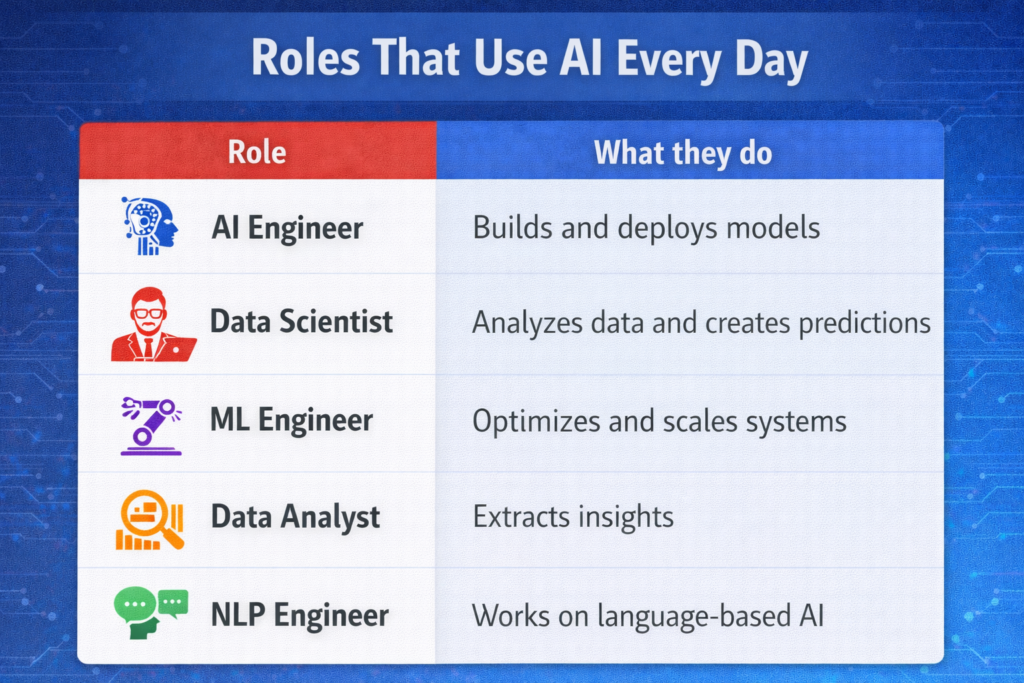
| Role | What they do |
|---|---|
| AI Engineer | Builds and deploys models |
| Data Scientist | Analyzes data and creates predictions |
| ML Engineer | Optimizes and scales systems |
| Data Analyst | Extracts insights |
| NLP Engineer | Works on language-based AI |
Where This Can Lead
Once you’ve built enough practical experience, you can move into roles like:
- AI Engineer
- Machine Learning Engineer
- Data Scientist
- BI Analyst
- AI Solutions Architect
Across industries too finance, healthcare, retail, manufacturing, telecom.
Teaching Methods That Actually Stick
The stronger programs don’t rely only on lectures. They mix things up a bit:
- Case studies based on real scenarios
- Group projects and peer reviews
- Live coding sessions
- Simulated enterprise workflows
The Not-So-Smooth Parts
Hands-on learning sounds great but it’s not always easy.
Common issues:
- Messy data (this never really goes away)
- Models not performing the way you expected
- Confusing evaluation metrics
- Limited compute resources
What tends to help:
- Breaking problems into smaller steps
- Using version control (seriously, don’t skip this)
- Documenting your work
- Testing models on different datasets
A Simple Project Example
Customer Churn Prediction
import pandas as pd
data = pd.read_csv("customer_data.csv")data.fillna(method='ffill', inplace=True)from sklearn.ensemble import RandomForestClassifier
model = RandomForestClassifier()
model.fit(X_train, y_train)from sklearn.metrics import accuracy_score
predictions = model.predict(X_test)
accuracy_score(y_test, predictions)
This is obviously simplified. Real projects are more involved, and the data is rarely this clean but the general flow is pretty close.
FAQ
Do I need coding experience?
Some basic Python helps, but a lot of programs guide you through the basics.
How long until I’m job-ready?
For many people, around 3–6 months of consistent effort is a reasonable start.
Are projects really necessary?
Yes. Probably more important than anything else.
Where should I start with tools?
Python, TensorFlow, PyTorch, and core data libraries.
Can I learn part-time?
Yes. Many programs are designed for working professionals.
Final Thoughts
AI education has shifted quite a bit. It’s not just about understanding concepts anymore it’s about actually using them in situations that feel real.
If there’s one thing worth remembering, it’s this: you get better by building.
Early projects might feel small, maybe even a bit rough around the edges. That’s normal. Stick with it. Over time, those small pieces start to come together and that’s when things really open up