Yes AI training courses in the U.S. can help working professionals develop practical, job-relevant skills in a relatively short time frame; however, the pace of learning depends significantly on course structure and delivery.
Well-designed Artificial Intelligence Certified Course do not rely exclusively on extended theoretical instruction. Instead, they introduce hands-on activities early in the learning process, such as building basic machine learning models, working with real-world datasets, and understanding data preprocessing challenges, which are often more complex than expected. This approach helps learners recognize how AI techniques are applied within actual business and IT workflows, rather than treating them as isolated concepts.
Training providers like H2K Infosys follow this applied learning model by integrating project-based exercises and practical scenarios into their courses of artificial intelligence. This enables working professionals to connect new skills with real-world use cases, improving both comprehension and the ability to apply AI effectively in their current roles.
What really makes the difference is the balance. You’re not just sitting there watching lectures—you’re building, experimenting, breaking stuff (that part kind of comes with the territory), and then figuring out how to fix it. Those small “wait… okay, now I get it” moments? That’s where things start to click.
Of course, everyone learns at a different pace. Your starting point matters. So does how much time you can realistically put in each week. Still, it’s pretty common to reach a solid, usable level within a few months enough to actually apply AI at work. Not mastery, but definitely practical.
What is AI Training for Working Professionals?
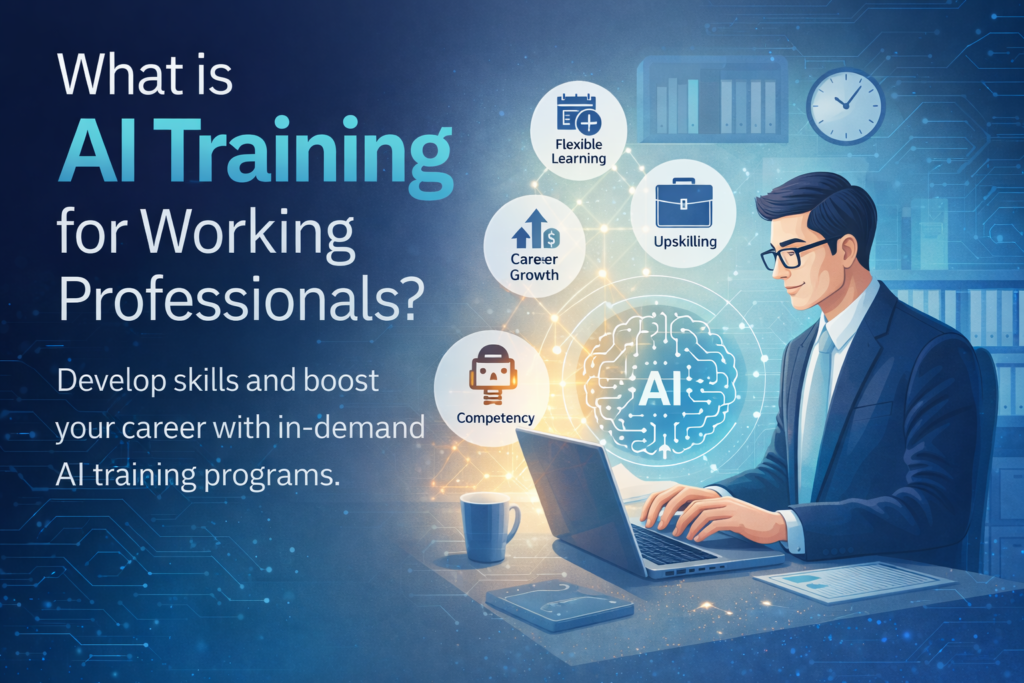
Think of it as learning that’s designed around a full-time job and everything else you’ve got going on.
These programs don’t assume you’re starting from scratch, but they also don’t expect you to already be deep into data science. They’re usually aimed at people in IT, analytics, or business roles basically anyone who now needs to use AI, not necessarily become a researcher overnight.
What Do These Courses Usually Cover?
Most solid programs follow a practical path. Not always perfectly, but you’ll generally see:
- Python basics (either from zero or a quick refresher)
- Machine learning supervised and unsupervised
- Deep learning concepts like neural networks (CNNs, RNNs… the usual suspects)
- Data preprocessing (this part catches people off guard it takes time)
- Model evaluation and deployment
- And lately, generative AI and large language models
The goal isn’t to turn you into an academic. It’s simpler than that learn enough to actually use AI without getting stuck every five minutes.
Why Do Working Professionals Even Need This?
Because AI isn’t some “future” thing anymore it’s already baked into how work gets done.
Most companies don’t expect you to pause your career and study full-time. They expect you to learn alongside your job (which is… not always easy, but doable).
People usually get into AI training to:
- Automate repetitive work
- Make better, data-driven decisions
- Add AI features into existing tools or workflows
- Keep up with shifting job expectations
And honestly, most professionals aren’t building models from scratch. They’re:
- Using pre-trained models
- Working with cloud-based AI tools
- Interpreting outputs and applying them
The better Ai Training Programs get this. They focus on usage, not just theory.
How Do These Courses Help You Learn Faster?
A lot of it comes down to structure. When it’s done right, you’re not constantly wondering what to learn next.
1. Modular learning
You move step by step—Python → data → ML → deployment. It feels connected instead of random.
2. Hands-on projects
Not just toy examples. Think churn prediction, fraud detection, recommendation systems—stuff that actually shows up at work.
3. Tool-focused learning
You get familiar with tools people actually use:
- Jupyter Notebook
- TensorFlow / PyTorch
- Scikit-learn
- Cloud platforms like AWS or Azure
4. Flexible schedules
This matters more than people admit. Self-paced lessons, weekend classes, recordings it’s what makes learning possible with a job.
Do You Need a Strong Background?
Not really but a few basics definitely help.
Things that make the start smoother:
- Basic Python
- Some understanding of statistics or probability
- Experience working with data (even simple stuff)
- Logical thinking
If you don’t have these yet, the beginning might feel slow. That’s normal. Most people go through that phase.
What Does AI Actually Look Like in Real Projects?
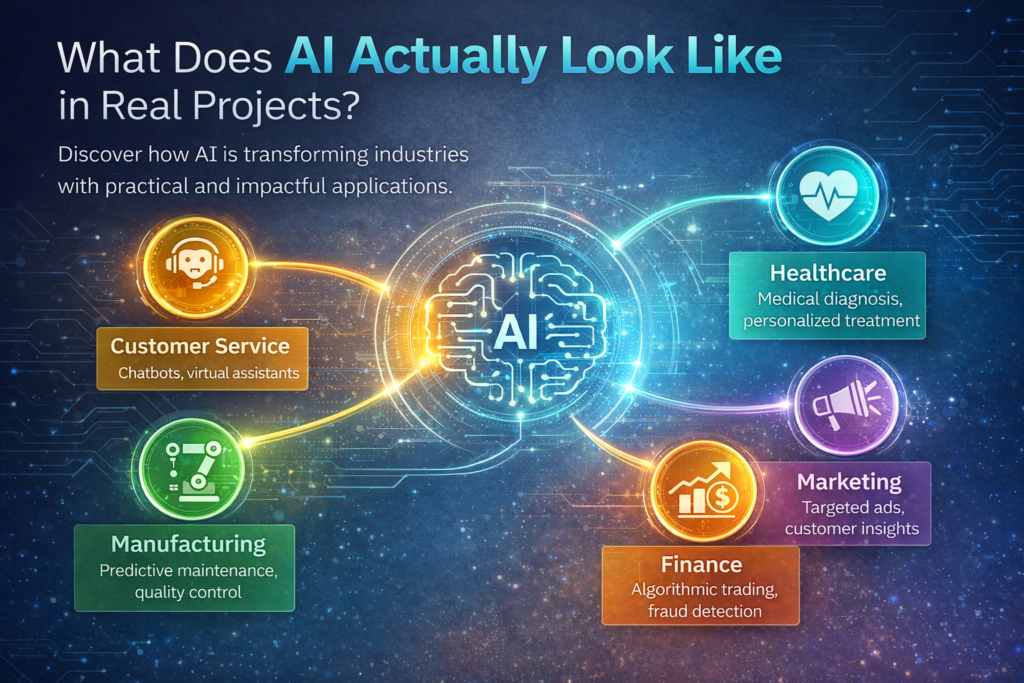
This is where things stop feeling abstract.
A typical workflow usually looks like:
- Define the problem (say, predicting customer churn)
- Gather data
- Clean and preprocess it (often the longest step)
- Choose a model
- Train it
- Evaluate performance
- Deploy it
- Monitor it over time
Depending on your role, you’ll interact with different parts of this.
For example, a QA engineer might use AI to:
- Predict failure points in testing
- Automatically categorize defects
- Analyze logs using NLP
That kind of hands-on exposure sticks way better than just reading about it.
How Is AI Used in Companies?
AI rarely works as a standalone piece it’s usually part of a bigger system.
Common use cases include:
- Customer analytics and recommendations
- IT operations automation (AIOps)
- Fraud detection
- Chatbots and virtual assistants
- Document processing
But real-world systems come with constraints:
- Data privacy
- Scalability
- Performance
- Compliance
Courses that actually talk about these feel more grounded. Otherwise, everything can seem a bit too… ideal.
Who’s Using AI Skills Today?
It’s not just data scientists anymore.
- Data analysts → predictive insights
- Software engineers → integrating ML models
- QA engineers → AI-driven testing
- DevOps engineers → monitoring systems
- Business analysts → interpreting results
There’s also a rise in hybrid roles people blending domain expertise with AI skills.
What Happens After AI Training?
For most people, it’s not a dramatic career switch. It’s more like an upgrade to what they already do.
Common paths:
- Machine Learning Engineer
- Data Analyst / Data Scientist
- AI Engineer
- BI Analyst
- Automation Specialist
A typical transition might look like:
manual tester → learns AI → moves into automation testing with ML tools
It’s gradual. And honestly, that’s what works for most people.
How Long Does It Take?
Rough idea (give or take):
- 4–6 weeks → basic understanding
- 2–3 months → building simple models
- 4–6 months → job-ready with projects
Consistency matters more than speed here.
Common Challenges (and How People Deal With Them)
Some usual struggles:
- Not enough time
- Getting stuck on math
- Lack of real-world practice
- Too many tools—it gets overwhelming
What tends to help:
- Focus on applied learning first
- Use existing libraries (don’t reinvent everything)
- Start small
- Practice regularly—even short sessions
- Accept that confusion is part of the process
Practical Tips for Learning AI
- Start with real problems, not abstract theory
- Build small projects (spam classifier, sales predictor, etc.)
- Focus on tools used in industry
- Don’t skip deployment—it matters more than you think
- Learn in cycles—AI changes fast
Quick FAQs
Can beginners join AI courses?
Yeah, many start with Python and basic stats.
Do you need coding experience?
Helpful, but not mandatory—good courses include it.
Is AI useful outside tech roles?
Absolutely. Business and product roles use it heavily now.
Are courses hands-on?
Most good ones are—projects and labs are standard.
Can you learn while working full-time?
Yes. Flexible formats make it manageable.
Where should you start?
Python and data handling—that’s usually the entry point.
Key Takeaways
- AI training can help you upskill quickly if it’s practical
- Hands-on work makes a big difference
- AI skills apply across roles, not just data science
- Real-world constraints matter more than theory alone
- With steady effort, you can become job-ready in a few months