H2K Infosys Artificial intelligence AI Training is essentially about getting people ready for real-world job roles where they build, deploy, and manage systems that can “think” in a limited sense. Once someone completes a structured Ai Learning Courses whether it’s a full certification or a shorter learning track they usually step into roles like machine learning engineer, data scientist, AI architect, or even AI Training product manager.
These jobs aren’t just about coding. They sit at the intersection of programming, data analysis, and system design basically, turning raw data into something useful inside actual business environments.
What is AI Training, really?
AI Training its core, Artificial Intelligence Certified Course is a structured way of learning how intelligent systems are built and used. These systems can look at data, spot patterns, and make decisions sometimes faster (and honestly, sometimes better) than humans in specific tasks.
Most courses don’t just stay theoretical. They usually walk you through how things work in practice.
What you typically learn
- Machine Learning (ML) – supervised vs. unsupervised learning, how models “learn” from data
- Deep Learning – neural networks, CNNs, RNNs (these sound complex at first—they are—but you get used to them)
- Natural Language Processing (NLP) – working with text, chatbots, language models
- Computer Vision – image recognition, object detection
- Data Engineering basics – preparing and cleaning data (this part is less glamorous but super important)
- Model Deployment – actually putting models into use via APIs or cloud platforms
Tools you’ll keep seeing
- Programming: Python, sometimes R
- ML frameworks: TensorFlow, PyTorch, Scikit-learn
- Data handling: Pandas, NumPy
- Cloud platforms: AWS, Azure, Google Cloud
- Deployment: Docker, Kubernetes
Most good programs try to mirror how things are done in real companies, not just in textbooks.
Why AI Training matters (especially if you’re working already)
AI is quietly everywhere now forecasting sales, detecting fraud, automating support chats, recommending products… the list goes on.
If you’ve got AI skills, you’re often working on systems that directly influence decisions. That’s a big deal.
A few reasons people are getting into it:
- Automating repetitive work (and saving time)
- Making better decisions using data instead of guesswork
- Connecting AI with business systems like ERP or CRM
- Opportunities across industries finance, healthcare, retail, manufacturing
It’s not just “tech jobs” anymore. AI Training shows up wherever data exists.
How AI Training actually works in real projects
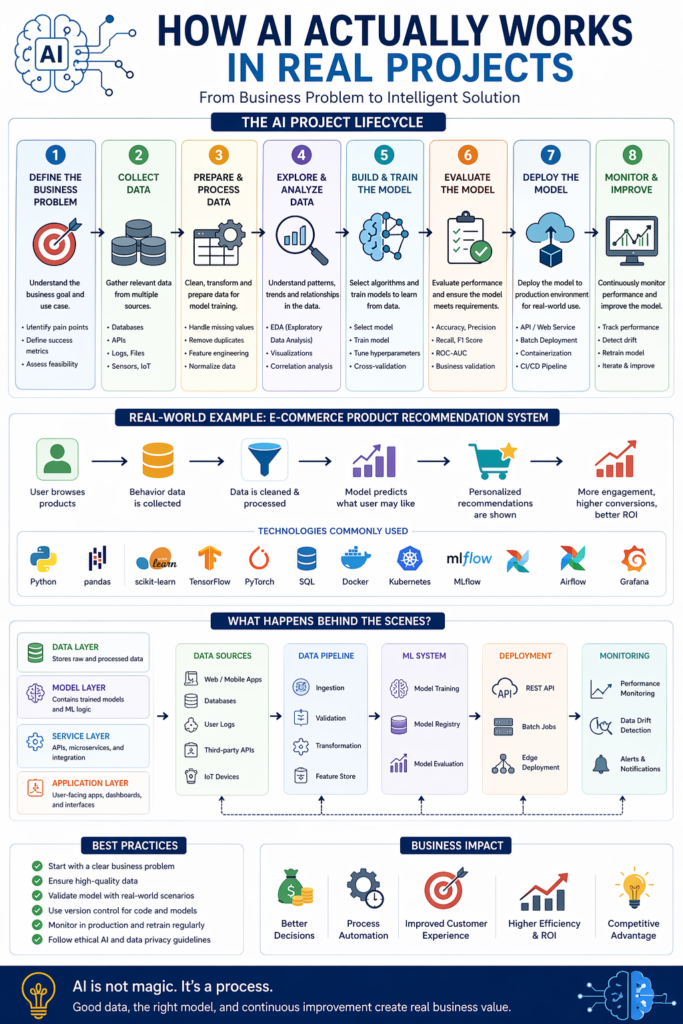
In theory, AI Training sounds magical. In practice, it’s a process kind of repetitive, sometimes messy.
A typical workflow looks like this:
- Data collection – pulling data from databases, APIs, logs, etc.
- Data preprocessing – cleaning it (this step takes longer than people expect)
- Feature engineering – deciding what data actually matters
- Model selection – choosing algorithms (regression, trees, neural nets…)
- Training & validation – teaching the model and checking if it works
- Deployment – plugging it into apps via APIs
- Monitoring – tracking performance and updating when needed
Common headaches
- Poor data quality
- Bias in models (a serious issue)
- Scaling models for real-world usage
- Integrating with older systems
This is where theory meets reality and things get interesting.
Skills you’ll need (no shortcuts here)
AI isn’t just one skill. It’s a mix.
Technical side
- Python or R
- Algorithms and data structures
- Statistics and probability
- Familiarity with ML frameworks
Analytical side
- Problem-solving
- Interpreting data
- Logical thinking
Supporting stuff (often overlooked)
- Git (version control)
- Basic cloud knowledge
- APIs and microservices
You don’t need to master everything at once, but you do need a bit of everything eventually.
Jobs where AI Training is used daily
People trained in AI Training usually end up in roles where they’re either building models, analyzing data, or designing systems.
Some common ones:
- Machine Learning Engineer
- Data Scientist
- AI Engineer
- Advanced Data Analyst
- AI Researcher
- AI Product Manager
Each role uses AI Training differently. Some are more technical, some more business-focused.
Career paths after AI training
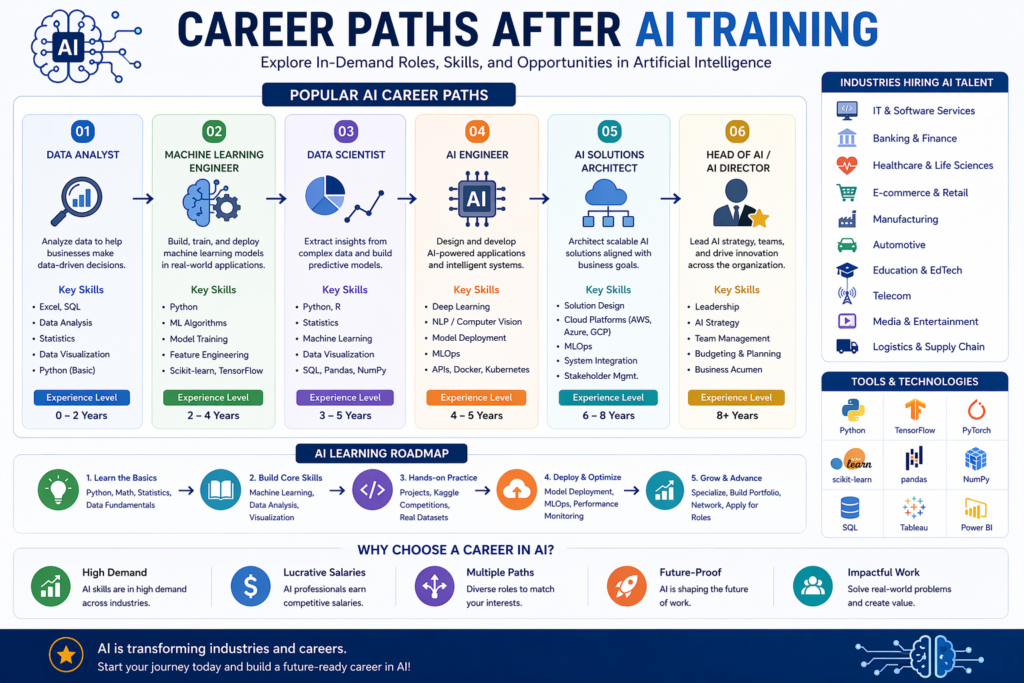
Here’s a more grounded look at where people typically land:
1. Machine Learning Engineer
You’re building and optimizing models, then making sure they actually run in production.
Salary (India approx): ₹6–12 LPA (entry), ₹25+ LPA (senior)
2. Data Scientist
More focused on analyzing data and generating insights. AI Training A bit more storytelling involved.
Salary: ₹5–20+ LPA depending on experience
3. AI Engineer
Bridges the gap between models and real applications. Works with APIs, cloud, and systems.
Salary: ₹8–22 LPA
4. AI Architect
Designs large-scale AI systems—more strategic, less hands-on coding.
Salary: ₹20–50+ LPA
5. AI Product Manager
Not coding-heavy, but you need to understand AI enough to guide teams and build products.
Salary: ₹15–35 LPA
6. NLP Engineer
Focuses on language—chatbots, text analysis, language models.
7. Computer Vision Engineer
Works with images and video think facial recognition, object detection.
Where AI Training is used in companies
AI isn’t just a “tech thing” anymore it’s baked into business operations.
Some common use cases:
- Fraud detection in finance
- Chatbots for customer support
- Demand prediction in supply chains
- Medical image analysis in healthcare
And it usually connects with systems like:
- ERP platforms
- CRM tools
- Data warehouses
Learning path (a realistic one)
If you’re starting from scratch, this is a practical order:
- Learn Python
- Get comfortable with basic math and statistics
- Understand machine learning concepts
- Work on datasets (this is where things click)
- Learn deep learning
- Practice deployment
- Build projects
Example project (very common)
Customer churn prediction:
- Collect customer data
- Clean it
- Train a classification model
- Evaluate it
- Deploy it via API
Simple idea—but very close to real business use.
Quick FAQs
What’s a good starting AI Training?
Anything that covers Python + ML + basic statistics in a structured way.
Do I need coding experience?
Helpful, yes. Mandatory? Not always—some courses start from basics.
Are AI jobs really in demand?
Yes—especially in data-driven industries.
Can non-IT professionals switch?
They can. It takes effort, but it’s definitely doable.
Which industries hire AI talent?
Finance, healthcare, retail, manufacturing, tech… pretty much everywhere now.
Key takeaways (without sounding like a checklist)
AI Training opens doors to a bunch of well-paying roles, but it’s not just about learning tools it’s about understanding how to apply them.
The work revolves around data, models, and real-world systems. And while it looks exciting from the outside (it is), a lot of it is also about solving messy, practical problems.
If you stick with it and actually build things you’ll see where it fits for you