Artificial Intelligence (AI) refers to the development of computer systems capable of performing tasks that typically require human intelligence, such as learning, reasoning, and decision-making. An Artificial Intelligence Training Program like those offered by H2K Infosys, provide structured learning paths that cover foundational concepts, practical tools, and real-world applications used in modern IT environments. These programs are designed to help professionals build skills in data-driven systems, automation, and intelligent application development.
What is Artificial Intelligence?
Artificial Intelligence is a branch of computer science focused on creating systems that can simulate human cognitive functions. These systems rely on algorithms, data, and computational power to analyze patterns and make predictions.
Core Components of AI
- Machine Learning (ML): Algorithms that learn from data without explicit programming
- Deep Learning: Neural networks that model complex patterns
- Natural Language Processing (NLP): Understanding and generating human language
- Computer Vision: Interpreting visual data such as images and videos
- Robotics & Automation: Physical or software-based task execution
AI systems typically operate by ingesting large datasets, training models, and deploying them into production environments where they can make predictions or automate decisions.
How Does Artificial Intelligence Work in Real-World IT Projects?
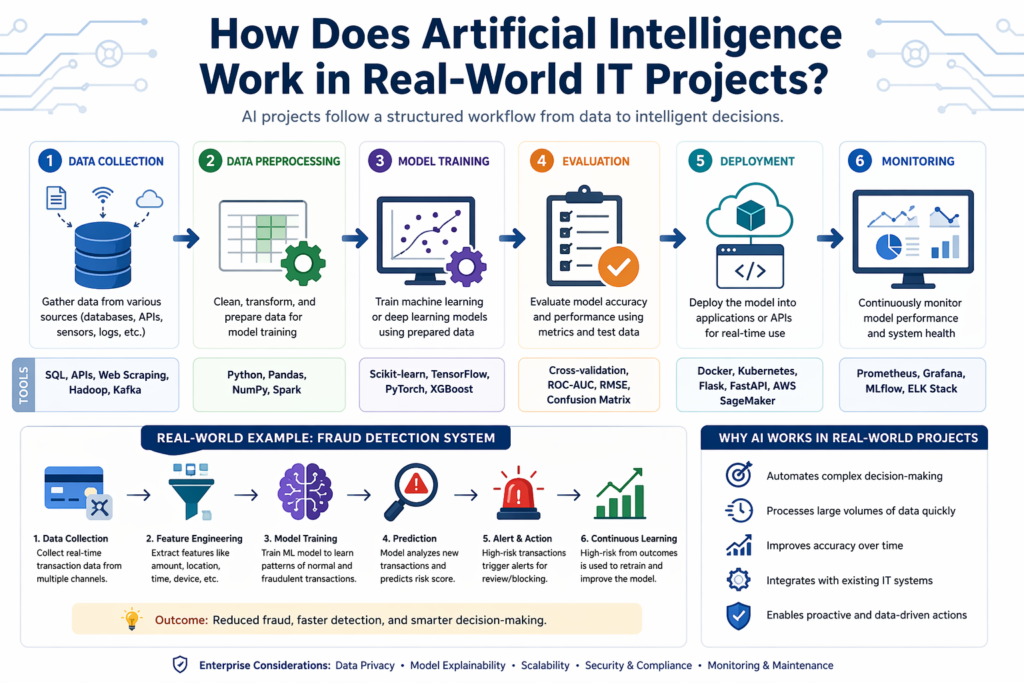
In enterprise IT projects, AI is implemented through structured workflows involving data engineering, model development, and deployment.
Typical AI Workflow in Production
| Stage | Description | Tools Commonly Used |
|---|---|---|
| Data Collection | Gathering structured/unstructured data | SQL, APIs, Hadoop |
| Data Preprocessing | Cleaning and transforming data | Python, Pandas |
| Model Training | Building predictive models | TensorFlow, PyTorch, Scikit-learn |
| Evaluation | Testing accuracy and performance | Cross-validation, metrics |
| Deployment | Integrating into applications | Docker, Kubernetes, Flask |
| Monitoring | Tracking performance in production | MLflow, Prometheus |
Example Use Case: Fraud Detection System
- Data from transactions is collected in real time
- Features such as transaction amount and frequency are extracted
- A machine learning model identifies anomalies
- Alerts are triggered for suspicious activity
- Continuous monitoring improves model accuracy
This workflow reflects how Online AI Programs prepare learners for real enterprise implementations.
Why is Artificial Intelligence Important for Working Professionals?
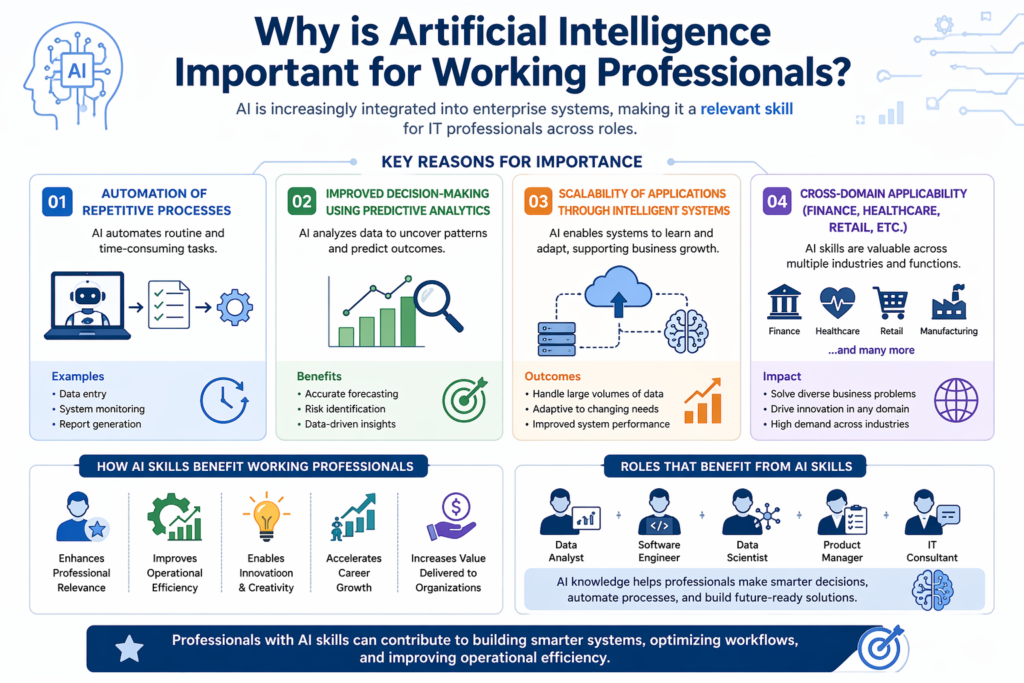
AI is increasingly integrated into enterprise systems, making it a relevant skill for IT professionals across roles.
Key Reasons for Importance
- Automation of repetitive processes (e.g., data entry, monitoring)
- Improved decision-making using predictive analytics
- Scalability of applications through intelligent systems
- Cross-domain applicability (finance, healthcare, retail, etc.)
Professionals with AI skills can contribute to building smarter systems, optimizing workflows, and improving operational efficiency.
What Skills Are Required to Learn Artificial Intelligence?
An effective artificial intelligence training program focuses on both technical and analytical skills.
Technical Skills
- Programming (Python, R)
- Data structures and algorithms
- Probability and statistics
- Linear algebra basics
AI-Specific Skills
- Machine learning algorithms
- Deep learning frameworks
- Data preprocessing techniques
- Model evaluation methods
Tools and Platforms
| Category | Tools |
|---|---|
| Programming | Python, R |
| ML Libraries | Scikit-learn, TensorFlow, PyTorch |
| Data Handling | Pandas, NumPy |
| Visualization | Matplotlib, Seaborn |
| Deployment | Docker, Kubernetes |
How is Artificial Intelligence Used in Enterprise Environments?
AI is embedded into enterprise systems to enhance automation, analytics, and user experience.
Common Enterprise Applications
- Customer Support: Chatbots and virtual assistants
- Supply Chain Optimization: Demand forecasting
- Cybersecurity: Threat detection and anomaly analysis
- Healthcare Systems: Diagnosis support and medical imaging
- Financial Services: Risk modeling and fraud detection
Enterprise Constraints to Consider
- Data Security and Compliance (GDPR, HIPAA)
- Model Explainability
- Scalability and latency requirements
- Integration with legacy systems
What Job Roles Use Artificial Intelligence Daily?
AI skills are relevant across multiple job roles in IT and data-driven organizations.
Role vs Skill Mapping
| Job Role | Key AI Skills |
|---|---|
| Data Scientist | ML modeling, data analysis |
| Machine Learning Engineer | Model deployment, optimization |
| AI Engineer | End-to-end AI system design |
| Data Analyst | Data visualization, basic ML |
| Software Engineer | API integration, AI features |
| DevOps Engineer | Model deployment pipelines |
What Careers Are Possible After Learning Artificial Intelligence?
Completing an online AI program opens pathways to various technical and analytical roles.
Career Options
- Machine Learning Engineer
- Data Scientist
- AI Research Assistant
- Business Intelligence Analyst
- NLP Engineer
- Computer Vision Engineer
Career Progression Example
| Level | Role | Focus |
|---|---|---|
| Entry | Data Analyst | Data handling, reporting |
| Mid | ML Engineer | Model building and deployment |
| Senior | AI Architect | System design and strategy |
How Do Online AI Programs Structure Learning?
Most artificial intelligence training programs follow a progressive learning path.
Learning Path Overview
- Foundation
- Programming basics
- Mathematics for AI
- Core AI Concepts
- Machine learning algorithms
- Data preprocessing
- Advanced Topics
- Deep learning
- NLP and computer vision
- Practical Projects
- Real-world datasets
- End-to-end model building
- Deployment & MLOps
- Model serving
- Monitoring and scaling
What Are Common Challenges When Learning AI?
Technical Challenges
- Understanding mathematical concepts
- Handling large datasets
- Model overfitting and underfitting
Practical Challenges
- Lack of real-world project exposure
- Difficulty in deploying models
- Keeping up with evolving tools
Best Practices
- Start with structured datasets
- Focus on hands-on projects
- Learn version control (Git)
- Practice model evaluation techniques
FAQ: Artificial Intelligence Training Program
What is the duration of an online AI program?
Most programs range from 3 to 9 months depending on depth and project work.
Do I need a programming background?
Basic programming knowledge is recommended, especially in Python.
What tools should beginners start with?
Python, Pandas, and Scikit-learn are commonly used starting points.
Is AI only for data scientists?
No, AI skills are used by software engineers, analysts, and DevOps professionals.
How important are projects in AI learning?
Projects are essential for understanding real-world workflows and building practical skills.
Can AI skills be applied across industries?
Yes, AI is used in finance, healthcare, retail, manufacturing, and more.
Conclusion
Key Takeaways
- Artificial Intelligence enables systems to perform tasks requiring human-like intelligence
- Online AI programs provide structured, practical learning paths
- Enterprise AI involves workflows from data collection to deployment
- AI skills are applicable across multiple IT roles and industries
- Hands-on projects are essential for mastering AI concepts
Explore H2K Infosys courses to gain hands-on experience with artificial intelligence training programs and advance your career in AI-driven technologies