Artificial Intelligence (AI) training programs, such as those offered by H2K Infosys, are structured learning paths designed to teach professionals how to build, deploy, and manage intelligent systems using data, algorithms, and computational models. These programs typically combine foundational concepts such as machine learning and data processing with practical tools used in enterprise environments. Enrolling in AI Learning Courses from H2K Infosys helps professionals gain validated, job-relevant skills aligned with current industry practices.
What is Artificial Intelligence?
Artificial Intelligence (AI) refers to the development of systems that can perform tasks typically requiring human intelligence. These tasks include pattern recognition, decision-making, natural language processing, and predictive analysis.
Core Components of AI
- Machine Learning (ML): Algorithms that learn patterns from data
- Deep Learning: Neural networks used for complex tasks such as image and speech recognition
- Natural Language Processing (NLP): Understanding and generating human language
- Computer Vision: Interpreting visual data from images or videos
- Data Engineering: Preparing and managing datasets for model training
AI systems rely heavily on structured workflows that include data ingestion, preprocessing, model training, evaluation, and deployment.
How Does Artificial Intelligence Work in Real-World IT Projects?
In enterprise IT environments, AI is implemented through structured pipelines and integrated into existing systems.
Typical AI Workflow in Production
| Stage | Description | Tools Commonly Used |
|---|---|---|
| Data Collection | Gathering structured/unstructured data | SQL, APIs, Hadoop |
| Data Preprocessing | Cleaning, transforming data | Python (Pandas), Spark |
| Model Development | Training ML models | Scikit-learn, TensorFlow |
| Model Evaluation | Validating performance | Cross-validation, metrics |
| Deployment | Integrating into applications | Docker, Kubernetes, Flask |
| Monitoring | Tracking performance in production | Prometheus, MLflow |
Example Use Case: Fraud Detection System
- Data ingestion from transaction logs
- Feature engineering (transaction frequency, geolocation)
- Model training using classification algorithms
- Real-time scoring via API endpoints
- Monitoring for model drift
Practical Considerations
- Latency requirements: Real-time vs batch processing
- Data privacy: Compliance with regulations (GDPR, HIPAA)
- Scalability: Handling large datasets and concurrent users
- Model retraining: Updating models as new data arrives
Why is Artificial Intelligence Important for Working Professionals?
AI is increasingly integrated into enterprise systems, making it relevant for professionals across multiple domains.
Key Reasons
- Automation of repetitive tasks: Reduces manual workload
- Data-driven decision making: Enhances accuracy and efficiency
- Cross-domain applicability: Used in finance, healthcare, retail, and IT operations
- Integration with existing roles: Developers, analysts, and engineers benefit from AI skills
Workplace Impact
- Software engineers incorporate ML models into applications
- Data analysts transition into predictive analytics roles
- DevOps teams manage AI deployment pipelines
What Skills Are Required to Learn Artificial Intelligence?
A structured AI learning path includes both technical and conceptual skills.
Core Technical Skills
- Programming (Python preferred)
- Mathematics (linear algebra, probability, statistics)
- Data manipulation and visualization
- Understanding of algorithms and data structures
AI-Specific Skills
- Machine learning model development
- Feature engineering
- Model evaluation techniques
- Working with AI frameworks
Supporting Skills
- Version control (Git)
- Cloud platforms (AWS, Azure, GCP)
- API development
- Debugging and optimization
How is Artificial Intelligence Used in Enterprise Environments?
AI is applied across various enterprise systems to enhance efficiency and decision-making.
Common Enterprise Applications
- Customer Support Automation: Chatbots using NLP
- Predictive Maintenance: Monitoring equipment health
- Recommendation Systems: Personalized product suggestions
- Cybersecurity: Threat detection using anomaly detection
- Business Intelligence: Forecasting and trend analysis
Integration Architecture
AI systems are typically integrated using:
- REST APIs
- Microservices architecture
- Data pipelines (ETL/ELT)
- Cloud-based ML services
Challenges in Enterprise AI Adoption
- Data quality and availability
- Integration with legacy systems
- Model interpretability
- Governance and compliance
What Job Roles Use Artificial Intelligence Daily?
AI skills are relevant across multiple job roles in IT and business environments.
Role vs Skill Mapping
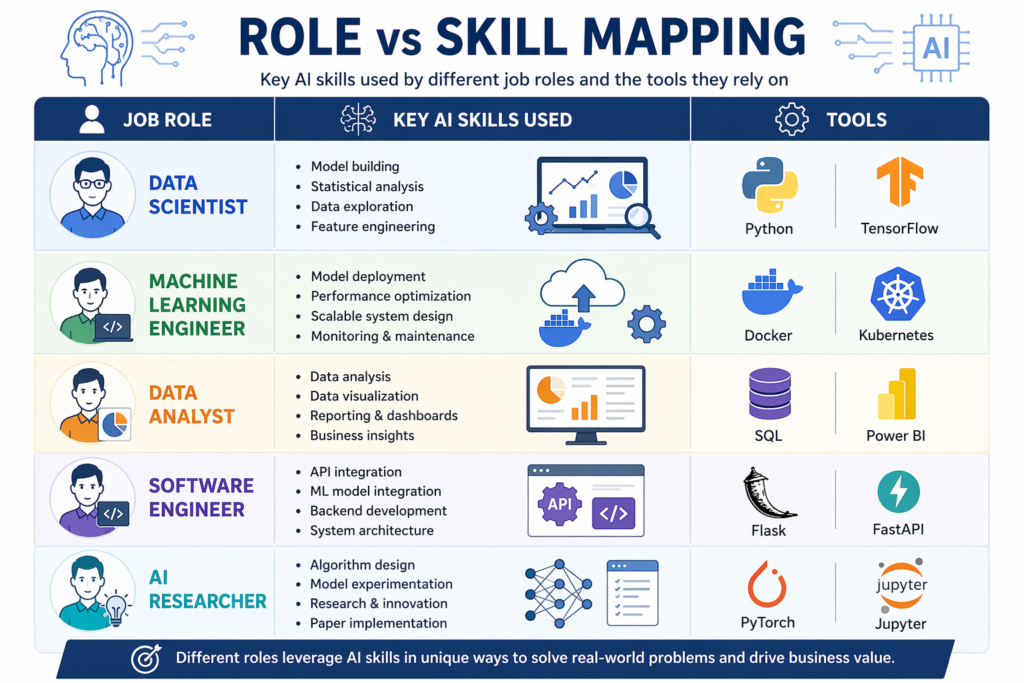
| Job Role | Key AI Skills Used | Tools |
|---|---|---|
| Data Scientist | Model building, statistics | Python, TensorFlow |
| Machine Learning Engineer | Deployment, optimization | Docker, Kubernetes |
| Data Analyst | Data analysis, visualization | SQL, Power BI |
| Software Engineer | API integration, ML models | Flask, FastAPI |
| AI Researcher | Algorithm design | PyTorch, Jupyter |
What Careers Are Possible After Learning Artificial Intelligence?
Completing ai learning courses with an AI Course Certification can lead to multiple career paths depending on specialization.
Career Paths
- Machine Learning Engineer
- Data Scientist
- AI Engineer
- Business Intelligence Analyst
- NLP Engineer
- Computer Vision Specialist
Career Progression Example
- Entry-level: Data Analyst / Junior ML Engineer
- Mid-level: ML Engineer / Data Scientist
- Senior-level: AI Architect / Lead Data Scientist
What Does a Job-Oriented AI Training Program Typically Include?
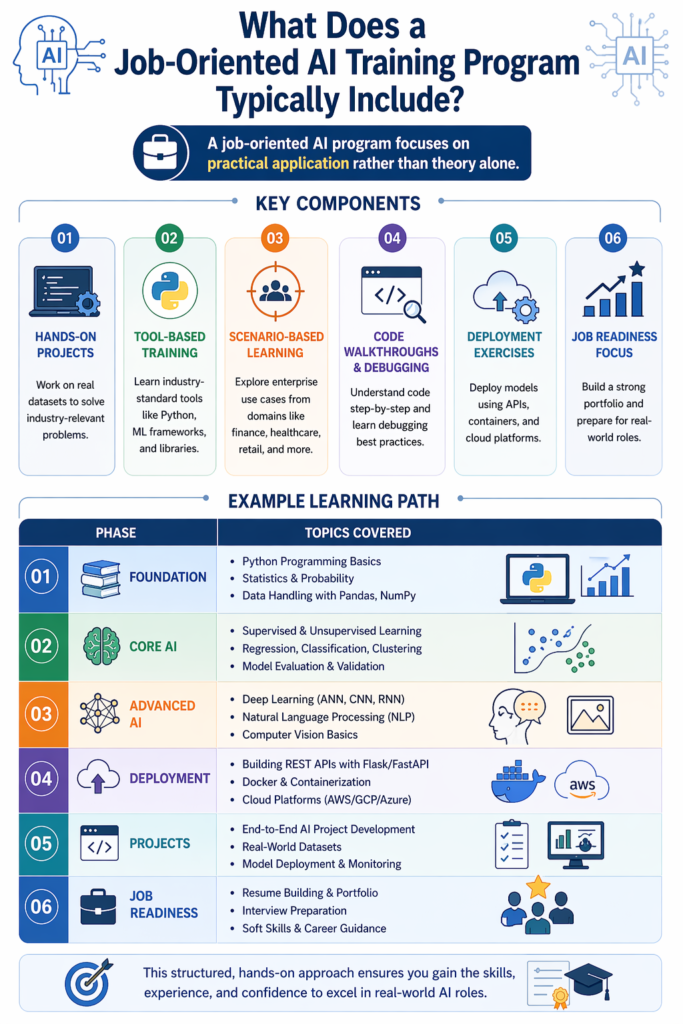
A job-oriented AI program focuses on practical application rather than theory alone.
Key Components
- Hands-on projects (real datasets)
- Tool-based training (Python, ML frameworks)
- Scenario-based learning (enterprise use cases)
- Code walkthroughs and debugging
- Deployment exercises
Example Learning Path
| Phase | Topics Covered |
|---|---|
| Foundation | Python, statistics, data handling |
| Core AI | Machine learning algorithms |
| Advanced | Deep learning, NLP |
| Deployment | APIs, containers, cloud |
| Projects | End-to-end AI solutions |
How Do AI Course Certifications Add Value?
AI certifications validate skills and demonstrate competency to employers.
Benefits of Certification
- Structured learning validation
- Industry-recognized credential
- Helps in resume screening
- Aligns with job requirements
What Employers Typically Look For
- Practical project experience
- Understanding of workflows
- Ability to debug and optimize models
- Familiarity with tools used in production
What Tools and Technologies Are Commonly Used in AI Learning Courses?
Popular AI Tools Comparison
| Tool | Purpose | Common Use Case |
|---|---|---|
| Python | Programming | Model development |
| TensorFlow | Deep learning | Neural networks |
| Scikit-learn | ML algorithms | Classification/regression |
| Pandas | Data processing | Data cleaning |
| Docker | Containerization | Model deployment |
| Kubernetes | Orchestration | Scaling AI services |
How Do Professionals Apply AI Skills in Real Projects?
Step-by-Step Application Example
Project: Customer Churn Prediction
- Collect customer data from CRM systems
- Clean and preprocess data
- Perform exploratory data analysis
- Train classification model (e.g., logistic regression)
- Evaluate using accuracy, precision, recall
- Deploy model as API
- Integrate with business dashboard
Best Practices
- Use version control for experiments
- Document assumptions and data sources
- Monitor model performance post-deployment
- Retrain models periodically
FAQ: Artificial Intelligence Learning Courses and Certification
What are AI learning courses?
AI learning courses are structured programs that teach concepts such as machine learning, data analysis, and model deployment using industry tools.
Who should enroll in AI courses?
Working professionals in IT, data analytics, software development, and engineering roles can benefit from AI training.
Do I need programming experience?
Basic programming knowledge, especially in Python, is recommended but can be learned alongside the course.
How long does it take to complete an AI course?
Typically ranges from 3 to 9 months depending on depth and pace.
Are AI certifications required for jobs?
Not mandatory, but certifications help validate skills and improve job prospects.
What kind of projects are included?
Projects often include predictive models, NLP applications, and real-world datasets.
Can AI skills be applied without a data science background?
Yes, many roles integrate AI tools without requiring deep research-level expertise
Conclusion
Key Takeaways
- Artificial Intelligence training focuses on practical, job-oriented skills
- AI is widely used in enterprise systems for automation and decision-making
- Learning involves tools, workflows, and real-world project scenarios
- Certifications help validate knowledge and improve employability
- Multiple career paths exist depending on specialization
Explore structured, hands-on Artificial Intelligence training programs at H2K Infosys to build practical skills aligned with real-world IT roles.
Enroll in a course designed to support career growth through applied learning and industry-relevant experience.