AI Training does more than teach technical concepts. It changes the way professionals think through problems, interpret information, and approach decision-making in real work environments. People who go through AI learning often become more comfortable handling data, spotting patterns, testing ideas, and building practical solutions instead of relying purely on guesswork or repetitive processes. H2K Infosys provides industry-focused AI training with hands-on projects, real-world use cases, and practical learning designed to help professionals build analytical thinking and job-ready AI skills.
Most modern AI learning Courses combine technical tools with hands-on problem solving. Learners usually work with real datasets, experiment with models, and move through project workflows that feel surprisingly close to what happens inside actual enterprise teams. That practical side matters a lot. Reading theory is one thing; figuring out why a model failed at 2 a.m. during testing is another.
Today, courses of artificial intelligence are no longer limited to data scientists or research engineers. Software developers, cloud engineers, QA professionals, cybersecurity analysts, business analysts—even operations teams are using AI concepts in one form or another. As more organizations lean into automation and data-driven systems, understanding AI has quietly become a useful skill across multiple IT roles.
What Is AI Training?
AI Training is the process of learning how intelligent systems process information, recognize patterns, make predictions, automate repetitive tasks, and support decision-making. Most programs mix foundational theory with practical implementation using industry tools and frameworks.
A typical AI learning path often includes:
- Machine Learning
- Deep Learning
- Data Analytics
- Natural Language Processing (NLP)
- Computer Vision
- Predictive Modeling
- AI Deployment
- Automation Workflows
The difference between older-style technical education and modern AI learning is pretty noticeable. Most current AI learning courses focus heavily on application. Learners aren’t just memorizing definitions—they’re building models, cleaning messy datasets, testing outputs, and solving business problems that resemble real production scenarios.
Why AI Training Matters for Working Professionals
AI technologies are now deeply connected to enterprise operations. Whether someone works in cloud infrastructure, software engineering, security, analytics, or business operations, there’s a good chance AI-driven tools are already part of the workflow.
In many companies, AI assists with:
- Customer support automation
- Fraud detection
- Business forecasting
- Threat monitoring
- Recommendation systems
- Reporting and analytics
Understanding how these systems work helps professionals think more analytically and make decisions with better context. It also reduces dependence on purely manual processes, which honestly can slow teams down more than people realize.
Benefits of AI Training for Professionals
| Professional Goal | How AI Training Helps |
|---|---|
| Improve analytical thinking | Encourages data-driven reasoning |
| Automate repetitive tasks | Reduces manual workload |
| Interpret business data | Supports informed decisions |
| Improve troubleshooting | Helps identify root causes |
| Understand enterprise AI systems | Builds practical industry knowledge |
Professionals who complete courses of artificial intelligence often become more confident working with operational data, identifying trends, and solving problems systematically instead of reacting to symptoms.
How AI Training Improves Problem-Solving Skills
One interesting thing about AI education is that it naturally forces people to think in structured steps. You can’t really build effective AI systems through random experimentation forever. Eventually, process matters.
In a typical machine learning workflow, professionals usually:
- Define the problem
- Gather data
- Prepare and clean the information
- Choose an appropriate model
- Test and evaluate results
- Improve the solution iteratively
That process builds discipline in problem-solving. Instead of jumping to assumptions, learners begin asking better questions:
- What exactly is failing?
- What patterns exist in the data?
- Which variables matter most?
- Is the outcome measurable?
- What evidence supports the conclusion?
That shift in thinking becomes useful far beyond AI projects.
For example, if a company wants to predict customer churn, the AI workflow may involve analyzing behavioral data, identifying patterns in cancellations, testing predictive models, and validating accuracy before deployment. It’s less about intuition and more about structured reasoning.
AI Training Strengthens Pattern Recognition
Analytical professionals are often good at noticing relationships, inconsistencies, or trends. AI education sharpens that skill because learners spend a lot of time analyzing large datasets and identifying meaningful signals hidden inside noisy information.
Professionals may learn how to identify:
- Usage trends
- Performance bottlenecks
- Fraud indicators
- Customer behavior patterns
- Security anomalies
These aren’t abstract exercises either. They directly relate to real enterprise environments.
Example: Fraud Detection
Financial organizations commonly use AI systems to identify suspicious transactions. Machine learning models analyze massive volumes of transaction data and flag unusual behavior patterns automatically.
Professionals working with these systems often need to:
- Analyze historical data
- Evaluate risk indicators
- Reduce false positives
- Improve prediction accuracy
And honestly, balancing accuracy with practicality becomes a challenge of its own. A system that flags everything as suspicious isn’t very useful in production.
AI Encourages Root Cause Analysis
Enterprise IT issues are rarely simple. Performance problems, outages, security incidents, or workflow failures usually involve multiple variables interacting at the same time.
AI training teaches learners to investigate underlying causes instead of only treating visible symptoms.
Common examples include:
- Application slowdowns
- Network instability
- Security breaches
- Predictive maintenance failures
- Customer service bottlenecks
Techniques like clustering, regression analysis, and decision trees help professionals understand why problems occur not just where they appear.
That mindset becomes extremely valuable in production environments where identifying the true root cause can reduce downtime and improve operational efficiency significantly.
How AI Improves Analytical Skills
Analytical thinking involves interpreting information carefully, comparing outcomes, evaluating evidence, and making informed decisions. AI learning courses reinforce these habits through continuous experimentation and testing.
Analytical Skills Developed Through AI Learning
| Skill | AI Application |
|---|---|
| Data interpretation | Understanding reports and dashboards |
| Statistical reasoning | Evaluating model performance |
| Predictive analysis | Forecasting business outcomes |
| Logical evaluation | Comparing solution approaches |
| Decision-making | Selecting optimized solutions |
As learners spend more time working with datasets and AI workflows, they usually become more comfortable handling ambiguity and extracting useful insights from incomplete information. That’s a skill many professionals underestimate until they actually need it.
Real-World Problem Solving in AI Learning Courses
Most modern AI Training emphasize practical implementation instead of theory-heavy instruction alone.
A common AI learning workflow looks something like this:
Step 1: Define the Business Problem
Examples may include:
- Predicting customer churn
- Detecting spam emails
- Automating invoice processing
- Forecasting sales demand
Step 2: Collect and Organize Data
Learners often work with:
- CSV files
- Databases
- APIs
- Cloud storage systems
Data organization sounds simple until someone works with raw enterprise data for the first time. Then things get messy fast.
Step 3: Clean the Data
Real-world data is rarely perfect.
Professionals learn how to:
- Remove duplicates
- Handle missing values
- Standardize formats
- Transform raw information into usable inputs
A surprising amount of AI work happens during this stage. Many experienced teams will tell you data preparation consumes far more time than model training itself.
Step 4: Build and Train Models
Common tools include:
- Python
- Scikit-learn
- TensorFlow
- PyTorch
- Keras
This is where learners begin evaluating model behavior, comparing outputs, and improving prediction accuracy through experimentation.
Step 5: Evaluate Results
AI models are commonly tested using metrics such as:
- Accuracy
- Precision
- Recall
- F1-score
Understanding these metrics helps professionals make decisions based on measurable evidence rather than assumptions.
Step 6: Deploy and Monitor Solutions
In enterprise environments, AI systems usually integrate with cloud infrastructure, APIs, dashboards, and monitoring tools.
Professionals may also evaluate:
- Scalability
- Security controls
- Infrastructure cost
- Reliability
- System performance
That full lifecycle builds practical problem-solving skills that apply across many technical domains—not just AI engineering.
Skills Required to Learn AI Training
AI learning blends technical knowledge with analytical reasoning.
Core Skills for AI Learning
| Skill Area | Importance |
|---|---|
| Python programming | Essential |
| Data analysis | Essential |
| Logical reasoning | Essential |
| Statistics | Important |
| Problem decomposition | Critical |
| Communication skills | Useful |
Most beginners start with foundational AI Training before moving into advanced machine learning or deep learning specialization.
Common Tools Used in AI Training
Enterprise AI projects rely on a mix of programming tools, frameworks, visualization platforms, and cloud services.
Popular AI Tools and Frameworks
| Tool | Purpose |
|---|---|
| Python | AI programming and scripting |
| TensorFlow | Deep learning development |
| PyTorch | Neural network modeling |
| Pandas | Data manipulation |
| NumPy | Numerical computation |
| Jupyter Notebook | Experimentation and testing |
| Tableau | Data visualization |
| Power BI | Business analytics |
Cloud platforms also provide managed AI services that simplify deployment and infrastructure management.
Common enterprise platforms include:
- Amazon Web Services
- Microsoft Azure
- Google Cloud
Understanding these environments helps professionals connect AI concepts with real operational workflows.
AI in Real-World IT Projects
AI systems are already embedded in many enterprise workflows.
Example: AI in IT Support
Traditional support operations often require teams to manually review and categorize incoming tickets.
AI-assisted systems can:
- Analyze ticket descriptions
- Categorize incidents automatically
- Prioritize urgent cases
- Suggest possible resolutions
This improves response times and allows teams to focus on higher-priority problems instead of repetitive triage work.
Professionals working with these systems often strengthen their:
- Data interpretation skills
- Troubleshooting methods
- Workflow optimization abilities
- Operational analysis capabilities
Enterprise AI Use Cases
AI adoption varies by industry, but several use cases are now common across production environments.
Common Enterprise AI Applications
| Industry | AI Use Case |
|---|---|
| Healthcare | Medical image analysis |
| Finance | Fraud detection |
| Retail | Recommendation systems |
| Manufacturing | Predictive maintenance |
| Cybersecurity | Threat detection |
| Logistics | Route optimization |
Enterprise teams also deal with practical implementation challenges such as:
- Data privacy
- Security compliance
- Infrastructure scalability
- Bias detection
- Model monitoring
And that’s important to understand. Building a model is only part of the process. Maintaining reliable, secure, production-ready AI systems is an entirely different challenge.
How AI Training Improves Decision-Making
AI learning encourages professionals to rely more on measurable evidence and less on assumptions.
As learners work with datasets and predictive systems, they begin evaluating:
- Confidence levels
- Risk factors
- Statistical probabilities
- Performance trade-offs
- Prediction accuracy
For example, a cybersecurity analyst using AI-driven threat detection tools may prioritize alerts based on risk scoring instead of reviewing every incident equally.
That kind of decision-making becomes more structured, more objective, and usually faster over time.
Common Challenges During AI Training
AI education can feel overwhelming at first because it combines programming, mathematics, data analysis, and business reasoning all at once.
Common Learning Challenges
| Challenge | Description |
|---|---|
| Understanding statistics | Probability and data interpretation |
| Managing datasets | Cleaning and organizing information |
| Model tuning | Improving prediction quality |
| Infrastructure limitations | Hardware and computing constraints |
| Deployment complexity | Production integration challenges |
Good AI learning courses usually address these challenges through guided labs, projects, and practical demonstrations rather than overwhelming learners with theory immediately.
Long-Term Analytical Thinking Through AI
One of the biggest long-term benefits of AI Training is the way it changes problem-solving habits.
Professionals gradually learn how to:
- Break down complex problems
- Test assumptions systematically
- Interpret evidence carefully
- Compare multiple solution paths
- Optimize workflows using data
Those habits transfer into areas like:
- Cloud computing
- Cybersecurity
- DevOps
- Software development
- Business intelligence
Over time, many learners become more comfortable handling uncertainty and evaluating problems logically instead of reactively.
Job Roles That Use AI Skills
AI-related skills now appear across a surprisingly wide range of technical roles.
Common Roles Using AI Skills
| Job Role | Typical AI Usage |
|---|---|
| Data Analyst | Predictive reporting and dashboards |
| Machine Learning Engineer | Model deployment |
| Software Developer | AI feature integration |
| Cloud Engineer | AI infrastructure management |
| Cybersecurity Analyst | Threat analysis |
| Business Analyst | Forecasting and reporting |
Even professionals who aren’t directly building machine learning models often use AI-powered tools in day-to-day operations.
Career Opportunities After Learning AI
Courses of artificial intelligence can support career growth across several technical domains.
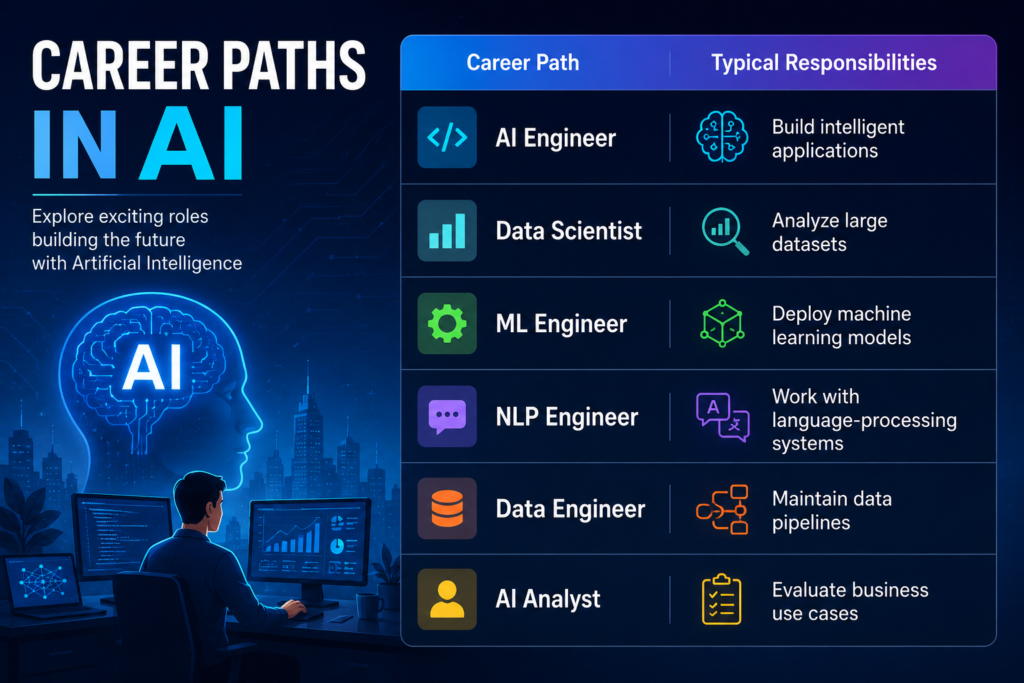
Career Paths in AI
| Career Path | Typical Responsibilities |
|---|---|
| AI Engineer | Build intelligent applications |
| Data Scientist | Analyze large datasets |
| ML Engineer | Deploy machine learning models |
| NLP Engineer | Work with language-processing systems |
| Data Engineer | Maintain data pipelines |
| AI Analyst | Evaluate business use cases |
Some professionals also combine AI with existing expertise, including:
- AI for cybersecurity
- AI in healthcare analytics
- AI-powered cloud operations
- Intelligent business automation
Hands-On Learning in AI Training
Hands-on implementation is usually what makes AI Training education stick.
Practical Activities Commonly Included
Data Analysis Exercises
Learners may analyze:
- Customer behavior data
- Business reports
- Sensor information
- System logs
Machine Learning Projects
Students often build:
- Classification systems
- Forecasting models
- Recommendation engines
- Chatbots
Deployment Practice
Advanced learners may also work with:
- APIs
- Docker containers
- Cloud services
- CI/CD workflows
That practical exposure helps professionals bridge the gap between theory and real operational environments.
Best Practices in Enterprise AI Projects
Production AI systems require governance, monitoring, and long-term maintenance not just technical implementation.
Common Enterprise Practices
Data Governance
Organizations often implement:
- Access controls
- Encryption
- Audit logging
- Compliance policies
Model Monitoring
Teams monitor systems for:
- Prediction drift
- Infrastructure usage
- Reliability issues
- Accuracy degradation
Documentation and Explainability
Enterprise AI projects frequently require:
- Version tracking
- Workflow documentation
- Validation reports
- Explainable outputs
Understanding these operational processes helps professionals think more critically about scalability, reliability, and system quality overall.
FAQ: AI Training and Analytical Skills
Are AI Training suitable for beginners?
Yes. Many programs begin with foundational concepts like Python programming, introductory machine learning, and basic data analysis before moving into advanced topics.
Do courses of artificial intelligence require advanced mathematics?
Not necessarily. Beginner programs often prioritize practical implementation first, although advanced AI specializations may involve statistics, probability, and linear algebra later on.
How long does it take to improve analytical skills through AI Training?
That depends on consistency, project experience, and prior technical background. Many learners begin noticing improvements in analytical thinking within a few months of structured practice.
Final Thoughts
AI Training helps professionals develop stronger analytical thinking, structured reasoning, and practical problem-solving skills by teaching them how to work with data, identify patterns, evaluate outcomes, and build intelligent solutions for enterprise environments.
Modern AI learning courses combine technical concepts with hands-on implementation, which makes the learning process far more practical and relevant to real-world IT operations. Over time, learners often become more confident solving complex problems, evaluating evidence, and making decisions based on measurable results rather than assumptions.
Key Takeaways
- AI learning courses strengthen structured problem-solving abilities
- Courses of artificial intelligence improve analytical and decision-making skills
- Hands-on AI projects teach practical enterprise workflows
- AI tools are widely used across cloud computing, cybersecurity, software development, and business analytics
- Real-world implementation helps learners apply concepts in operational environments
- Enterprise AI projects require attention to scalability, monitoring, governance, and security
Explore H2K Infosys AI Training courses to gain practical experience with enterprise AI tools, workflows, and real-world projects that support long-term career growth in modern IT environments.