
If you are looking to start your career as a business analyst in 2026 and the years beyond that, you must have a combination of communication, logical thinking, business knowledge, and the use of workplace tools. You will be expected to solve business problems effectively and efficiently.
The interesting part of this scenario is that companies are not hiring analysts to only “gather requirements.” They expect professionals to build connections between business objectives, customer satisfaction, and the digital transformation of the business. This is the reason many Business Analyst Training programs have had very high enrollments within the last couple of years.
From the most aspiring Analysts, to the experienced IT professionals changing careers, I have discovered that most attendees of trainings have been focusing on certifications. However, in the field, their skills with software are far more useful than definitions in a Business Analyst textbook.
If you are one of these people looking to take Business Analyst Placement as soon as possible, here are skills you absolutely must have:
1. Requirement Gathering and Analysis
This is the most critical step in any business analysis process.
A Business Analyst spends a considerable amount of their time understanding needs of stakeholders, and to be frank, this is often more challenging than people think. Clients tell Analysts the symptoms of the problems, explain them, and expect the Analysts to decipher the problem and provide a solution. Good BAs know how to strategically pose questions.
For instance, suppose a retail company complains:
“Our online sales dashboard is slow.”
A novice BA would document the statement and would consider it good enough to “move on.”
An Experienced BA digs deeper:
- Is the issue with performance?
- Is the data too old?
- Is the dashboard just too complex?
- Is this why you’ve stopped using it?
That difference makes all the difference.
Because theory cannot teach this skill properly, Strong BA Training programs usually include mock stakeholder meetings and live requirement workshops.
2. Your Communication Skills
People always underestimate this
While frameworks are important, if you don’t have the skill to easily explain your ideas to the developers, managers and clients, your projects will become a complete disaster.
And talking to people is much more than the usual emails and meetings.
These days, as a Business Analyst, you will have to:
- Facilitate online workshops
- Show and explain data
- Explain technical things in plain English
- Have Challenging conversations with your stakeholders and explain why their priorities are not in line with the goals of the organization
The changing work environments and the use of AI, cloud migrations and the automation of work have all made your role as a BA in a Business Analyst Training and Placement programs important more than ever.
The emphasis is on realtime presentation and construction activity.
3. Requirement Gathering and Analysis
Business Analysts are becoming more data-centric.
While you don’t need to become a data scientist, you must be clear on the data and understand the following:
- KPIs
- Dashboards
- Business metrics
- Analysis of trends
Now, tools like Excel, Power BI, and SQL have almost become a requirement in every BS job post.
A few months ago, an interviewee recounted that, in their experience, candidates who described their ability to make data-driven decisions outshone those with only a theoretical Background in Business Analysis. This idea has remained with me as I believe these types of descriptions sketch the future of this Industry. It is because of this sort of anecdote that I find most of the content of the current generation of Business Analyst courses to be relevant, since the latest Business Analyst Course have, with the inclusion of the analytics modules, reflected the interest of organizations in their analysts providing value to the decision-making processes of the organization.
4. Critical Thinking and Problem Solving
Great Business Analysts tend to be those who Executive Real World Projects.
- Textbook project management
- unpredictable deadlines
- conflicting stakeholders
- evolving requirement
- shifting priorities
Genuinely, a good business analyst understands the landscape and conceptualizes clever strategies to deal with any of the above.
- Can a feature be simplified?
- Can friction be removed through the elimination of unnecessary operations?
- In the absence of a complete system overhaul, can the system be rebuilt to remove user friction?
These questions rely heavily on critical thinking, especially when considering the rapid adoption of AI and automation across various industries. Companies are shifting their focus from “request documentation” to “opportunity identification.”
This is the main reason for the more noticeable preference from companies for hands-on Business Analyst Training over other Business Analyst Training with a more Traditional Academic approach.
5. Agile and Scrum Knowledge
Agile is a given.
Currently, almost all IT, Start-up, FinTech, Healthcare, and even Government Industries have adopted Agile.
Business Analysts need to be knowledgeable in:
- creating and managing a sprint
- user stories
- product backlogs
- scrum workflows
- acceptance criteria
One thing I’ve repeatedly observed is that applicants who can confidently discuss Agile scenarios in interviews tend to perform the best.
A real BA Certification program needs to describe real Agile processes, not just show slides and give definitions.
6. Documentation Skills
Definitely not the most exciting aspect of a BA’s job.
However, it is massively important.
Good documentation saves projects from confusion, delays, and costly mistakes.
Business analysts create:
- BRDs (Business Requirement Documents)
- FRDs (Functional Requirement Documents)
- User stories
- Process flow diagrams
- Gap analysis reports
And yes, clear writing is an often-overlooked superpower.
Good documentation is simple, organized, and impossible to misread.
I’ve seen projects delayed for months by vague requirement documents. One unclear requirement can result in a significant amount of development effort to be thrown out and redone.
Part of the reason that structured Business Analyst Courses spend a lot of time on documentation is that there is a standard way to do it on real enterprise projects.
7. Documentation Skills
This skill is one that will become more and more important as you move in your career.
A Business Analyst needs to work with many different groups:
- Clients
- Project Managers
- Developers
- QA Teams
- Executives
- End Users
They each speak a different “language.”
Developers are looking at the nuts and bolts of building things, while Executives are looking at the bottom line. Users are looking for a solution that will be the easiest for them to use, usually.
A Business Analyst needs to be able to manage all those different constraints, and do so in a way that does not create conflicts.
In the enterprise digital projects that are happening all over the world right now, making all the Stakeholders align is in fact the biggest problem, while the rest of the technologies are not.
This is something that the best Business Analyst Training and Placement Institutes emphasize real case studies discussion, and role-based projects.
8. Process Modeling and Workflow Understanding
As a BA, you need to be able to improve processes, not just watch them.
If you are equipped with the following skills, you can help companies improve their efficiency and decrease expenses.
- Process mapping
- Workflow analysis
- Gap analysis
- BPMN basics
- Use case creation
For example, in 2026, most companies are in the process of replacing older systems and using AI business tools to automate their repetitive, tedious workflows. Identifying where legacy systems, integration, and automation improvements should occur is the responsibility of the Business Analyst.
Because there is very little practical knowledge in the general-purpose online training courses, this is the reason why industry-based BA Training is of such great importance.
9. Technical Knowledge
Becoming a software developer is not a requirement.
However, a Business Analyst should have the following knowledge and skills:
- API
- Cloud Applications
- Databases
- Systems
- AI
- Basic Architectural Knowledge
In the rapidly evolving industry, companies expect BAs to work with digital transformation Teams.
Knowledge of even the most basic systems that companies use to automate their processes will help to eliminate communication gaps.
Strong Business Analyst Courses usually include teaching the technical fundamentals of systems to non-programming professionals.
10. Dealing with Change
In 2026, this is the most important skill of them all.
Getting too comfortable with the knowledge and the tools you have will make you obsolete very quickly. The pace at which technology and business shifts is unbelievable.
This is what sets the most successful BAs apart: a focus on most of the following:
- Monitoring shifts in your domain
- The latest in business technology
- Emerging analytics
- AI and the applications
Interestingly, the business world seems to value this skill more than even technical knowledge.
That’s why many students are opting for career-focused Business Analyst Training and Placement courses with live projects, guidance, interview training, and hands-on experiences, as compared to spending their time on courses with a lot of theory.
Why Hands-on Training Only Gets More Crucial
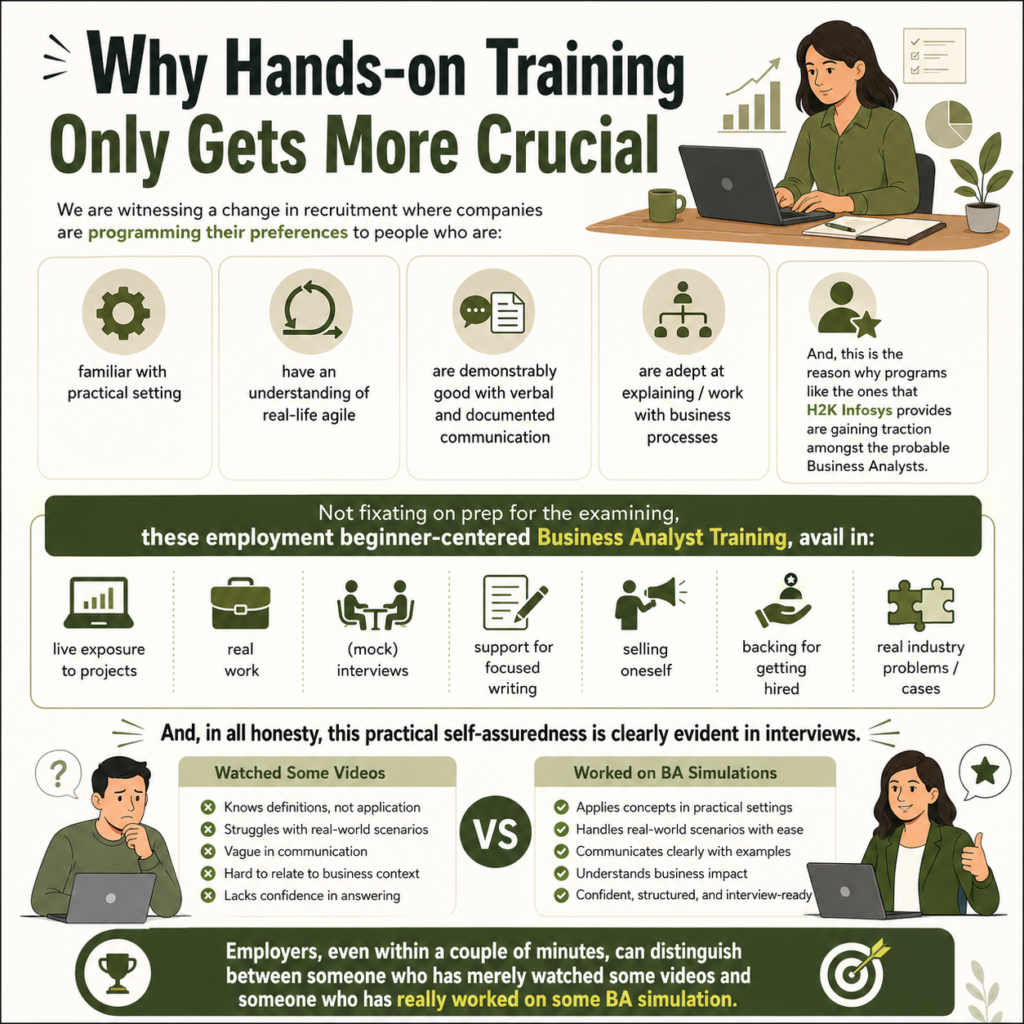
We are witnessing a change in recruitment where companies are programming their preferences to people who are:
- familiar with practical setting
- have an understanding of real-life agile
- are demonstrably good with verbal and documented communication
- are adept at explaining/work with business processes
And, this is the reason why programs like the ones that H2K Infosys provides are gaining traction amongst the probable Business Analysts.
Not fixating on prep for the examining, these all employment beginner-centered Business Analyst Training, avail in:
- live exposure to projects
- real work
- (mock) interviews
- support for focused writing
- selling oneself
- backing for getting hired
- real industry problems/cases
And, in all honesty, this practical self-assuredness is clearly evident in interviews.
Employers, even within a couple of minutes, can distinguish between someone who has merely watched some videos and someone who has really worked on some BA simulation.
Conclusion
There’s a huge gap between Business Analyst then, and the Business Analyst of now.
The modern BA operates at a higher level of thinking i.e, one who has clear thinking with an understanding to analyze problems, is a fast relearning and adapting to present tech BA. BA’s now are not just bases for a requirements doc.
And what’s the main draw? There are so few fields where you can leverage your communication, analytical, and business skills to get jobs in every sector, say, health, finance or AI business platforms.
This is the primary reason why so many people have begun shifting into Business Analysis.