
You might have wondered if companies hire freshers for these kinds of roles. That’s a fair question. After all, most job postings seem to want experience. The good news is that many organisations today are willing to take on entry-level candidates with the right skills, practical knowledge, and understanding of how business analysis works. So yes, you can very well get a job after Business Analyst Training, even if you are at the start of your career.
The job market is different from what it was just a few years ago. Companies are investing in automation, AI tools, cloud platforms, and digital transformation projects, and that means they need people who can understand business problems and help teams solve them. Enter business analysts. An effective business analyst course not only teaches you theory but also teaches you how to write requirements, communicate with stakeholders, work in Agile teams, and work with real-world business scenarios. People tend to underestimate the importance of these practical skills.
I have talked to many learners with little or no experience in the industry who were able to get into the industry after being properly trained. One reason for this is that the programs from H2K Infosys have been attracting aspiring business analysts. They don’t just teach concepts and move on; their approach is hands-on learning, project-based practice, interview preparation, and career guidance. For freshers looking to get a Business Analyst Certification and build confidence before entering the job market, that kind of support can make the journey feel a lot less overwhelming.
Is Business Analyst Training Really Worth It for Freshers?
Let’s be real for a second. BA roles aren’t like coding jobs, where you build a GitHub portfolio and apply. Business Analysis is about communication, requirement gathering, understanding what a business actually needs, and translating that for a technical team. That sounds abstract until you’ve actually done it in a structured setting.
That’s why the training program you pick matters so much. A good business analyst course doesn’t just teach you frameworks and buzzwords. It puts you through real scenarios, stakeholder interviews, writing BRDs, building process flow diagrams, and working in Agile sprints. When you come out the other side, you’re not guessing what a BA does. You’ve already done it, at least in a training environment.
And that matters enormously to hiring managers. They’re not expecting freshers to have three years of corporate experience. They’re looking for someone who clearly understands the role, can communicate well, and has something tangible to show. A strong training background with real project artifacts checks all of those boxes.
Why 2026 Is Actually a Good Time to Start
Here’s something a lot of freshers don’t realize: the BA job market right now is genuinely solid. Companies that rushed into automation over the last few years are now realizing they need skilled people to bridge the gap between business goals and technical execution. That’s exactly what a Business Analyst does.
The U.S. Bureau of Labor Statistics projects management analysis roles, which include Business Analyst positions, to grow by around 11% through 2032. That’s faster than average. And it’s not just replacement hiring. Companies are creating new BA positions, especially in fintech, healthcare tech, e-commerce, and enterprise software.
What’s also shifted is that many hiring managers now actively prefer freshers for entry-level BA roles. Why? Because they’re coachable, they know current tools, and they don’t come in with years of bad habits baked in. If you show up with solid Business Analyst Training behind you and a clean portfolio of artifacts, you’re genuinely competitive even against people with some work experience.
What H2K Infosys Gets Right for Freshers
If you’re comparing programs right now, here’s why H2K Infosys keeps coming up in BA communities and forums.
Their Business Analyst Training program is built specifically for people starting from zero, with no IT background and no prior domain experience required. You learn through live, instructor-led sessions, not pre-recorded videos you’ll half-watch and forget. The instructors are practitioners, not just teachers, and the curriculum reflects what’s actually happening in the industry right now: Agile BA workflows, data literacy, remote stakeholder management, and modern documentation tools.
But what really separates H2K Infosys is the project work. You don’t just sit through lectures; you build real deliverables. Business Requirement Documents, use case diagrams, user stories, process flows, the kind of artifacts you can drop straight into a portfolio and talk through confidently in an interview. By the time you’re done, you have proof of work. That’s huge when you’re a fresher with no corporate experience to lean on.
And then there’s the career support. Resume preparation, mock interviews, job search coaching, it’s all part of the program, not a paid add-on you have to chase separately. For someone navigating their first job search in a field they’re new to, that structure is genuinely valuable. H2K Infosys has helped a lot of people make this transition successfully, and that track record speaks for itself.
What Freshers Actually Need to Get Hired
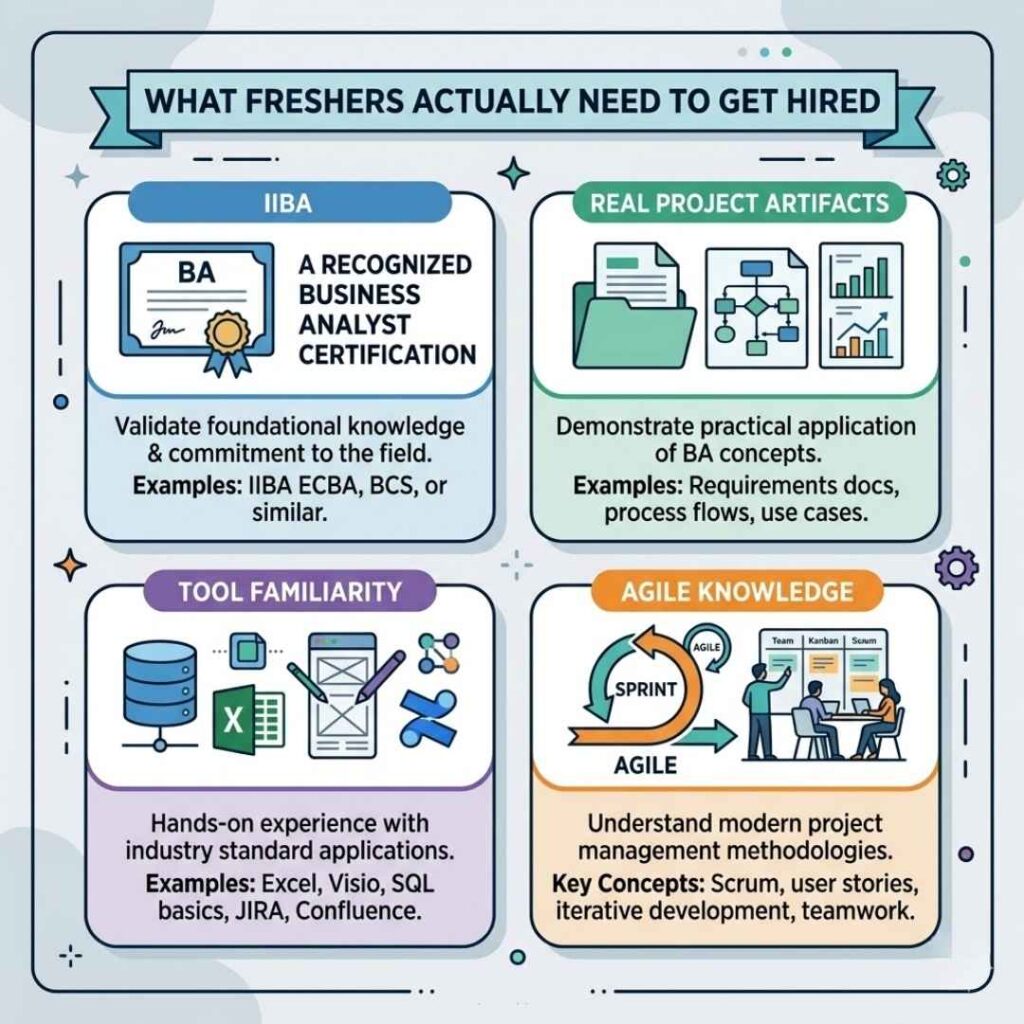
Let’s get specific. Here’s what actually separates freshers who land BA jobs from those who don’t.
A Recognized Business Analyst certification
In 2026, this is non-negotiable. The ECBA from IIBA is designed exactly for people with no work experience. It validates your knowledge and signals you’re serious. Pair that with a strong training credential, and you’ve got a resume that stands out immediately.
Real project artifacts
This is the big one. Hiring managers want to see that you can write a BRD, build a process flow, document user stories, and run a stakeholder analysis. If your training didn’t include this, you’re going into interviews with nothing concrete to show, and that’s a tough spot to be in.
Tool familiarity
Most BA job descriptions in 2026 expect at least basic comfort with JIRA, Confluence, MS Visio or Lucidchart, Excel, and increasingly SQL for basic data querying. Tableau and Power BI familiarity is a nice bonus. If your business analyst course didn’t cover these, fill that gap before you start applying.
Agile knowledge
Practically every tech-adjacent company runs on some version of Agile or Scrum. If you can’t speak to user stories, sprint planning, and backlog grooming, you’ll struggle in interviews. Make sure this is part of your training; it’s not optional anymore.
A Real Example That Shows It’s Possible
I came across a story in a BA community forum that stuck with me. Someone with a hospitality management background, no tech experience, and no corporate IT exposure decided to pivot into Business Analysis in early 2025. They enrolled in a structured training program, built a portfolio around a mock e-commerce project, got their ECBA certification, and started applying.
Four months later, they had two job offers. One from a mid-sized fintech company, one from a staffing firm placing BAs with enterprise clients.
What they said made the difference: “I could talk about real artifacts. Not theory. Actual documents I’d created during training.”
That’s the benchmark. That’s what good Business Analyst Training produces: people who can walk into a room and have that conversation.
Common Mistakes Freshers Make
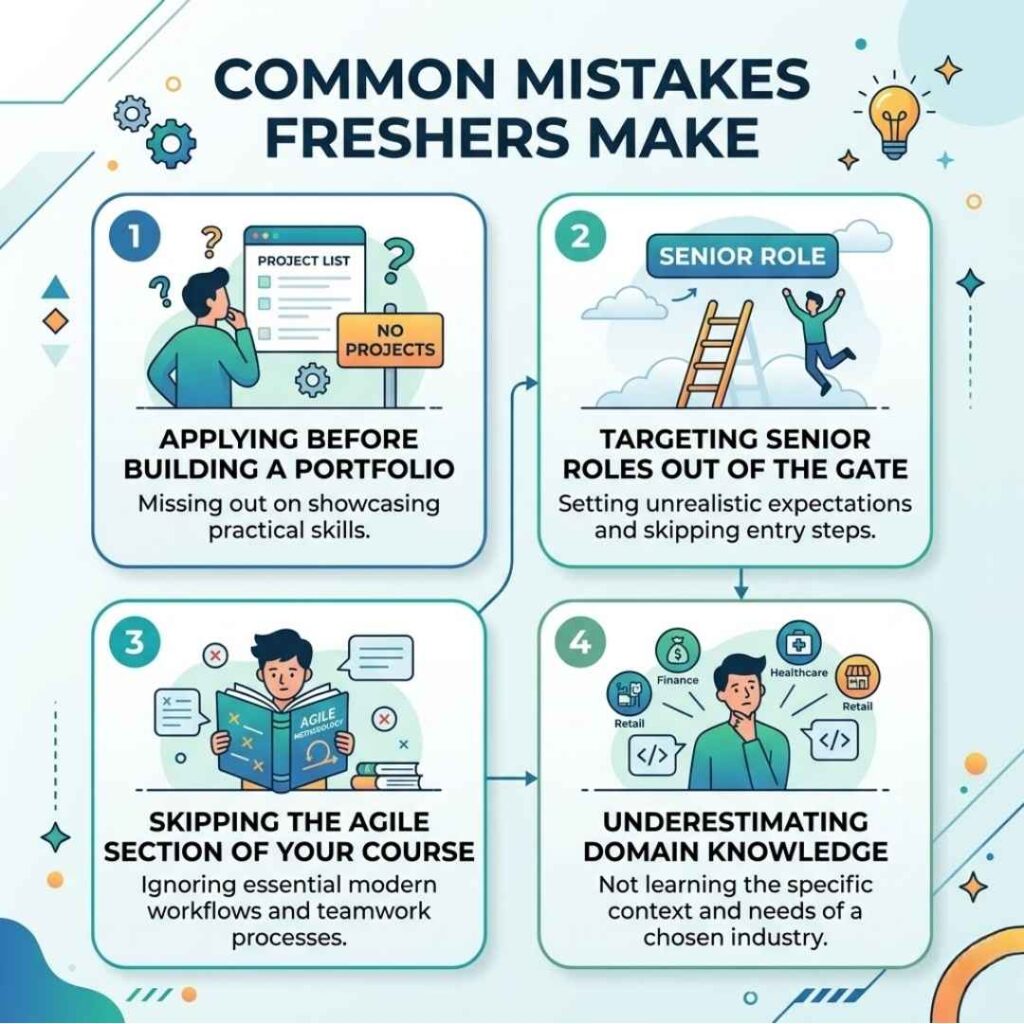
Since we’re being honest, let’s talk about what doesn’t work.
Applying before building a portfolio: Sending out resumes before you have any BA artifacts is like applying to be a designer with no designs. Finish your training, build 2–3 solid project deliverables, then apply in that order.
Targeting senior roles out of the gate: Junior BA, BA associate, entry-level business analyst, business systems analyst, these are your targets. Filter by 0–2 years of experience. You can move up quickly once you’re in the door.
Skipping the Agile section of your course: I’ve seen freshers fast-forward through Agile content because it feels less tangible. Don’t. It shows up in almost every BA interview in some form.
Underestimating domain knowledge: If you have any background in healthcare, finance, retail, or logistics, even from a previous unrelated job, lean into it. Domain familiarity plus BA training is a genuinely compelling combination that’s easy to undersell.
The Bottom Line
Can freshers get jobs after Business Analyst Training? Without a doubt, yes. But the training has to actually prepare you, not just certify you.
A structured Business Analyst certification program, real hands-on project work, and solid career support give you everything you need to compete at the entry level. The market is growing. The demand is real. And freshers who come in properly trained are landing jobs consistently.
If you’re serious about making this move, H2K Infosys is one of the strongest options out there for people starting from scratch. The curriculum is current, the project work is real, and the career support is built in, not bolted on. It’s the kind of program that doesn’t just teach you Business Analysis. It gets you hired.
Start with the right training. Build your portfolio. Get certified. Then apply. That’s the path, and it works.