
You can become a business analyst with no experience by learning the right skills, taking practical business analyst training, building small projects, and showing employers that you can solve business problems clearly. For many beginners, the way to learn is to follow a structured learning path like the one at H2KInfosys, where they can learn the basics of requirements gathering, process mapping, Agile, and real-time BA documentation before applying for jobs.
You don’t need a fancy background or years of corporate experience to get started. Most Entry-Level Business Analyst’s come from a background of customer service, sales, operations, admin, finance, IT support, or even straight out of college. The trick is knowing how to link business needs with real solutions.
What Does an Entry-Level Business Analyst Do?
An Entry-Level Business Analyst helps an organization to identify problems and find better ways of working.
Simply put, a business analyst talks to people, understands what they need, documents requirements, studies processes, and helps teams improve systems or workflows.
For example, if a company has a slow customer refund process, a business analyst might look through the current process, talk to the support team, identify where the delays occur and then recommend a better process.
Typical tasks are:
- Business requirements gathering
- Stakeholder communication
- Writing use cases
- Developing process maps
- Data review
- Support project teams
- Testing a system for business needs
It is not always a very technical position. Much of it is communication, problem-solving, and clear thinking.
Can You Become a Business Analyst With No Experience?
Yes, you can Entry-Level Business Analyst. But you need to show you understand what the role entails at a fundamental level.
Having ‘no experience’ doesn’t mean you have nothing useful to offer. If you’ve ever solved customer problems, improved a process, created reports, trained someone, handled data, or worked with different teams, you already have skills that can transfer into business analysis.
A customer support person may already know how to spot repeat customer issues. The workflows and process gaps could be known by an individual in operations. Fresh graduates can create sample projects to show their practical knowledge.
The goal is to translate your current experience into Entry-Level Business Analyst speak.
Skills You Need to Become a Business Analyst
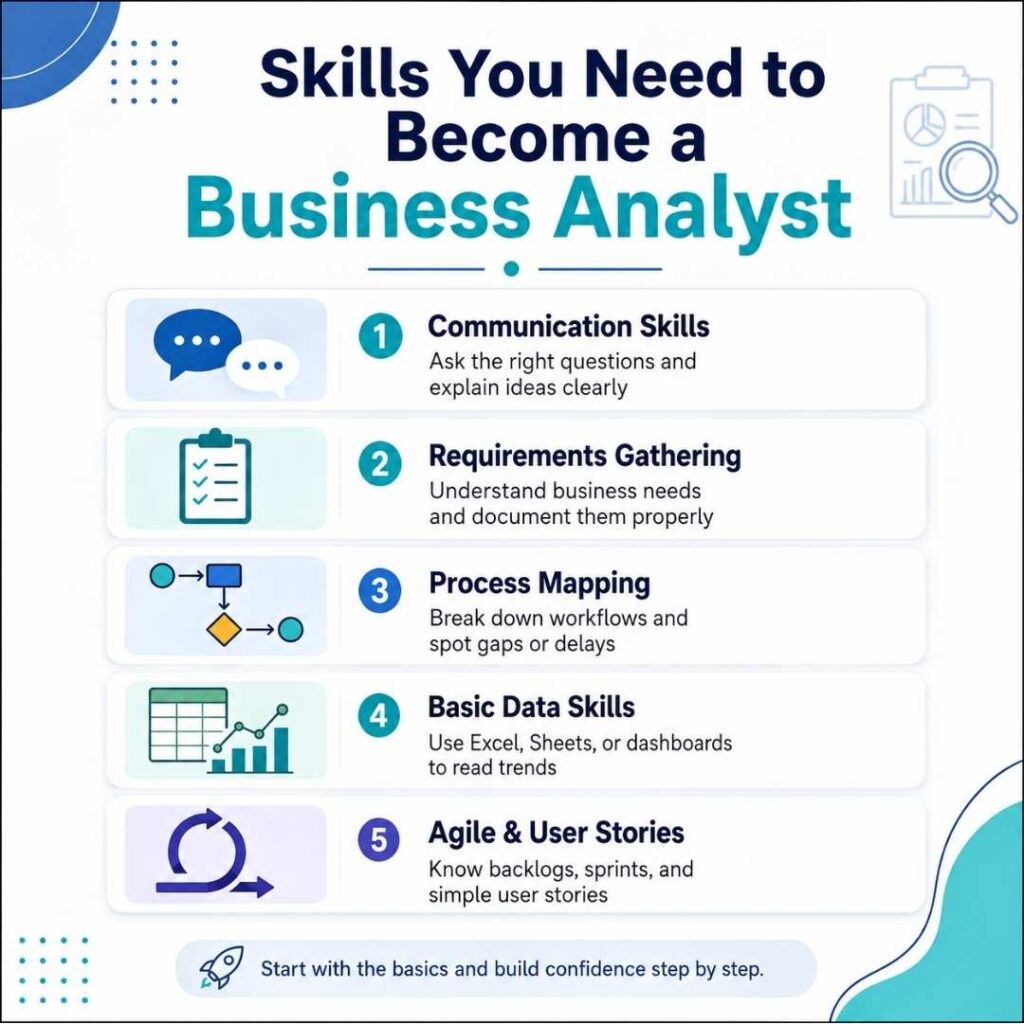
You do not need to master everything at once. Start with Entry-Level Business Analyst: the basics.
1. Communication Skills
Entry-Level Business Analyst speaks with managers, users, developers, testers, and project teams. You need to ask good questions and explain things clearly.
A good Entry-Level Business Analyst does not just take instructions. They try to understand the real problem behind the request.
2. Requirements Gathering
Requirements are what the business needs from a system, process, or project.
For example, if a company wants a new booking system, the business analyst finds out:
- Who will use it?
- What problem should it solve?
- What features are needed?
- What should happen if something goes wrong?
- How will success be measured?
This is one of the most important BA skills.
3. Process Mapping
Process mapping means showing how work happens step by step.
You can practice this with simple examples like:
- Online shopping checkout
- Leave approval process
- Customer complaint process
- Appointment booking process
This helps you understand where delays, mistakes, or confusion happen.
4. Basic Data Skills
You should be comfortable with Excel or Google Sheets. Learn formulas, filters, charts, and pivot tables.
Basic SQL and dashboard tools like Power BI or Tableau can also help, especially if you want to stand out.
5. Agile and User Stories
Many companies use Agile methods. So it helps to understand user stories, acceptance criteria, sprints, and backlogs.
A simple user story looks like this:
“As a customer, I want to reset my password so that I can access my account without contacting support.”
That is the kind of simple, clear writing business analysts often do.
Step-by-Step Guide to Become an Entry-Level Business Analyst
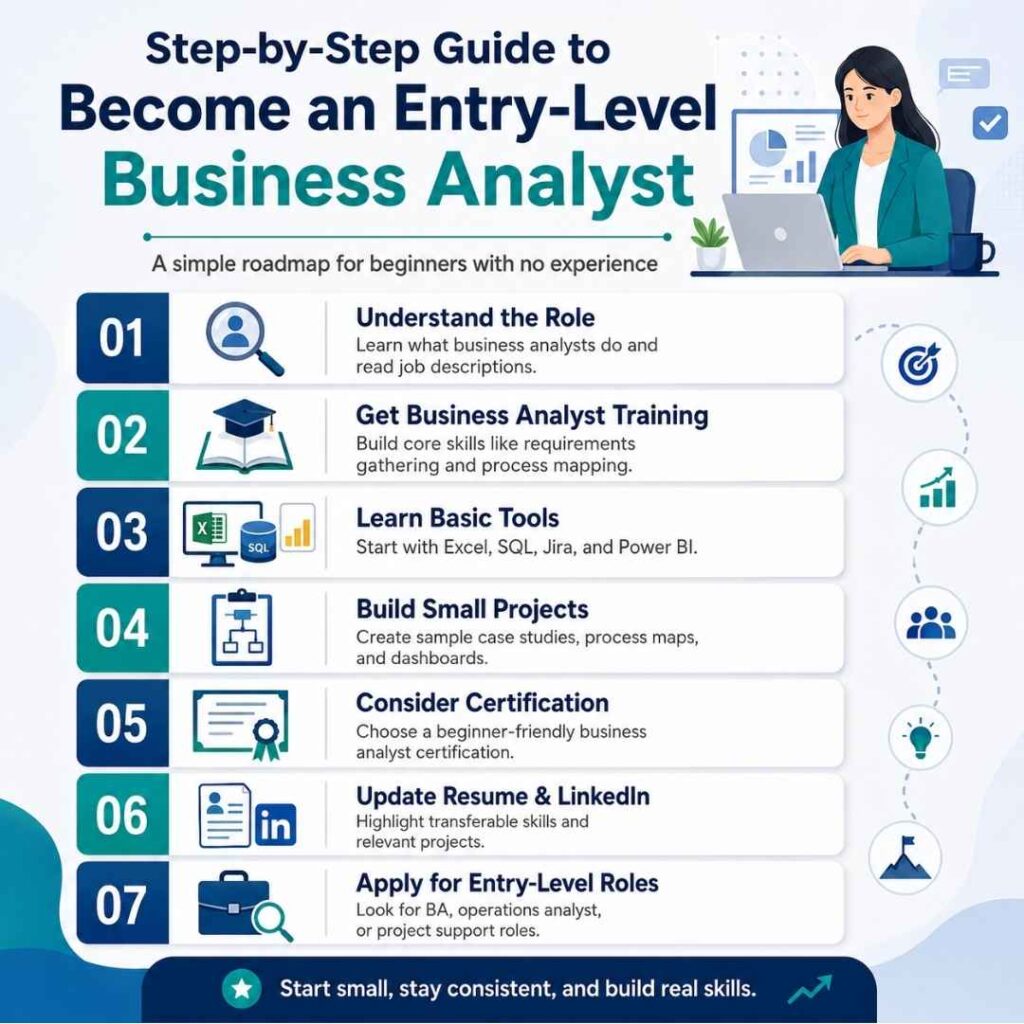
Step 1: Understand the Role
Before joining any business analyst course, read real job descriptions. Search for roles like:
- Junior Business Analyst
- Entry-Level Business Analyst
- Business Support Analyst
- Process Analyst
- Operations Analyst
- Product Analyst
Look at the skills employers repeat again and again. This will help you focus on what actually matters.
Step 2: Take Practical Business Analyst Training
Good business analyst training should teach you how to do real BA work, not just theory.
Look for training that covers:
- Requirements gathering
- Process mapping
- Stakeholder communication
- Agile basics
- User stories
- Business documents
- Excel or basic data analysis
- Real project examples
The best training gives you practice, templates, and case studies.
Step 3: Build Small Projects
Entry-Level Business Analyst, This is very important if you do not have experience.
Create two or three simple portfolio projects. For example:
- A process improvement project for a customer refund process
- A requirements document for an online booking system
- A simple Excel or Power BI dashboard using sample sales data
These projects show employers that you can apply what you learned.
You do not need a huge portfolio. A few clear, practical examples are enough.
Step 4: Consider a Business Analyst Certification
A business analyst certification can be helpful, particularly if you are new. It demonstrates that you are committed to the field.
But be cautious. It doesn’t necessarily mean you will land a job with a certification. Best used in combination with hands-on skills, projects, and a solid resume.
Choose a certification that is for beginners and matches your level of experience. If you’re just starting out, don’t go for advanced certifications that need years of experience.
Step 5: Learn Useful Tools
You do not need to learn every tool in the market. Start with the basics:
- Excel or Google Sheets
- PowerPoint
- Word or Google Docs
- Jira
- Trello
- Power BI or Tableau
- Basic SQL
Even knowing the basics of these tools can help you feel more confident in interviews.
Step 6: Update Your Resume
Your resume should reflect the skills you already have, even if your job title wasn’t “Business Analyst.”
For instance, instead of writing:
“Handled customer complaints”
You may write:
“Assisted in identifying opportunities for process improvement and reviewed common customer issues.
Instead of
“Filed reports”
You can write:
“Created regular reports for performance monitoring and useful trend identification.”
These little changes make your experience sound more connected to business analysis.
Step 7: Apply for Entry-Level and Related Roles
Don’t just apply for jobs with the title “Business Analyst”.
And look for similar positions like:
- Project Coordinator
- Operations Analyst
- Reporting Analyst
- Quality Assurance Analyst
- Analyst, Business Support
- Customer Success Partner
- Implementation Analyst
Many people enter business analysis through these roles first.
How to Choose the Right Business Analyst Course
A good business analyst course should be simple Entry-Level Business Analyst, practical, and beginner-friendly.
Before choosing one, check if it includes:
- Real examples
- Case studies
- Practice assignments
- Templates
- Agile basics
- Requirements documents
- Resume and interview help
Avoid courses that promise a guaranteed job. No course can honestly promise that. A good course should help you build real skills and confidence.
How to Get Experience Without a BA Job
This is where many beginners feel stuck. Employers ask for experience, but you need an Entry-Level Business Analyst job to get experience.
The solution is to create your own practice experience.
You can :
- Build sample projects.
- Volunteer to enhance a process at your current job.
- Create example documents
- Analyse open data sets.
- Create simple dashboards
- Document Workflows Everywhere
For example, if you work in retail, you can write down how you order stock and how to improve it. If you work in customer support, you can analyse common complaints and propose improved support procedures.
That is real business thinking.
Final Thoughts
Becoming an Entry-Level Business Analyst with no experience is possible, but you need to be practical about it.
Don’t wait until you know everything. Begin with the fundamentals. How requirements work. Learn. Sketch out the process. Do small projects. Get a helpful Entry-Level Business Analyst. Select a business analyst course that offers practical exercises. Add a business analyst certification if it helps you achieve your goals.
Most importantly, demonstrate to employers that you can think clearly, problem-solve, and communicate well.
This is really what business analysis is all about.
FAQs
1. Can I become a business analyst with no experience?
Yes. You can start by learning BA skills, taking practical training, building projects, and applying for entry-level or related roles.
2. Do I need a business analyst certification?
A business analyst certification can help, but it is not required for every role. Practical skills and projects are also very important.
3. Which skills are most important for beginners?
Communication, requirements gathering, process mapping, Excel, Agile basics, and problem-solving are the most important beginner skills.
4. Is a business analyst course worth it?
A business analyst course is worth it if it includes practical examples, real assignments, templates, and project work.
5. How long does it take to become job-ready?
Many beginners can become job-ready in three to six months with focused learning, practice projects, and consistent job applications.