If you’re a fresher trying to understand how to prepare for a Business Analyst Interviews, the honest answer is simple you need a clear mix of fundamentals, practical exposure, and guided practice through a structured business analyst course, and many learners today find programs like H2Kinfosys business analyst training helpful because they combine theory with real interview-style scenarios instead of just textbook learning. The goal isn’t just to study BA concepts, but to actually learn how to apply them when you’re asked real-world questions in interviews.
Most freshers struggle not because the role is too complex, but because their preparation is unstructured and scattered. Once you fix that, things start to feel much more manageable.
First things first: What interviewers actually look for
When companies hire Business Analyst Interviews for freshers BA roles, they’re not expecting you to be a domain expert. They’re checking three things:
- Can you understand a business problem clearly?
- Can you translate that problem into structured requirements?
- Can you communicate your thoughts without confusion?
Sounds simple, but here’s the catch most freshers over-focus on theory and ignore practical thinking.
I’ve seen candidates who can define “SRS” perfectly but struggle to explain how they’d gather requirements from a client who keeps changing their mind mid-discussion. That’s where real preparation matters.
How to Prepare for Business Analyst Interviews as a Fresher
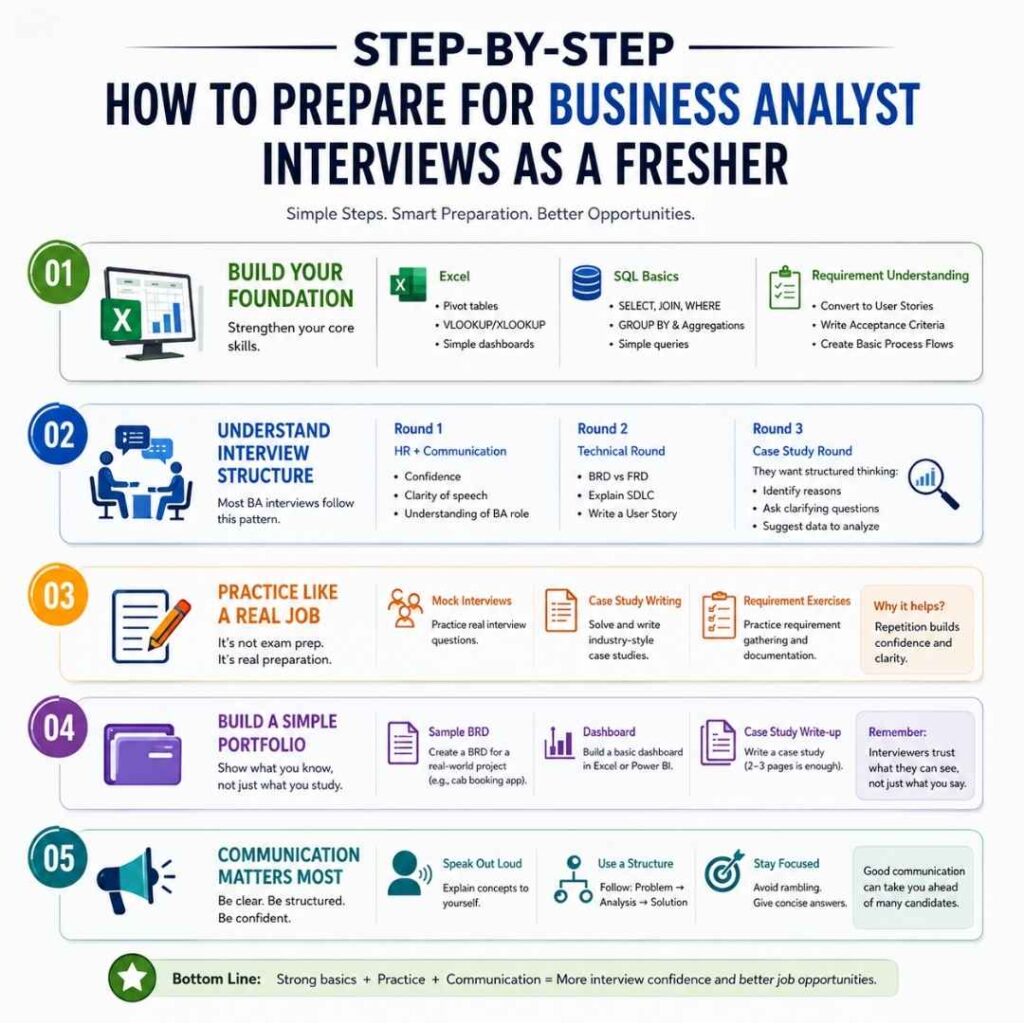
Step 1: Build your foundation
Before jumping into mock Business Analyst Interviews, you need core skills:
1. Excel (must have)
You should be at ease with:
- Pivot tables
- VLOOKUP/XLOOKUP
- Simple dashboards
In a real interview, you might be asked:
“Demonstrate how you would summarise sales data for decision-making.”
If you’re wavering here, that’s an immediate red flag.
2. SQL basics
You don’t need advanced optimization, but you must know SQL basics:
- SELECT, JOIN, WHERE
- GROUP BY and aggregations
- Simple case-based queries
3. Requirement understanding
This is the heart of a BA role. Practice converting messy statements into:
- User stories
- Acceptance criteria
- Basic process flows
Honestly, this is where a structured business analyst training program becomes useful, because it forces you to practice real-world case studies instead of just reading theory.
Step 2: Learn how interviews are actually structured
Most Business Analyst Interviews follow a predictable pattern:
Round 1: HR + communication check
They test:
- Confidence
- Clarity of speech
- Basic understanding of BA role
Round 2: Technical round
Expect questions like:
- What is BRD vs FRD?
- Explain SDLC
- Write a sample user story
Round 3: Case study round
This is where things get interesting.
Example:
“A food delivery app is seeing a drop in repeat customers. What would you do?”
They’re not looking for a perfect answer they want structured thinking:
- Identify possible reasons
- Ask clarifying questions
- Suggest data points to analyze
If you panic here, it usually means you haven’t practiced enough real case scenarios.
Step 3: Practice like it’s a real job (not exam prep)
Here’s a small reality check: watching YouTube Business Analyst Interviews is not enough.
You need to simulate:
- Mock interviews
- Case study writing
- Requirement gathering exercises
One thing I noticed with students is that when they join a proper ba training and placement program, their confidence jumps faster not because content is magical, but because repetition is built into the system.
They’re constantly exposed to:
- Real interview questions
- Industry-style case studies
- Feedback loops (this part matters a lot)
Step 4: Build a simple portfolio (most freshers skip this)
Even as a fresher Business Analyst Interviews , you can stand out with a mini-portfolio:
- A sample BRD for a cab booking app
- A basic dashboard – Excel or Power BI
- A case study write-up (2–3 pages is enough)
Think of it like this:
Interviewers trust what they can see, not just what you say.
I’ve seen candidates with average resumes get selected just because they could clearly explain one solid project.
Step 5: Communication matters more than perfection
This is where many candidates underestimate things.
You don’t need to use “fancy English.” You want a straight answer.
Try to do the practice:
* Explaining concepts out loud (talking to yourself, yes)
* Responding in structured format: problem → analysis → solution
* Not rambling (big one)
Even small changes to your articulation can change how interviewers see you.
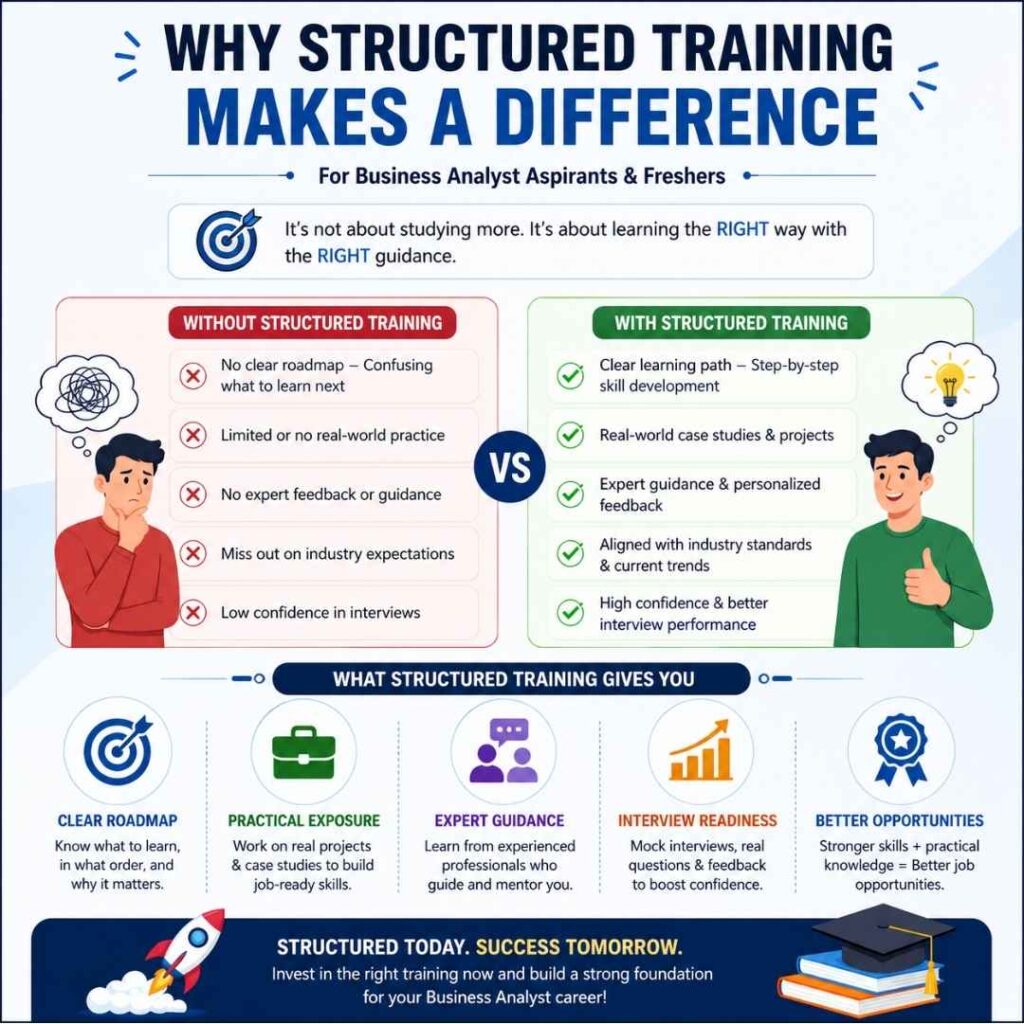
Why structured training makes a difference
Let’s be real for a second.
Self-learning works… but only up to a point.
Most freshers hit a plateau because:
- They don’t know what to practice next
- They don’t get real feedback
- They miss industry context
That’s where structured programs like a Business Analyst Interviews become practical. Not because they “teach everything,” but because they:
- Give you a roadmap
- Provide case-based practice
- Help you simulate real interview pressure
- Keep you consistent (which is the real struggle)
A quick real-world observation (from interviews & training scenarios)
One pattern I’ve noticed in recent hiring cycles (especially 2025–2026 trend shifts) is that companies are leaning more toward:
- Scenario-based questioning
- Data interpretation tasks
- Cross-functional communication ability
So instead of asking “What is Agile?”, they ask:
“How would you handle a sprint where requirements keep changing mid-cycle?”
That shift is important. If your preparation is still textbook-heavy, you’ll feel stuck.
Final preparation checklist
Before your interview, make sure you can:
- Explain BA role in your own words
- Solve basic Excel and SQL questions
- Handle at least 5–6 case studies
- Write one sample user story confidently
- Talk through a project without hesitation
And most importantly don’t try to sound perfect. Try to sound clear.
FAQ’s – Business Analyst Interview Preparation
What is the best way to start preparing for a business analyst interview as a fresher?
Start with basics like Excel, SQL, requirement gathering concepts, and simple case studies. Instead of just reading theory, when you feel comfortable do mock interviews and real world scenarios.
Do I need coding to become a business analyst?
There is no heavy coding. Most entry level BA positions only require basic SQL. It is more about analysing, communicating and solving business problems.
Is a business analyst course necessary for freshers?
It’s not a requirement but it helps a lot if you are starting from zero. Self-study often lacks the guidance, practice cases, and interview prep that a structured course offers.
What topics are most important for BA interviews?
Key areas include:
* Requirement gathering techniques
* Agile and Scrum basics
* SQL fundamentals
* Excel for data analysis
* Writing user stories and BRD/FRD
What kind of questions are asked in fresher BA interviews?
You may be asked:
* Explain a user story
* Difference between BRD and FRD
* How would you handle changing requirements?
* Basic SQL queries
* Real-time case scenarios
Final thoughts
If you’re serious about entering the BA field, consistency matters more than intensity. Even 2–3 hours of focused daily practice beats random weekend cramming.
And honestly, if you want a more guided path, joining a structured Business Analyst Interviews and business analyst training with placement support can save you a lot of trial-and-error time. It keeps your preparation aligned with what companies are actually asking right now, not what older tutorials used to teach.
At the end of the day, interviews are not about memorization. They’re about showing that you can think like someone already doing the job.
Start there, and you’re already ahead of most freshers.