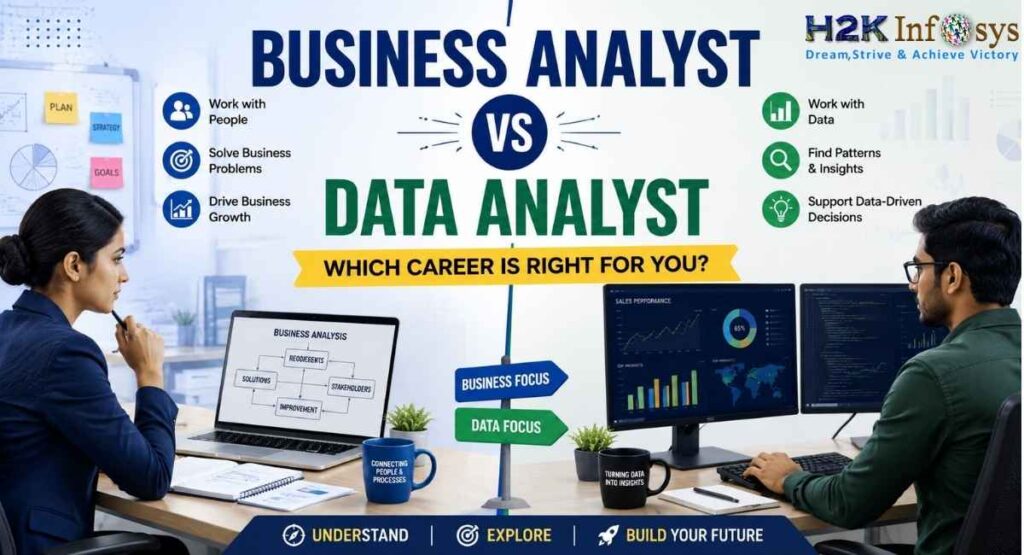
If you’re considering Business Analyst vs Data Analyst, you’re probably wondering which career is the better fit for your future. Both the roles are in high demand and have great scope of growth which is why it is one of the most common questions asked by the learners while exploring the career options through H2K Infosys. The only difference is Business Analysts are more concerned with solving business problems and improving processes, while Data Analysts work with data to extract insights that help businesses make smarter decisions.
At first sight these two careers can appear very similar. Both require analysis, critical thinking and helping organisations make better decisions. But the daily duties, the skills and the career paths are very different. Understanding the differences between them can help you find a position that best fits your interests and strengths.
Whether you are a recent graduate, looking for a business analyst training or Business Analyst certification, or planning a career change, knowing what each role entails is the first step. In this guide, we will compare Business Analyst vs Data Analyst with their responsibilities, skills, salaries, career progression, and future prospects so that you can make an informed choice.
What Does a Business Analyst Do?
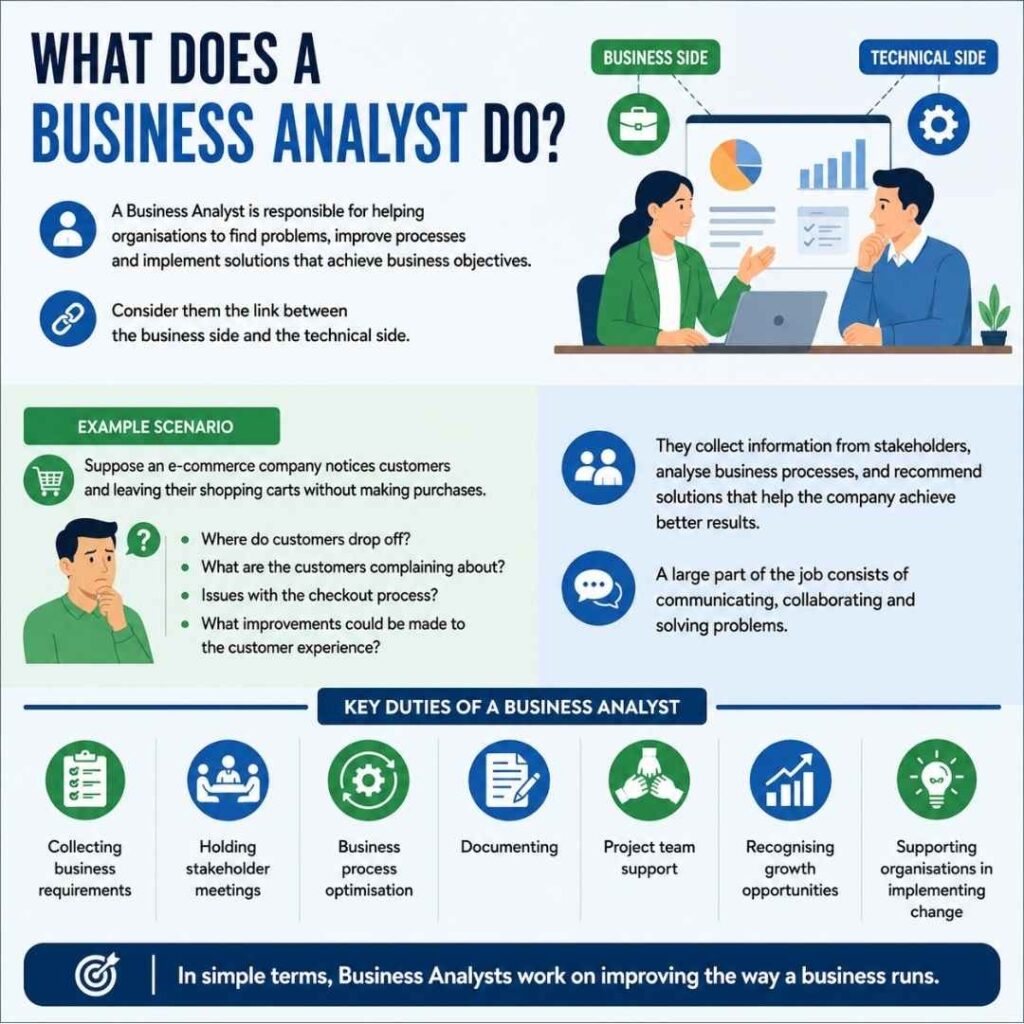
A Business Analyst is responsible for helping organisations to find problems, improve processes and implement solutions that achieve business objectives.
Consider them the link between the business side and the technical side.
For example, suppose an e-commerce company notices customers are leaving their shopping carts without making purchases.
A Business Analyst starts by asking questions:
- Where do customers drop off?
- What are the customers complaining about?
- Issues with the checkout process?
- What improvements could be made to the customer experience?
They collect information from stakeholders, analyse business processes, and recommend solutions that help the company achieve better results.
A large part of the job consists of communicating, collaborating and solving problems.
Key Duties of a Business Analyst
- Collecting business requirements
- Holding stakeholder meetings
- Business process optimisation
- Documenting
- Project team support
- Recognising growth opportunities
- Supporting organisations in implementing change
In simple terms, Business Analysts work on improving the way a business runs.
What Does a Data Analyst Do?
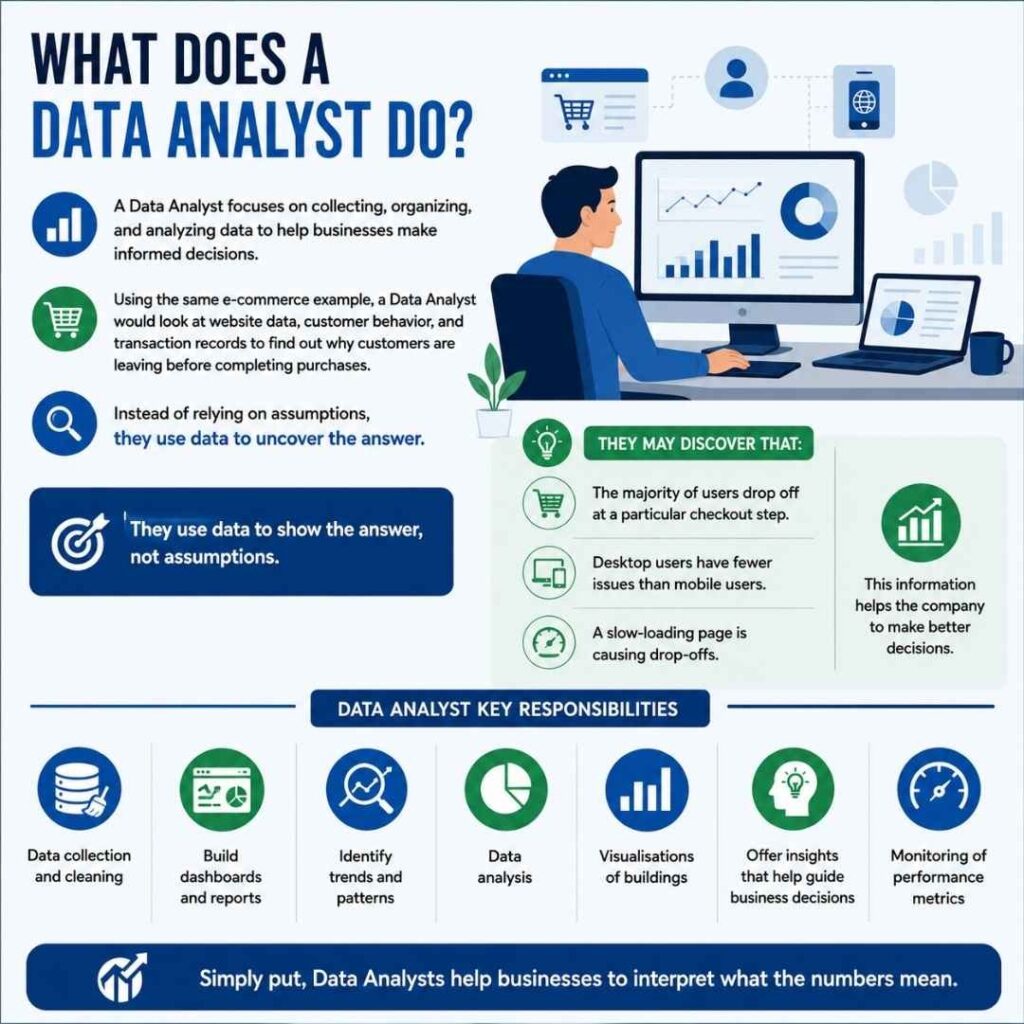
A Data Analyst is someone who collects, organises and analyses data to help businesses make informed decisions.
In the same e-commerce example, a Data Analyst would be looking at the data on the website, customer behaviour, and transaction records to find out why customers are leaving before they complete their purchases.
They don’t make assumptions. They use data to find the answer.
They use data to prove the answer, not assumptions.
They may discover that:
- The majority of users drop off at a particular checkout step
- Desktop users have fewer issues than mobile users.
- A slow-loading page is causing drop-offs.
This information helps the company to make better decisions.
- Data Analyst Key Responsibilities
- Data collection and cleaning
- Build dashboards and reports.
- Identify trends and patterns.
- Data analysis
- Visualisations of buildings
- Offer insights that help guide business decisions.
- Monitoring of performance metrics
Simply put, Data Analysts help businesses to interpret what the numbers mean.
Business Analyst vs Data Analyst: Quick Comparison
| Factor | Business Analyst | Data Analyst |
| Main Focus | Business problems | Data insights |
| Daily Work | Meetings, requirements, process improvement | Data analysis, reporting, dashboards |
| Key Skills | Communication, problem-solving | SQL, analytics, statistics |
| Stakeholder Interaction | High | Moderate |
| Technical Skills | Moderate | High |
| Goal | Improve business performance | Discover insights from data |
| Career Path | Product Manager, Consultant, Strategy Leader | Data Scientist, Analytics Manager |
The easiest way to remember the difference is Business Analyst vs Data Analyst:
Business Analysts focus on the “why” behind business challenges.
Data Analysts focus on the “what” revealed by the data.
Skills Needed to Become a Business Analyst
A lot of people think Business Analysts just need business knowledge.
Not at all.
The most effective Business Analysts blend analytical thinking with communication skills.
Some of the core skills are:
Communication Skills
You’ll spend a lot of time talking to stakeholders, gathering requirements and explaining solutions.
Problem-Solving Ability
Companies hire analysts to solve problems, not just to spot them.
Understanding Business Processes
“You have to understand how organisations operate, and where you can make improvements.
Requirements Gathering
One of the most important parts of the role is to understand what stakeholders really need.
Technical Knowledge Basic
Business Analysts are not generally developers, but a good understanding of software systems and digital products is very helpful.
This is one of the reasons many professionals choose a business analyst course before setting foot in the field.
Skills Needed to Become a Data Analyst
Data Analysts need more technical skills.
Typical skills are:
SQL
SQL is one of the most important tools when you are working with databases.
Excel
There are so many modern analytics tools available today, but Excel is still widely used.
Data Visualization
Tools such as Power BI and Tableau help analysts to present their findings in a clear way.
Statistics
Some basic statistical knowledge is needed to understand trends and patterns.
Data Storytelling
It is important to find insights. It’s just as important to be able to explain those insights clearly.
What Does a Typical Day Look Like?
This is where a lot of people find out which career is best for them, Business Analyst vs Data Analyst.
A Day in the Life of a Business Analyst
A day might look like:
- Meetings with stakeholders
- Discussion of project needs
- Business process review
- Teaming with project teams
- Documentation preparation
- Business problem solving
If you like dealing with people and solving organisational problems, this work can be very rewarding.
A Day in the Life of a Data Analyst
A day in the life might include:
- Writing SQL queries
- Cleaning of datasets
- Creating dashboards
- Analysis of trends
- Reportage
- Reporting results to management
If you like numbers and tech, you’ll probably like this setting.
Salary Comparison – Business Analyst vs Data Analyst
People often ask, “Which position pays more?
The honest answer is that both Business Analyst vs Data Analyst careers have great earning potential.
Entry-level salaries tend to be similar.
As professionals become more experienced:
- Business Analysts tend to move into consulting, product management or leadership roles.
- Data Analysts often move into data science, machine learning or analytics management.
Don’t just focus on salary, think about what kind of work you will enjoy doing for years.
Career satisfaction, more often than not, leads to better long-term growth than chasing the highest starting pay.
Future Scope: Which Career Has Better Opportunities?
It’s an exciting time for both professions: Business Analyst vs Data Analyst.
Companies are spending big on digital transformation, automation, AI and data-driven decision making.
That is why the demand for Business Analyst vs Data Analyst continues to be high.
Business Analysts are becoming increasingly important as organisations require professionals to bridge business objectives with technology solutions.
Simultaneously, Data Analysts are helping businesses make sense of growing volumes of data.
AI tools can automate some tasks, but they can’t replace critical thinking, business understanding, stakeholder management, and strategic decision-making.
That’s why both careers continue to provide strong opportunities.
Which Career Is Right for You Business Analyst vs Data Analyst ?
Choosing between Business Analyst vs Data Analyst can be challenging, especially if you’re starting your career or planning a career change. Explore the key differences, required skills, salary, and career growth to find the path that’s right for you.
Choose Business Analysis if:
- You like working with people
- You like solving business problems
- You like to communicate and to work in teams
- You like the game plan
- You want to bridge business and technology
Choose Data Analysis if:
- You like to work with numbers.
- You enjoy identifying patterns and trends
- You are excited about technology and analytics tools
- You like to decide on the basis of evidence
- You’re comfortable working with big data
Neither is good.
It just depends on what kind of work energises you.
How to Start a Career as a Business Analyst
If business analysis sounds like something you’d be good at, start with the basics.
A formal business analyst training program can help you to understand:
- Requirement gathering
- Analysis of business processes
- Agile methods
- Managing stakeholders
- Techniques for documentation
Many employers also prefer those with a recognised business analyst certification, as this demonstrates both commitment and professional knowledge.
Job seekers who combine classroom education with hands-on experience often have an edge.
You can also get experience by working on projects in your current organization or doing real-world case studies.
Final Thoughts
Deciding between a Business Analyst vs Data Analyst career is not about finding the ‘better’ profession. “It’s about finding the role that aligns with your interests and strengths.”
If you like understanding people, solving business problems, and making change, Business Analysis could be the career for you.
If you enjoy working with data, finding trends and making evidence based decisions, then Data Analysis could be more your thing.
If you’re thinking about a change of career, spend some time learning about both roles, speak to people in the field and look at a business analyst course or training program.
The more you understand the reality of the work, the easier it will be to pick a Business Analyst vs Data Analyst career you’ll enjoy not just next year, but for many years to come.
FAQ’s – Business Analyst vs Data Analyst
Do I need coding skills to become a Business Analyst?
Not necessarily. Most Business Analyst roles don’t require advanced programming skills. However, having a basic understanding of databases, SQL, or reporting tools can be helpful and may give you an advantage when applying for jobs.
Can a Business Analyst become a Data Analyst?
Yes, it’s possible. Many professionals move from Business Analysis into Data Analysis by learning tools like SQL, Excel, Power BI, or Python. Since Business Analysts already understand business processes, adding technical skills can make the transition easier.
Which is easier to learn: Business Analysis or Data Analysis?
It depends on your strengths. If you’re comfortable communicating with people and solving business problems, Business Analysis may feel easier. If you enjoy working with numbers, technology, and data, you may find Data Analysis more natural.
Can fresh graduates become Business Analysts?
Yes, many fresh graduates start their careers as Junior Business Analysts. Completing a business analyst course, gaining hands-on project experience, and developing strong communication and analytical skills can improve your chances of landing your first role.
Which career has better growth opportunities?
Both careers offer excellent long-term growth. Business Analysts often move into roles such as Product Manager, Project Manager, or Business Consultant. Data Analysts can grow into positions like Data Scientist, Analytics Manager, or Business Intelligence Analyst. Your career growth will depend on your skills, experience, and willingness to keep learning.