Artificial General Intelligence is the concept of creating AI systems that can think, learn, adapt and solve problems across multiple domains in much the same way as a human. Unlike today’s narrow AI tools that are great at one specific task, AGI would be capable of handling unfamiliar situations without needing separate training every single time.
And honestly, this is no longer just a sci-fi conversation happening in research labs. In the last year alone, companies like OpenAI, Google DeepMind, Anthropic, and xAI have openly discussed Artificial General Intelligence timelines, reasoning breakthroughs, long-memory systems, and autonomous AI agents in ways that felt impossible even two or three years ago.
So… What Exactly Is Artificial General Intelligence?
Most AI systems today are “narrow AI.”
Your Spotify recommendations? Narrow AI.
Chatbots writing emails? Narrow AI.
AI image generators? Still narrow AI.
They’re powerful, yes. Sometimes shockingly good. But they work inside boundaries.
AGI is different.
A true AGI system would theoretically:
- Learn new tasks without retraining
- Apply knowledge from one field to another
- Reason through unfamiliar problems
- Understand context more deeply
- Make decisions with long-term planning
- Adapt in real time
Think about how humans operate. A doctor can learn photography. A software engineer can cook dinner while listening to a podcast and planning a vacation. Human intelligence transfers between domains naturally.
That transferability is the missing piece current AI still struggles with.
Even the latest models that appear incredibly smart can fail in weirdly simple situations. One minute they solve advanced code problems, the next minute they misunderstand common-sense instructions. Researchers working on ARC-AGI benchmarks have repeatedly pointed this out.
Why Is Everyone Suddenly Talking About AGI Again?
A couple of years ago, Artificial General Intelligence conversations mostly lived in academic circles. Now it’s everywhere.
Part of that is because generative AI exploded faster than almost anyone expected. Another reason is that frontier AI models are improving in reasoning, multimodal understanding, and memory at a pace that even some researchers admit feels difficult to predict.
There’s also massive investment flowing into AI infrastructure right now. Companies are spending billions on chips, data centers, and AI agents because the race is no longer just about chatbots. It’s about building systems that can eventually operate independently across industries.
One thing I’ve personally noticed while working with AI tools lately is how quickly they’ve shifted from “answering prompts” to actually assisting with workflows. AI systems now:
- write code,
- analyze documents,
- automate operations,
- generate research summaries,
- create marketing campaigns,
- and even coordinate multi-step tasks.
That progression matters. It suggests the industry is moving toward systems capable of broader decision-making rather than isolated outputs.
AGI vs Generative AI: Not the Same Thing
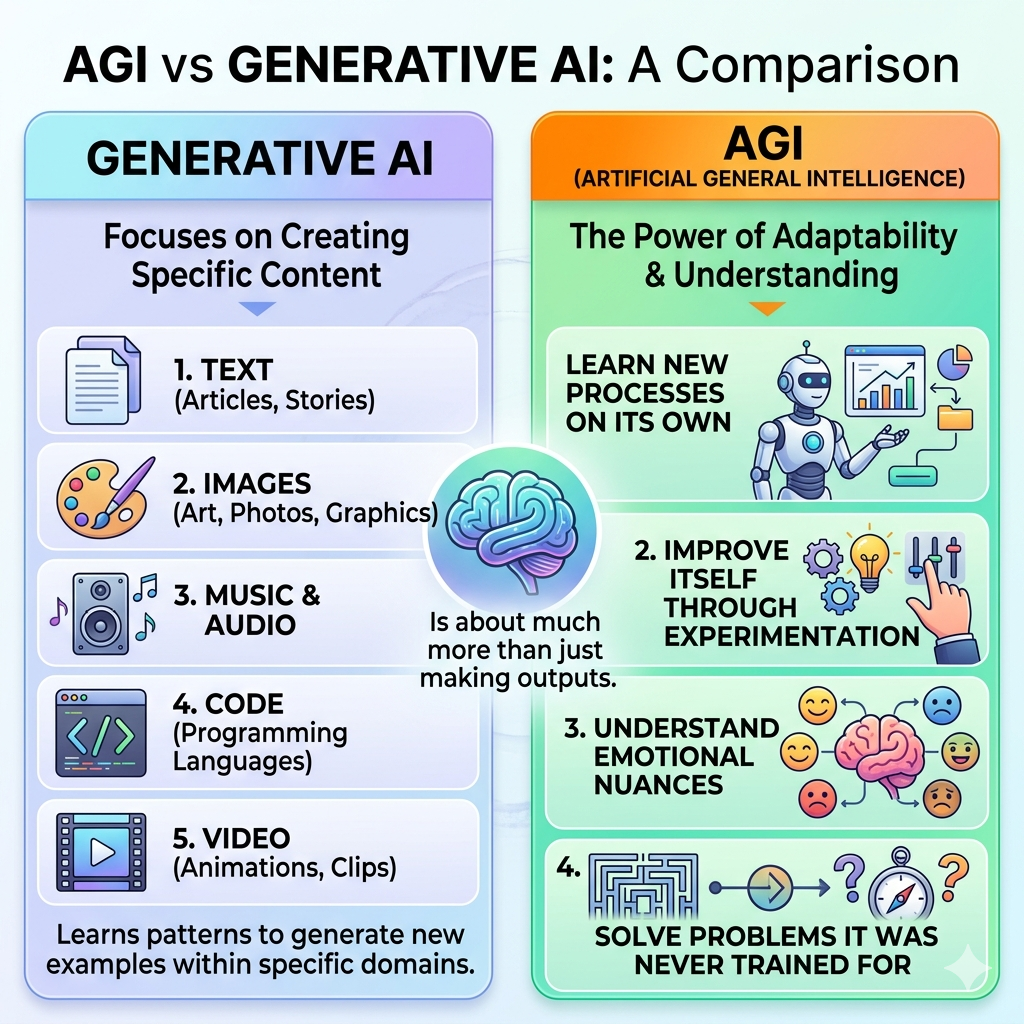
People mix these up constantly.
Generative AI creates content:
- text,
- images,
- music,
- code,
- video.
AGI is about much more than just making outputs.
Picture an AI that can:
- Learn a brand new business process on its own
- Improve itself through experimentation
- Understand emotional nuances
- Solve problems it has never been specifically trained to solve
That’s Artificial General Intelligence territory.
Current models still rely heavily on patterns from training data. They don’t truly “understand” the world the way humans do. They simulate understanding extremely well which, honestly, is why the conversation gets confusing.
The Big Question: Are We Close to Artificial General Intelligence?
Depends on who you ask.
Some AI leaders believe AGI could arrive within this decade. Others argue we’re still missing critical breakthroughs in reasoning, memory consistency, and long-term adaptability.
And there’s a real split happening right now between:
- optimistic AI labs,
- cautious researchers,
- and skeptical engineers actually deploying these systems in production.
That last group is interesting.
Because while demos can look magical, deploying AI at scale often reveals limitations fast:
- hallucinations,
- inconsistency,
- context loss,
- poor long-term planning,
- and reliability issues.
There’s even growing discussion online around the “agentic gap” the difference between impressive benchmarks and dependable real-world autonomy.
So yes, progress is happening quickly. But no, we’re probably not at “machines replacing all human intelligence next year.”
At least not yet.
How Artificial General Intelligence Could Change Industries
This is where things get very real very fast.
Healthcare
AGI-powered systems could eventually assist doctors with:
- diagnosis,
- drug discovery,
- personalized treatment planning,
- and medical research.
Google DeepMind already discusses AI accelerating scientific discovery and molecular research.
Software Development
AI coding assistants are becoming surprisingly capable. Some companies already use AI agents for debugging, testing, and documentation workflows.
If AGI-level systems emerge, software engineering may shift from “writing every line manually” toward supervising intelligent systems.
That’s one reason demand for an Artificial Intelligence engineer course has exploded recently. Companies want professionals who understand both AI systems and real-world deployment.
Education
This one gets overlooked.
An AGI tutor could potentially adapt learning styles in real time for every student individually. Not pre-recorded lessons. Actual personalized instruction.
Honestly, traditional online learning platforms are already evolving in this direction.
Why AI Skills Matter More Than Ever Right Now
This is probably the most practical part of the conversation.
Whether Artificial General Intelligence arrives in 5 years or 15 years, one thing is already clear: AI literacy is becoming a career advantage almost everywhere.
Businesses are hiring people who understand:
- machine learning,
- AI workflows,
- prompt engineering,
- automation,
- data modeling,
- and AI ethics.
That’s exactly why interest in Artificial Intelligence course online programs has surged globally.
And not just among developers.
Marketing teams, finance professionals, healthcare workers, operations managers everyone is trying to understand how AI changes their field.
A lot of learners also prefer structured AI and machine learning courses because the field evolves ridiculously fast. Watching random YouTube videos helps, sure, but guided programs tend to make concepts stick better.
One thing H2K Infosys does particularly well here is bridging theory with practical implementation. And that matters because a lot of AI courses still feel too academic or divorced from real world use in the workplace.
The difference between “learning AI concepts” and “knowing how companies apply AI in production” is huge.
What Makes H2K Infosys Relevant in the AI Learning Space?
There are thousands of AI courses online now. Some are excellent. Some are honestly just repackaged buzzwords.
What learners increasingly want is:
- project-based learning,
- industry-relevant tools,
- mentorship,
- certification guidance,
- and exposure to real-world use cases.
That’s where H2K Infosys has been gaining attention.
Instead of teaching AI like a university theory subject, their approach leans more toward practical implementation:
- machine learning workflows,
- automation tools,
- cloud integration,
- AI engineering concepts,
- and hands-on exercises.
For someone exploring an Artificial Intelligence engineer course, practical exposure matters more than memorizing definitions.
Because employers are asking:
“Can you work with AI systems in real environments?”
Not:
“Can you define neural networks from memory?”
That shift is changing online education fast.
The Ethical Side of AGI Nobody Can Ignore
This part deserves more attention than it usually gets.
If AGI eventually becomes real, society will face difficult questions:
- Who controls it?
- How is it regulated?
- What jobs change?
- What happens if systems become autonomous?
- How do we prevent misuse?
Major AI companies are already publishing safety frameworks and discussing governance publicly.
At the same time, critics argue the industry is moving faster than regulation can keep up.
And honestly… both things can be true.
The technology is advancing rapidly, but global policy frameworks are still catching up.
What Should Students and Professionals Do Right Now?
You don’t need to panic about AGI replacing humanity next Tuesday.
But ignoring AI completely? That’s probably not a smart long-term move either.
The better approach is:
- understand how AI works,
- learn practical AI tools,
- stay informed,
- and build adaptable skills.
A strong Artificial Intelligence course online can help professionals future-proof their careers without needing a full computer science degree.
And for people wanting deeper technical expertise, an Artificial Intelligence engineer course offers a path into one of the fastest-growing areas in tech.
The interesting thing is that companies no longer expect everyone to become hardcore AI researchers. They just want professionals who can work alongside intelligent systems effectively.
That’s a much more achievable goal.
Final Thoughts
Artificial General Intelligence still sits somewhere between breakthrough science and uncertain future speculation. But the direction is obvious: AI systems are becoming more capable, more autonomous, and more integrated into daily work.
The smartest move right now probably isn’t obsessing over whether AGI arrives in 2028 or 2035.
It’s learning how to work with AI before everyone else catches up.
And that’s exactly why demand for quality AI and machine learning courses keeps climbing. Businesses are already transforming workflows around AI tools, automation, and intelligent systems.
The people who understand these technologies early will likely have a major advantage over the next decade.
And honestly? We’re still early enough that learning now can genuinely change your career trajectory.