
If you’re planning to earn a Business Analyst Certification, the short answer is this: most people complete training in anywhere from 4 weeks to 6 months, depending on their schedule, prior experience, and the type of certification they choose. Some learners finish an intensive program in a few weekends, while working professionals often spread their learning over a few months to balance work and study.
And honestly, this is where a lot of people get confused. They assume that becoming a business analyst takes years of technical training. It usually doesn’t. What takes time is learning how businesses actually operate, gathering requirements, understanding stakeholder expectations, analyzing data, and communicating solutions clearly. Training for a Business Analyst Certification provides a structured roadmap that helps learners develop these skills, connect practical knowledge with industry practices, and prepare for a successful business analyst career.
Why Certification Timelines Vary So Much
Not all certifications are built the same. A beginner exploring business analysis courses online will have a very different timeline compared to someone already working in IT, finance, or operations.
A few things affect how long the Training for a Business Analyst Certification takes:
- Your existing professional background
- Whether you study part-time or full-time
- The certification level
- Hands-on project requirements
- Live instructor-led vs self-paced learning.
Someone switching careers from customer support or sales may need more foundational learning. Meanwhile, a project coordinator already dealing with stakeholders daily might move through the material surprisingly fast.
I’ve seen professionals complete an online business analyst certification in under two months simply because they were already doing parts of the job without realizing it.
Typical Training Duration by Certification Type
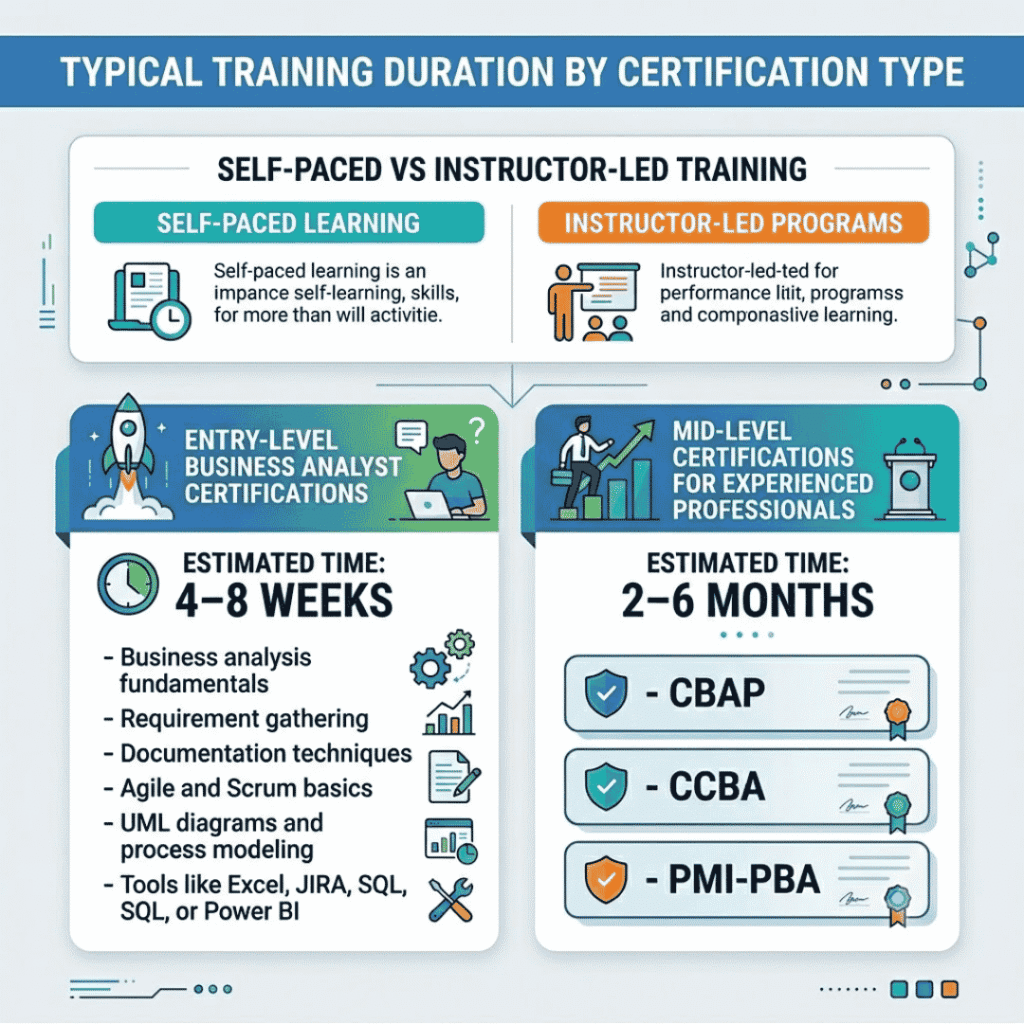
Here’s a more realistic breakdown of what learners usually experience Training for a Business Analyst Certification.
Entry-Level Business Analyst Certifications
Estimated Time: 4–8 Weeks
These are designed for beginners and career changers. Training for a Business Analyst Certification generally covers:
- Business analysis fundamentals
- Requirement gathering
- Documentation techniques
- Agile and Scrum basics
- UML diagrams and process modeling
- Tools like Excel, JIRA, SQL, or Power BI
This is the route many fresh graduates choose because it builds both theory and practical exposure.
Programs from Training for a Business Analyst Certification providers like H2K Infosys are popular partly because they combine certification prep with real-time project simulations. That practical angle matters more now than it did a few years ago. Employers increasingly want candidates who can explain how they solved a business problem, not just list a certification badge on LinkedIn.
Mid-Level Certifications for Experienced Professionals
Estimated Time: 2–6 Months
If you’re pursuing Training for a Business Analyst Certification aligned with frameworks like:
- CBAP
- CCBA
- PMI-PBA
…the timeline stretches because these certifications expect prior business analysis experience.
Most professionals prepare for several months while continuing their full-time jobs. There’s usually:
- deeper case-study work,
- advanced stakeholder management,
- business process optimization,
- and exam-focused preparation is involved.
This isn’t cramming. It’s more about developing analytical thinking.
Self-Paced vs Instructor-Led Training
This decision alone can change your timeline significantly.
Self-Paced Learning
Good for:
- experienced professionals,
- disciplined learners,
- people with unpredictable schedules.
The upside is flexibility. The downside? Many people pause halfway through and never finish. That happens more often than training providers like to admit.
Instructor-Led Programs
These usually move faster because:
- schedules are structured,
- assignments have deadlines,
- mentors answer questions in real time,
- And peer discussions keep motivation high.
A lot of learners pursuing an online Training for a Business Analyst Certification now prefer live virtual classes instead of fully recorded courses. Since remote work exploded globally, interactive online learning has become much more normal and frankly, more effective when done properly.
What You Actually Learn During Business Analyst Training
People sometimes imagine business analysts spend all day building spreadsheets. In reality, modern business analysis is heavily communication-driven.
Most quality business analysis courses include:
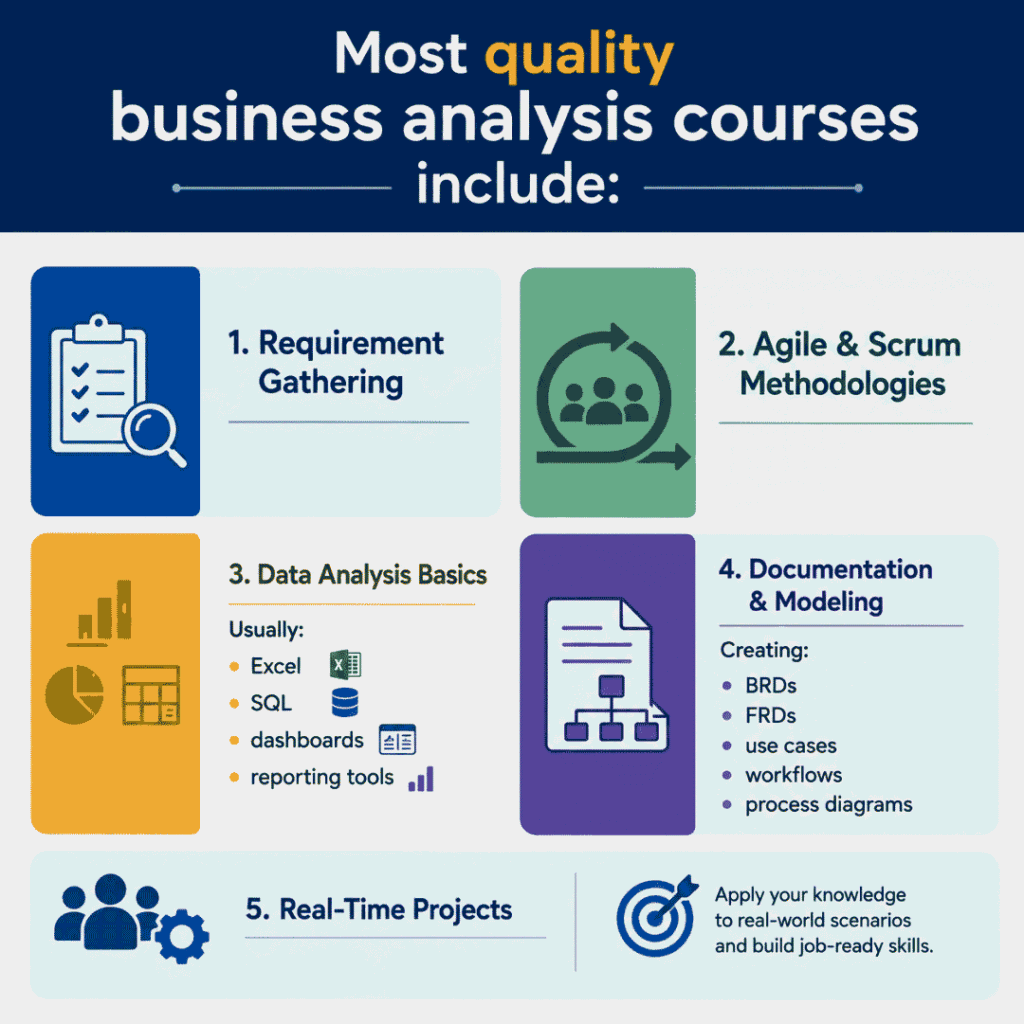
Requirement Gathering
Learning how to talk with stakeholders and identify actual business problems, which sounds simple until you’re in a meeting where five departments want completely different things.
Agile & Scrum Methodologies
Especially important now because many companies operate in Agile environments.
Data Analysis Basics
Usually:
- Excel
- SQL
- dashboards
- reporting tools
Not every business analyst becomes deeply technical, but understanding data is becoming increasingly important.
Documentation & Modeling
Creating:
- BRDs
- FRDs
- use cases
- workflows
- process diagrams
Real-Time Projects
This is the part employers care about most.
A certification without practical exposure can feel incomplete during interviews. Recruiters often ask:
“Can you walk me through a project where you handled stakeholder requirements?”
That’s why training providers emphasizing hands-on projects tend to stand out.
Can You Learn Business Analysis Faster in 2026?
Training for a Business Analyst Certification-Actually, yes.
The learning ecosystem has changed a lot over the past couple of years.
AI-powered analytics tools, smarter dashboards, and automation platforms are reducing some of the repetitive manual work business analysts used to do. But interestingly, companies now value analysts who can interpret business context even more.
In other words:
- Tools got smarter,
- But critical thinking became more valuable.
That’s one reason certifications remain relevant despite all the AI chatter happening lately.
Many newer training programs also integrate:
- AI-assisted reporting,
- modern Agile workflows,
- cloud collaboration tools,
- and real-world case studies from industries like healthcare, banking, and retail.
How Many Hours Per Week Should You Study?
A practical benchmark looks like this: Training for a Business Analyst Certification
| Study Schedule | Approximate Completion Time |
| 5–7 hours/week | 4–6 months |
| 10–15 hours/week | 2–3 months |
| Intensive bootcamp | 4–8 weeks |
Most working professionals fall somewhere in the middle.
And realistically? Consistency matters more than marathon study sessions. Two focused hours after work often beats a distracted eight-hour weekend binge.
Is an Online Business Analyst Certification Worth It?
For many professionals, yes, especially career switchers.
A structured Training for a Business Analyst Certification can help you:
- Organize your learning,
- gain confidence,
- build project experience,
- and prepare for interviews.
The Training for a Business Analyst Certification itself opens some doors. The practical skills open the important ones.
This is where providers like H2K Infosys have a strong reputation with learners moving into tech and business analysis roles. Their programs are more focused on practical implementation, mock interviews, and real-time project environments as opposed to theory-based teachings. “That approach aligns pretty well with what employers are currently valuing in 2026 hiring cycles.
Final Thoughts
So, how long does it take to get the Training for a Business Analyst Certification?
For most students,
- 1-2 months for fast-track basic training,
- 3-6 months prep for more advanced professional certification,
- longer if dealing with work, family, or career changes.
The Training for a Business Analyst Certification timeline matters less than the quality of the learning experience.
A strong program should help you understand how businesses solve problems in the real world, not just help you pass an exam. That’s the difference employers notice during interviews almost immediately.
And honestly, that’s usually the turning point where certification starts feeling less like coursework… and more like a genuine career shift.
FAQ’s – Training for a Business Analyst Certification
How long does it take to complete Business Analyst Certification Training?
The duration of Business Analyst Certification Training depends on the course format, learning pace, and prior experience. Most learners can complete training within a few weeks to a few months with consistent practice.
What skills do I learn during Business Analyst Certification Training?
Business Analyst Certification Training typically covers requirement analysis, BRD/FRD documentation, Agile and Scrum, process modeling, SQL basics, data analysis, and communication skills.
Is Business Analyst Certification enough to get a job?
Certification helps demonstrate knowledge, but employers also look for practical experience, project exposure, tool knowledge, and strong problem-solving skills.
Is Business Analyst Certification Training worth it for beginners?
Yes, certification training helps beginners learn essential business analysis skills such as requirement gathering, documentation, Agile methods, SQL basics, and stakeholder communication.
What is the best way to prepare for Business Analyst Certification Training?
The best way to prepare is to understand business analysis fundamentals, learn key tools, practice requirement documentation, work on real-world case studies, and follow a structured training plan.