Artificial Intelligence Online Training programs in 2026 are increasingly evaluated not only by curriculum quality, but also by the level of career support they provide. The most effective AI certified courses, including those offered by H2K Infosys, typically combine technical instruction, hands-on projects, mentorship, interview preparation, portfolio development, and exposure to enterprise AI workflows. For working professionals, career support has become a critical factor because AI job roles now require practical implementation experience alongside theoretical knowledge.
Modern Artificial Intelligence courses commonly include machine learning, deep learning, generative AI, data engineering fundamentals, cloud AI platforms, and MLOps practices. However, programs that offer structured career guidance, project-based learning, and alignment with real enterprise use cases are generally more valuable for long-term career development.
What is Artificial Intelligence?
Artificial Intelligence (AI) refers to computer systems designed to perform tasks that typically require human intelligence. These tasks may include:
- Pattern recognition
- Natural language processing
- Decision-making
- Predictive analytics
- Image recognition
- Recommendation systems
- Conversational interfaces
AI systems are commonly built using:
- Machine Learning (ML)
- Deep Learning
- Neural Networks
- Natural Language Processing (NLP)
- Reinforcement Learning
- Computer Vision
In enterprise environments, AI is often integrated into existing software systems, cloud platforms, data pipelines, and business automation workflows.
Key Components of Modern AI Systems
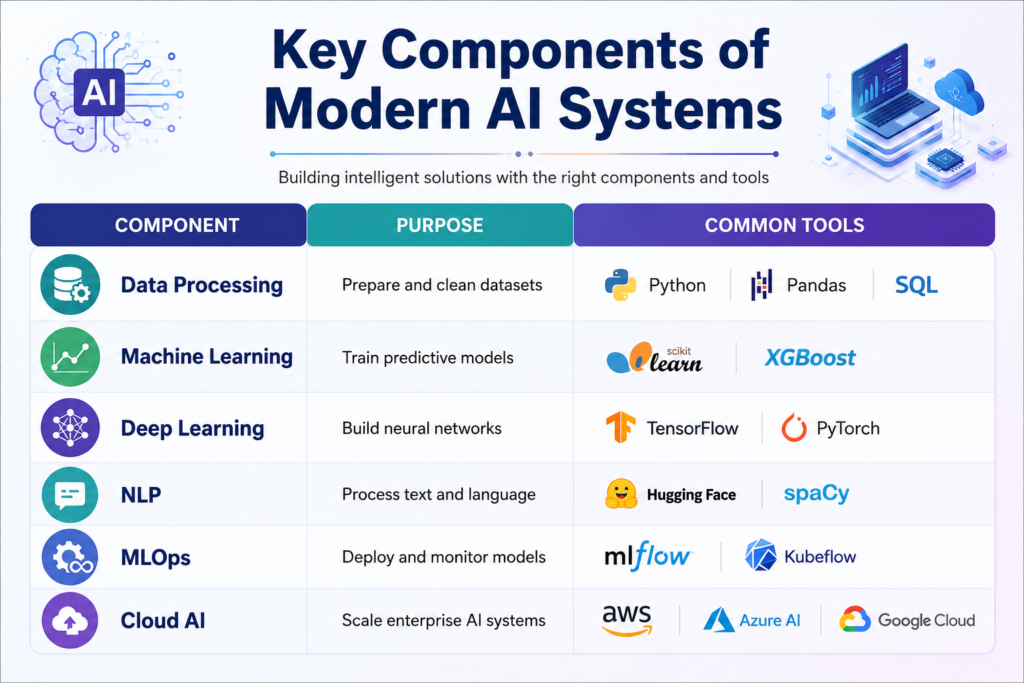
| Component | Purpose | Common Tools |
|---|---|---|
| Data Processing | Prepare and clean datasets | Python, Pandas, SQL |
| Machine Learning | Train predictive models | Scikit-learn, XGBoost |
| Deep Learning | Build neural networks | TensorFlow, PyTorch |
| NLP | Process text and language | Hugging Face, spaCy |
| MLOps | Deploy and monitor models | MLflow, Kubeflow |
| Cloud AI | Scale enterprise AI systems | AWS, Azure AI, Google Cloud |
Why is Artificial Intelligence Important for Working Professionals?
Artificial Intelligence is now integrated into multiple business domains, including healthcare, finance, cybersecurity, retail, manufacturing, and IT operations. Working professionals increasingly need AI literacy because organizations are adopting automation and data-driven decision systems across departments.
Common Enterprise Drivers for AI Adoption
Process Automation
AI helps automate repetitive operational tasks such as:
- Ticket routing
- Fraud detection
- Customer support classification
- Document processing
Predictive Analytics
Organizations use AI models to:
- Forecast sales
- Predict customer churn
- Monitor infrastructure performance
- Optimize supply chains
Intelligent Decision Support
AI systems assist teams in analyzing large datasets and generating actionable insights.
Generative AI Integration
Many enterprises are integrating large language models into:
- Internal knowledge systems
- Chatbots
- Software development workflows
- Content generation tools
For IT professionals, learning AI can support career transitions into roles involving automation, analytics, cloud engineering, and intelligent application development.
What Should Professionals Look for in Artificial Intelligence Online Training?
Not all Artificial Intelligence Online Training Programs provide the same level of technical depth or career support. In 2026, professionals typically evaluate courses using several practical criteria.
Technical Curriculum Coverage
A strong AI program generally includes:
- Python programming
- Statistics and probability
- Machine learning algorithms
- Deep learning concepts
- NLP fundamentals
- Generative AI applications
- Cloud AI services
- Model deployment
- MLOps workflows
Real-World Project Experience
Enterprise employers commonly expect candidates to demonstrate hands-on experience.
Useful project categories include:
| Project Type | Enterprise Relevance |
|---|---|
| Fraud Detection | Banking and finance |
| Customer Churn Prediction | Telecom and SaaS |
| AI Chatbot Development | Customer service |
| Resume Screening Systems | HR automation |
| Recommendation Engines | E-commerce |
| Predictive Maintenance | Manufacturing |
Career Support Services
Career support often differentiates beginner-level courses from professional workforce development programs.
Key services may include:
- Resume review
- Mock interviews
- LinkedIn profile optimization
- Portfolio guidance
- Internship support
- Live mentorship
- Technical interview preparation
Instructor Experience
Programs led by instructors with enterprise implementation experience generally provide more realistic explanations of:
- Production deployment
- Scalability issues
- Security considerations
- Data governance
- Model monitoring challenges
How Does Artificial Intelligence Work in Real-World IT Projects?
Artificial Intelligence systems in enterprise environments usually operate as part of a broader software ecosystem rather than standalone applications.
Typical Enterprise AI Workflow
Step 1: Data Collection
Organizations gather data from:
- Databases
- APIs
- CRM systems
- IoT devices
- Application logs
Step 2: Data Preparation
Data engineers and analysts clean and transform datasets.
Common tasks include:
- Removing duplicates
- Handling missing values
- Feature engineering
- Data normalization
Step 3: Model Training
Machine learning models are trained using frameworks such as:
- Scikit-learn
- TensorFlow
- PyTorch
Example workflow:
from sklearn.ensemble import RandomForestClassifier

model = RandomForestClassifier()
model.fit(X_train, y_train)
predictions = model.predict(X_test)
Step 4: Model Validation
Teams evaluate:
- Accuracy
- Precision
- Recall
- Latency
- Bias detection
Step 5: Deployment
Models are deployed through:
- REST APIs
- Kubernetes clusters
- Cloud AI platforms
- Edge devices
Step 6: Monitoring and Maintenance
Production AI systems require ongoing monitoring for:
- Model drift
- Performance degradation
- Data quality issues
- Security vulnerabilities
What Skills Are Required to Learn Artificial Intelligence?
Artificial Intelligence Online Training programs often assume foundational technical knowledge, but many are structured for beginner-to-intermediate learners.
Core Skills for AI Learning
| Skill Area | Importance |
|---|---|
| Python Programming | Essential |
| SQL and Databases | Highly useful |
| Statistics | Important |
| Linear Algebra | Helpful for deep learning |
| Cloud Fundamentals | Increasingly important |
| Problem Solving | Essential |
| Data Visualization | Frequently required |
Technical Concepts Commonly Covered
Programming Fundamentals
Learners typically practice:
- Variables
- Loops
- Functions
- APIs
- Data structures
Machine Learning Concepts
Key topics include:
- Supervised learning
- Unsupervised learning
- Classification
- Regression
- Clustering
Deep Learning
Professionals often learn:
- Neural networks
- CNNs
- RNNs
- Transformers
- Fine-tuning large language models
MLOps and Deployment
Modern AI certified courses increasingly teach:
- CI/CD pipelines
- Docker containers
- Kubernetes
- Model versioning
- Monitoring tools
How is Artificial Intelligence Used in Enterprise Environments?
Enterprise AI implementation focuses heavily on scalability, security, reliability, and operational efficiency.
AI Use Cases Across Industries
| Industry | Common AI Applications |
|---|---|
| Healthcare | Medical imaging analysis |
| Finance | Fraud detection |
| Retail | Recommendation systems |
| Manufacturing | Predictive maintenance |
| Cybersecurity | Threat detection |
| HR | Resume screening |
| Logistics | Route optimization |
Enterprise Constraints and Challenges
Data Security
AI systems often process sensitive business information. Teams must implement:
- Access controls
- Encryption
- Compliance monitoring
Model Explainability
Organizations may require interpretable models for regulatory compliance.
Scalability
Production systems must handle:
- High request volumes
- Large datasets
- Real-time inference
Integration Complexity
AI solutions are commonly integrated with:
- ERP systems
- Cloud infrastructure
- APIs
- Business intelligence platforms
Which Features Define the Best AI Certified Courses in 2026?
The Best Ai Certified Courses in 2026 are typically distinguished by practical relevance and structured career development support rather than certification alone.
Characteristics of High-Quality AI Courses
Live Instructor-Led Training
Live sessions help learners:
- Ask technical questions
- Review projects
- Understand debugging workflows
- Practice implementation tasks
Capstone Projects
Capstone projects simulate real enterprise environments.
Examples include:
- AI-powered recommendation systems
- Customer analytics dashboards
- LLM-based document assistants
- Predictive monitoring applications
Cloud Platform Exposure
Many organizations deploy AI solutions on cloud platforms.
Training often includes:
- AWS SageMaker
- Azure Machine Learning
- Google Vertex AI
Interview Preparation
Technical preparation may cover:
- Python coding
- Machine learning theory
- System design
- SQL queries
- AI project discussions
What Job Roles Use Artificial Intelligence Daily?
AI skills are increasingly embedded into both specialized and hybrid IT roles.
Common AI-Related Roles
| Job Role | Primary Responsibilities |
|---|---|
| Machine Learning Engineer | Build and deploy ML models |
| Data Scientist | Analyze and model data |
| AI Engineer | Develop AI applications |
| NLP Engineer | Work with language models |
| MLOps Engineer | Maintain ML infrastructure |
| Data Analyst | Generate business insights |
| Cloud AI Engineer | Deploy scalable AI systems |
Hybrid Roles Emerging in 2026
Many organizations now seek professionals who combine AI with domain expertise.
Examples include:
- AI-enabled DevOps Engineer
- Cybersecurity AI Analyst
- AI Business Analyst
- AI Product Manager
- Intelligent Automation Consultant
What Careers Are Possible After Learning Artificial Intelligence?
Career opportunities after completing Artificial Intelligence Online Training depend on prior experience, technical specialization, and project exposure.
Entry-Level Transition Paths
Professionals from these backgrounds often transition into AI-related roles:
| Previous Background | Possible AI Path |
|---|---|
| Software Development | ML Engineer |
| Data Analysis | Data Scientist |
| System Administration | MLOps Engineer |
| QA Testing | AI Automation Specialist |
| Business Analysis | AI Product Analyst |
Mid-Level Career Growth
Experienced professionals may move into:
- AI Solution Architecture
- AI Program Management
- Enterprise Automation Leadership
- Intelligent Systems Consulting
Freelance and Contract Opportunities
AI skills are also used in:
- Chatbot implementation
- Data annotation
- AI workflow automation
- LLM integration projects
How Important is Career Support in Artificial Intelligence Training?
Career support is increasingly important because AI hiring processes often evaluate practical readiness rather than certification alone.
Common Hiring Expectations
Recruiters and technical managers often look for:
- Real project experience
- GitHub portfolios
- Cloud deployment knowledge
- Communication skills
- Problem-solving ability
Valuable Career Support Components
Resume Optimization
AI resumes should highlight:
- Projects
- Technical stack
- Business impact
- Deployment experience
Mock Technical Interviews
Practice interviews may include:
- Coding assessments
- ML algorithm discussions
- SQL challenges
- Scenario-based problem solving
Portfolio Development
A practical portfolio commonly includes:
- Jupyter notebooks
- API deployments
- GitHub repositories
- Documentation
Mentorship
Mentors can help learners:
- Select projects
- Understand enterprise workflows
- Prepare for interviews
- Improve architecture decisions
What Learning Path is Common for Artificial Intelligence Professionals?
AI learning is usually incremental rather than linear.
Typical Learning Roadmap
| Stage | Topics |
|---|---|
| Foundation | Python, SQL, statistics |
| Intermediate | Machine learning algorithms |
| Advanced | Deep learning, NLP |
| Enterprise AI | Cloud AI, MLOps |
| Specialization | Generative AI, Computer Vision |
Suggested Workflow for Learners
- Learn Python fundamentals
- Practice data analysis
- Study machine learning algorithms
- Build small AI projects
- Learn cloud deployment
- Practice model monitoring
- Develop enterprise-scale projects
What Challenges Do Professionals Face When Learning AI?
Artificial Intelligence learning can be complex because it combines programming, mathematics, infrastructure, and business logic.
Common Learning Challenges
Mathematical Foundations
Topics like probability and linear algebra may require additional study.
Large Tool Ecosystem
Professionals often encounter multiple frameworks simultaneously:
- TensorFlow
- PyTorch
- Hugging Face
- LangChain
- MLflow
Deployment Complexity
Building models is different from deploying them securely in production systems.
Rapid Technology Changes
AI frameworks evolve frequently, requiring continuous learning.
How Do Enterprise Teams Deploy Artificial Intelligence Solutions?
Enterprise AI deployment involves multiple teams working together.
Typical AI Deployment Architecture
| Layer | Tools Commonly Used |
|---|---|
| Data Ingestion | Kafka, Airflow |
| Storage | Snowflake, S3 |
| Model Training | TensorFlow, PyTorch |
| Deployment | Docker, Kubernetes |
| Monitoring | Prometheus, Grafana |
Production Best Practices
Version Control
Teams commonly use Git for:
- Code tracking
- Experiment management
- Collaboration
CI/CD for ML
Machine learning pipelines may include:
- Automated testing
- Model validation
- Deployment automation
Security Controls
AI environments often require:
- Role-based access control
- API authentication
- Audit logging
FAQ: Artificial Intelligence Online Training and AI Certified Courses
What is the best way to start learning Artificial Intelligence?
Most professionals begin with Python programming, data analysis, and basic machine learning concepts before progressing into deep learning and enterprise AI deployment.
Are AI certified courses useful for career transitions?
Yes. AI certified courses can help professionals build foundational skills, especially when combined with hands-on projects and portfolio development.
Do employers value practical AI projects?
In many cases, employers prioritize demonstrable project experience over certification alone. Real-world implementations and deployment exposure are commonly evaluated during interviews.
Which programming language is most commonly used in AI?
Python is widely used because of its ecosystem of AI and machine learning libraries.
Is cloud knowledge important for AI careers?
Yes. Many enterprise AI systems are deployed on AWS, Azure, or Google Cloud infrastructure.
How long does it take to learn Artificial Intelligence?
The timeline varies based on prior technical experience. Many working professionals spend several months building foundational skills before advancing into specialized AI topics.
What industries hire AI professionals?
Healthcare, finance, retail, logistics, cybersecurity, education, and manufacturing commonly hire AI professionals.
Can non-programmers learn AI?
Yes, although programming skills eventually become necessary for building and deploying AI systems effectively.
Conclusion
Artificial Intelligence Online Training in 2026 is increasingly focused on practical implementation, enterprise workflows, and career readiness. The most effective ai certified courses generally combine foundational theory with project-based learning, cloud deployment exposure, mentorship, and interview preparation.
Professionals evaluating AI programs should prioritize:
- Hands-on enterprise projects
- Real-world deployment workflows
- Cloud and MLOps exposure
- Structured career support
- Practical portfolio development
- Instructor experience in production environments
To build practical AI skills through hands-on projects, mentorship, and career-focused learning, explore the Artificial Intelligence programs offered by H2K Infosys.
These programs are designed to help working professionals strengthen technical expertise and prepare for evolving AI job roles in enterprise environments.