H2K Infosys offers online artificial intelligence training designed to prepare learners for Crack AI Job Interviews by developing practical, hands-on skills in machine learning, deep learning, data processing, model deployment, and problem-solving. A well-structured Artificial intelligence Engineer Course typically combines theoretical concepts with real-world projects, which can make a significant difference during technical interviews. Instead of merely memorizing definitions, learners gain a clear understanding of how AI systems are built, trained, tested, evaluated, and deployed in real enterprise environments. environments.
Crack AI Job Interviews It also prepares candidates for a technical interview with coding exercises, project-based learning, workflow discussions, and exposure to real-world use cases of AI that companies actually deal with.
Today’s AI hiring is all about applied knowledge, meaning employers are looking for people who can solve real-world business problems, not just recite textbook definitions. Interviews typically include questions on model selection, data handling, algorithm reasoning, Python coding, cloud-based AI workflows and deployment approaches.
What Is Artificial Intelligence Online Training?
Basically, artificial intelligence online training is a well-structured educational course provided through virtual platforms that teaches on AI concepts, frameworks, tools and ways of implementation. It is commonly used by:
- Software developers
- Data analysts
- DevOps engineers
- Cloud professionals
- Business analysts
- IT graduates
- Working professionals moving into AI-focused roles
A modern artificial intelligence engineer course usually covers areas like:
| Learning Area | Topics Covered |
|---|---|
| Programming Foundations | Python, NumPy, Pandas |
| Machine Learning | Regression, classification, clustering |
| Deep Learning | Neural networks, CNNs, RNNs |
| AI Frameworks | TensorFlow, PyTorch, Scikit-learn |
| Data Engineering Basics | ETL, feature engineering |
| Model Deployment | APIs, Docker, cloud deployment |
| MLOps Concepts | CI/CD for AI pipelines |
| Interview Preparation | Coding, case studies, project discussions |
The strongest programs focus less on passive learning and more on implementation. That’s usually where candidates gain confidence.
Why AI Matters for Working Professionals
Artificial intelligence is now deeply integrated into enterprise systems automation platforms, cybersecurity tools, cloud environments, analytics pipelines, customer support systems, pretty much everywhere. Companies use AI-driven workflows to improve efficiency, forecasting, personalization, and operational decision-making.
Professionals with AI knowledge are increasingly involved in projects like:
- Predictive analytics
- Intelligent automation
- Recommendation engines
- Fraud detection systems
- NLP-based support platforms
- Computer vision applications
And honestly, AI knowledge is no longer limited to research teams or data scientists. Enterprise IT teams now expect developers, analysts, and engineers to at least understand AI-assisted workflows and automation concepts.
Industries actively using AI include:
- Healthcare
- Finance
- Retail
- Manufacturing
- Telecommunications
- Logistics
- Insurance
- E-commerce
How Artificial Intelligence Works in Real IT Projects
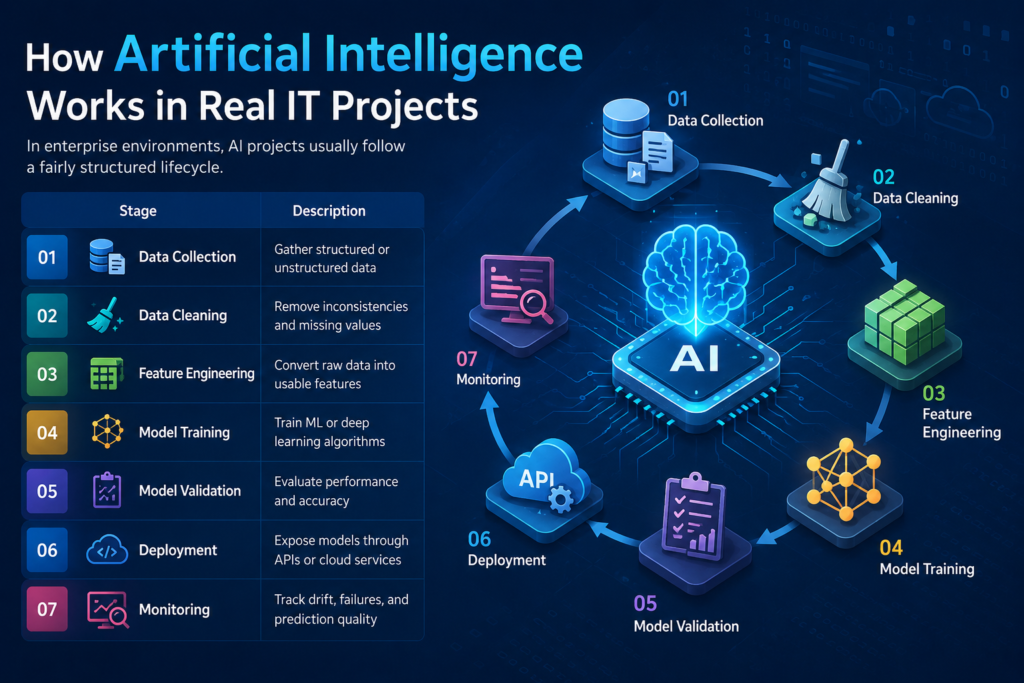
In enterprise environments, AI projects usually follow a fairly structured lifecycle.
| Stage | Description |
|---|---|
| Data Collection | Gather structured or unstructured data |
| Data Cleaning | Remove inconsistencies and missing values |
| Feature Engineering | Convert raw data into usable features |
| Model Training | Train ML or deep learning algorithms |
| Model Validation | Evaluate performance and accuracy |
| Deployment | Expose models through APIs or cloud services |
| Monitoring | Track drift, failures, and prediction quality |
Take customer support AI as an example.
A company might collect thousands of historical support tickets, train an NLP model to categorize issues automatically, integrate it into a CRM system, and then continuously monitor prediction accuracy in production. Sounds straightforward on paper but in practice, there are always messy datasets, unexpected edge cases, deployment challenges, and retraining issues.
That’s why hands-on labs matter so much in an artificial intelligence engineer course.
Crack AI Job Interviews with AI Online Training Helps
Crack AI Job Interviews can be surprisingly practical. Most companies test whether candidates can actually apply concepts instead of just repeating terminology.
1. Stronger Technical Foundations
Interviewers commonly ask about:
- Machine learning algorithms
- Neural networks
- Overfitting vs underfitting
- Feature engineering
- Evaluation metrics
- Bias-variance tradeoff
- Optimization techniques
Structured training programs help learners understand how these concepts work in real scenarios instead of relying on memorized definitions.
2. Better Python Skills
Python remains the dominant language for AI development, and most AI interviews involve coding in some form.
A simple example might look like this:
from sklearn.linear_model import LogisticRegression

model = LogisticRegression()
model.fit(X_train, y_train)

predictions = model.predict(X_test)
Candidates are often expected to explain:
- Data preprocessing steps
- DataFrame handling
- Functions and loops
- Training workflows
- API integration basics
Good AI courses usually include notebook-based coding labs, which helps people get comfortable writing and debugging code under pressure.
3. Hands-On Project Experience
This part is huge during interviews.
AI interviewers frequently ask candidates to walk through projects in detail:
- Why was a certain algorithm selected?
- What challenges appeared during preprocessing?
- How was model tuning handled?
- What deployment strategy was used?
- Which performance metrics mattered most?
People who’ve actually worked on projects tend to answer naturally. You can usually tell when someone genuinely struggled through implementation versus someone who only watched tutorials.
Common training projects include:
| Project Type | Skills Demonstrated |
|---|---|
| Sentiment Analysis | NLP, text preprocessing |
| Fraud Detection | Classification algorithms |
| Recommendation Systems | Collaborative filtering |
| Image Classification | CNNs, TensorFlow |
| Predictive Analytics | Regression techniques |
Familiarity With Industry Tools
Enterprise AI teams rarely rely on a single toolset.
Common technologies include:
| Category | Tools |
|---|---|
| Programming | Python, Jupyter Notebook |
| ML Frameworks | Scikit-learn, TensorFlow, PyTorch |
| Data Processing | Pandas, NumPy |
| Visualization | Matplotlib, Seaborn |
| Cloud AI Services | AWS SageMaker, Azure AI, Google Vertex AI |
| Deployment | Docker, FastAPI |
| Version Control | Git, GitHub |
Interviewers often ask why certain tools were selected or how workflows were integrated together.
And honestly, being able to explain tool choices calmly and clearly can leave a stronger impression than trying to sound overly technical.
Understanding AI System Design
For mid-level and senior roles, interviews often move beyond algorithms into architecture and scalability discussions.
Topics may include:
- Designing scalable ML pipelines
- Managing large datasets
- Model retraining workflows
- Monitoring model drift
- API-based deployments
- Real-time inference systems
This is where online training with deployment-focused labs becomes valuable. Academic theory alone usually doesn’t prepare people for these discussions.
Skills Needed to Start an AI Engineer Course
A lot of beginners assume AI requires advanced mathematics from day one. That’s not always true.
Helpful prerequisites include:
| Skill Area | Importance |
|---|---|
| Basic Python | Essential |
| Statistics Fundamentals | Helpful |
| SQL Basics | Useful |
| Data Analysis | Recommended |
| Problem Solving | Important |
| Cloud Basics | Advantageous |
Most professionals start with machine learning fundamentals and gradually move into deep learning, deployment, and MLOps topics over time.
AI in Enterprise Environments
Enterprise AI focuses heavily on scalability, governance, automation, and business integration.
Common use cases include:
Intelligent Automation
- Invoice processing
- Ticket routing
- Document classification
- HR screening
Predictive Analytics
- Customer churn forecasting
- Equipment failure prediction
- Demand forecasting
- Risk analysis
Cybersecurity
- Suspicious login detection
- Malware analysis
- Fraud monitoring
- Network anomaly detection
Generative AI
- AI copilots
- Chatbots
- Knowledge assistants
- Automated summarization systems
In real enterprise environments, AI professionals also need to think about:
- Data privacy
- Compliance requirements
- Infrastructure costs
- Explainability
- Scalability constraints
That practical mindset often separates strong interview candidates from average ones.
Common Topics in AI Interviews
Certain technical areas appear repeatedly across AI interviews.
| Topic | Common Questions |
|---|---|
| Machine Learning | Supervised vs unsupervised learning |
| Statistics | Standard deviation, probability |
| Deep Learning | Backpropagation concepts |
| NLP | Tokenization, embeddings |
| Computer Vision | CNN architecture |
| Python | Preprocessing functions |
| SQL | Querying filtered datasets |
| Model Evaluation | Precision vs recall |
Crack AI Job Interviews interviewers may also present scenario-based questions like:
- How would you reduce overfitting?
- What would you do with missing data?
- How would you improve model accuracy?
- How would you deploy this model to production?
- How would you monitor performance drift?
People with project exposure usually handle these conversations more comfortably because they’ve seen similar issues before.
AI Career Roles
AI knowledge supports a wide range of technical roles.
| Job Role | Primary Responsibilities |
|---|---|
| AI Engineer | Build and deploy AI systems |
| Machine Learning Engineer | Train and optimize models |
| Data Scientist | Analyze and interpret data |
| NLP Engineer | Develop language-processing systems |
| Computer Vision Engineer | Build image-analysis systems |
| AI Product Analyst | Connect AI with business needs |
| MLOps Engineer | Manage deployment pipelines |
Many professionals transition into AI from software development, cloud engineering, DevOps, or analytics backgrounds. It’s actually a pretty common path now.
Typical AI Interview Process
Most AI hiring processes involve multiple rounds.
| Interview Round | Focus Area |
|---|---|
| Screening Round | Resume and project discussion |
| Coding Assessment | Python and problem-solving |
| ML Fundamentals | Algorithms and statistics |
| System Design | Scalable AI workflows |
| Managerial Round | Communication and collaboration |
| Final Evaluation | Project depth and applied thinking |
Candidates who understand both theory and implementation usually perform better, especially in later rounds where discussions become more practical.
Common Challenges During AI Interview Preparation
A few patterns show up repeatedly among beginners.
Too Much Theory
Some candidates spend months memorizing concepts but struggle to explain how systems actually work.
Limited Project Experience
Interviewers often want implementation details, not just surface-level explanations.
Weak Coding Skills
Python proficiency matters more than many people initially expect.
Lack of Deployment Knowledge
Modern Crack AI Job Interviews increasingly include cloud deployment and MLOps discussions.
Fragmented Learning
Self-learning without structure can create knowledge gaps that become obvious during interviews.
A structured artificial intelligence engineer course helps reduce these issues by providing guided projects, practical exercises, and workflow-oriented learning.
What to Look for in the Best Artificial Intelligence Course Online
Not every AI course offers the same depth or industry relevance.
Important factors include:
| Criteria | Why It Matters |
|---|---|
| Hands-On Projects | Demonstrates practical skills |
| Industry Tools | Aligns with enterprise environments |
| Instructor Expertise | Improves clarity |
| Interview Preparation | Supports job readiness |
| Cloud & Deployment Topics | Reflects real AI workflows |
| Updated Curriculum | Keeps pace with evolving tools |
Courses that include real datasets, deployment exercises, GitHub portfolio guidance, and end-to-end projects tend to provide stronger career value.
Why Cloud and MLOps Skills Matter
Modern AI systems almost never run in isolated environments anymore.
Enterprise teams commonly use:
- AWS SageMaker
- Azure Machine Learning
- Google Vertex AI
- Kubernetes
- Docker
- CI/CD pipelines
MLOps helps organizations:
- Automate deployments
- Monitor model drift
- Scale inference systems
- Improve reproducibility
- Maintain governance standards
Candidates who understand deployment workflows are often viewed as more production-ready during hiring discussions.
Frequently Asked Questions
Is an artificial intelligence engineer course suitable for beginners?
Yes. Many programs begin with Python, data analysis, and machine learning fundamentals before moving into advanced topics.
Which programming language is most important for AI interviews?
Python is still the primary language used across AI and machine learning workflows.
Do AI interviews require advanced mathematics?
Most entry-level roles focus more on practical understanding of statistics and machine learning concepts rather than highly advanced mathematics.
Are projects important during AI interviews?
Absolutely. Crack AI Job Interviews often evaluate how candidates approach preprocessing, model training, evaluation, and deployment challenges.
Which industries hire AI professionals?
Healthcare, finance, cybersecurity, retail, logistics, manufacturing, insurance, and e-commerce are all actively hiring AI talent.
Key Takeaways
Artificial intelligence online training helps candidates build practical, implementation-focused AI skills. A structured artificial intelligence engineer course supports Crack AI Job Interviews preparation through coding practice, projects, workflow understanding, and exposure to real enterprise tools.
AI interviews increasingly test practical problem-solving, deployment awareness, Python skills, and system design thinking not just theory.
The Best Artificial Intelligence Course Online focuses on hands-on learning, real-world workflows, cloud integration, and portfolio-building experience that employers can actually evaluate.
Crack AI Job Interviews H2K Infosys Artificial Intelligence courses help learners gain practical exposure to modern AI tools, enterprise workflows, deployment strategies, and interview preparation techniques that align with real industry expectations.