The software industry is evolving rapidly, and one of the most transformative changes in recent years has been the integration of artificial intelligence (AI) into quality assurance (QA) testing. Traditional testing methods are being enhanced or even replaced by AI-powered tools that can automate repetitive tasks, predict defects, and improve overall software quality.
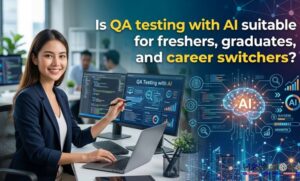
This shift naturally raises an important question: Is QA testing with AI a viable career option for freshers, recent graduates, and people looking to switch careers? The short answer is yes but with some important nuances.
In this blog, we’ll explore how AI is changing QA testing, what skills are required, and whether this career path is suitable for different types of learners and professionals.
Understanding QA Testing with AI
Before diving into suitability, it’s important to understand what QA testing with AI actually means.
Traditionally, QA testers manually check software for bugs, performance issues, and usability problems. Automation testing later emerged, where scripts were written to execute tests automatically.
Now, AI takes this a step further by:
- Automatically generating test cases
- Predicting high-risk areas in code
- Self-healing test scripts when UI changes
- Analyzing test results faster and more accurately
- Reducing human effort in repetitive tasks
This evolution makes QA more efficient but also changes the skillset required.
Why QA with AI Is Gaining Popularity
AI-powered QA is not just a trend; it’s becoming a necessity in modern software development. Here’s why:
1. Faster Development Cycles
Companies are releasing updates more frequently. AI helps testers keep up with rapid development by automating large portions of testing.
2. Improved Accuracy
AI can detect patterns and anomalies that humans might miss, leading to higher-quality software.
3. Cost Efficiency
Reducing manual effort saves time and operational costs for organizations.
4. Scalability
AI tools can handle large volumes of testing across multiple platforms simultaneously.
Because of these advantages, companies are increasingly looking for QA professionals who understand AI-assisted testing.
Is QA with AI suitable for freshers?
For freshers entering the tech industry, QA testing with AI can be an excellent starting point.
Advantages for Freshers
1. Lower Entry Barrier Compared to Development
Unlike software development, QA doesn’t always require deep coding expertise at the beginning. Freshers can start with basic testing concepts and gradually move into automation and AI.
2. Hands-On Learning Opportunities
Many AI-powered testing tools are user-friendly and don’t require extensive programming knowledge initially.
3. Growing Demand
Organizations are actively hiring testers who are willing to learn modern tools, including AI-based platforms.
Challenges for Freshers
- Understanding AI concepts can feel overwhelming at first
- Requires continuous learning and adaptability
- Basic programming knowledge (like Python or Java) becomes important over time
Verdict for Freshers
Yes, QA testing with AI is suitable, especially for those who are curious, willing to learn, and open to working with evolving technologies.
Is QA with AI Suitable for Graduates?
Graduates, particularly those from computer science or related fields, are in a strong position to enter AI-driven QA roles.
Why Graduates Have an Advantage
1. Technical Foundation
Graduates often already understand programming, databases, and software development life cycles.
2. Easier Transition to Automation
With some coding background, learning automation tools like Selenium or AI-based testing frameworks becomes easier.
3. Better Career Growth Opportunities
Graduates can quickly move from manual testing to automation and then to AI-based testing roles.
What Graduates Should Focus On
- Learning automation tools (Selenium, Playwright, Cypress)
- Understanding AI basics (machine learning concepts, data handling)
- Familiarity with CI/CD pipelines
- Exploring AI testing tools (like Testim, Applitools, or Functionize)
Verdict for Graduates
QA with AI is not only suitable; it’s one of the smartest career paths, offering strong growth and future-proof opportunities.
Is QA with AI appropriate for career switchers?
For professionals looking to transition into tech, QA testing with AI can be a highly accessible entry point.
Why It Works for Career Switchers
1. Easier Transition Compared to Coding Roles
Switching directly into software development can be challenging. QA offers a smoother entry into the tech ecosystem.
2. Transferable Skills
Many non-tech professionals already have relevant skills:
- Analytical thinking
- Attention to detail
- Problem-solving
- Process-oriented mindset
These are essential in QA.
3. Step-by-Step Learning Path
Career switchers can start with:
- Manual testing → Automation → AI-based testing
Challenges for Career Switchers
- Learning technical concepts from scratch
- Understanding programming basics
- Adapting to fast-changing tools and technologies
Tips for Career Switchers
- Start with fundamentals of software testing
- Learn one programming language (Python is a great choice)
- Practice with real-world projects
- Take online courses focused on AI in QA
Verdict for Career Switchers
Absolutely suitable, especially for those willing to invest time in learning and building practical skills.
Skills Required for QA Testing with AI
Regardless of your background, certain skills are essential to succeed in this field.
1. Testing Fundamentals
- Types of testing (manual, automation, performance, etc.)
- Test case design
- Bug tracking and reporting
2. Programming Knowledge
- Basic understanding of Python, Java, or JavaScript
- Writing and maintaining test scripts
3. Automation Tools
- Selenium
- Cypress
- Playwright
4. AI and Machine Learning Basics
- Understanding how AI models work (at a conceptual level)
- Data-driven testing approaches
5. Analytical Thinking
- Identifying edge cases
- Predicting potential failures
6. Familiarity with AI Testing Tools
- Testim
- Applitools (visual testing)
- Mabl
- Functionize
Career Opportunities in AI-Powered QA
The demand for AI-enabled QA professionals is increasing across industries.
Common Job Roles
- QA Analyst
- Automation Test Engineer
- AI Test Engineer
- Software Test Engineer
- QA Lead (with AI expertise)
Industries Hiring
- IT services
- E-commerce
- FinTech
- Healthcare tech
- SaaS companies
Salary Potential
While salaries vary by region and experience, professionals with AI testing skills often earn more than traditional QA testers due to their specialized expertise.
Pros and Cons of Choosing QA with AI
Pros
- High demand in the job market
- Faster entry into the tech industry
- Continuous learning and growth
- Opportunity to work with cutting-edge technology
Cons
- Requires ongoing upskilling
- AI tools can change rapidly
- Some roles may still require coding expertise
- Initial learning curve for non-tech backgrounds
How to Get Started
If you’re convinced this path is right for you, here’s a simple roadmap:
Step 1: Learn Testing Basics
Understand SDLC, STLC, and manual testing concepts.
Step 2: Learn Programming
Start with Python or Java.
Step 3: Explore Automation
Practice tools like Selenium or Cypress.
Step 4: Learn AI Concepts
Focus on basics—no need to become a data scientist.
Step 5: Practice with Projects
Build small projects or contribute to open-source testing.
Step 6: Learn AI Testing Tools
Experiment with modern tools that integrate AI.
Final Thoughts
QA testing with AI is not just a niche skill; it’s becoming a standard in modern software development. Whether you’re a fresher exploring your first job, a graduate planning your career, or a professional looking to switch fields, this domain offers strong opportunities.
The key is to approach it step by step. You don’t need to master everything at once. Start with fundamentals, build your skills gradually, and stay updated with industry trends.