If you’re planning to enter the BA field in 2026, knowing only theory is no longer enough. Recruiters now expect candidates to be comfortable with real-world Business Analyst Tools like Jira, SQL, Power BI, Excel, Tableau, and Confluence before they even attend the final interview round. That’s honestly one of the biggest reasons why many learners now prefer Business analyst online training programs that include hands-on projects instead of just recorded theory sessions.
A few years ago, companies were okay with hiring freshers and training them later. That has changed a lot. Most organisations want “project-ready” candidates from day one. Especially after AI tools started automating repetitive reporting tasks, businesses are focusing more on analysts who can work with data, communicate requirements clearly, and collaborate using modern project tools.
I noticed something interesting while speaking with a couple of recruiters recently. They said resumes mentioning practical exposure to Jira dashboards or Power BI reports are getting shortlisted faster than resumes that only list certifications. That tells you where the industry is heading. H2K Infosys has also been emphasising this industry-focused, hands-on learning approach to help candidates become job-ready with practical exposure.
Why Business Analyst Tools Matter More in 2026
Business Analysts today sit between business teams, developers, QA teams, and sometimes even AI automation platforms. So companies expect candidates to understand both communication and technology.
For example:
- Jira can help a healthcare company track feature requests.
- A banking project might heavily rely on SQL queries for reporting.
- Power BI dashboards are commonly used by retail businesses for customer analytics.
- Agile teams collaborate daily using Confluence documentation.
You can have the best theoretical knowledge, but without being exposed to tools, you will feel incomplete during placements.
Top Business Analyst Tools
That’s why many Ba training and placement programs now focus heavily on live tool practice instead of only classroom explanations.
1. Jira – Still the Most Requested BA Tool
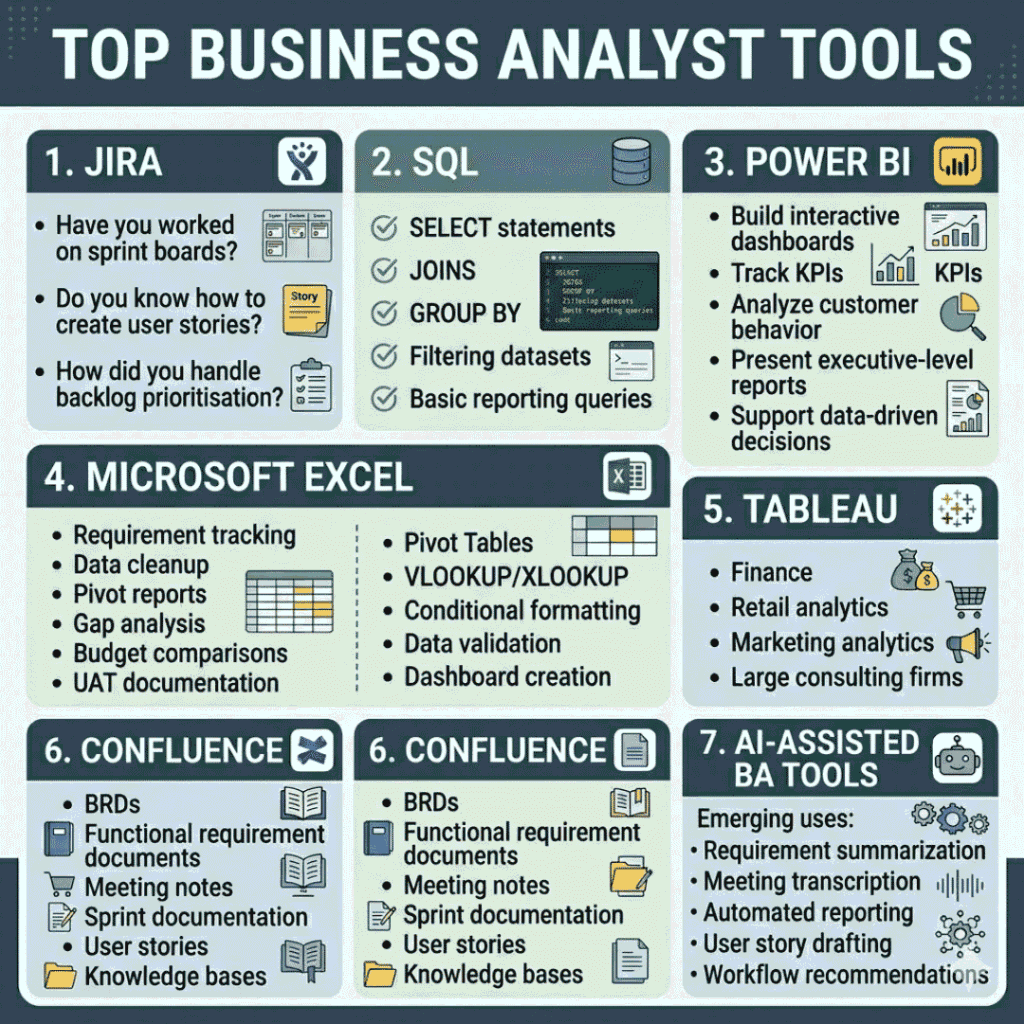
If there’s one tool you absolutely cannot ignore in 2026, it’s Jira.
Agile projects dominate almost every industry now, healthcare, fintech, insurance, e-commerce, even government tech projects. Jira helps teams track tasks, user stories, sprint planning, and bug reporting.
Interviewers often ask questions like:
- “Have you worked on sprint boards?”
- “Do you know how to create user stories?”
- “How did you handle backlog prioritisation?”
And honestly, answering these confidently becomes easier if you’ve practised on real Jira environments during Business Analyst online training.
One learner I spoke to recently said their placement interviewer literally opened a Jira workflow screen and asked them to explain how requirements move through the Agile lifecycle. That’s becoming common now.
2. SQL – The Skill Recruiters Quietly Expect
A lot of beginners assume coding is mandatory for Business Analyst Tools. Not exactly.
But SQL? That’s different.
Even non-technical BA roles now expect at least basic SQL knowledge because analysts constantly validate data, generate reports, and support decision-making.
You don’t need advanced database engineering skills. Usually, companies expect things like:
- SELECT statements
- JOINS
- GROUP BY
- Filtering datasets
- Basic reporting queries
The surprising part is how often SQL appears in placement rounds now. Especially in product companies and healthcare domains.
Good Business analyst certification programs include SQL practice using real datasets because interview panels increasingly ask scenario-based questions instead of textbook definitions.
3. Power BI – One of the Fastest-Growing Placement Skills
Power BI has exploded in demand recently. Honestly, almost every second BA job posting now mentions reporting or visualisation tools somewhere in the requirements section.
Business Analyst Tools want analysts who can explain trends visually instead of sharing giant spreadsheets nobody reads.
With Power BI, Business Analysts can:
- Build interactive dashboards
- Track KPIs
- Analyze customer behavior
- Present executive-level reports
- Support data-driven decisions
AI-powered reporting features inside Power BI are also changing how analysts work. Microsoft has been expanding Copilot integrations, and companies are actively adopting these features.
That’s why practical dashboard projects during BA training and placement programs matter so much now.
4. Microsoft Excel – Still Everywhere
People keep predicting Excel will disappear. It never does.
Even companies using advanced analytics platforms still depend heavily on Excel for:
- Requirement tracking
- Data cleanup
- Pivot reports
- Gap analysis
- Budget comparisons
- UAT documentation
A senior BA I worked with once joked that “every digital transformation still ends inside an Excel sheet somewhere.” Honestly… not completely wrong.
The difference in 2026 is that companies expect advanced Excel skills, not just basic formulas.
Things like:
- Pivot Tables
- VLOOKUP/XLOOKUP
- Conditional formatting
- Data validation
- Dashboard creation
are almost considered baseline skills now.
5. Tableau – Strong for Analytics-Focused BA Roles
While Power BI dominates many enterprise environments, Tableau is still highly preferred in analytics-heavy organisations.
Especially in:
- Finance
- Retail analytics
- Marketing analytics
- Large consulting firms
Tableau helps analysts create highly visual storytelling dashboards. Recruiters usually value candidates who can clearly explain business insights rather than simply generate charts.
That’s something many freshers underestimate. Visualisation is not just “making graphs.” It’s about explaining what the business should do next.
6. Confluence – The Documentation Backbone
A lot of business analysts’ work revolves around documentation. Confluence is one of the most widely used platforms for maintaining:
- BRDs
- Functional requirement documents
- Meeting notes
- Sprint documentation
- User stories
- Knowledge bases
In remote and hybrid teams, documentation quality matters even more now because distributed teams rely on centralised collaboration tools daily.
Good Business Analyst Tools online training programs usually simulate this environment through project documentation exercises.
7. AI-Assisted BA Tools Are Entering the Market
This is where things are changing rapidly.
AI is not replacing Business Analyst Tools, but it is definitely changing how they work.
Modern BA teams now use AI-assisted tools for:
- Requirement summarization
- Meeting transcription
- Automated reporting
- User story drafting
- Workflow recommendations
Some companies are experimenting with AI integrations inside Jira and Microsoft ecosystems already.
Because of this shift, placement-oriented training programs are slowly adding AI-awareness modules into their curriculum. Candidates who understand how AI supports BA workflows are gaining an advantage during interviews.
What Recruiters Actually Look for During Placements
From what I’ve seen in Business Analyst Tools, companies rarely expect freshers to master every tool perfectly.
They tend to search for:
- Knowledge of project workflows
- Basic technical knowledge
- Ability to communicate
- Hands-on exposure
- Actual project examples
- Problem-solving attitude
That’s why project-based learning is much more important than memorising definitions for interviews.
Many students take random online courses and have problems during placements because they have never worked on simulated business cases.
Programs of H2K Infosys are very much oriented towards real-time project environments, Agile workflows, exposure to Jira, basics of SQL and mock interview preparations. That practical approach tends to help learners explain concepts naturally in interviews rather than sounding rehearsed.
Selecting the Proper Training in 2026
Not all courses prepare the candidates for real placement expectations.
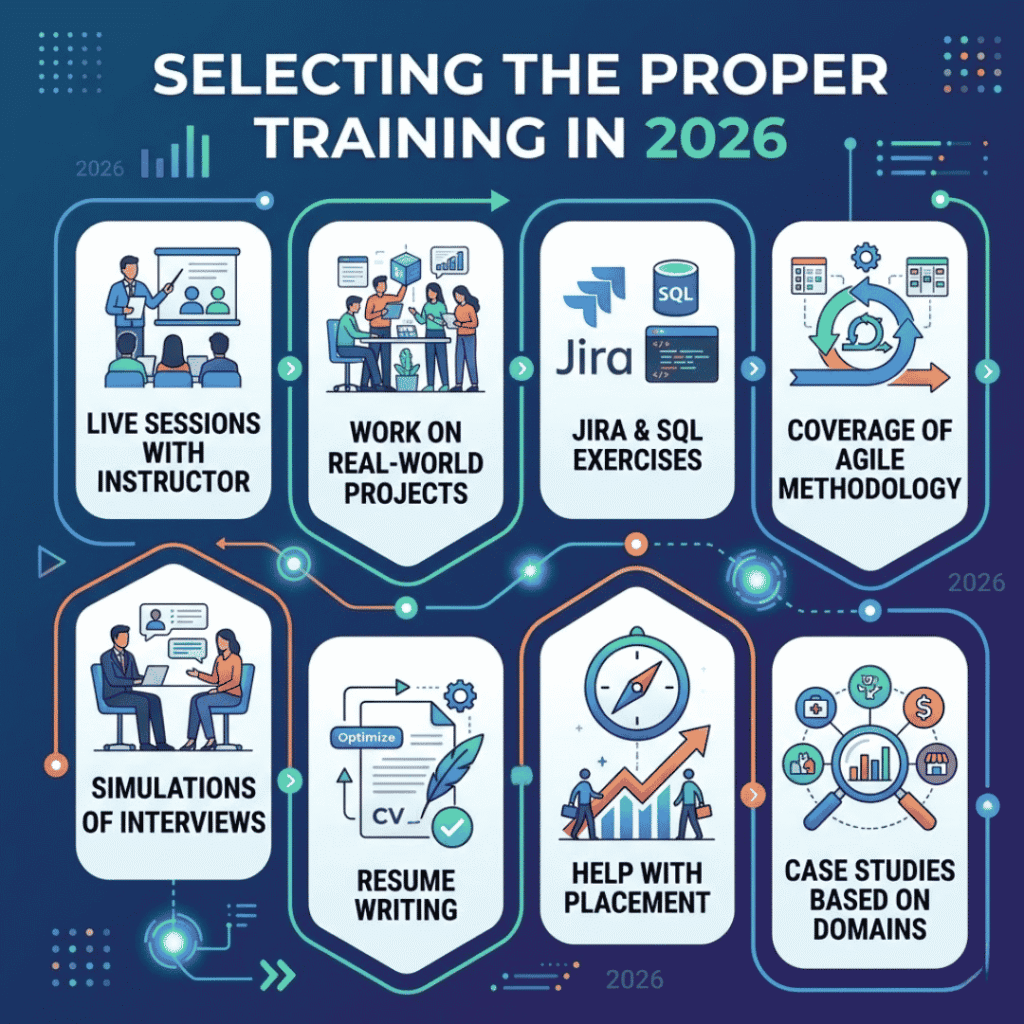
A business analyst certification or training program should include:
- Live sessions with the instructor
- Work on real-world projects
- Jira & SQL exercises
- Coverage of agile methodology
- Simulations of interviews
- Resume writing
- Help with placement
- Case studies based on domains.
Those factors matter a great deal more than slick marketing claims.
The quickest learners are usually the ones who practise on tools instead of just watching tutorials passively, honestly.
Final Thoughts
The Business Analyst Tools role in 2026 is becoming more pragmatic, data-driven, and tool-driven than ever before. Today’s recruiters want candidates who can jump in and be productive on Agile teams, communicate effectively with stakeholders, and readily use modern reporting and collaboration platforms.
Tools like Jira, SQL, Power BI, Tableau, Excel, and Confluence are great learning tools that can increase your chances of getting placed. And when the learning is through organised, project-based Business Analyst Tools online training, the transition into real-world projects is much smoother.
The market is competitive right now, no doubt about it. But candidates who combine business thinking with practical tool exposure are still getting strong opportunities across healthcare, finance, retail, and IT consulting sectors.