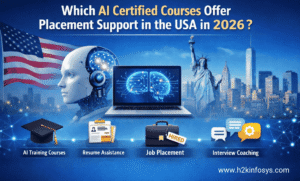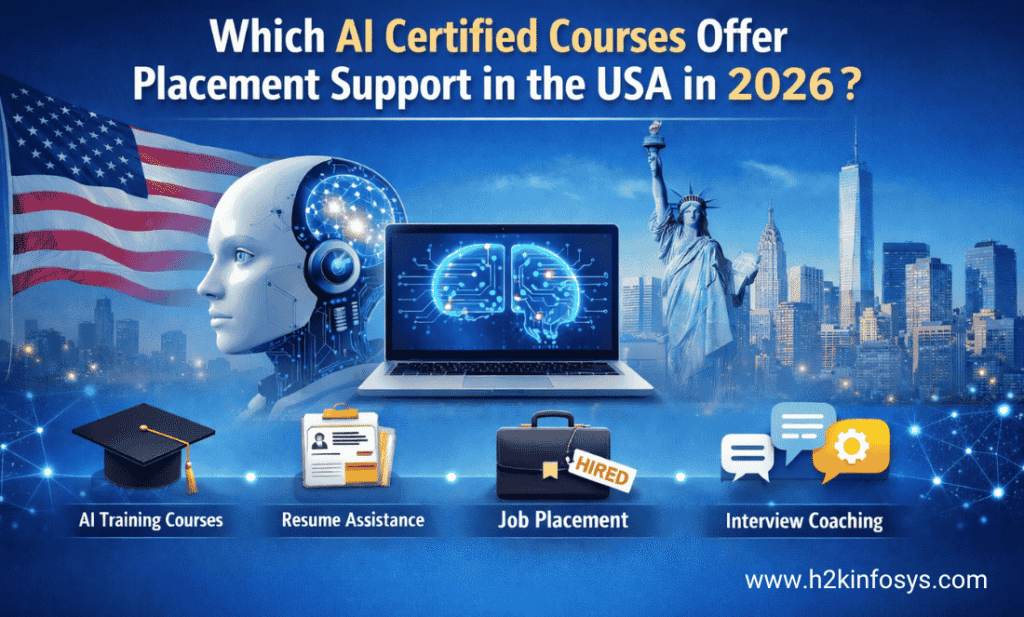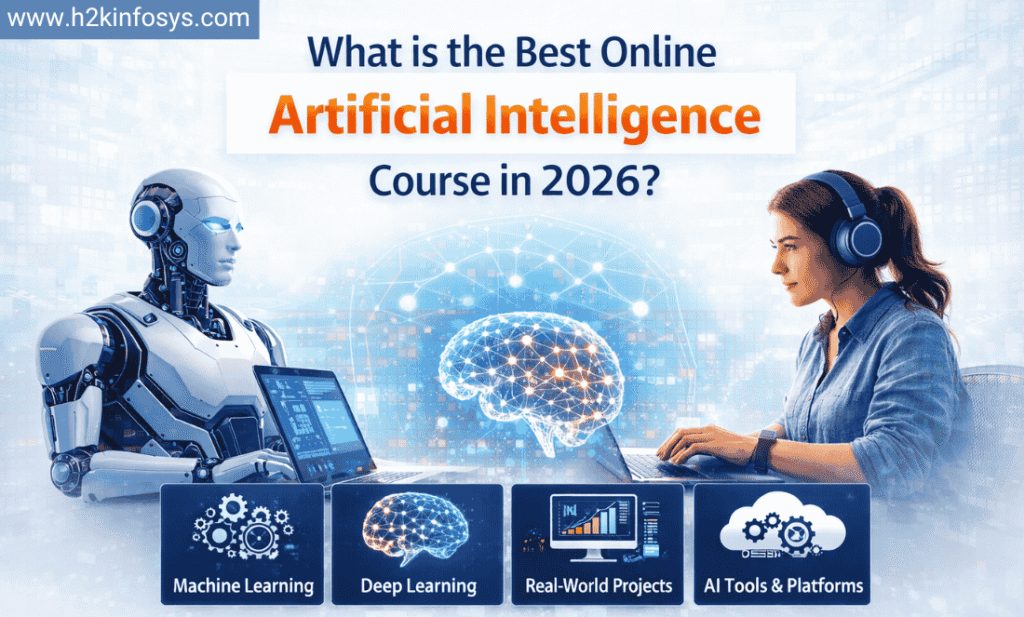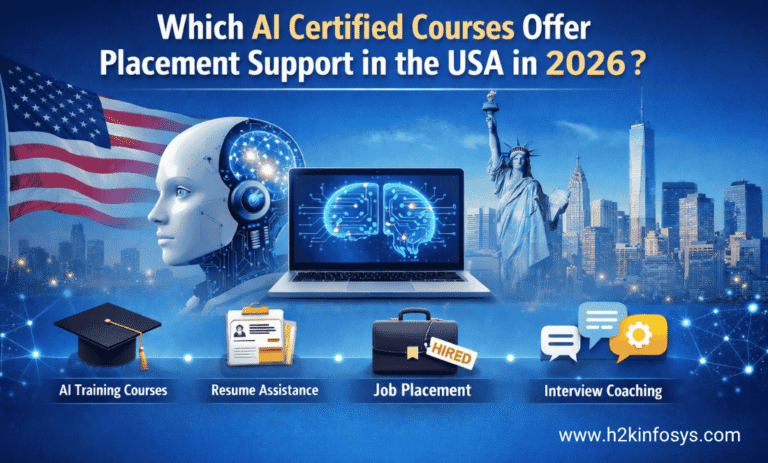
Artificial intelligence (AI) certified courses with placement support in the USA in 2026 are typically offered by specialized IT training providers, university affiliated programs, and industry bootcamps. These programs combine structured AI Training Courses with career services such as resume preparation, interview coaching, and job placement assistance. Common providers include platforms like H2K Infosys known for real-time project training and job-oriented placement support and select university extension programs.
What is an AI Certified Course With Placement Support?
An AI certified course with placement support is a structured training program that teaches artificial intelligence concepts and tools while also assisting learners in securing employment. These programs are designed for working professionals transitioning into AI roles or enhancing their technical skill sets.
Key Components
- Technical Curriculum
- Machine learning (ML)
- Deep learning
- Natural language processing (NLP)
- Data engineering basics
- Hands-On Training
- Real-world datasets
- Capstone projects
- Cloud-based AI deployments
- Placement Support Services
- Resume building aligned with US job market
- Mock interviews (technical + behavioral)
- Job referrals or recruiter connections
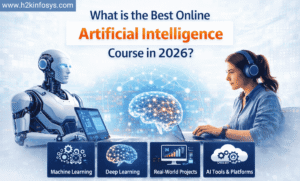
Which Are the Best Online Artificial Intelligence Courses in 2026?
The best online artificial intelligence course depends on depth, industry alignment, and placement support. Below is a structured comparison of widely recognized programs.
Top AI Training Courses With Placement Support – H2K Infosys
Artificial Intelligence Online Training with Placement
Comprehensive AI certification covering Python, Machine Learning, Deep Learning, and Generative AI, combined with real-world projects and job placement assistance.
Machine Learning Training Course (Job-Oriented)
Industry-focused ML program with hands-on projects, covering regression, classification, NLP, deep learning, and more, along with placement support.
AI Training Program with Real-Time Projects
Practical AI training designed to build job-ready skills through enterprise-level projects, portfolio development, and career preparation.
AI Certification with Career & Placement Support
Includes resume building, mock interviews, and direct job assistance by connecting learners with hiring companies.
Generative AI & AI Tools Training (Career-Oriented)
Focuses on modern AI tools and technologies with structured learning, interview preparation, and ongoing placement guidance.
Evaluation Criteria
- Industry relevance
- Hands-on project exposure
- Instructor expertise
- Career support infrastructure
Why is AI Training Important for Working Professionals?
AI is increasingly integrated into enterprise systems, making it a valuable skill for professionals in software development, data analysis, and IT operations.
Common Use Cases in Enterprises
- Predictive analytics in finance and retail
- Automation systems in DevOps pipelines
- Customer experience personalization using NLP
- Fraud detection models in banking systems
Benefits for Professionals
- Transition into high-demand roles
- Increase in cross-functional project involvement
- Ability to work with data-driven decision systems
How Does Artificial Intelligence Work in Real-World IT Projects?

AI systems in enterprise environments follow structured workflows involving data processing, model development, and deployment.
Typical AI Workflow
- Data Collection
- Structured (databases)
- Unstructured (text, images)
- Data Preprocessing
- Cleaning
- Feature engineering
- Model Training
- Algorithms such as:
- Linear regression
- Decision trees
- Neural networks
- Algorithms such as:
- Model Evaluation
- Accuracy metrics
- Cross-validation
- Deployment
- APIs
- Cloud platforms (AWS, Azure)
- Monitoring
- Model drift detection
- Performance tuning
How is AI Used in Enterprise Environments?
AI is commonly used in production systems where scalability, security, and performance are critical.
Enterprise AI Applications
- Recommendation Engines
- E-commerce platforms
- Chatbots and Virtual Assistants
- Customer support automation
- Anomaly Detection Systems
- Cybersecurity monitoring
- Supply Chain Optimization
- Forecasting demand patterns
Tools Used in Production
- TensorFlow, PyTorch (model development)
- Apache Spark (data processing)
- Docker & Kubernetes (deployment)
- AWS SageMaker, Azure ML (cloud AI services)
What Skills Are Required to Learn Artificial Intelligence?
AI training courses typically expect foundational knowledge but are structured to build skills progressively.
Core Skills
- Programming
- Python (primary language)
- Mathematics
- Linear algebra
- Probability and statistics
- Data Handling
- Pandas, NumPy
- Machine Learning Concepts
- Supervised vs unsupervised learning
Advanced Skills
- Deep learning architectures (CNN, RNN)
- Natural language processing
- Model optimization techniques
What Job Roles Use AI Daily?
AI skills are applied across multiple roles in modern IT environments.
Common Roles
| Role | Responsibilities | Tools Used |
|---|---|---|
| AI Engineer | Build and deploy ML models | TensorFlow, AWS |
| Data Scientist | Analyze data and build predictive models | Python, R |
| Machine Learning Engineer | Optimize ML pipelines | Scikit-learn, Spark |
| NLP Engineer | Develop language models | Hugging Face, spaCy |
| AI Product Manager | Define AI-driven product features | Analytics tools |
What Careers Are Possible After Learning AI?
Completing the best online artificial intelligence course with placement support can lead to various career paths.
Entry-Level Roles
- Junior Data Analyst
- ML Associate Engineer
- AI Support Engineer
Mid-Level Roles
- Machine Learning Engineer
- Data Scientist
- AI Developer
Advanced Roles
- AI Architect
- Research Scientist
- AI Solutions Consultant
How Do AI Courses Provide Placement Support in the USA?
Placement support varies by provider but generally includes structured career services aligned with US hiring practices.
Typical Placement Support Features
- Resume formatting based on ATS systems
- LinkedIn profile optimization
- Mock technical interviews
- Behavioral interview preparation (STAR method)
- Job referrals via partner networks
Challenges in Placement
- Visa constraints (for international learners)
- Experience requirements for senior roles
- Competition in entry-level positions
What Should You Look for in AI Training Courses?
Choosing the right Artificial intelligence Certified Course requires evaluating multiple factors beyond curriculum.
Key Considerations
- Hands-on project exposure
- Real-world datasets
- Instructor industry experience
- Access to cloud labs
- Post-training support
Red Flags
- Overly theoretical content without practical labs
- Lack of instructor interaction
- No structured career support
How Do Professionals Apply AI Skills in Real Jobs?
Example Scenario: Fraud Detection System
- Collect transaction data from banking systems
- Preprocess data using Python libraries
- Train anomaly detection model
- Deploy model using REST API
- Monitor alerts in real-time dashboards
Example Scenario: Customer Support Chatbot
- Collect historical chat data
- Train NLP model using transformer architectures
- Integrate chatbot with CRM system
- Deploy using cloud services
- Continuously improve based on feedback
FAQ: AI Training Courses and Placement Support
Which AI courses offer guaranteed placement in the USA?
Some programs offer job guarantees under specific conditions. Most others provide placement assistance rather than guarantees.
Is prior coding experience required?
Basic programming knowledge helps, but many AI training courses start with Python fundamentals.
How long does it take to complete an AI course?
Typically 4–9 months depending on depth and learning pace.
Are online AI courses recognized by employers?
Courses with hands-on projects and industry-relevant tools are generally valued more than purely theoretical certifications.
What salary can AI professionals expect in the USA?
Entry-level roles may start around $70,000–$90,000 annually, depending on skills and location.
Conclusion
Key Takeaways
- AI certified courses with placement support combine technical training and career services
- The best online artificial intelligence course includes hands-on projects and real-world tools
- Placement support typically includes resume building, mock interviews, and job referrals
- AI skills are widely used in enterprise environments across multiple industries
- Career paths range from entry-level analysts to advanced AI architects
Explore H2K Infosys AI training courses to gain hands-on experience and structured career support.
Enroll to build practical AI skills aligned with real-world job requirements.