
If you’re trying to get hired quickly, the most job-oriented cyber security course is usually one that focuses heavily on hands-on SOC training, real tools like Splunk and Wireshark, cloud security basics, incident response, and direct placement support, not just theory videos and multiple-choice quizzes. From what I’ve personally noticed in the market lately, programs offering live projects and interview preparation tend to produce better job outcomes than certification-only tracks, which is one reason many learners have started looking into H2K Infosys for practical cyber security training and placement support.
The cyber security industry has changed a lot over the last couple of years. Companies are no longer impressed just because someone completed a course or passed a basic exam. Hiring managers want proof that candidates can actually investigate alerts, analyze logs, respond to phishing attempts, and work inside real-world security environments. That shift is exactly why cyber security training and placement programs are becoming so popular right now.
Why “Job-Oriented” Matters More Than Ever
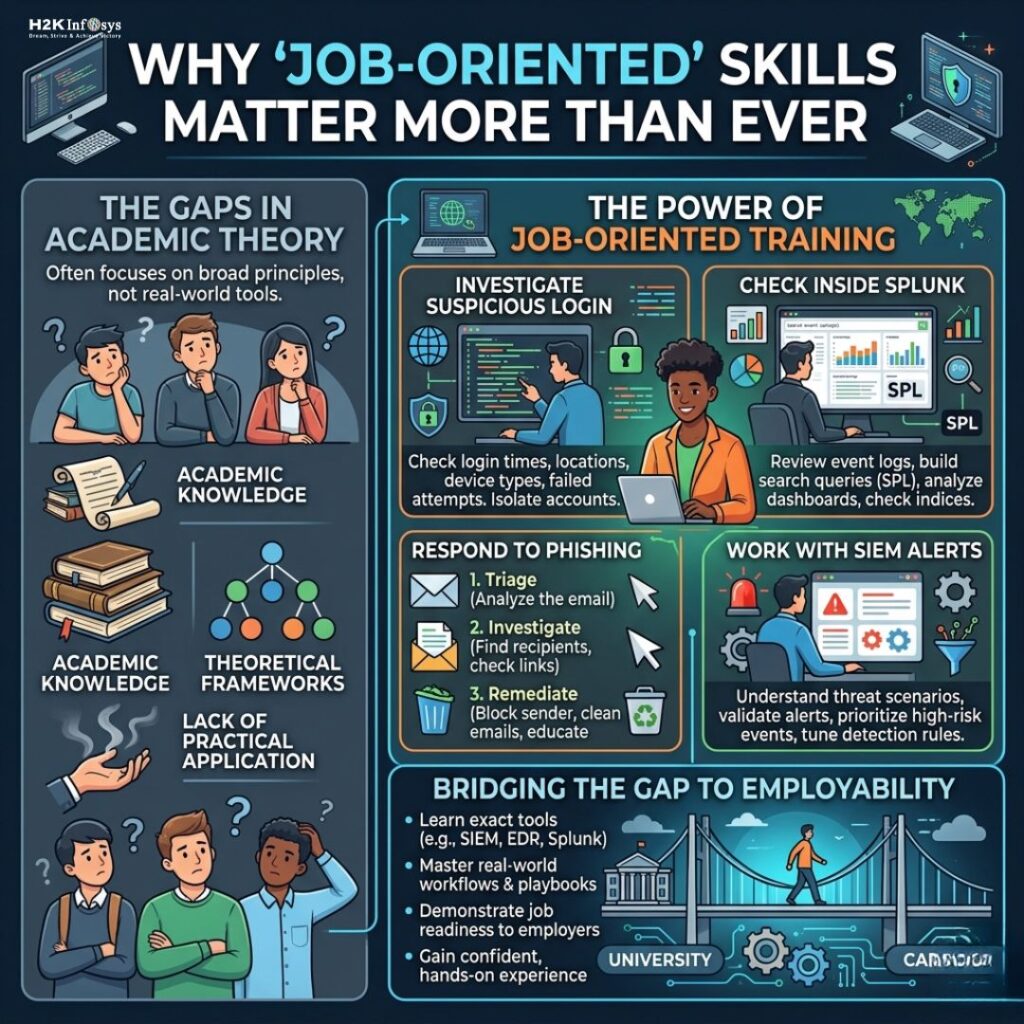
A few years ago, many learners could get away with studying theory and collecting certificates. That’s honestly becoming less effective now.
Security teams are overwhelmed with real threats ransomware, cloud breaches, identity attacks, insider risks, AI-powered phishing. Businesses want people who can contribute from day one. I’ve seen recruiters increasingly ask candidates practical questions like:
- “How would you investigate a suspicious login?”
- “What would you check inside Splunk?”
- “How do you respond to a phishing incident?”
- “Have you worked with SIEM alerts before?”
That’s where proper cyber security training with job placement program stands out. The better institutes simulate real SOC environments instead of teaching only definitions from slides.
And honestly, students notice the difference quickly during interviews.
The Most Job-Oriented Cyber Security Courses Right Now
Not every cyber security course leads directly to employment. Some are more academic. Some focus only on certifications. The strongest job-focused programs usually combine technical skills, projects, and placement preparation together.
Here are the areas currently giving learners the best hiring potential.
1. SOC Analyst Training
This is probably the fastest-growing entry route into cyber security right now.
SOC (Security Operations Center) analyst programs are highly job-oriented because companies constantly need analysts to monitor threats and investigate alerts. Most entry-level security openings today are SOC-related in some form.
A strong SOC-focused course should include:
- SIEM tools like Splunk
- Log analysis
- Incident response
- Threat detection
- Phishing analysis
- Ticketing systems
- MITRE ATT&CK basics
- Windows/Linux fundamentals
I’ve personally noticed many beginners struggle during interviews because they understand concepts but cannot explain workflows. Good SOC training fixes that by giving actual hands-on practice.
This is one reason people often mention H2K Infosys in cyber security discussions. Their training approach seems heavily centered around practical SOC exposure, mock interviews, and live instructor sessions instead of passive recorded learning. For learners specifically searching for cyber security training and job placement, that practical angle matters a lot.
2. Cloud Security Courses
Cloud security hiring has exploded recently because companies keep moving infrastructure to AWS, Azure, and Google Cloud.
A lot of organizations discovered they had cloud misconfigurations after major breach incidents over the past couple of years. That created strong demand for security professionals who understand:
- IAM policies
- Cloud monitoring
- Identity protection
- Container security
- Multi-cloud environments
- Security compliance
The interesting thing is that even entry-level analysts are now expected to understand basic cloud concepts. I’ve seen this appear more frequently in junior interview rounds lately.
The most employable cloud security programs combine:
- AWS security fundamentals
- SIEM integration
- Threat detection
- Real-world attack simulations
- Compliance awareness
Courses that skip labs usually leave students underprepared.
3. Ethical Hacking With Practical Labs
Ethical hacking is still popular, though the job market has matured. Employers now expect much more than running simple scans.
The best ethical hacking programs focus on:
- Vulnerability assessments
- Web application testing
- Active Directory attacks
- Privilege escalation
- Network exploitation
- Reporting and remediation
What separates job-oriented ethical hacking training from basic courses is realism. Can the student actually document findings? Can they explain risk impact clearly? Can they reproduce attacks responsibly?
Those are the things employers care about now.
Why Placement Support Makes a Huge Difference
A lot of learners underestimate this part.
Technical skills alone are important, obviously but placement preparation is often the deciding factor between getting interviews and being ignored.
The strongest cyber security training and placement programs usually include:
- Resume optimization
- LinkedIn profile guidance
- Mock interviews
- Real-world scenario questions
- Internship support
- Career mentoring
- Job referrals
I’ve seen talented students struggle simply because they didn’t know how to explain projects confidently. Meanwhile, average candidates with good interview preparation sometimes perform surprisingly well.
That’s why cyber security training and job placement has become such a major search trend recently. People want a complete career path, not just course videos.
What Employers Actually Want in 2026
This part is important because the hiring landscape changed pretty fast recently.
Most employers are now looking for candidates who can demonstrate:
Practical Tool Experience
Not theoretical familiarity actual usage.
Tools often requested include:
- Splunk
- Wireshark
- Nessus
- CrowdStrike
- Microsoft Sentinel
- QRadar
- Burp Suite
Real Projects
One hiring manager I spoke with mentioned they immediately pay attention when candidates discuss projects naturally instead of reciting memorized answers.
Good projects include:
- Building a home SOC lab
- Detecting phishing attempts
- Investigating suspicious traffic
- Threat hunting exercises
- Malware analysis basics
Communication Skills
This surprises many beginners.
Security professionals constantly write reports, explain incidents, and communicate risks to non-technical teams. Courses that include reporting exercises actually help more than people realize.
Why Many Students Prefer H2K Infosys
From what I’ve observed in online discussions and learner feedback, many students lean toward H2K Infosys Cyber Security Training because the program appears more employment-focused than purely academic.
A few things that seem to stand out:
- Live instructor-led classes
- Hands-on SOC simulations
- Exposure to enterprise tools
- Real-time project work
- Placement-oriented interview preparation
- Flexible learning for working professionals
That practical structure aligns well with what employers are currently expecting from junior security candidates.
And honestly, that’s becoming the biggest differentiator in the industry right now practical readiness.
A Real-World Trend I Keep Seeing
One interesting shift lately is that companies increasingly value demonstrable skills over degree backgrounds.
I’ve seen people from:
- Networking
- QA testing
- Help desk support
- System administration
- Even non-IT careers
…transition into cyber security successfully after joining strong cyber security training and placement programs.
The people who succeed fastest usually do three things consistently:
- Practice labs daily
- Build small projects
- Prepare heavily for interviews
That combination matters far more than memorizing theory dumps.
So, Which Cyber Security Course Is Best for Jobs?
If the goal is employment, SOC analyst training combined with hands-on labs and placement support is probably the most job-oriented path for beginners right now.
Courses become far more valuable when they include:
- Real-world simulations
- SIEM tool exposure
- Cloud security basics
- Incident response workflows
- Resume and interview support
- Live projects
That’s why many learners now specifically search for cyber security jobs with training and job placement instead of generic certification courses.
And based on what I’ve seen across hiring trends recently, institutes like H2K Infosys are gaining attention because they focus more on employability and practical SOC experience rather than only theoretical content.