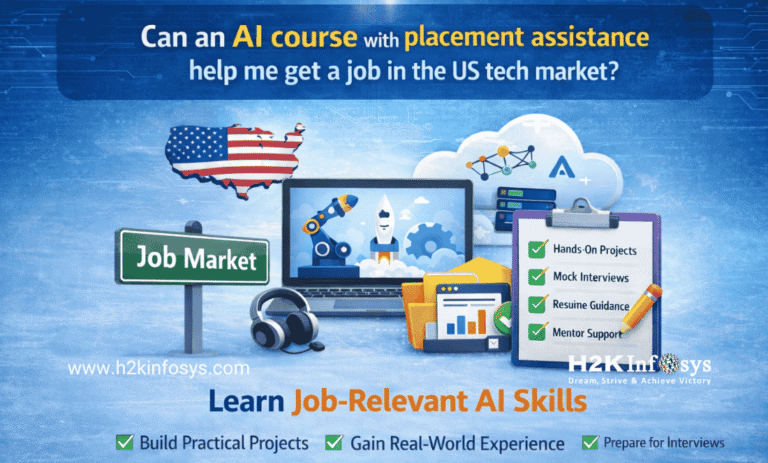
H2K Infosys Artificial intelligence training program combined with structured placement assistance can help learners prepare for AI related roles in the US tech market by building job relevant technical skills, practical project experience, and interview readiness. While job placement is never guaranteed, completing an AI course certification aligned with industry tools, workflows, and enterprise practices significantly improves employability and readiness for real world AI positions.
AI training programs that include hands-on labs, portfolio projects, and career preparation components help bridge the gap between academic learning and enterprise job requirements. Placement assistance often includes resume optimization, mock interviews, and guidance on applying for relevant roles in the US technology ecosystem.
What Is an Artificial Intelligence Training Program?
An Artificial intelligence Training Program is a structured learning pathway that teaches professionals how to design, build, deploy, and manage intelligent systems using machine learning, data science, and automation tools. These programs focus on both theoretical concepts and practical implementation.
Core components typically include:
- Machine learning fundamentals
- Deep learning and neural networks
- Natural language processing (NLP)
- Computer vision basics
- Model deployment and monitoring
- Python programming for AI
The goal is to prepare learners to work with AI systems used in enterprise applications such as predictive analytics, recommendation engines, chatbots, and automation platforms.
Key Technologies Covered in an AI Course Certification
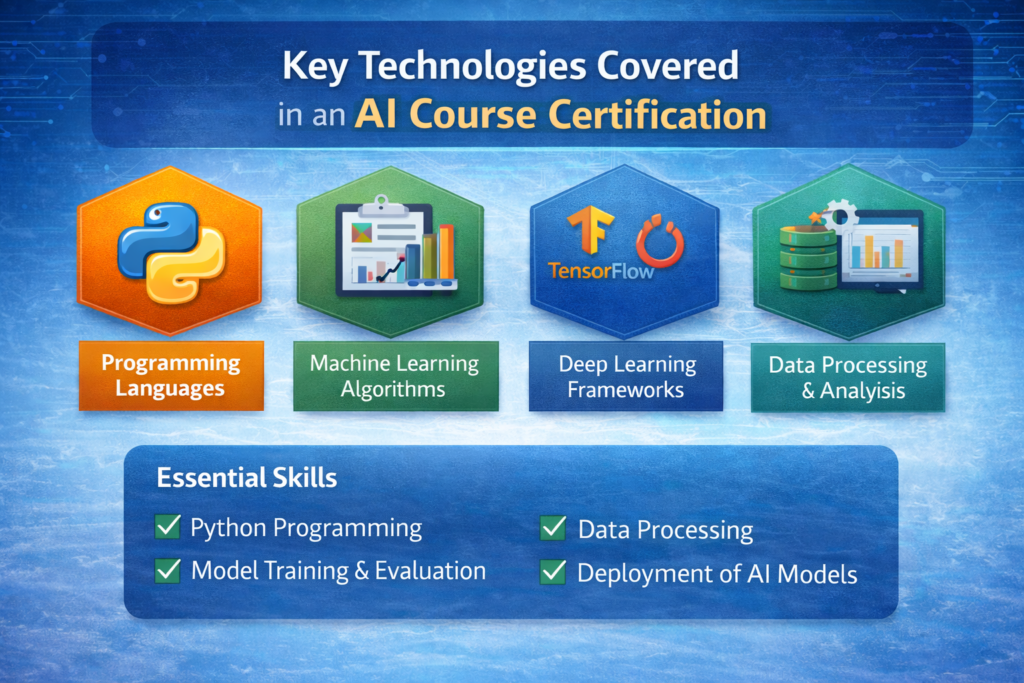
| Category | Tools / Technologies | Purpose |
|---|---|---|
| Programming | Python, NumPy, Pandas | Data processing and model building |
| Machine Learning | Scikit-learn, XGBoost | Predictive modeling |
| Deep Learning | TensorFlow, PyTorch | Neural network development |
| Data Handling | SQL, Apache Spark | Data storage and processing |
| Deployment | Docker, Kubernetes | Model deployment |
| Visualization | Matplotlib, Tableau | Reporting and insights |
These tools reflect what is commonly used in enterprise environments.
How Does AI Work in Real-World IT Projects?
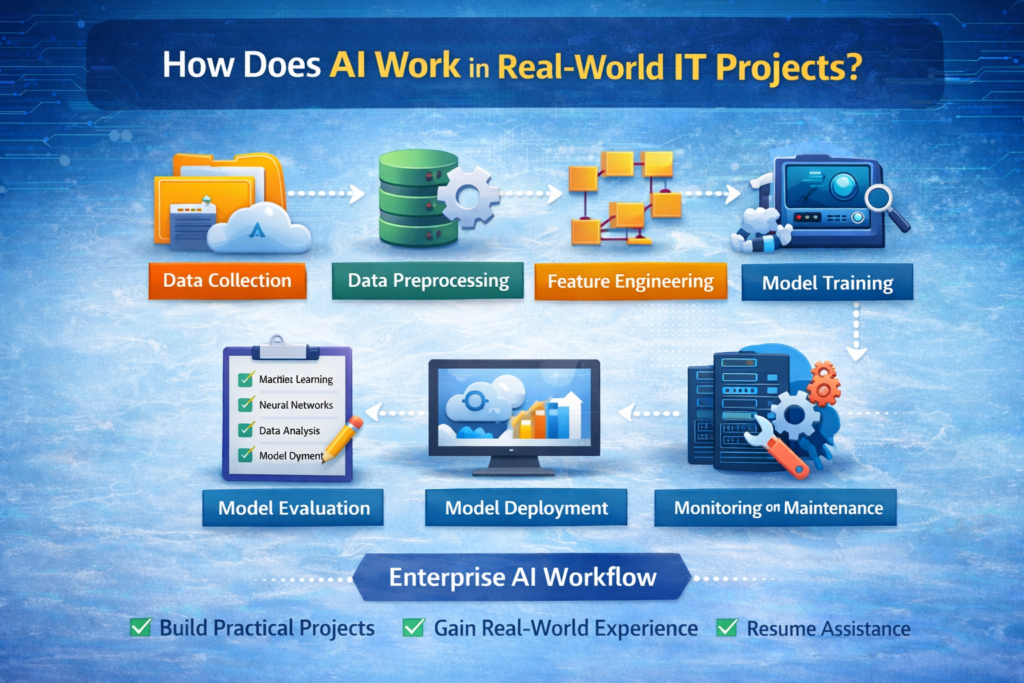
AI systems operate by analyzing data, learning patterns, and making predictions or decisions based on those patterns. In enterprise IT environments, AI is integrated into workflows to automate processes and improve efficiency.
Example Enterprise Workflow
A typical AI project follows these stages:
- Data collection
Data is gathered from databases, APIs, or cloud storage. - Data preprocessing
Data is cleaned, formatted, and prepared. - Model training
Machine learning algorithms are trained using historical data. - Model evaluation
Performance is measured using accuracy, precision, or recall. - Deployment
Models are deployed into production systems. - Monitoring and maintenance
Models are monitored and updated as needed.
Example: Fraud Detection System
A financial company may use AI to detect fraudulent transactions.
Workflow:
- Collect transaction data
- Train classification models
- Deploy model into payment processing system
- Automatically flag suspicious transactions
This process demonstrates how AI is used operationally in enterprise systems.
Why Is an AI Course Certification Important for Working Professionals?
An AI Course Certification helps professionals gain validated skills that align with industry requirements. Employers often look for candidates who demonstrate both technical capability and applied knowledge.
Benefits include:
- Structured learning path
- Hands-on project experience
- Industry-recognized skill validation
- Exposure to enterprise tools and workflows
Professionals transitioning from QA, data analysis, or software development roles often use AI certifications to expand their skill set.
How Placement Assistance Supports Job Readiness
Placement assistance focuses on preparing learners for technical hiring processes, particularly in competitive job markets like the United States.
Typical placement assistance includes:
Resume Preparation
Professionals learn how to present:
- Technical skills clearly
- Project experience effectively
- Tools and frameworks used
Example resume entry:
AI-based recommendation system using Python, Scikit-learn, and Pandas. Implemented collaborative filtering algorithm and deployed model using Docker.
Mock Interviews
Mock interviews simulate real hiring scenarios:
- Technical questions
- Coding exercises
- System design questions
Job Search Strategy
Placement support often includes guidance on:
- LinkedIn optimization
- Portfolio creation
- Job application strategies
What Skills Are Required to Learn Artificial Intelligence?
AI requires a combination of programming, mathematics, and data analysis skills.
Technical Skills
| Skill | Purpose |
|---|---|
| Python | Core programming language for AI |
| Statistics | Model evaluation and prediction |
| Linear Algebra | Neural network operations |
| Data Analysis | Data preprocessing |
| Machine Learning | Model building |
Supporting Skills
- Problem-solving
- Logical thinking
- Debugging
- Data interpretation
These skills are commonly taught in an Artificial intelligence training program.
How AI Is Used in Enterprise Environments
AI is used across industries in production environments.
Common Enterprise Applications
Healthcare:
- Disease prediction
- Medical image analysis
Finance:
- Fraud detection
- Risk analysis
Retail:
- Recommendation systems
- Customer behavior analysis
Technology:
- Chatbots
- Automation tools
Example Enterprise Stack
| Layer | Tools |
|---|---|
| Data Storage | AWS S3, SQL |
| Processing | Spark, Python |
| Model Training | TensorFlow |
| Deployment | Docker |
| Monitoring | Prometheus |
These tools are commonly used in production environments.
What Job Roles Use AI Daily?
AI skills are used in multiple professional roles.
Common AI Job Roles
| Role | Responsibilities |
|---|---|
| Machine Learning Engineer | Build AI models |
| Data Scientist | Analyze data and build predictive models |
| AI Engineer | Design AI systems |
| Data Analyst | Data interpretation |
| AI Developer | Build AI applications |
These roles exist across many US technology companies.
How AI Course Certification Helps Prepare for US Tech Jobs
US tech companies typically evaluate candidates based on:
- Technical skills
- Project experience
- Problem-solving ability
- System understanding
An AI course certification prepares learners through:
- Hands-on projects
- Real-world tools
- Technical interview preparation
Example Project Portfolio
AI-based chatbot using NLP:
Technologies used:
- Python
- NLTK
- TensorFlow
Skills demonstrated:
- NLP model development
- Data preprocessing
- Model deployment
This type of project helps demonstrate practical skills.
How Placement Assistance Helps International Professionals
For professionals targeting the US tech market, placement assistance can help with:
- Resume formatting aligned with US standards
- Technical interview preparation
- Understanding employer expectations
It also helps learners understand:
- Role requirements
- Technical expectations
- Hiring processes
Learning Path for Artificial Intelligence Training Program
A structured learning path typically follows this sequence:
Step 1: Programming Fundamentals
Learn:
- Python basics
- Data structures
Step 2: Data Analysis
Learn:
- Data cleaning
- Data visualization
Step 3: Machine Learning
Learn:
- Regression
- Classification
Step 4: Deep Learning
Learn:
- Neural networks
- Image processing
Step 5: Deployment
Learn:
- Model deployment
- Cloud integration
Example Real-World AI Project Workflow
Project: Customer Churn Prediction
Step 1: Data collection
Step 2: Data cleaning
Step 3: Feature engineering
Step 4: Model training
Step 5: Model evaluation
Step 6: Deployment
Tools used:
- Python
- Scikit-learn
- Pandas
- Docker
This workflow reflects how AI is used in enterprise environments.
Challenges Professionals Face When Entering AI Careers
Common challenges include:
Lack of practical experience
Limited project portfolio
Interview preparation gaps
Understanding production deployment
An AI course certification helps address these challenges through structured learning and projects.
How Employers Evaluate AI Candidates
Employers typically evaluate candidates based on:
Technical skills:
- Python
- Machine learning
- Data handling
Project experience:
- Model development
- Deployment
Problem-solving:
- Algorithm understanding
- Debugging
Communication skills:
- Explaining technical concepts
FAQ Section
Can beginners learn AI through an Artificial intelligence training program?
Yes. Many programs start with Python and data fundamentals before moving to advanced AI concepts.
Does AI course certification guarantee a job?
No certification guarantees employment. However, it significantly improves job readiness and employability.
How long does it take to learn AI?
Most structured programs take 4 to 12 months depending on depth and pace.
Is placement assistance useful?
Placement assistance helps prepare candidates for interviews and improves job readiness.
Is AI in demand in the US tech market?
AI skills are widely used across industries such as healthcare, finance, and technology.
How Professionals Use AI Skills on the Job
Typical tasks include:
- Data analysis
- Model building
- Model deployment
- Monitoring AI systems
Example daily workflow:
- Analyze data using Python
- Train models
- Evaluate model performance
- Deploy models
How AI Course Certification Supports Career Transition
Professionals from various backgrounds transition into AI roles.
Common backgrounds include:
- Software developers
- QA engineers
- Data analysts
- IT professionals
AI training builds skills needed for career transition.
Key Takeaways
- An Artificial intelligence training program helps professionals build practical AI skills aligned with enterprise requirements
- AI course certification improves job readiness and technical credibility
- Placement assistance supports resume preparation and interview readiness
- Hands-on projects help demonstrate real-world skills
- AI skills are used across multiple roles in the US technology market
To build practical AI skills with structured guidance, explore H2K Infosys Artificial Intelligence training programs. These programs provide hands-on experience and career preparation aligned with industry requirements.