
Most Business Analyst positions do not require code-related skills. H2K Infosys differentiates between coding skills, analytical reasoning, and articulation skills. Business analysts primarily collect requirements, improve business processes, and bridge the gap between the IT and business sides. While you do not need coding skills to get the job, familiarity with SQL, Excel, Tableau, Power BI, and even Python or R may be advantageous. Business Analyst Training is designed to improve your skills with these tools. In fact, a good grasp of Microsoft Office and general database concepts is often more critical. Ultimately, in the long term, business acumen, stakeholder engagement, and problem-solving will be the key to your success in the BA profession.
What are Business Analyst Roles Actually About?
In today’s evolving business landscape, Business Analyst roles are more important than ever, as they help organizations navigate change and drive efficiency. Understanding the various aspects of Business Analyst roles is crucial for success.
At a high level, Business Analyst roles consist of problem-solving. You interpret and document processes, collect requirements, converse with stakeholders, convert business needs into something the tech teams can build, and ensure the solution delivered solves the problem. These key responsibilities highlight the significance of Business Analyst roles in the success of projects.
In old school business environments – banking, insurance, healthcare – Business Analyst roles typically center around:
- Stakeholder communication
- Process mapping
- Requirement gathering
- Gap Analysis
- Business Requirement Document and Functional Requirement Document Creation
- User Acceptance Testing Support
What’s the primary omission here? Real programming.
With digital transformation, AI, and data-driven decision making, the role of the Business Analyst is evolving, and unfortunately, it does not mean the analyst needs to possess extensive programming skills.
The Benefits of Coding (and When It is NOT Necessary)
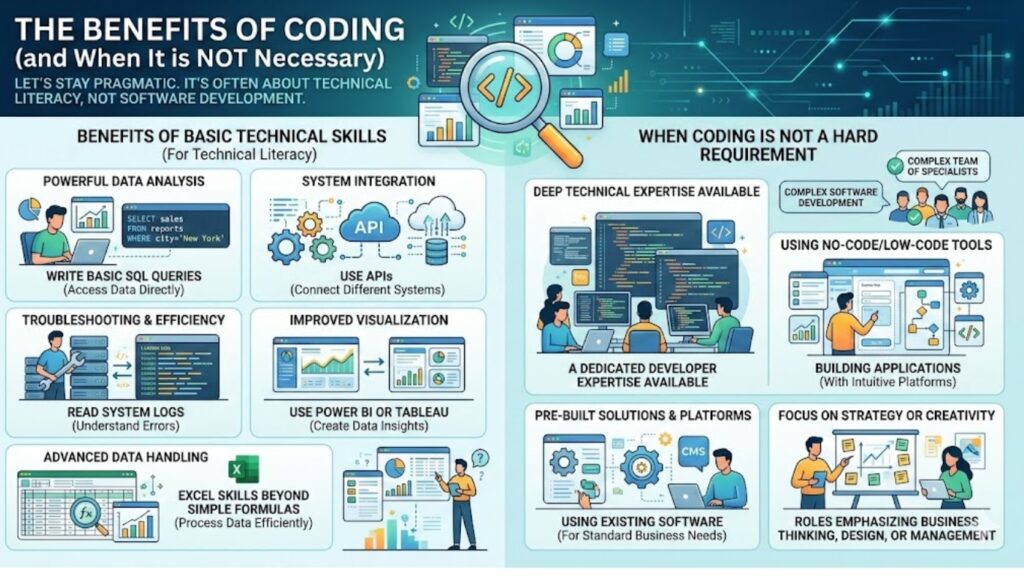
Let’s stay pragmatic.
Some basic technical skills are beneficial, including:
- Writing basic SQL queries
- Using APIs
- Reading system logs
- Using Power BI or Tableau
- Excel skills beyond simple formulas
This is not software development, it’s technical literacy.
Consider, for instance, a recent retail analytics project I witnessed. The Business Analyst positions involved direct SQL access to the data warehouse. This wasn’t a case of developer roles, but rather that data team dependencies in a waterfall model slowed down operational decisions.
Some understanding of coding is valuable, but it isn’t a hard requirement.
Roles for Business Analysts in 2026: What Are the New Expectations?
If you are observing industry shifts more recently, particularly the sudden spike in the employment of AI across businesses, you are likely to notice something.
Businesses are not requesting analysts to write battalions of code. What they also demand that analysts do is:
- Translate the results produced by AI,
- Create the framework for workflow automation,
- Integrate business strategy with technology,
- Know about systems integration.
Quite tellingly, a recent analysis of LinkedIn and other major job posting sites has revealed that most of the recently posted positions for Business Analysts state that knowledge of SQL is preferred, rather than required.
And that is a distinction.
Technical vs Functional Business Analyst Roles
Business Analyst job descriptions and roles vary by degree and type of responsibility.
1. Functional Business Analyst Roles
These roles involve a deeper look into business operations and stakeholder communications.
Do these involve coding? Rarely.
2. Technical Business Analyst Roles
These roles interact with development teams.
For these roles, a working knowledge of databases and APIs is useful, but as with coding, deep knowledge is not necessary.
3. Data-Focused Business Analyst Roles
These roles may require working knowledge of SQL and data visualization software.
This is still not significant programming, but there is a need for some technical SQL and visualization knowledge.
So, coding for BA roles is really only relevant for a small number of specialized roles.
How BA Training Prepares You (Without Turning You into a Developer)
If you’re exploring BA training or business analysis training, you’ll notice something quickly,most structured programs don’t focus on programming languages.
Instead, they teach:
- Requirement elicitation techniques
- UML diagrams
- Agile and Scrum frameworks
- JIRA and Confluence usage
- SQL basics (sometimes)
Good business analyst courses focus on bridging communication gaps, not building software from scratch.
When people enroll in business analyst classes, they’re usually career switchers, finance professionals, HR specialists, and fresh graduates. They’re not all coming from IT backgrounds.
And that’s okay.
Does Having Coding Skills Improve Job Prospects? Yes, but only to an extent.
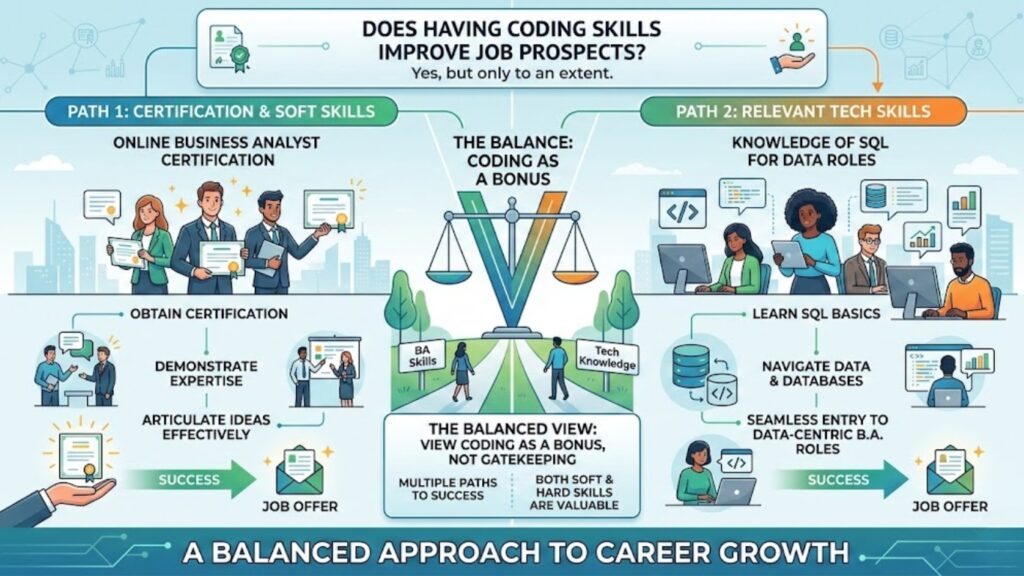
I have watched people obtain positions because they had business analyst certification online credentials and were able to demonstrate expertise and articulate their ideas. Conversely, people with knowledge of SQL were able to obtain data-centric roles in the business analyst area more seamlessly.
So view coding as a bonus.
Not gatekeeping.
Real-World Example: Fintech Startup vs Enterprise Bank
A fintech startup I followed recently required Business Analyst roles to work directly with APIs and understand JSON responses. They didn’t expect analysts to build backend systems but they needed them to understand how the product functioned technically.
Contrast that with a large enterprise bank. Their Business Analyst roles were heavily documentation-driven. Stakeholder meetings, compliance workflows, and regulatory mapping. Zero coding.
Same title. Completely different expectations.
That’s why context matters more than blanket statements.
What Should You Learn Instead?
If you’re planning to enter Business Analyst roles, focus on:
- Communication clarity
- Structured documentation
- Business process modeling
- Stakeholder management
- Analytical thinking
- Basic SQL (just enough to query data)
Many business analysis online training programs now blend Agile frameworks with data literacy. That’s where the market is moving.
Pairing business analysis training with a recognized business analyst certification also builds credibility especially if you’re transitioning from another field.
And if you’re considering business analyst training and placement programs, check whether they include mock projects. Real project simulations matter more than theoretical lessons.
So, Is Learning to Code Necessary?
Here’s my perspective.
If you are looking for Business Analyst roles in:
- Product-based companies
- Tech startups
- Data-driven ecosystems
Understanding a few coding fundamentals will boost your confidence, especially if you learn SQL.
For roles such as:
- Process consulting
- Banking or insurance BA roles
- ERP functional consulting
You can easily succeed without coding.
Remember, coding is a means to an end, not an end goal.
Conclusion
While coding skills are not required for Business Analyst positions, having a strong understanding of technology is very helpful in a digital-first marketplace.
If you want to pursue a career in Business Analyst positions, then strong BA training, practical business analyst courses, and a business analyst certification online will be necessary.
Strive to be the person who comprehends business issues and the technical scope of the solutions. That is the real value of a Business Analyst.
Truthfully, that is the combination – not the programming skills – that employers want the most.
FAQs:
1. Is coding mandatory for Business Analyst roles?
No, coding is generally not mandatory for most Business Analyst roles. However, basic technical knowledge can be helpful.
2. Do Business Analysts need to know programming?
Business Analysts do not usually need advanced programming skills, but understanding basic coding concepts can improve communication with developers.
3. Can I become a Business Analyst without coding?
Yes. You can become a Business Analyst without coding by developing skills in requirements gathering, documentation, SQL, Excel, Agile, and stakeholder communication.
4. What technical skills should a Business Analyst learn?
Useful skills include SQL, Excel, Power BI, Tableau, Jira, data analysis, and basic understanding of software development processes.
5. Is SQL required for Business Analysts?
SQL is not mandatory for every BA role, but it is a valuable skill for Business Analysts working with databases and data-driven projects.