If you’re looking at AI from a career growth perspective especially in the U.S. the fastest path usually isn’t the most theoretical one. What really makes a difference is a program (like those offered by H2K Infosys) that blends applied machine learning courses, solid data engineering fundamentals, and real hands-on work. Not just concepts but actually building systems that feel close to what you’d see on the job.
A lot of people assume Online Ai Classes means deep math and research-heavy topics. That’s part of it, sure but in reality, the courses that help people land jobs quicker tend to focus more on doing than just understanding. Think Python-based projects, working with cloud tools, and getting comfortable with how AI fits into business environments.
When people finish these kinds of programs especially the ones with real-world workflows they often move into roles like Machine Learning Engineer, Data Scientist, or AI Engineer much faster.
So, what exactly is an AI course ?
At its core, an Best Ai certification Courses teaches things like machine learning, deep learning, NLP, and how to work with data. But that definition alone doesn’t say much about career impact.
Some courses stay very academic algorithms, equations, theory. Those are useful, no doubt, but they don’t always translate quickly into job-ready skills.
The ones that tend to accelerate careers usually include:
- Applied machine learning (not just theory)
- Projects using real datasets (messy, imperfect ones—like in real life)
- Exposure to cloud platforms like AWS, Azure, or GCP
- Some idea of deployment—how models actually go live (this is where MLOps comes in)
Different types of AI courses
Not all AI learning paths are equal, and this becomes pretty obvious once you start comparing outcomes.
- Theoretical AI: heavy on math and algorithms → slower transition into jobs
- Applied AI: focused on building models → quicker job readiness
- AI + Cloud: includes deployment and scaling → highly valued in companies
- AI + Data Engineering: combines pipelines with ML → strong long-term growth
Why applied AI tends to work better
This is pretty straightforward: companies care about what you can build.
Applied courses line up closely with what employers actually need. You’re not just learning what a model is, you’re building one, deploying it, and maybe even monitoring it afterward.
A few reasons this approach works:
- You can apply the skills immediately
- You get familiar with real tools (TensorFlow, PyTorch, etc.)
- You build a portfolio this matters more than people think
- The skills transfer across industries (finance, healthcare, retail… you name it)
A simple example
Let’s say someone builds a project like:
- Predicting customer churn using Python
- Exposing it via a REST API
- Tracking performance once it’s live
That’s not just a project it mirrors what actually happens inside companies. And that’s exactly what recruiters look for.
How AI actually works in real-world projects
In practice, AI isn’t just about training a model and calling it a day. It’s a full pipeline.
Typically, it looks something like this:
- Data collection – pulling data from databases, APIs, logs
- Preprocessing – cleaning, transforming, feature engineering
- Model training – using algorithms like regression, trees, neural networks
- Evaluation – checking metrics like accuracy, precision, recall
- Deployment – turning the model into a service (APIs, containers, cloud)
- Monitoring – watching for performance drops, retraining when needed
And yes, each step uses different tools:
- Data: Pandas, NumPy, Spark
- Models: Scikit-learn, TensorFlow, PyTorch
- Deployment: Docker, Kubernetes, Flask
- Cloud: AWS SageMaker, Azure ML
Why AI matters so much for working professionals
AI isn’t some niche skill anymore it’s everywhere.
Companies use it to:
- Automate repetitive tasks
- Make better decisions using predictions
- Personalize user experiences
- Detect fraud or anomalies
You’ll see it across industries:
- Finance → risk and fraud models
- Healthcare → diagnostics and predictions
- Retail → demand forecasting
- IT → predictive maintenance
Skills you actually need
To really benefit from AI courses, you need a mix of technical and practical skills.
Core skills:
- Python (non-negotiable, honestly)
- Basic statistics and probability
- Data handling
- Machine learning fundamentals
Helpful extras:
- SQL
- Cloud basics
- Git
- APIs
And usually, people progress like this:
- Beginner → Python + basic stats
- Intermediate → ML models + preprocessing
- Advanced → deep learning, deployment, MLOps
How AI is used inside companies
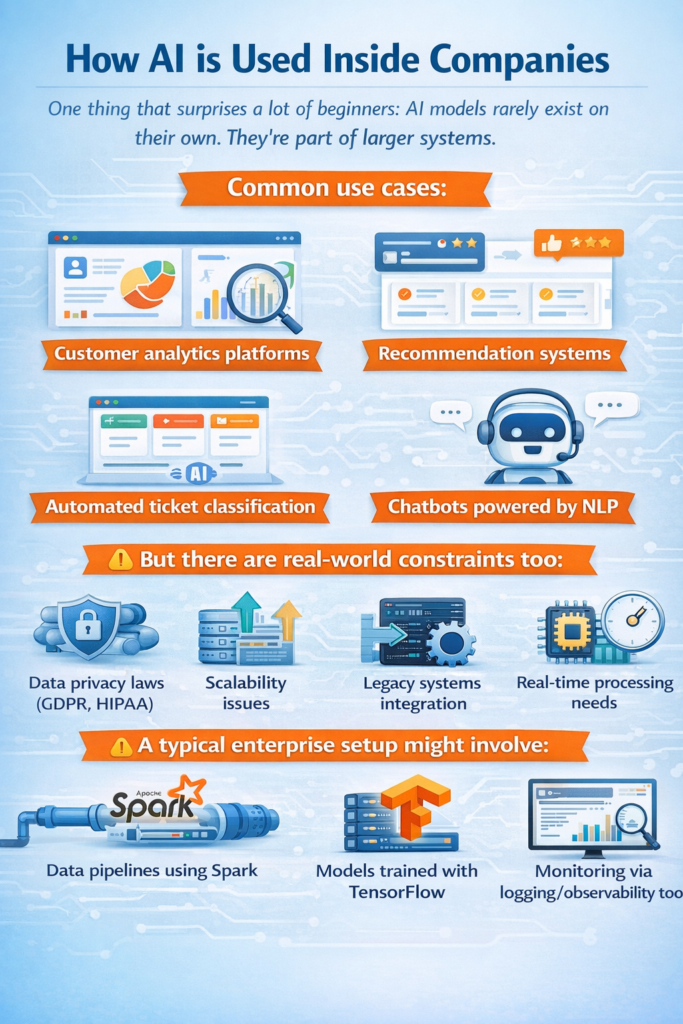
One thing that surprises a lot of beginners: AI models rarely exist on their own. They’re part of larger systems.
Common use cases:
- Customer analytics platforms
- Recommendation systems
- Automated ticket classification
- Chatbots powered by NLP
But there are real-world constraints too:
- Data privacy laws (GDPR, HIPAA)
- Scalability issues
- Legacy systems integration
- Real-time processing needs
A typical enterprise setup might involve:
- Data pipelines using Spark
- Models trained with TensorFlow
- Deployment on Kubernetes
- Monitoring via logging/observability tools
Roles that use AI regularly
Different roles use AI in slightly different ways:
- Machine Learning Engineer → builds and deploys models
- Data Scientist → analyzes data, creates predictions
- AI Engineer → integrates AI into applications
- Data Engineer → builds pipelines and data systems
Career paths after learning AI
If you focus on practical, hands-on learning, you open doors to roles like:
- Machine Learning Engineer
- Data Scientist
- AI Engineer
- NLP Engineer
- Computer Vision Engineer
A typical progression looks like:
- Entry → Data Analyst / Junior ML Engineer
- Mid → Machine Learning Engineer
- Senior → AI Architect / Lead Data Scientist
What kind of AI course actually leads to faster growth?
If speed matters, look for courses that:
- Include real projects (not toy datasets)
- Cover the full workflow from data to deployment
- Use cloud tools
- Focus on real industry problems
A strong course usually covers:
- Python fundamentals
- Machine learning
- Deep learning
- NLP and/or computer vision
- MLOps and deployment
What to look for in a good AI certification
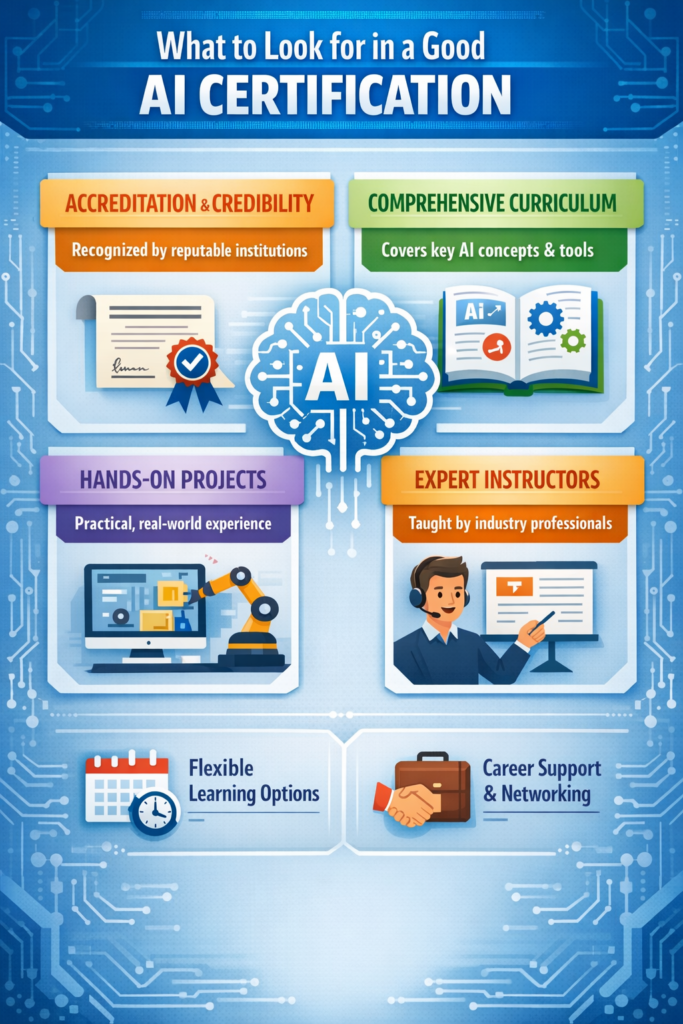
Not all certifications are worth your time.
Things that matter:
- Industry-relevant curriculum
- Hands-on projects
- Experienced instructors
- Exposure to real tools
- Recognition (to some extent)
Common tools you should see:
Python, Scikit-learn, TensorFlow, PyTorch, AWS, Azure, Docker, Kubernetes
Why online AI classes work well
Honestly, flexibility is a big advantage.
You can:
- Learn at your own pace
- Revisit recorded sessions
- Practice through labs
- Build projects alongside your job
The best ones guide you through:
- Building models step-by-step
- Deploying them
- Completing a capstone project
Quick FAQs
Which AI specialization grows fastest?
Machine learning engineering and AI engineering high demand, very practical.
Do certifications matter?
They help, but projects and real experience matter more.
How long to become job-ready?
Roughly 4–8 months with consistent effort and hands-on work.
Is coding required?
Yes Python is essential.
Can non-IT people switch to AI?
Yes, but expect to spend time building fundamentals first.
Which industries hire AI professionals?
Finance, healthcare, retail, tech, logistics… pretty much everywhere now.
Key takeaways
- Applied, hands-on AI learning beats theory if your goal is career growth
- Real-world skills like deployment, cloud, and MLOps are what employers want
- Online courses can work really well if they’re practical
- The best programs focus on building, not just explaining
- Career paths are flexible but ML Engineer and AI Engineer roles grow fastest