Advanced AI Engineer courses online come from all sorts of places universities, large learning platforms, and niche IT training providers like H2K Infosys. But what really sets them apart isn’t just the name behind them. It’s how deep they go, how much hands-on work you actually get, and whether they reflect real world project environments. The best Ai learning Courses don’t stop at theory they push you to build, test, and deploy solutions that closely mirror actual industry work.
So, what exactly is an AI Engineer courses online?
At its core, an AI Engineer courses online is a structured way to learn how to design, build, and maintain intelligent systems. That usually means working with machine learning models, deep learning networks, and data-driven applications. Not just understanding them but actually making them work.
What you typically learn (the core stuff)
Most solid AI Engineer courses online cover:
- Machine Learning algorithms and workflows
- Deep Learning and neural networks
- Natural Language Processing (NLP)
- Computer Vision
- Model deployment and MLOps
- Data preprocessing and feature engineering
One thing people often don’t realize Ai Course Certification are a bit different from general data science programs. They lean more toward deployment, scalability, and how systems run in production. It’s less about analysis and more about building something that survives outside a notebook.
Who actually offers advanced AI Engineer courses online?
You’ll find three main types of providers, and each has its own vibe.
1. University-backed programs
These are usually tied to academic institutions or executive education platforms.
What they’re good at:
- Strong fundamentals
- Deep theoretical grounding
- Structured, long-term learning (sometimes up to 1–2 years)
Where they fall short (sometimes):
- Not always focused on real-world deployment
- Limited exposure to industry tools
2. MOOC platforms
Think self-paced, flexible learning.
Pros:
- Learn anytime, anywhere
- Budget-friendly
- Covers a wide range of topics
Cons:
- You’re mostly on your own
- Not always job-focused
- Hands-on guidance can be minimal
3. Industry-focused IT training providers
These are designed for people who want to actually switch careers or level up quickly.
What stands out:
- Real-world project work (this is huge)
- Hands-on labs with guidance
- Mentorship and support
- Focus on job readiness
Honestly, this is where many learners get the “aha” moment when things stop being abstract and start feeling practical.
What makes an AI Engineer courses online advanced?
Not all certifications are created equal. Some look impressive but don’t go very deep.
Here’s what usually separates advanced programs:
Real-world projects
You’re not just coding toy examples. You might build:
- Fraud detection systems
- Recommendation engines
- NLP-based chatbots
- Image classification pipelines
End-to-end learning
From messy data to a working system:
- Data collection
- Cleaning and preprocessing
- Model building
- Evaluation
- Deployment (APIs, containers, etc.)
Industry tools
You’ll typically work with:
- Python
- TensorFlow / PyTorch
- Pandas, NumPy
- Docker, Kubernetes
- Cloud platforms like AWS or Azure
How AI actually works in real projects
In real environments, AI isn’t magic it’s a pipeline.
A typical workflow looks something like this:
- Define the problem (e.g., predict customer churn)
- Gather data (databases, APIs, logs)
- Clean and prepare the data
- Choose a model
- Train and validate it
- Deploy it (often as an API)
- Monitor performance over time
And yes monitoring is a big deal. Models don’t just sit there forever working perfectly.
Why AI Engineer courses online matters (especially now)
AI is everywhere quietly embedded in systems across industries.
Some reasons professionals are jumping into AI:
- Automating repetitive work
- Making better, data-driven decisions
- Staying relevant in a changing job market
- Expanding existing IT roles
Real-world use cases
- Finance → fraud detection
- Healthcare → medical imaging
- Retail → recommendation systems
- IT → predictive maintenance
Skills you actually need
AI isn’t just coding—it’s a mix of different skill sets.
Technical side:
- Python programming
- Data structures and algorithms
- Linear algebra and statistics
- Machine learning concepts
- Deep learning frameworks
Practical side:
- Debugging models (this takes patience)
- Cleaning messy data
- Improving model performance
- Deploying models into real systems
AI in enterprise environments
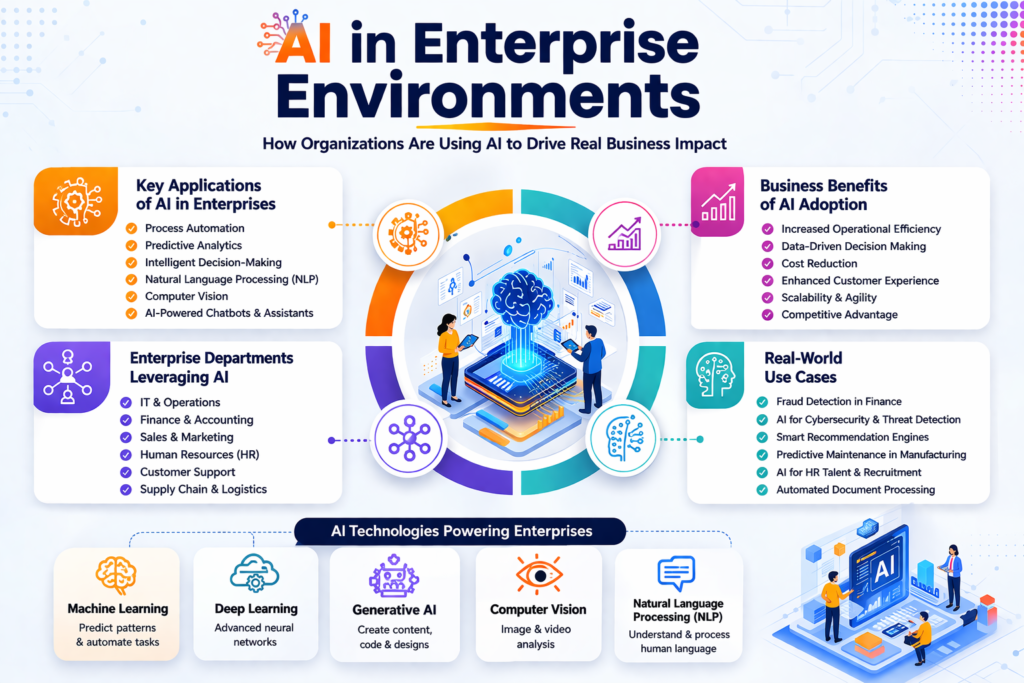
In companies, AI systems need to meet real constraints:
- Scalability – handling large volumes of data
- Security – protecting sensitive information
- Performance – fast predictions
- Monitoring – tracking accuracy over time
Take customer support, for example:
- Chatbots integrated with CRM systems
- NLP to understand user intent
- Automated ticket routing
It’s all connected behind the scenes.
Job roles that use AI Engineer courses online daily
AI skills aren’t limited to one role. You’ll see them across:
- AI Engineers → build and deploy models
- Data Scientists → analyze and model data
- ML Engineers → optimize and scale systems
- Data Analysts → extract insights
- Software Engineers → integrate AI into apps
Career paths after an AI Engineer courses online
Once you build solid skills, a few paths open up:
- AI Engineer
- Machine Learning Engineer
- Data Scientist
- NLP Engineer
- Computer Vision Engineer
And yes these roles tend to pay well, mainly because demand is still pretty high across industries.
How to evaluate a good AI Engineer courses online
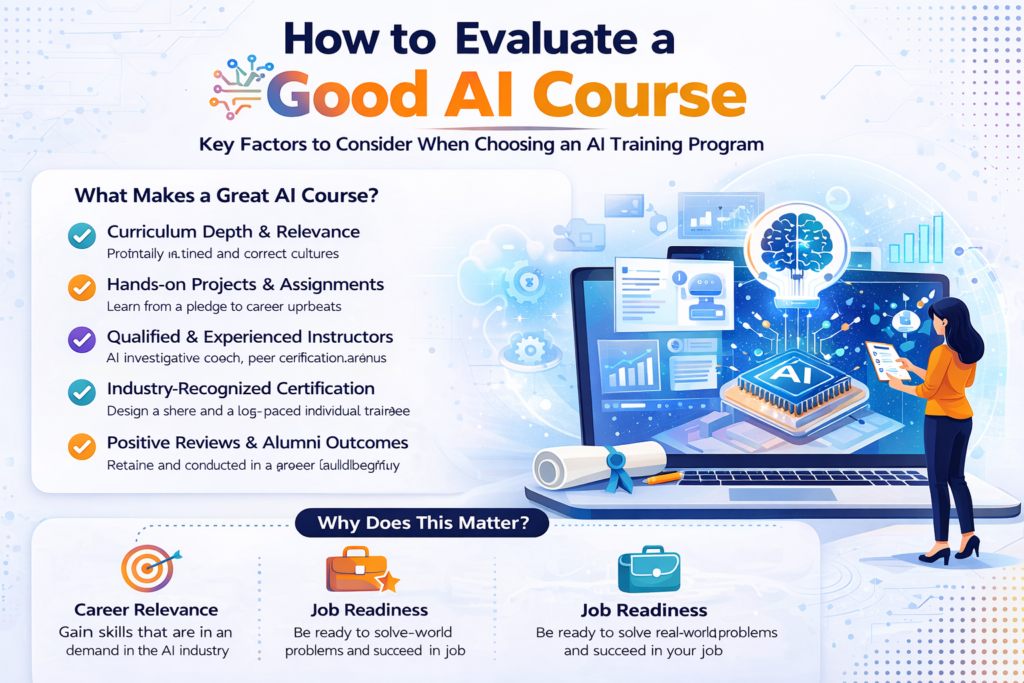
If you’re comparing options, don’t just look at the title.
Check for:
- Depth of curriculum
- Hands-on labs and projects
- Use of real datasets
- Instructor experience
- Coverage of modern tools
A basic vs advanced course often looks like this:
| Feature | Basic Course | Advanced Course |
|---|---|---|
| Theory | Yes | Yes |
| Projects | Limited | Extensive |
| Deployment | No | Yes |
| Mentorship | No | Yes |
| Certification | Basic | Industry-aligned |
A practical way to learn AI (step-by-step)
If you’re starting from scratch, a simple path could be:
- Learn Python
- Understand statistics and probability
- Study machine learning basics
- Work with datasets
- Move into deep learning
- Build projects
- Deploy your models
It sounds linear, but in reality you’ll probably loop back a lot. That’s normal.
Common challenges (and yeah, they’re real)
Technical:
- Math can feel overwhelming
- Debugging models gets frustrating
- Large datasets can slow you down
Practical:
- Not enough real-world exposure
- Lack of meaningful projects
- Difficulty moving into job roles
Most people hit these bumps. The key is sticking through them.
Tips that actually help
- Focus on hands-on work (seriously, this matters most)
- Use real datasets whenever possible
- Practice deployment, not just modeling
- Learn Git—it’s unavoidable
- Get comfortable with cloud platforms
Quick FAQs
AI vs Machine Learning?
AI is the bigger umbrella. Machine learning is one part of it.
Are certifications enough?
Not really. Projects and experience matter just as much—if not more.
How long does it take?
Roughly 6–12 months to become job-ready, depending on your pace.
Do you need coding?
Yes Python is pretty much essential.
Can working professionals learn AI online?
Absolutely. Many courses are built with flexibility in mind.
Top industries using AI?
Finance, healthcare, retail, IT pretty much everywhere now.
Final thoughts
If there’s one thing to keep in mind it’s this: the best AI Engineer courses online don’t just teach concepts. They make you build things that feel real.
That hands-on experience? That’s what actually prepares you for the job.
If you’re exploring structured, practical learning, programs like H2K Infosys are designed with that exact goal helping you move from learning concepts to applying them in real-world scenarios, with guidance along the way.