Yes, business analyst training can absolutely help you crack interviews, but only if the training goes beyond theory and prepares you for real project scenarios, stakeholder communication, tools, and problem-solving. That’s the part many people realize a little too late.
A lot of candidates complete a generic business analyst course, collect a certificate, and then freeze the moment an interviewer asks, “Tell me about a requirement conflict you handled.” That’s where practical exposure matters more than slides or recorded videos. This is exactly why many learners now prefer practical-focused training providers like H2K Infosys, where interview preparation and real-time project exposure are given more importance alongside theory.
And honestly, recruiters in 2026 have become sharper about this. They’re not just hiring people who “know Agile.” They want candidates who can explain how Agile actually works inside a messy real-world project.
The Problem With Many Business Analyst Courses
Not every business analyst course is built for job readiness.
Some are still stuck in old-school training formats where you spend weeks memorizing definitions nobody asks about in actual interviews. You learn what SDLC means, maybe a few Agile terms, maybe some BABOK concepts, and that’s it.
Then interviews hit you with practical questions.
Things like:
- “How would you gather requirements from a difficult client?”
- “What happens if business requirements change mid-sprint?”
- “How do you prioritize conflicting stakeholder requests?”
- “Have you worked with Jira workflows before?”
That’s where many candidates struggle.
I’ve honestly seen people with shorter training crack interviews faster than candidates with multiple certifications. Usually, because they practiced real scenarios instead of just reading slides.
And recruiters can tell the difference quickly.
There’s a certain way experienced candidates speak. Their answers sound natural, not memorized.
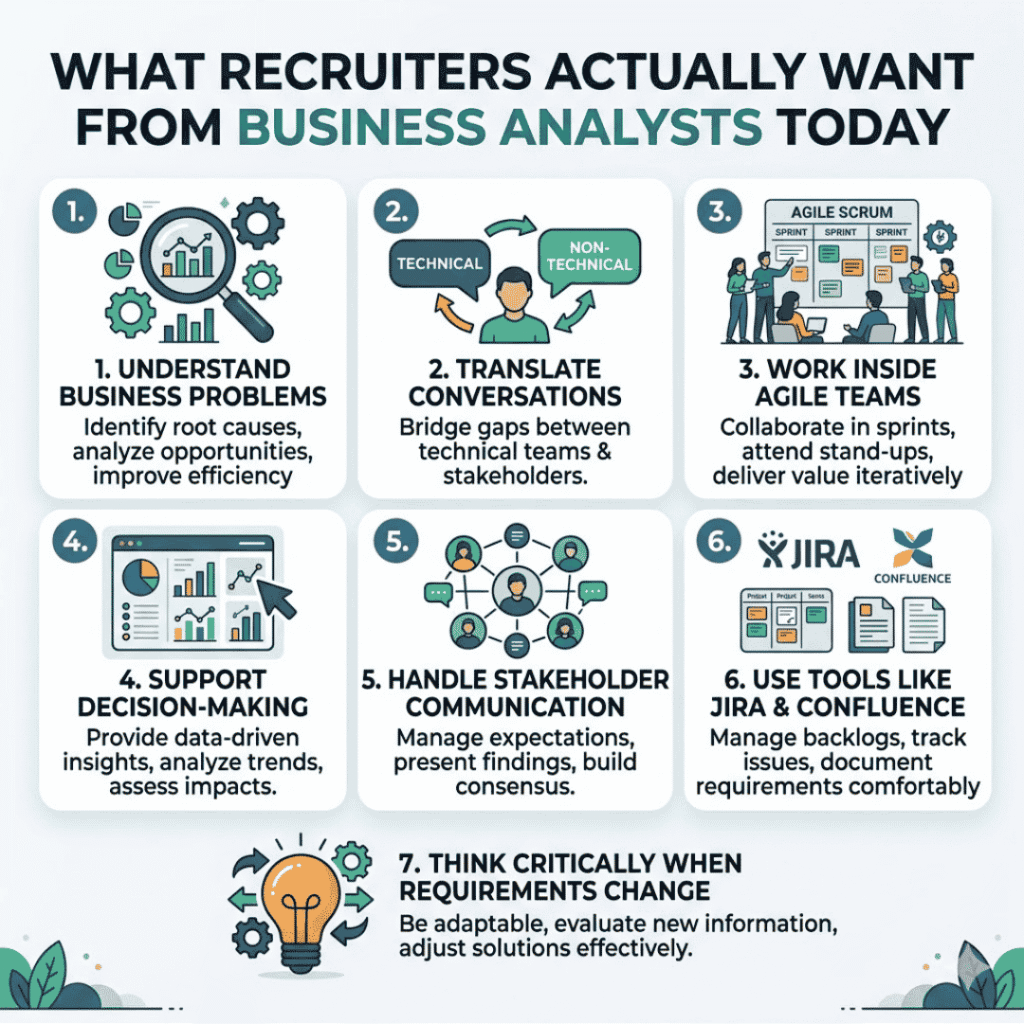
What Recruiters Actually Want From Business Analysts Today
This has changed a lot over the last couple of years.
Companies aren’t hiring business analysts just to write documents anymore. AI tools already help automate parts of documentation and reporting.
Now, businesses want analysts who can:
- Understand business problems
- Translate technical and non-technical conversations.
- Work inside Agile teams
- Support decision-making
- Handle stakeholder communication
- Use tools like Jira and Confluence comfortably.
- Think critically when requirements change.
That last part matters more than people realize.
Projects almost never go exactly as planned.
One hiring manager I spoke with recently mentioned that they care less about “perfect terminology” and more about whether a candidate can survive real project chaos without panicking.
That probably explains why scenario-based interviews are becoming more common.
Why Practical Training Makes a Huge Difference
This is where the quality of a business analyst class starts to matter.
Good training programs don’t just explain concepts.
They simulate actual work.
You work through:
- Requirement gathering sessions
- User story creation
- Sprint planning discussions
- Mock stakeholder meetings
- Change request handling
- UAT coordination
- Documentation exercises
- Interview simulations
That kind of exposure changes the way candidates answer questions.
Instead of sounding overly polished and textbook-like, they sound believable.
For example, weaker interview answers usually sound something like this:
“A BRD contains business requirements gathered from stakeholders.”
Technically correct.
But experienced interviewers hear that answer ten times a day.
Candidates who’ve practiced real projects usually explain things differently:
“In one healthcare practice project, we first documented compliance-related requirements in the BRD before converting them into sprint-ready user stories for the development team.”
That sounds closer to real work.
Because it is.
Why H2K Infosys Comes Up Frequently in BA Training Discussions
When people look for job-focused business analyst training, H2K Infosys gets mentioned pretty often, mainly because its training structure leans heavily toward practical preparation instead of only certification theory.
A lot of online institutes promise placement support, but candidates usually care about one thing underneath all the marketing:
“Will I actually feel confident during interviews?”
That’s the real question.
What makes H2K Infosys stand out for many learners is the way they combine:
- Live instructor-led sessions
- Real-time project exposure
- Agile and Scrum workflows
- Jira training
- Resume preparation
- Mock interviews
- Placement-oriented guidance
That combination tends to help candidates move beyond memorized answers.
And honestly, mock interviews help more than people expect.
Many candidates already know the concepts. They just haven’t practiced saying answers out loud under pressure.
That’s a completely different skill.
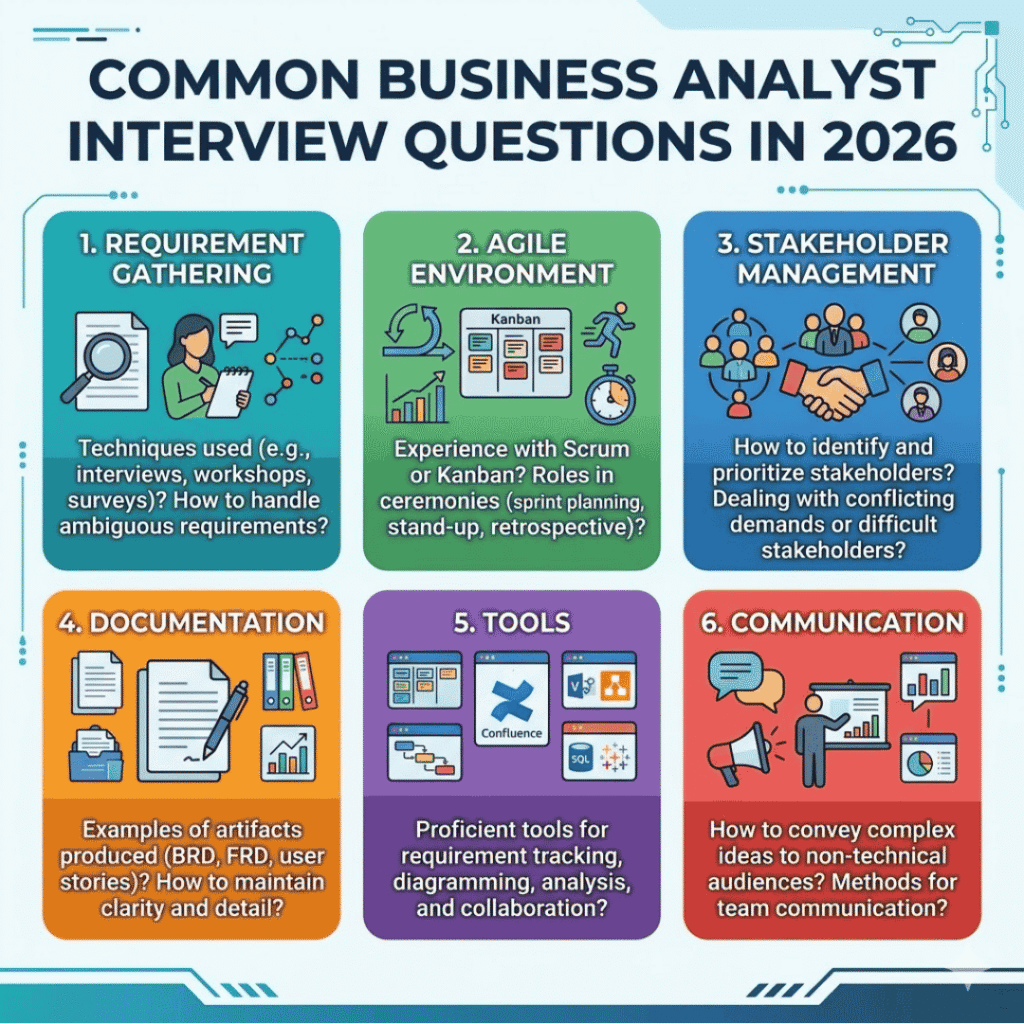
Interview Questions Business Analysts Commonly Face in 2026
Interviews today feel more conversational than they used to.
Companies want to know how you think.
Some common questions include:
Requirement Gathering
“How would you collect requirements from multiple departments with different priorities?”
Agile Environment
“What happens during backlog grooming?”
Stakeholder Management
“What would you do if a stakeholder keeps changing requirements?”
Documentation
“How do you decide whether something belongs in a BRD or a user story?”
Tools
“How have you used Jira or Confluence in projects?”
Communication
“How would you explain a technical issue to a non-technical client?”
A strong business analyst course should prepare candidates to answer these comfortably using examples and practical thinking.
Not robotic definitions.
The AI Shift Is Changing Business Analyst Roles Too
This part is interesting.
A few years ago, people started worrying that AI tools would reduce demand for business analysts.
What actually happened is a bit different.
Companies still need analysts, maybe even more now, because someone has to bridge communication between business teams, technical teams, and AI-assisted systems.
AI can summarize meetings.
AI can generate drafts.
AI can organize workflows.
But businesses still need humans to:
- Clarify ambiguous requirements
- Understand stakeholder intent
- Prioritize business goals
- Resolve communication gaps
- Make judgment calls
Those are human-heavy skills.
And interviews increasingly focus on them.
One Thing Candidates Often Ignore
Communication.
Seriously.
A candidate may know Agile inside out but still fail interviews because answers sound stiff or overly rehearsed.
Business analysts spend a huge part of their job talking:
- To clients
- To developers
- To managers
- To testers
- To product owners
Interviewers naturally pay attention to how clearly candidates explain things.
That’s another reason practical business analyst training tends to work better than purely theoretical learning.
The more discussions, mock sessions, and presentations you practice, the more natural your communication becomes.
Is Certification Enough by Itself?
Usually not.
Certifications help validate learning, especially for freshers and career switchers, but they rarely guarantee interview success on their own.
Most hiring managers still care more about:
- Problem-solving ability
- Communication
- Real-world understanding
- Team collaboration
- Confidence in handling scenarios
A certificate may get your resume shortlisted.
Practical readiness is what usually gets the offer.
Who Should Consider a Business Analyst Class?
Business analyst training can be especially useful for:
- Fresh graduates
- QA professionals moving into BA roles.
- Support engineers
- Project coordinators
- Non-technical professionals entering IT.
- Professionals returning after career breaks.
And because remote collaboration has become normal across many companies, documentation and communication skills are becoming even more valuable.
That trend isn’t slowing down.
Final Thoughts
So, is business analyst training enough to crack interviews?
It definitely can be if the training includes practical exposure, project-based learning, mock interviews, and real-world business scenarios.
The strongest candidates usually come from programs that teach beyond theory.
That’s one reason many aspiring analysts explore options like H2K Infosys Business Analyst Course, especially when they want training that feels closer to actual workplace expectations.
Because at the end of the day, interviewers are not searching for someone who memorized definitions.
They’re looking for someone who already sounds capable of doing the job.