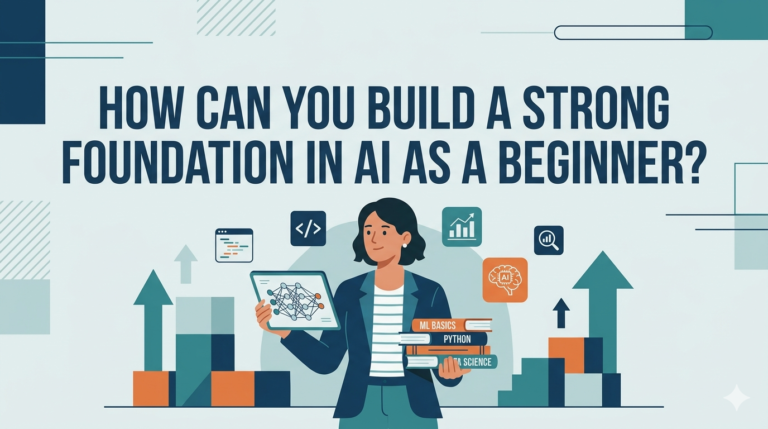
The fastest way to build a strong foundation in Artificial Intelligence as a beginner is to start with practical learning instead of drowning yourself in theory. A structured artificial intelligence course for beginners, combined with small real-world projects and consistent hands-on practice, usually works far better than trying to learn everything from random YouTube playlists.
Honestly, this is something a lot of beginners figure out a little late. Artificial Intelligence looks exciting from the outside ChatGPT, self-driving cars, AI coding assistants, image generators but once you start learning, it can suddenly feel like you walked into a room where everyone already knows calculus, Python, and ten different buzzwords.
The good news? You do not need to be a math genius or a Silicon Valley engineer to get started.
You just need the right learning path.
Why So Many Beginners Struggle With AI Learning
A few years ago, learning AI mostly meant reading research papers and trying to survive dense academic content. Things are different now. AI education has become more accessible, but weirdly, that created another problem information overload.
One person tells you to master Python first. Another says start with neural networks. Someone on Reddit insists you need advanced statistics before touching machine learning.
Meanwhile, companies are actively hiring people with practical Artificial Intelligence skills right now.
That disconnect confuses beginners.
I’ve noticed the students who progress fastest usually avoid one big mistake they don’t try to learn AI in a completely unstructured way.
Instead, they follow a guided roadmap through a proper artificial intelligence online training program where concepts build gradually.
And honestly, that makes a massive difference.
Start With the Basics – Not the Fancy Stuff
A strong AI foundation starts with understanding how machines learn from data.
Not building AGI. Not creating the next ChatGPT clone. Just understanding the core logic.
At the beginner level, focus on
- Basic Python programming
- Understanding data
- Simple machine learning concepts
- Problem-solving mindset
- Real-world AI applications
- Model training basics
- Ethical AI awareness
That’s enough to create momentum.
One thing beginners often underestimate is how motivating small wins can be.
For example, creating a tiny AI model that predicts house prices or detects spam emails sounds simple, but it teaches foundational thinking. You start understanding patterns, datasets, training, testing, and why models sometimes fail.
That’s real learning.
Why Python Still Dominates AI in 2026
Even with new AI tools appearing almost every month, Python continues to dominate AI and machine learning.
There’s a practical reason for that.
Most modern AI frameworks, TensorFlow, PyTorch, Scikit-learn, LangChain, Hugging Face work incredibly well with Python. Companies building AI products still rely heavily on Python-based ecosystems.
If you are joining a machine learning ai course today, chances are Python will be the starting point.
And that’s actually helpful.
Because once you become comfortable with:
print(“Hello AI”)
…the fear starts disappearing.
A lot of beginners imagine programming as some impossible skill. In reality, AI coding becomes manageable when you learn it step-by-step inside guided projects.
The Shift Happening in AI Careers Right Now
This part matters.
The AI industry in 2026 is no longer focused only on researchers.
Businesses now need
- AI analysts
- Prompt engineers
- ML support specialists
- AI automation consultants
- Data associates
- Junior machine learning engineers
- AI-powered QA testers
Even non-technical professionals are entering AI-driven roles.
A recent trend across healthcare, finance, retail, and cybersecurity industries shows companies integrating generative AI into everyday workflows instead of treating it like an experimental side project.
You can actually see this shift in hiring trends on platforms like LinkedIn and Indeed. Employers increasingly care about whether candidates can apply AI tools in practical situations.
That’s why hands-on artificial intelligence online training matters more than passive learning.
What a Good Beginner AI Course Should Include
Not every course marketed as beginner-friendly truly is.
Some jump into advanced algorithms too quickly. Others overload students with theory but barely explain how AI gets used in actual businesses.
A strong artificial intelligence course for beginners should include
1. Python Fundamentals
You don’t need advanced software engineering initially.
But you should learn:
- Variables
- Functions
- Loops
- Data structures
- API
- Basic debugging
That foundation helps later when working with machine learning libraries.
2. Data Handling
AI depends on data.
Beginners should learn how to:
- Read datasets
- Clean data
- Visualize information
- Handle missing values
- Understand patterns
This is where many students suddenly realize AI is not magic. It’s heavily dependent on data quality.
3. Machine Learning Concepts
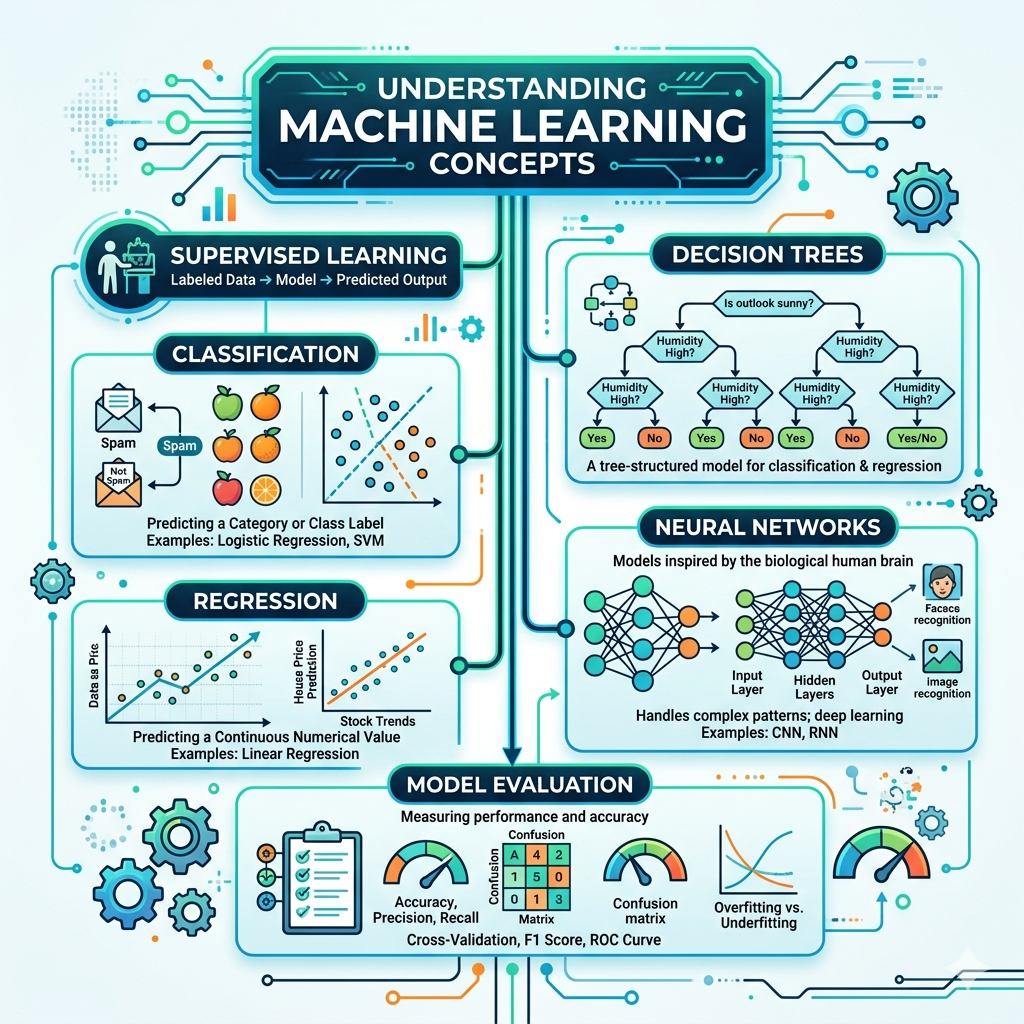
A beginner-friendly machine learning ai course should explain concepts in plain English.
Things like:
- Supervised learning
- Classification
- Regression
- Decision trees
- Neural networks
- Model evaluation
You don’t need PhD-level mathematics on day one.
You just need conceptual clarity.
4. Real Projects
This is huge.
The students who retain knowledge best are usually the ones building things.
Even small projects help:
- Movie recommendation systems
- AI chatbots
- Fraud detection models
- Resume screening tools
- Customer sentiment analysis
Projects create confidence.
Why H2K Infosys Stands Out for Beginners
One reason many beginners struggle is because they learn in isolation.
That’s where structured training platforms like H2K Infosys come into the conversation.
What makes their learning approach useful for beginners is the balance between theory and real-world application.
Instead of overwhelming students with academic jargon immediately, their programs focus on practical understanding, guided labs, project-based learning, and industry-oriented training.
That matters more than people think.
Especially when someone is transitioning from:
- Non-IT backgrounds
- Manual testing
- Business analysis
- Customer support
- Fresh graduate programs
A lot of learners need structured mentorship, not just video lessons.
H2K Infosys also places strong emphasis on job-oriented skills, interview preparation, and hands-on exposure. That’s increasingly important because companies hiring junior AI talent want candidates who can explain workflows and demonstrate practical understanding not just repeat definitions.
The Reality About AI Learning Curves
Here’s something nobody says enough.
You will feel confused sometimes.
That’s normal.
Even experienced engineers occasionally pause mid-project and think:
“Wait… why is this model behaving like this?”
AI learning is iterative.
Some days concepts click instantly. Other days you rewatch the same lesson three times.
That doesn’t mean you’re failing.
Actually, the people who stay consistent through the confusing stages usually end up progressing the farthest.
One small habit helps a lot build tiny things regularly.
Not giant portfolio projects. Tiny experiments.
That rhythm compounds over time.
How Beginners Can Practice AI Without Expensive Resources
This is another common misconception.
You do not need a powerful gaming PC or enterprise-level setup to start learning AI.
Today, beginners can practice using:
- Google Colab
- Kaggle notebooks
- GitHub repositories
- Open-source datasets
- Hugging Face models
- Free-tier cloud platforms
Some of the best beginner projects are built entirely on free tools.
I’ve seen learners create surprisingly useful AI applications with nothing more than a browser, curiosity, and consistent practice.
AI Ethics Matters More Than Ever in 2026
One major shift happening now is the growing focus on responsible AI.
Companies are paying closer attention to
- Bias in AI systems
- Data privacy
- Explainability
- AI hallucinations
- Compliance requirements
This became especially visible after enterprises started deploying generative AI at scale.
A quality machine learning ai course should introduce ethical AI concepts early instead of treating them as an afterthought.
Because real-world AI isn’t just about building models anymore.
It’s also about building trustworthy systems.
The Best Learning Path for AI Beginners
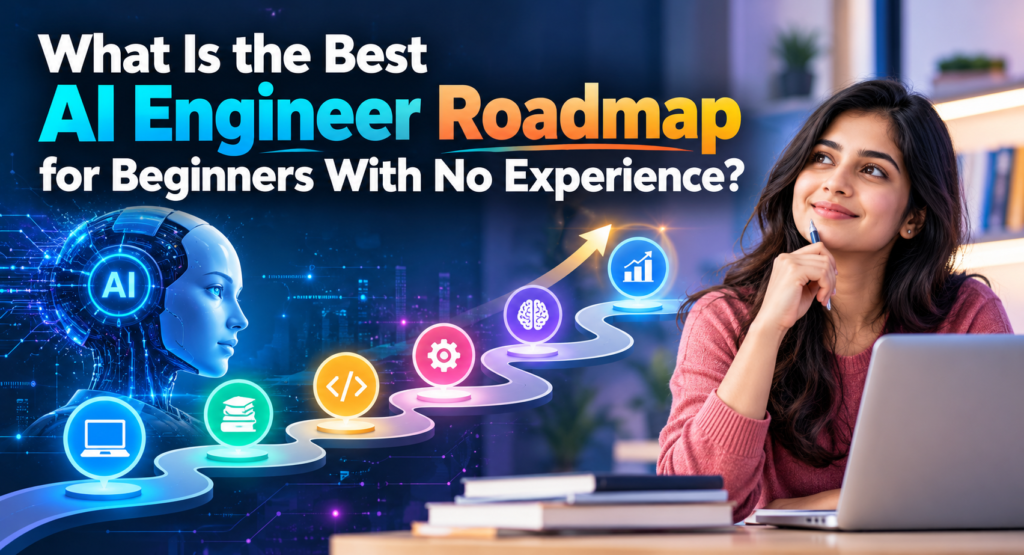
If someone asked me for the simplest realistic roadmap, it would probably look like this:
Month 1
- Learn Python basics
- Understand how datasets work
- Practice simple coding exercises
Month 2
- Start beginner machine learning concepts
- Work with Pandas and NumPy
- Build tiny prediction models
Month 3
- Create hands-on projects
- Learn basic neural networks
- Explore generative AI tools
Month 4+
- Specialize gradually
- Explore NLP, computer vision, or AI automation
- Build portfolio projects
- Practice interviews
That path is much more sustainable than trying to master everything immediately.
Why AI Skills Are Becoming Career Insurance
This sounds dramatic, but honestly, AI literacy is slowly becoming as important as digital literacy.
Even professionals outside tech are now expected to understand:
- AI-assisted workflows
- Automation tools
- Data interpretation
- Prompt engineering
- AI productivity systems
Marketing teams use AI. Finance teams use AI. Healthcare organizations use AI. Cybersecurity teams definitely use AI.
The professionals adapting early usually gain a major advantage.
And this is exactly why beginner-friendly artificial intelligence online training programs are growing so rapidly.
People are realizing AI is no longer a future skill.
It’s a present-day career skill.
Final Thoughts
Building a strong foundation in AI as a beginner does not require perfection.
It requires consistency, curiosity, and the right guidance.
The smartest approach is usually starting with a structured artificial intelligence course for beginners that combines practical projects, mentorship, and real-world applications. From there, concepts become less intimidating and much more actionable.
Platforms like H2K Infosys help simplify that journey by giving beginners a clearer roadmap, hands-on exposure, and industry-focused learning support.
And honestly, that kind of structure saves people months of confusion.
AI is evolving ridiculously fast right now.
But beginners still have a huge opportunity.
You don’t need to know everything.
You just need to start building the foundation.