
Introduction
Every business decision relies on clear data, strong logic, and a deep understanding of needs. Behind these decisions stands a skilled Business Analyst. If you want to build a career in this field, you may ask a simple question. What is the best way to learn business analysis from scratch?
Many beginners feel confused at the start. They see many tools, methods, and certifications. They do not know where to begin. The good news is that you can learn business analysis step by step with a clear plan.
In this guide, you will learn how to start from zero, build strong fundamentals, gain practical skills, and move toward a successful career. This blog will also help you understand the value of business analyst certification, business analyst training and placement, and a structured business analyst course.
Why Business Analysis Is a High Demand Skill
Businesses today depend on data driven decisions. According to industry reports, demand for Business Analysts continues to grow across sectors like IT, finance, healthcare, and retail.
Key reasons for high demand
- Companies want to reduce costs and improve efficiency
- Organizations need clear requirements before building products
- Data analysis helps in better decision making
- Agile development increases the need for skilled analysts
A Business Analyst acts as a bridge between business goals and technical solutions. This role creates value in every project.
What Does a Business Analyst Do?
Before you learn business analysis, you must understand the role.
Core responsibilities
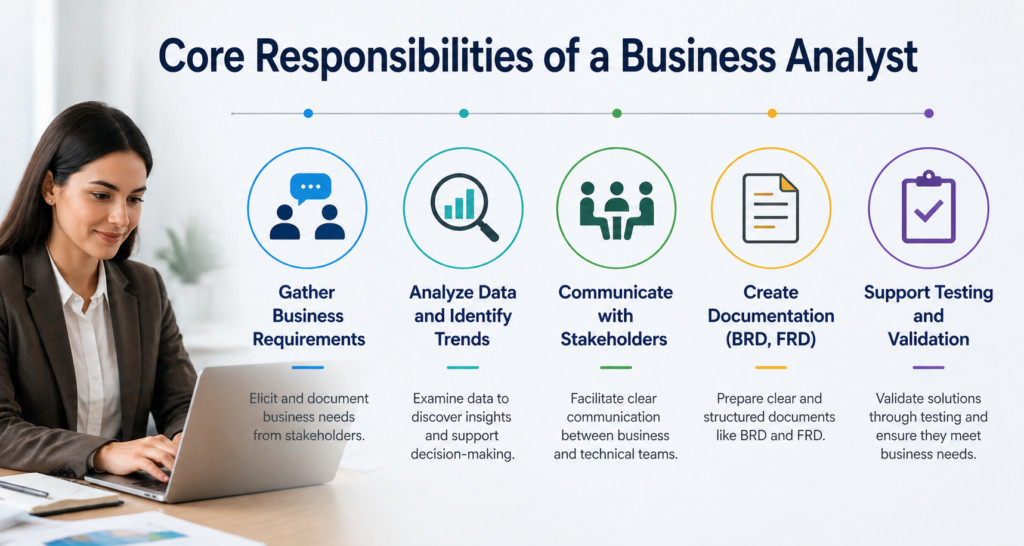
- Gather business requirements
- Analyze data and identify trends
- Communicate with stakeholders
- Create documentation like BRD and FRD
- Support testing and validation
Real world example
A retail company wants to improve online sales. A Business Analyst studies customer data, identifies issues in the checkout process, and suggests improvements. The result is higher conversions and better user experience.
Step 1: Understand the Basics of Business Analysis
You must start with core concepts when you learn business analysis.
Key concepts to learn
- Business processes
- Requirement types
- Stakeholder management
- Data analysis basics
- SDLC and Agile methodologies
Simple diagram of business analysis flow
Business Need → Requirement Gathering → Analysis → Solution → Validation
This flow shows how a Business Analyst adds value at each stage.
Step 2: Build a Strong Foundation With Structured Learning
A structured business analyst course helps you cover all essential topics in a logical order.
Topics you should focus on
- Requirement elicitation techniques
- Process modeling
- Use case creation
- Data visualization basics
- Documentation standards
A structured approach helps you learn business analysis faster and with clarity.
Step 3: Learn Key Tools Used by Business Analysts
Tools help you work efficiently. When you learn business analysis, you should practice tools used in the industry.
Common tools
- Excel for data analysis
- SQL for querying data
- Power BI or Tableau for visualization
- JIRA for project tracking
- Visio or Lucidchart for process diagrams
Example: Basic SQL Query
SELECT customer_name, purchase_amount
FROM sales
WHERE purchase_amount > 500;
This query helps identify high value customers.
Step 4: Practice Requirement Gathering Techniques
Requirement gathering is a core skill. You must practice this when you learn business analysis.
Techniques to use
- Interviews
- Surveys
- Workshops
- Observation
Example scenario
A company wants to build a mobile app. You conduct interviews with users and stakeholders. You collect needs like fast login, simple navigation, and secure payment.
Step 5: Work on Real World Projects
You cannot rely only on theory. You must apply knowledge to real scenarios when you learn business analysis.
Project ideas
- Analyze a retail sales dataset
- Create a requirement document for a food delivery app
- Build a process flow for an online booking system
Example project structure
- Define problem
- Collect data
- Analyze data
- Present findings
- Suggest solution
This approach builds practical skills.
Step 6: Learn Documentation Skills
Documentation is a key part of the role.
Important documents
- BRD (Business Requirement Document)
- FRD (Functional Requirement Document)
- User stories
Example user story
“As a customer, I want to track my order so that I know delivery status.”
Clear documentation helps teams understand requirements.
Step 7: Understand Agile and Scrum
Modern teams use Agile methods. You must learn business analysis in an Agile environment.
Key Agile concepts
- Sprint
- Product backlog
- User stories
- Scrum meetings
Example workflow
- Collect user stories
- Prioritize tasks
- Develop in sprints
- Review and improve
Agile improves speed and flexibility.
Step 8: Develop Communication Skills
A Business Analyst communicates with many teams.
Skills to build
- Clear writing
- Active listening
- Presentation skills
- Stakeholder management
Example
You present findings to managers. You use simple charts and clear language. This helps them make quick decisions.
Step 9: Gain Knowledge of Business Domains
Domain knowledge improves your value.
Popular domains
- Banking
- Healthcare
- E-commerce
- Insurance
When you learn business analysis, domain knowledge helps you understand problems faster.
Step 10: Prepare for Business Analyst Certification
A business analyst certification validates your skills.
Benefits
- Improves credibility
- Increases job opportunities
- Shows structured knowledge
Preparation tips
- Study core concepts
- Practice mock tests
- Review case studies
Certification helps you stand out in the job market.
Step 11: Build a Strong Portfolio
A portfolio shows your skills.
What to include
- Case studies
- Sample documents
- Data analysis projects
- Process diagrams
A strong portfolio proves your ability to solve real problems.
Step 12: Focus on Business Analyst Training and Placement
Many learners aim for job readiness. Business analyst training and placement programs often focus on skills needed for employment.
Skills employers expect
- Problem solving
- Data analysis
- Communication
- Tool knowledge
When you learn business analysis, focus on job relevant skills.
Step 13: Prepare for Interviews
Interview preparation is important.
Common questions
- What is a Business Analyst role
- Explain requirement gathering
- What is Agile methodology
- Describe a project you worked on
Tip
Use real examples to answer questions.
Common Mistakes to Avoid
When you learn business analysis, avoid these mistakes:
- Skipping fundamentals
- Ignoring practical projects
- Not practicing tools
- Weak communication skills
- No portfolio
Avoiding these helps you progress faster.
Learning Roadmap for Beginners
Month 1
- Learn basics
- Understand role and concepts
Month 2
- Practice tools
- Start small projects
Month 3
- Work on real case studies
- Build portfolio
Month 4
- Prepare for certification
- Practice interviews
This roadmap helps you learn business analysis step by step.
Real World Case Study
Problem
A company faced low customer retention.
Approach
- Analyze customer data
- Identify drop points
- Conduct user feedback sessions
Solution
- Improve onboarding process
- Add customer support features
Result
Retention increased by 25 percent.
This example shows how analysts create business value.
Key Skills You Must Master
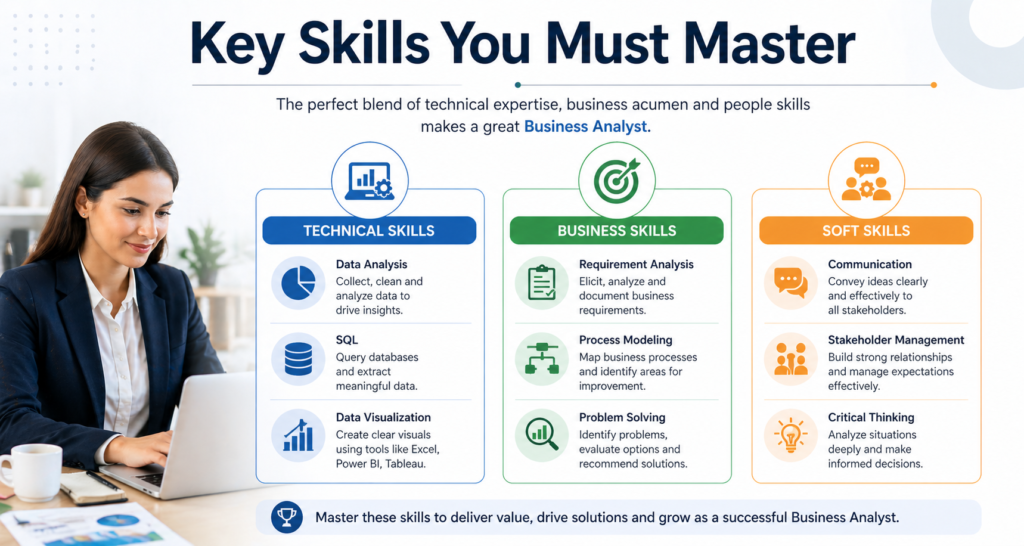
Technical skills
- Data analysis
- SQL
- Visualization
Business skills
- Requirement analysis
- Process modeling
Soft skills
- Communication
- Problem solving
You must balance all skills when you learn business analysis.
Benefits of Learning Business Analysis
- High demand career
- Good salary growth
- Opportunities across industries
- Strong career stability
Many professionals choose to learn business analysis for long term growth.
How to Stay Updated
The field evolves fast.
Ways to stay updated
- Read industry blogs
- Follow case studies
- Practice new tools
- Join discussions
Continuous learning is important.
Key Takeaways
- Start with basics and build strong fundamentals
- Practice real world projects
- Learn tools and documentation
- Focus on communication skills
- Prepare for business analyst certification
- Build a portfolio to show your skills
- Follow a clear roadmap
Conclusion
Start your journey today and take consistent steps to build your skills.
Choose a clear path, stay focused, and grow into a confident Business Analyst.