Why This Even Matters Right Now
If you’ve been browsing job roles lately, you’ve probably noticed something… “Data Analytics Training” is everywhere.
Not just in tech companies. Retail, healthcare, finance ,pretty much every industry is hiring analysts in some form. But here’s the catch: they’re not just hiring people who studied data. They want people who can work with it.
I remember talking to someone who had just completed data analytics training. They had the certificate, knew the terminology, but still felt unsure in interviews. Their exact words were something like, “I understand it… but I haven’t really done it.”
That stuck with me.
Because that’s exactly what separates average training from valuable data analytics training.
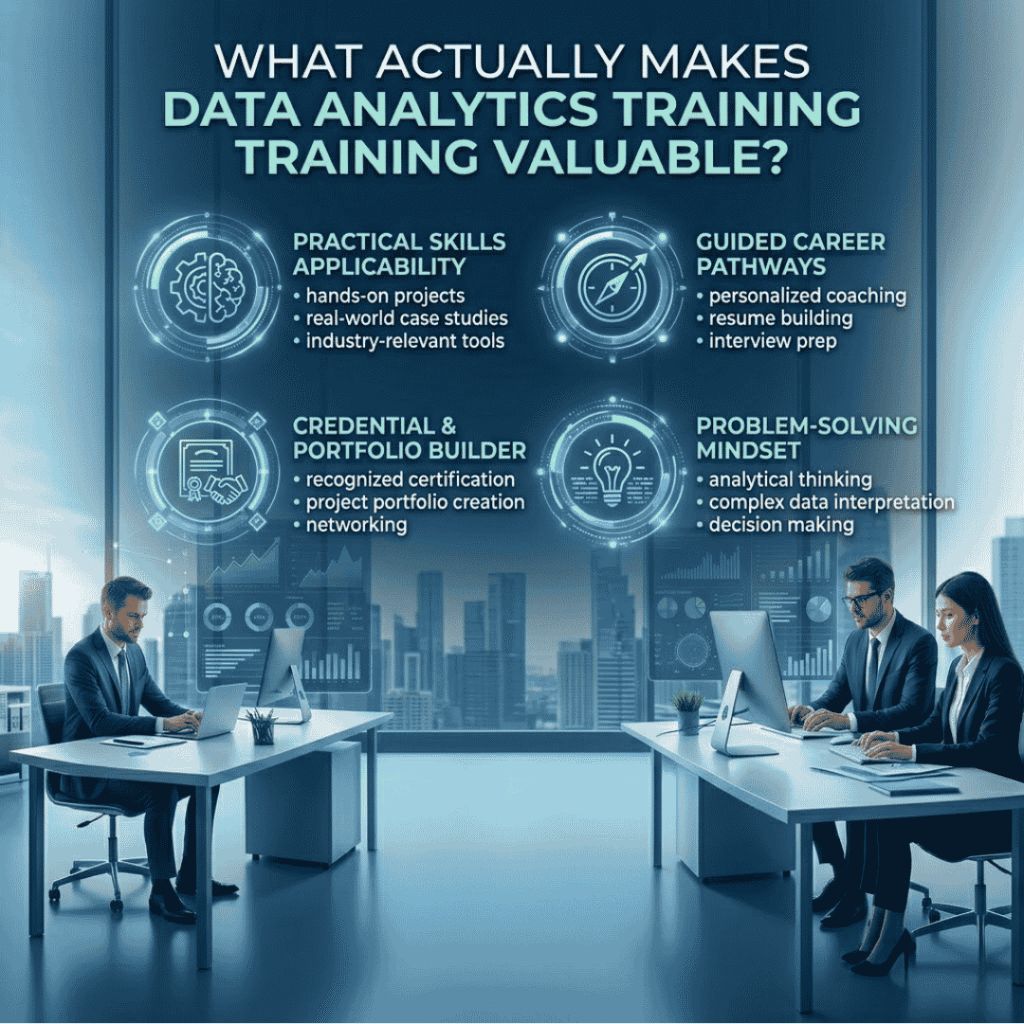
So What Actually Makes a Data Analytics Training Valuable?
Not the marketing. Not the certificate.
It comes down to whether the training reflects what’s happening in real jobs.
Let me break that down a bit.
You’re Learning Tools You’ll Actually Use
This might sound obvious, but it’s where many courses miss the mark.
A useful data analytics training should involve tools like the following:
- SQL (this one comes up everywhere)
- Excel (still heavily used, even in big companies)
- Tableau or Power BI
- Maybe Python, depending on the role
I’ve heard hiring managers say this pretty directly: if a candidate struggles with SQL basics, the interview usually doesn’t go much further.
So yeah, tools matter. A lot.
You’re Not Just Watching… You’re Doing
There’s a big difference between understanding something and being able to do it without guidance.
Some courses lean heavily on recorded videos. You follow along, everything works, and it feels good.
But then you try it alone… and suddenly it’s not so simple.
Strong data analytics training pushes you into situations where
- The data isn’t clean
- The problem isn’t clearly defined
- You have to figure things out
That’s actually closer to real work.
It Builds Your Thinking, Not Just Your Skills
This is harder to explain, but really important.
Being an analyst isn’t just about writing queries or building dashboards. It’s about asking:
- What’s the problem here?
- What does the data actually tell us?
- What should we do next?
For example, saying:
“Customer churn increased by 8%.”
is okay.
But saying
“Churn increased mainly among new users we might need to improve onboarding”
that’s the kind of thinking companies look for.
And honestly, not every data analytics training teaches that.
You Walk Away With Something Tangible
A certificate is fine. It shows you completed something.
But in interviews, what really helps is:
- Projects
- Case studies
- Real examples of your work
I’ve seen candidates open their portfolio and walk through a project step by step that alone can change the entire conversation.
That’s where good data analytics training becomes actually useful when it’s backed by real work.
What’s Changed in the US Job Market Lately
Things aren’t exactly the same as they were a few years ago.
There’s been a shift toward the following:
- Skill-based hiring
- Faster onboarding expectations
- Less focus on traditional degrees
Companies want people who can contribute quickly. Even at entry level.
Also, with AI tools becoming more common, the expectation isn’t just “analyze data” it’s “interpret and explain it.”
So the human side of analytics is becoming more important, not less.
What You Really Gain From Good Data Analytics Training
If the training is done right, you don’t just learn; you start to feel comfortable working with data.
You build:
- Confidence using tools
- A way of thinking through problems
- A portfolio you can actually talk about
Career options usually include:
- Data Analyst
- Business Analyst
- Reporting Analyst
Salary-wise (US market):
- Around $65K–$85K starting
- Higher with experience
The demand is still there. That hasn’t changed.
Where People Usually Slip Up
This part’s worth paying attention to.
Common mistakes I’ve seen:
- Choosing the cheapest option without checking quality
- Skipping practice (this one hurts later)
- Thinking a certificate is enough
- Trying to learn everything at once
- Not building a portfolio
It’s easy to rush, but this field rewards consistency more than speed.
Why Structured Training Still Helps
You can piece everything together on your own. Plenty of people do.
But it’s not always straightforward.
You end up:
- Switching between resources
- Getting stuck without feedback
- Wondering if you’re learning the right things
That’s where structured programs come in.
Training providers like H2K Infosys, for example, tend to focus more on real-time scenarios and job-oriented skills. Not just theory, but how things actually work in a US-based role.
And that kind of direction can save a lot of time.
If you’re serious about building a career in this, structured training can really help especially when it’s aligned with real job expectations.
A Few Practical Tips Before You Start
Just a few things I’d personally check:
- Does the course include projects?
- Is SQL covered properly?
- Will you build a portfolio?
- Is there any interview prep?
These details matter more than flashy promises.
FAQs
Is a data analyst certification online enough by itself?
Not really. It helps, but you’ll need projects and practical skills to stand out.
How long does it take to get job-ready?
Usually around 3–6 months if you’re consistent.
Do US companies accept online training?
Yes, but they focus more on what you can do than where you learned it.
Is Python required?
Helpful, but SQL is more important for entry-level roles.
What should I learn first?
Start with SQL and Excel; they form the base for most analytics work.
You Can Also Explore
If you’re planning to go deeper, you might want to look into:
- Building a data analyst portfolio that actually gets attention
- Practicing real SQL interview questions
- Understanding the difference between Tableau and Power BI
Final Thoughts
A Data Analytics Training program becomes valuable when it feels close to real work.
If it helps you think, solve problems, and explain insights, you’re in a good place.
If it’s just theory, you’ll probably feel stuck later.
If you’re starting out, focus on learning by doing. And if you prefer a guided approach, a company like H2K Infosys can provide that structure and real-world alignment.
At the end of it all, the goal isn’t just to learn Data Analytics Training.
It’s to be able to sit in front of it… and know what to do next.