Artificial Intelligence (AI) training online can take anywhere from a few weeks to more than a year depending on a person’s background, career goals, and how much time they can consistently dedicate each week. Some beginner-friendly programs focus on fundamentals and can be completed in a few months, while more advanced career-focused training covers machine learning, data science, cloud AI tools, and real-world projects over a longer period.
Programs from H2K Infosys are designed to make the learning process more practical and structured with live instructor-led sessions, hands-on assignments, and job-oriented support. That helps learners build real skills faster instead of only studying theory.
Some people move through the material surprisingly fast. Others slow down once the projects become more hands-on and less “watch-the-video, answer-the-quiz.” That’s pretty common, honestly. An advanced Artificial intelligence Certification Online especially one covering machine learning, deep learning, cloud AI services, deployment pipelines, and production workflows can easily stretch into the 9 -12 month range. Sometimes longer.
A lot depends on the format too. Self-paced learning feels flexible at first, but without deadlines, it’s easy for a “6-month program” to quietly become an 11-month journey. Instructor-led courses usually keep people moving because there’s structure, accountability, project reviews, and somebody expecting assignments to actually get submitted.
Then there’s background experience. Someone already comfortable with Python, SQL, statistics, or software development will naturally pick up AI concepts faster than someone starting from scratch. Beginners often need extra time for the math-heavy parts things like probability, linear algebra, optimization, and model evaluation. That’s usually where learners pause, rewind videos, stare at formulas for a while, grab coffee, and try again.
So, what exactly is Artificial Intelligence online training?
At its core, AI training teaches systems how to simulate certain human-like abilities: learning from data, spotting patterns, making predictions, automating decisions, understanding language, even recognizing images. Most solid programs cover a mix of theory and implementation rather than staying purely academic.
Typical topics include:
- Machine Learning (ML)
- Deep Learning
- Natural Language Processing (NLP)
- Computer Vision
- Neural Networks
- Python programming
- Data preprocessing
- AI model deployment
- Cloud-based AI services
The better programs don’t stop at concepts. They make learners actually build things — models, APIs, deployment pipelines, dashboards, recommendation systems. That practical side matters way more than people expect in the beginning.
Because the truth is, building a model in a notebook is one thing. Getting it to run reliably in production without breaking everything around it? Totally different challenge.
That’s why modern Artificial Intelligence Engineer Course increasingly include MLOps and cloud deployment workflows. Enterprise AI today is bigger than just “train model, get prediction.” Teams also deal with infrastructure, monitoring, scalability, security policies, governance standards, versioning, and all the messy operational stuff nobody talks about in beginner tutorials.
A simplified enterprise AI workflow usually looks something like this:
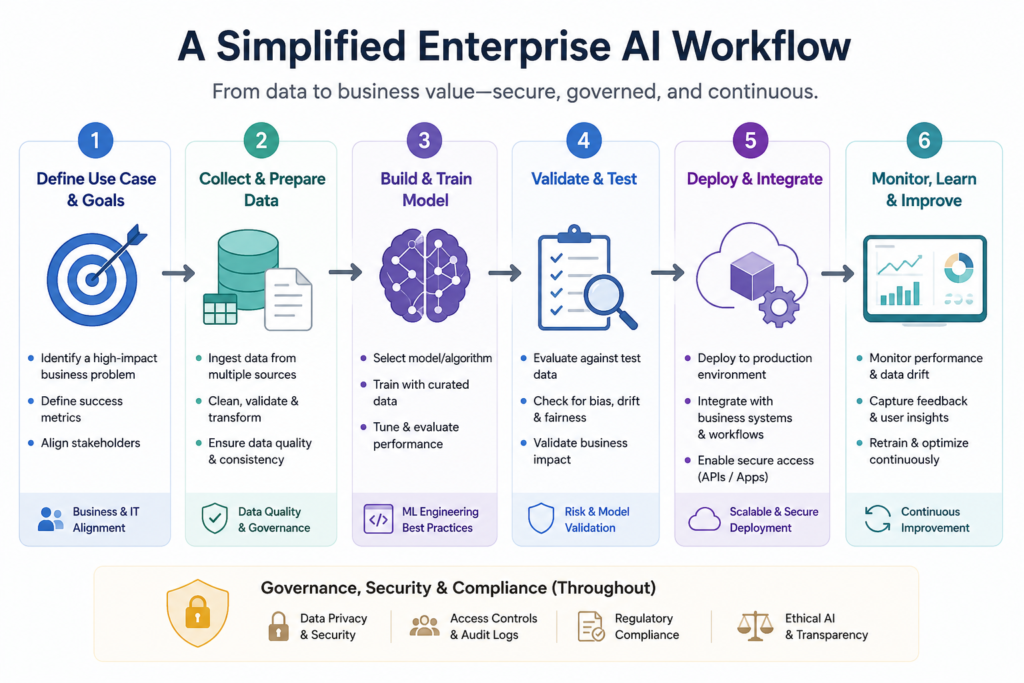
- Data collection
- Data preprocessing
- Feature engineering
- Model training
- Model testing
- Deployment
- Monitoring and optimization
And each step comes with its own headaches.
A typical enterprise stack might include tools like:
| Stage | Common Tools |
|---|---|
| Data Collection | SQL, Apache Kafka |
| Data Cleaning | Pandas, NumPy |
| Model Development | Scikit-learn, TensorFlow |
| Experiment Tracking | MLflow |
| Deployment | Docker, Kubernetes |
| Monitoring | Prometheus, Grafana |
Real-world projects rarely stay confined to just training algorithms. Teams have to think about latency, compliance requirements, infrastructure costs, and reliability too. Sometimes the “AI part” ends up being the easiest piece.
How long AI training takes also depends heavily on the learning path itself.
An introductory AI course might only take 4–8 weeks and works well for complete beginners. A professional-level artificial intelligence certification online program often lands somewhere around 4–6 months. More advanced artificial intelligence engineer courses can run 6–12 months or more, especially if they include deployment labs, capstone projects, or cloud engineering components.
Independent learners studying part-time usually spend:
- Around 8–12 hours per week
- Roughly 4–9 months completing coursework
- Extra time troubleshooting projects and preparing for certifications
And honestly, projects always take longer than expected. Always.
You think you’re “almost done,” then suddenly you’re debugging dependency issues at 11 PM because Docker refuses to cooperate for reasons nobody fully understands.
Hands-on work changes the learning experience completely.
Common AI project areas include:
- Predictive analytics
- Recommendation systems
- Fraud detection
- Chatbot development
- Image classification
- Customer sentiment analysis
Those projects are where learners usually grow the fastest because implementation exposes gaps theory tends to hide.
As for the technical skills needed, AI sits at the intersection of programming, mathematics, and problem-solving.
Core areas usually include:
| Skill Area | Why It Matters |
|---|---|
| Python Programming | Core AI development language |
| Statistics | Supports predictions and evaluation |
| Machine Learning | Main implementation framework |
| Data Processing | Required for training models |
| SQL | Helps retrieve and manage enterprise data |
| Cloud Platforms | Supports scalable deployment |
| APIs & Integration | Connects AI systems with applications |
Mathematical topics often include:
- Probability distributions
- Linear algebra
- Gradient descent
- Optimization algorithms
- Statistical inference
Some learners genuinely enjoy the math side. Others mostly survive it through persistence and repetition. Both approaches work, honestly.
One thing many professionals discover halfway through training is that AI isn’t just for “AI companies” anymore. Industries everywhere are adopting it:
- Healthcare
- Banking
- Retail
- Logistics
- Cybersecurity
- Manufacturing
- Telecommunications
Even traditional software teams are increasingly expected to understand at least basic AI concepts.
A few common enterprise AI use cases include:
Predictive Maintenance
Manufacturers use AI models to predict equipment failures before downtime happens.
Fraud Detection
Financial institutions analyze transaction behavior patterns to identify suspicious activity in real time.
Customer Support Automation
NLP-powered chatbots handle repetitive interactions at scale, reducing support load.
Recommendation Systems
Retail and streaming platforms personalize recommendations using machine learning algorithms.
Cybersecurity Monitoring
AI systems analyze logs and network traffic to detect anomalies and potential threats.
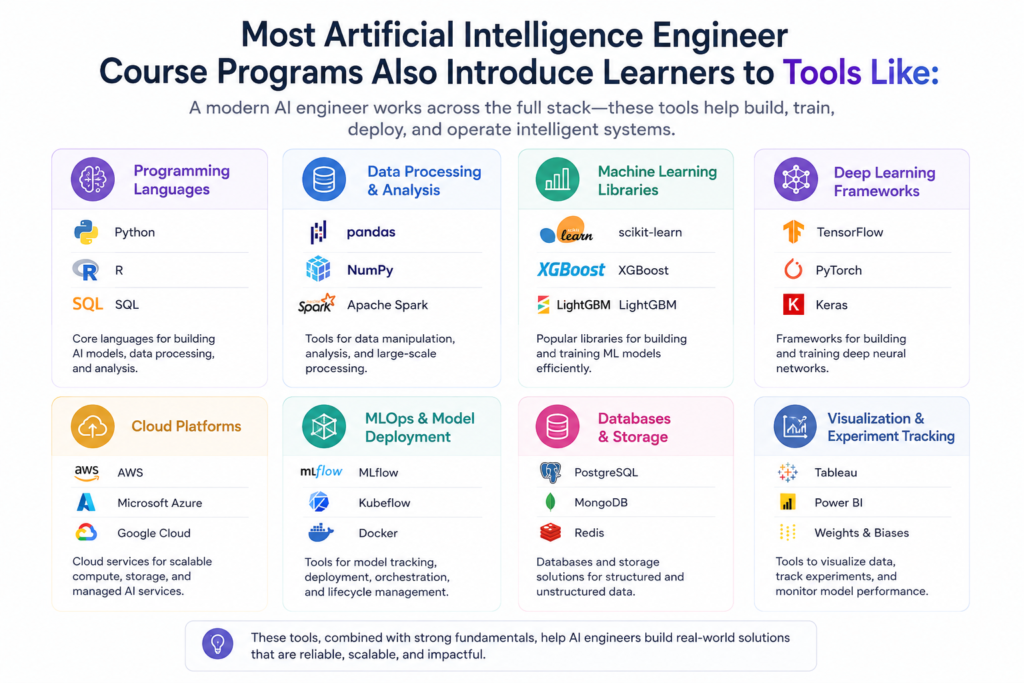
Most artificial intelligence engineer course programs also introduce learners to tools like:
| Technology | Typical Use |
|---|---|
| Python | AI development |
| TensorFlow | Deep learning |
| PyTorch | Neural networks |
| Scikit-learn | Machine learning |
| Pandas | Data analysis |
| NumPy | Numerical computation |
| Jupyter Notebook | Experimentation |
| AWS AI Services | Cloud deployment |
| Azure AI | Enterprise integrations |
| Docker | Containerization |
| Kubernetes | Scalable deployment |
MLOps has become especially important over the last few years.
For people unfamiliar with the term, MLOps combines machine learning, DevOps, and data engineering practices to manage AI systems efficiently in production environments.
That includes things like:
- Automated deployment
- Continuous training pipelines
- Model monitoring
- Version control
- Infrastructure automation
Companies increasingly expect AI professionals to understand operational workflows, not just model building.
Of course, AI training isn’t always smooth.
Common challenges include:
- Understanding mathematical concepts
- Handling large datasets
- Preventing model overfitting
- Deploying systems to cloud infrastructure
- Integrating multiple tools together
And debugging machine learning pipelines can sometimes feel less like engineering and more like detective work. Tiny configuration issues somehow turn into two-hour problems.
A typical AI learning path usually progresses in stages.
Beginner Stage Often includes:
- Python basics
- SQL fundamentals
- Data structures
- Introductory statistics
Estimated duration: 2–6 weeks
Intermediate Stage
Learners move into:
- Machine learning algorithms
- Feature engineering
- Data preprocessing
- Model evaluation
Estimated duration: 2–4 months
Advanced Stage
Focus areas usually include:
- Deep learning
- NLP
- Computer vision
- MLOps
- Cloud deployment
Estimated duration: 3–6 months
For working professionals, realistic study schedules usually look something like this:
| Weekly Study Time | Estimated Completion Time |
|---|---|
| 5 hours/week | 10–12 months |
| 10 hours/week | 6–8 months |
| 15 hours/week | 4–6 months |
| 20+ hours/week | 3–5 months |
Consistency matters more than intensity. Studying steadily every week almost always works better than cramming for two weekends and disappearing for a month afterward.
Career-wise, AI skills apply across more roles than people initially expect:
| Role | Main Responsibility |
|---|---|
| AI Engineer | Build and deploy AI systems |
| Machine Learning Engineer | Develop predictive models |
| Data Scientist | Analyze and model data |
| NLP Engineer | Build language-processing systems |
| Computer Vision Engineer | Develop image-analysis systems |
| AI Solutions Architect | Design enterprise AI platforms |
| Data Engineer | Build data infrastructure |
A lot of professionals pursue AI training because they want to:
- Transition into data-focused careers
- Improve automation capabilities
- Build intelligent applications
- Work with modern cloud systems
- Support analytics initiatives inside their organizations
As for certifications yes, they can help. An artificial intelligence certification online program can demonstrate structured learning, familiarity with industry tools, and exposure to practical concepts.
But employers usually care most about:
- Real projects
- Deployment experience
- Problem-solving ability
- Understanding production systems
A certificate alone rarely makes someone job-ready. Projects are what really build confidence.
When evaluating AI programs, learners should usually look for:
- Hands-on projects using real datasets
- Cloud deployment labs
- Exposure to enterprise tools
- Mentorship or instructor support
- Coverage of scalability, monitoring, and production workflows
Because theory matters, sure. But implementation teaches the lessons people actually remember.
Take something like a customer-support chatbot project. The workflow might involve:
- Collecting support transcripts
- Cleaning and preprocessing text data
- Training NLP models
- Testing response quality
- Deploying APIs
- Monitoring interactions over time
Or a fraud detection pipeline:
- Transaction data ingestion
- Feature extraction
- Model training
- Real-time scoring
- Alert generation
- Continuous retraining
That’s why AI learning feels so project-heavy. The difficult parts often appear after the tutorial ends.
People also ask fairly often whether AI is difficult to learn.
The honest answer? It can be challenging because it combines programming, mathematics, statistics, and systems thinking all at once. But with structured learning and consistent practice, most learners improve steadily over time even if progress feels slow in the beginning.
Many professionals become reasonably job-ready within 6–12 months of consistent study and project work. Basic Python knowledge helps a lot before starting, though beginner-friendly programs usually teach foundational coding too.
Python remains the dominant language in AI because of its enormous ecosystem of machine learning libraries and community support. Cloud knowledge is increasingly important as well since most enterprise AI systems now run on AWS, Azure, or Google Cloud environments.
And for anyone still confused about the difference between AI and machine learning:
Machine learning is really a subset of AI focused specifically on learning from data. AI itself is broader — it includes reasoning systems, automation, NLP, robotics, computer vision, and decision-making technologies.
One thing that consistently matters across all AI roles, though, is project experience.
Employers want to see evidence that someone can actually build, troubleshoot, deploy, and improve systems in realistic environments.
That’s where the real learning happens.
At the end of the day, the time required for Artificial Intelligence online training varies based on experience level, learning pace, and how deep someone wants to go technically. Most working professionals complete an artificial intelligence engineer course somewhere between 4 and 12 months through steady, structured learning.
The strongest programs usually combine:
- Programming fundamentals
- Machine learning concepts
- Enterprise workflows
- Cloud deployment experience
- Real-world implementation projects
That mix tends to build practical skills that actually transfer into production environments not just theoretical understanding that disappears after the exam.