H2K Infosys AI Online Training really can improve your chances of getting hired mostly because it teaches the kind of skills companies actually expect people to use now. Instead of spending months buried in theory, definitions, and endless diagrams, you end up working with machine learning models, data pipelines, automation workflows, and generative AI tools that businesses already rely on every day.
Recruiters don’t stop at certifications anymore. A certificate might help your resume get noticed for a few seconds, sure, but what usually stands out is proof that you’ve actually built something before. Real projects. Real troubleshooting. Real problem-solving.
That’s where structured Best Online Artificial Intelligence Course tends to help a lot. It bridges the gap between “I studied this” and “I know how to use this in an actual work environment.”
A solid AI Online Training especially one built around practical projects usually exposes you to real tools, messy datasets, debugging issues, deployment headaches, and all the small frustrations textbooks conveniently skip over.
Over time, that naturally builds confidence. More importantly, it gives you something meaningful to talk about during interviews instead of repeating memorized concepts that every other candidate already knows. That alone can make someone noticeably more competitive for roles like AI Engineer, Data Scientist, or even automation-focused IT positions.
What Is Artificial Intelligence Online Training?
At its core, Artificial Intelligence Engineer Course is simply a structured way to learn how intelligent systems are built, trained, and used in real-world scenarios.
Yes, it’s online learning but the bigger focus is usually hands-on work. You’re learning how systems make predictions, recommendations, or decisions in ways that loosely mimic human reasoning.
Most programs cover areas like:
- Machine learning fundamentals
- Deep learning concepts
- Natural Language Processing, or NLP
- Data cleaning and preprocessing
- Model building and evaluation
- Deploying AI models into live systems
What makes AI Online Training feel different from traditional academic learning is the heavy focus on tools and practical execution.
You’re not just reading concepts and memorizing terminology. You’re actively working with technologies like Python, TensorFlow, PyTorch, and cloud platforms while you learn.
That hands-on element changes things quite a bit, honestly.
Why AI Online Training Matters for Working Professionals
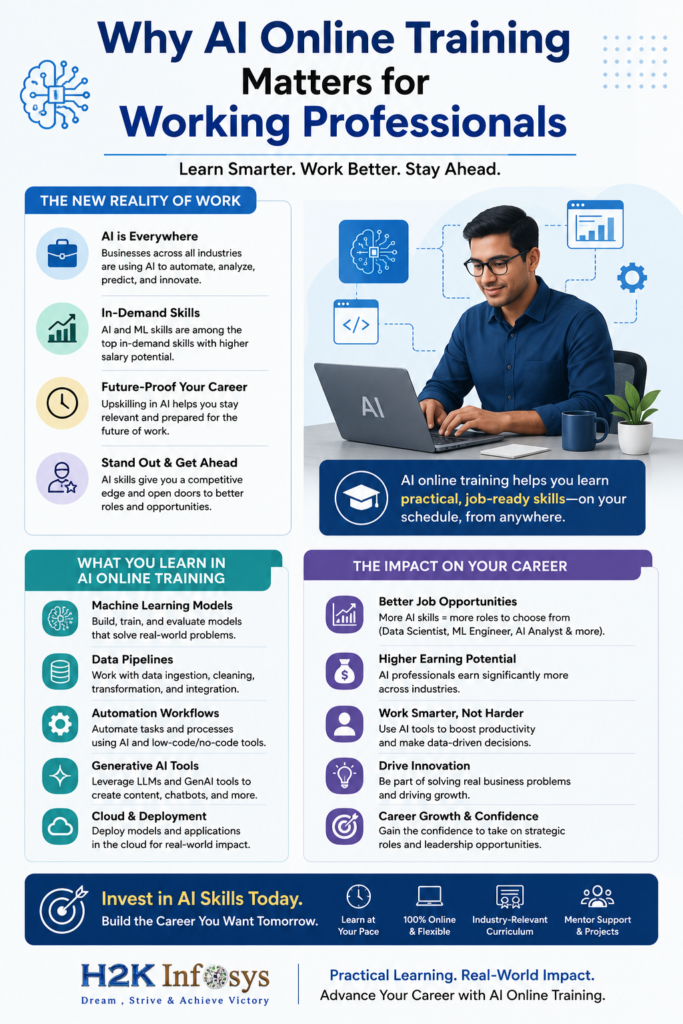
For working professionals, time is usually the biggest obstacle. That’s probably one of the main reasons online AI programs have become so popular over the last few years.
Most programs now offer things like:
- Flexible schedules that fit around full-time jobs
- Hands-on assignments instead of endless theory
- Cloud-based labs with less setup frustration
- Updated learning paths based on industry demand
- Access from basically anywhere
And AI itself isn’t really some “future skill” anymore. It’s already woven into how companies operate.
Whether it’s customer analytics, fraud detection, forecasting, recommendation systems, or workflow automation, AI quietly shows up everywhere now, even in places people don’t immediately notice.
So professionals who learn it in a structured, practical way often transition faster into AI-driven roles because they already understand how these systems function in day-to-day business settings.
How AI Online Training Actually Helps You Get Hired
This is where things become more practical than theoretical.
You Build Real Skills
You don’t just “learn AI.” You practice it.
That usually means building models, handling imperfect datasets, debugging errors, tuning performance, and deploying solutions that actually work.
During interviews, those experiences matter because you can speak from experience instead of reciting textbook definitions word-for-word.
Hiring managers notice that difference pretty quickly.
You Get Exposure to Industry Tools
Most strong AI Online Training programs include tools companies already rely on heavily, such as:
- Python
- Scikit-learn
- TensorFlow
- PyTorch
- AWS
- Azure ML
Once you’ve worked with these tools in actual projects, technical conversations become much easier.
You stop sounding overly theoretical, which honestly happens to a lot of candidates.
You Work on Real Projects
Instead of textbook-only exercises, you might end up building things like:
- Fraud detection systems
- Recommendation engines
- Customer churn prediction models
- Chatbots or AI assistants
And in many cases, those projects become your strongest talking points later during interviews.
A surprising number of interview discussions eventually turn into project walkthroughs anyway.
You Build a Portfolio
This part gets overlooked more often than it should.
A GitHub profile with meaningful projects usually speaks louder than certificates alone. Recruiters and hiring managers want evidence that you can build, troubleshoot, and think through problems independently without constant guidance.
Projects make that visible almost immediately.
You Become More Interview-Ready
A lot of structured AI Online Training now include interview prep too mock interviews, technical questions, case studies, and guidance on how to explain projects naturally without sounding robotic or rehearsed.
That communication side matters more than people expect. Some technically strong candidates struggle simply because they can’t clearly explain what they built or why it mattered.
And honestly, employers pay attention to that.
Skills You Need Before Learning AI
You don’t need to be an expert before starting, but having a few basics definitely helps.
Helpful Technical Foundations
- Basic Python programming
- Statistics and probability fundamentals
- Logical thinking
- Basic data handling concepts
AI Skills You’ll Build Along the Way
- Machine learning algorithms
- Neural networks
- Feature engineering
- Model evaluation techniques
Tools You’ll Probably Use
- Jupyter Notebook or Google Colab
- AWS or Azure cloud platforms
- Sometimes Docker basics too
Soft skills matter too, honestly. Being able to explain your work clearly — especially during interviews or team discussions becomes surprisingly important.
A lot of technically capable people underestimate that part until much later.
Where AI Is Used in Real Companies
AI isn’t limited to tech companies anymore. It has spread into almost every major industry at this point.
You’ll find it in:
- Automation systems that reduce manual work
- Customer analytics platforms
- Fraud detection systems in banking
- Recommendation engines like the ones used by Netflix or Amazon
- Chatbots and virtual assistants
A typical AI workflow inside companies usually looks something like this:
Data collection → cleaning → model training → testing → deployment → monitoring → retraining
Nothing overly glamorous, honestly. Most of the work involves continuous improvement, troubleshooting, maintenance, and fixing unexpected problems behind the scenes.
That’s the reality people don’t always talk about enough.
Job Roles That Use AI Skills
Different AI-related roles focus on different responsibilities.
AI Engineer
Builds and integrates AI systems.
Data Scientist
Analyzes data and extracts insights.
Machine Learning Engineer
Deploys and scales machine learning models.
Data Analyst
Supports business decisions through reporting and analysis.
NLP Engineer
Works on language-focused AI systems.
As companies continue adopting AI more deeply, demand for these roles keeps growing across industries.
Career Paths After AI Online Training
Once you complete structured AI Online Training, career options usually open up quite a bit.
A lot of people begin with roles like:
- Junior Data Analyst
- AI Associate
- ML Intern
Then gradually move toward positions such as:
- Machine Learning Engineer
- Data Scientist
- AI Solutions Engineer
And eventually into more advanced roles like:
- AI Architect
- MLOps Engineer
- Deep Learning Specialist
The path isn’t perfectly linear, though. It depends heavily on consistency, projects, curiosity, and how much hands-on work you actually do outside the course itself.
Some people progress quickly. Others take longer. That’s pretty normal.
Typical Learning Path in AI Online Training
Most learners move through AI Online Training in stages:
- Python and basic math
- Machine learning fundamentals
- Deep learning and NLP
- Deployment and production systems
It’s usually more of a gradual build-up than a straight line. Some concepts click quickly. Others take repetition, failed experiments, debugging sessions, and a bit of patience.
Honestly, struggling with certain topics is part of the process.
Tools You’ll Actually Use
AI work tends to be very tool-driven. Common tools include:
- Python and sometimes R
- TensorFlow and PyTorch
- Pandas and NumPy
- Matplotlib or Power BI
- AWS, Azure, or Google Cloud
- Docker and Kubernetes in more advanced environments
These aren’t just “nice additions” either. They’re widely used in real production systems.
Real-World Alignment and Challenges
One thing strong AI Online Training programs do well is simulate real enterprise environments as closely as possible.
Because in actual companies, AI systems need to be:
- Scalable
- Secure
- Fast and optimized
- Continuously monitored and updated
Without practical exposure, many learners hit a wall. They understand concepts in theory but struggle once they face real datasets, deployment problems, or production environments.
That gap between theory and application is where a lot of people get stuck.
FAQs
Is AI Online Training useful for beginners?
Yes especially programs that begin with fundamentals and gradually move toward hands-on projects instead of overwhelming learners immediately.
Can I get a job after AI Online Training?
It helps significantly, but projects, consistency, and practical experience matter just as much as the course itself.
Do I need coding experience before starting?
Basic Python knowledge helps a lot, although many beginner-friendly programs teach from scratch.
Which industries hire AI professionals?
IT, healthcare, finance, telecom, automotive, e-commerce honestly, AI Online Training has expanded into almost every major industry now.
Final Thoughts
AI Online Training isn’t just another learning trend anymore. It’s slowly becoming one of the more practical ways to transition into modern IT and data-driven roles.
The real value comes when the learning stays hands-on and closely tied to real industry workflows — not just slides, quizzes, and theory-heavy lectures that people forget a week later.
People who stay consistent, build projects, experiment independently, and keep practicing usually transition into AI-related careers much more smoothly than those who focus only on certifications.
And for learners trying to build practical, job-focused AI skills, structured programs like those offered by H2K Infosys can help bridge the gap between learning concepts and applying them in real-world environments.