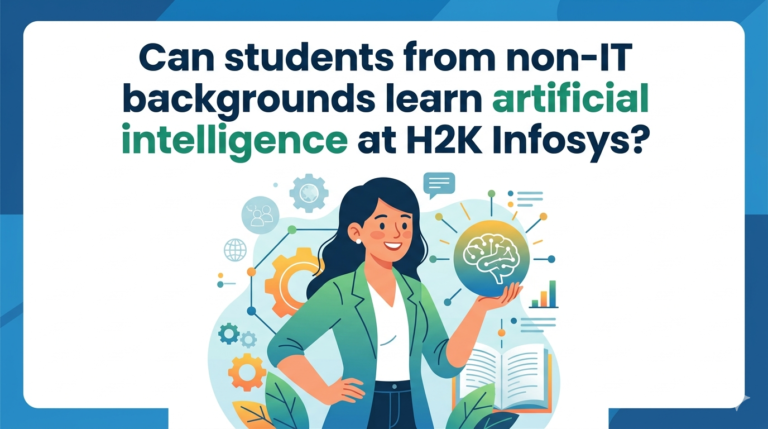
Yes students from non-IT backgrounds can absolutely learn artificial intelligence at H2K Infosys, and honestly, many of them are doing surprisingly well once they understand how practical and beginner-friendly modern AI learning has become. You do not need to be a hardcore programmer or someone with a computer science degree to start building a career in AI anymore.
That idea still surprises a lot of people.
A few years ago, artificial intelligence felt like something reserved for software engineers sitting in giant tech companies. Now? The landscape looks very different. Businesses in healthcare, banking, retail, logistics, education, and even HR are using AI tools daily. Naturally, companies need people from different educational backgrounds who understand both industry problems and AI-driven solutions.
That’s one reason many learners are exploring H2K Infosys for structured, career-focused Artificial Intelligence Training that does not assume everyone comes from an IT background.
Why Non-IT Students Are Entering AI in 2026
There’s been a noticeable shift in the AI hiring market lately.
Companies are no longer just looking for coders. They’re looking for analysts, domain experts, testers, business thinkers and operations pros who can work with AI systems. If someone understands healthcare workflows, finance operations, customer support, or supply chains, they already bring valuable context into AI projects.
That matters more than people realize.
For example, a pharmacy graduate learn artificial intelligence can contribute to healthcare analytics projects faster than someone who only knows coding but has zero healthcare understanding. Companies began to prioritize real-world AI adoption over purely theoretical development.And honestly, that opened doors for many career changers.
So, What Makes Easier to Learn artificial intelligence Today?
The biggest misconception is that AI learning starts with the advanced mathematics and impossible coding problems.
In reality, most beginner-friendly AI and Machine learning courses today follow a layered approach:
- Understanding AI concepts in simple language
- Learning basic Python gradually
- Working with datasets step-by-step
- Using AI tools and frameworks practically
- Building small projects before advanced ones
This approach makes learning less intimidating.
At H2K Infosys , the focus is heavily practical. That’s important because many non-IT learners struggle when courses become overly academic. Watching theory-heavy videos for hours without real examples can make anyone lose confidence.
Practical exposure changes everything.
Common Non-IT Backgrounds Successfully Moving into AI
One thing I’ve noticed while watching AI career transitions recently is that learners from non-technical backgrounds often underestimate how transferable their skills already are.
Some common examples include:
Healthcare Professionals
Nurses, pharmacists, and healthcare administrators are learning AI for medical data analysis, patient prediction systems, and healthcare automation.
Finance and Accounting Graduates
AI is now heavily used in fraud detection, financial forecasting, and risk analytics.
Marketing Professionals
Modern marketing depends on AI-driven personalization, recommendation systems, and customer behavior analysis.
Mechanical or Civil Engineering Graduates
Many engineering graduates pivot into AI because they already understand analytical thinking and problem-solving.
Fresh Graduates from Arts or Commerce Backgrounds
This surprises people the most. But with proper guidance and consistent practice, many fresh graduates build foundational AI skills successfully.
The key difference usually comes down to structured learning and mentorship.
What Does H2K Infosys Teach Beginners in Artificial Intelligence?
One reason learners prefer H2K Infosys is that the training path is designed for career transition, not just theory collection.
The Artificial Intelligence Engineer Course typically introduces learners to:
- Python fundamentals
- Data handling and visualization
- Machine learning basics
- AI model concepts
- Deep learning fundamentals
- Real-time project exposure
- Resume preparation
- Interview support
- Job-oriented case studies
That last part matters a lot.
A course can teach algorithms all day long, but if learners cannot explain how AI solves business problems during interviews, things get difficult.
The stronger programs focus on practical business scenarios.
Real-World Example: A Non-IT Career Transition into AI
One learner story that reflects today’s trend involved a customer support professional moving into AI analytics.
She had no technical degree. No programming experience either.
Initially, even Python syntax felt overwhelming. But after spending a few months working through guided projects and simple automation tasks, she started understanding how machine learning models predict customer behavior.
Eventually, she contributed to a churn prediction project during training.
That hands-on experience became the turning point during interviews.
This is honestly where many learners begin believing they can actually work in AI.
The Learning Curve Is Real – But It’s Manageable
Let’s be realistic for a second.
AI is not “easy.” Anyone promising instant expertise in two weeks is overselling things.
There will be moments where concepts like neural networks, regression models, or data preprocessing feel confusing. That happens to almost everybody including IT professionals.
The difference is that non-IT students often assume confusion means failure.
It usually doesn’t.
Good Artificial Intelligence Training breaks complex topics into manageable steps. And once learners begin applying concepts practically, confidence builds naturally.
Sometimes slower than expected, honestly. But it builds.
Why Practical Projects Matter More Than Degrees in 2026
This is probably one of the biggest shifts happening in the tech hiring market.
Companies increasingly care about:
- What projects you built
- Whether you understand business applications
- Your ability to work with AI tools
- Problem-solving skills
- Communication abilities
A degree alone is no longer enough.
Even major companies are focusing on skills-based hiring now.
That’s why project-based AI and Machine learning courses are becoming more valuable than purely academic programs.
At H2K Infosys , learners get exposure to practical assignments and real-world workflows, which helps bridge the gap between learning and actual job readiness.
AI Careers Available for Non-IT Learners
A lot of beginners assume they must become advanced AI researchers.
That’s not necessarily true.
There are multiple entry points into AI-related careers:
| Role | Suitable for Beginners? | Typical Focus |
|---|---|---|
| AI Analyst | Yes | Business insights and reporting |
| Junior Data Analyst | Yes | Data interpretation and visualization |
| Machine Learning Support Roles | Yes | Model testing and monitoring |
| AI Operations Associate | Yes | Workflow automation |
| Business Intelligence Associate | Yes | Dashboard and trend analysis |
| Prompt Engineering Roles | Increasingly Yes | Generative AI optimization |
Interestingly, prompt engineering and AI operations roles exploded after generative AI adoption accelerated globally.
Many non-IT learners are entering these roles because communication skills and logical thinking matter heavily there.
The Importance of Mentorship During AI Learning
This part often gets ignored.
The internet has thousands of free tutorials to learn artificial intelligence . Yet many learners still quit halfway.
Why?
Because isolated learning becomes frustrating.
Mentorship helps learners:
- Stay accountable
- Understand industry expectations
- Solve technical confusion faster
- Build interview confidence
- learn artificial intelligence practical workflows
That’s one reason why structured learn Artificial Intelligence Training programs tend to produce better outcomes than random video learning.
Especially for career changers.
AI Tools Have Become More Beginner-Friendly
Another thing worth mentioning modern AI tools are much easier to work with now compared to even four or five years ago.
Platforms and libraries have simplified many technical barriers.
Today’s learners often work with:
- Python notebooks
- Prebuilt AI frameworks
- Visualization tools
- Low-code AI environments
- Generative AI assistants
This allows beginners to focus more on understanding applications instead of getting stuck in setup issues for weeks.
Honestly, that accessibility changed AI education completely.
What Employers Expect from Entry-Level AI Candidates
Most companies do not expect beginners to build the next advanced language model.
What they usually expect is:
- Basic understanding of machine learning
- Ability to work with datasets
- Awareness of AI workflows
- Communication skills
- Problem-solving mindset
- Practical exposure through projects
This is why a career-oriented Artificial Intelligence Engineer Course becomes useful for non-IT learners.
The right training path focuses on employability, not just technical jargon.
Is Coding Mandatory to learn artificial intelligence?
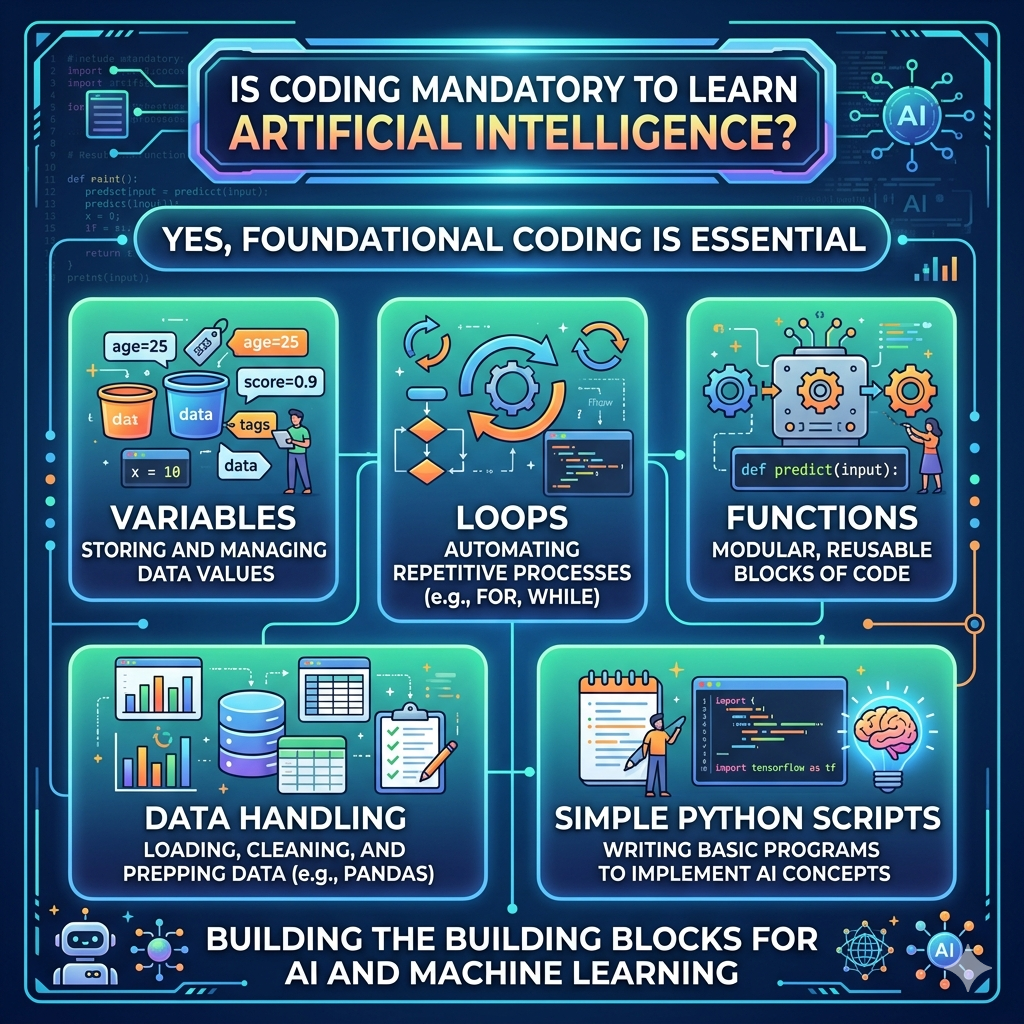
Some coding knowledge definitely helps.
But the good news is that beginners usually start with very basic programming concepts.
Most non-IT learners begin by learning:
- Variables
- Loops
- Functions
- Data handling
- Simple Python scripts
That foundation gradually grows into machine learning implementation.
Nobody starts by building advanced AI systems on day one.
And honestly, trying to rush that process usually backfires.
Why H2K Infosys Appeals to Career Changers
There are several reasons non-IT learners consider H2K Infosys when exploring AI careers:
- Beginner-friendly learning structure
- Job-oriented Artificial Intelligence Training
- Real-time project exposure
- Flexible online learning
- Practical assignments
- Career guidance support
- Interview preparation sessions
- Industry-focused curriculum
The emphasis on practical learning tends to help learners feel less intimidated.
That emotional side of learning actually matters more than people admit.
Confidence becomes a huge factor in technology transitions.
The AI Industry Is Still Growing Rapidly
AI adoption is not slowing down.
Businesses across industries continue integrating automation, predictive analytics, and generative AI into daily operations. Recent developments in AI-powered customer support, healthcare diagnostics, cybersecurity monitoring, and enterprise automation are creating demand for trained professionals who understand applied AI.
And companies need more than elite researchers.
They need practical professionals who can work with AI systems, interpret outputs, support deployments, and communicate business impact.
That creates opportunities for motivated learners from non-IT backgrounds.
Final Thoughts
So, can students from non-IT backgrounds learn artificial intelligence at H2K Infosys?
Absolutely.
The transition may feel intimidating initially, especially for learners who have never worked with coding or data before. But with structured guidance, practical exposure, mentorship, and consistent effort, non-IT students can successfully build AI skills and move toward technology careers.
The important thing is choosing a learning environment that teaches AI in a practical, career-focused, and beginner-friendly way.
That’s where H2K Infosys stands out for many learners exploring AI and Machine learning courses today.
And honestly, the biggest barrier for most people is not background.
It’s simply deciding to start.