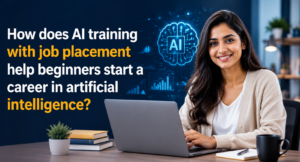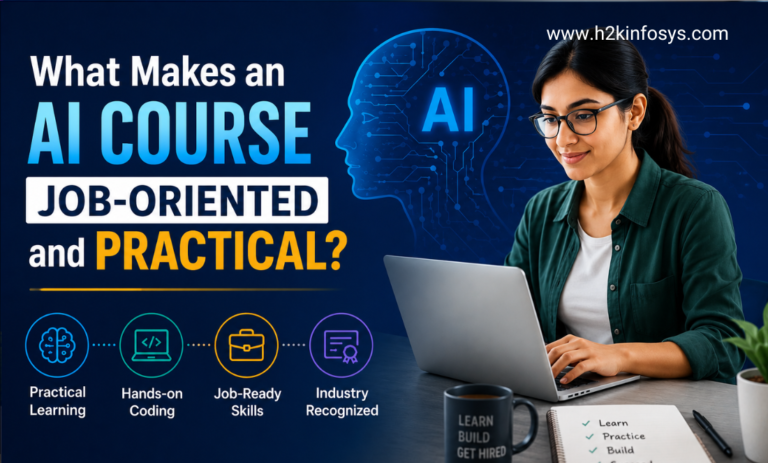
A job-oriented AI course from H2K Infosys is really about learning skills you can actually use in day-to-day business and IT environments, not just memorizing theories or reading research papers you may never apply. The best programs usually combine core AI concepts with hands-on implementation, real tools, practical projects, and the kind of workflow problem-solving teams deal with in actual companies.
Unlike heavily academic courses that stay focused on equations and theory, practical AI and machine learning Training tends to emphasize things like deployment, handling messy datasets, evaluating models properly, automation workflows, and understanding how AI fits into enterprise systems. That difference matters more than people initially think.
A solid artificial intelligence course for beginners should help learners understand how AI systems are built, tested, integrated, monitored, and maintained once they’re running in production. Because honestly, training a model is only one small part of the process. Real-world AI work usually involves debugging pipelines, fixing data issues, monitoring performance drift, and making systems scale reliably.
Good programs also expose learners to tools companies actually use Python, TensorFlow, PyTorch, Scikit-learn, cloud AI services, Git workflows, and data engineering pipelines. Without that practical exposure, it becomes harder to transition into real projects later on.
What Is a Job-Oriented AI Course?
A job-oriented AI course is designed around industry roles and practical business requirements rather than pure academic learning. The idea is simple: learn concepts, then immediately apply them in realistic technical scenarios.
These courses often include:
- Hands-on labs
- Real-world datasets
- Industry-standard tools and frameworks
- Capstone projects
- Model deployment workflows
- Version control practices
- Cloud integration
- Collaboration workflows used by IT teams
One thing people notice pretty quickly is that practical courses usually teach how AI projects move from experimentation into production environments. That transition is where many beginners struggle.
Practical AI vs Traditional Theory Courses
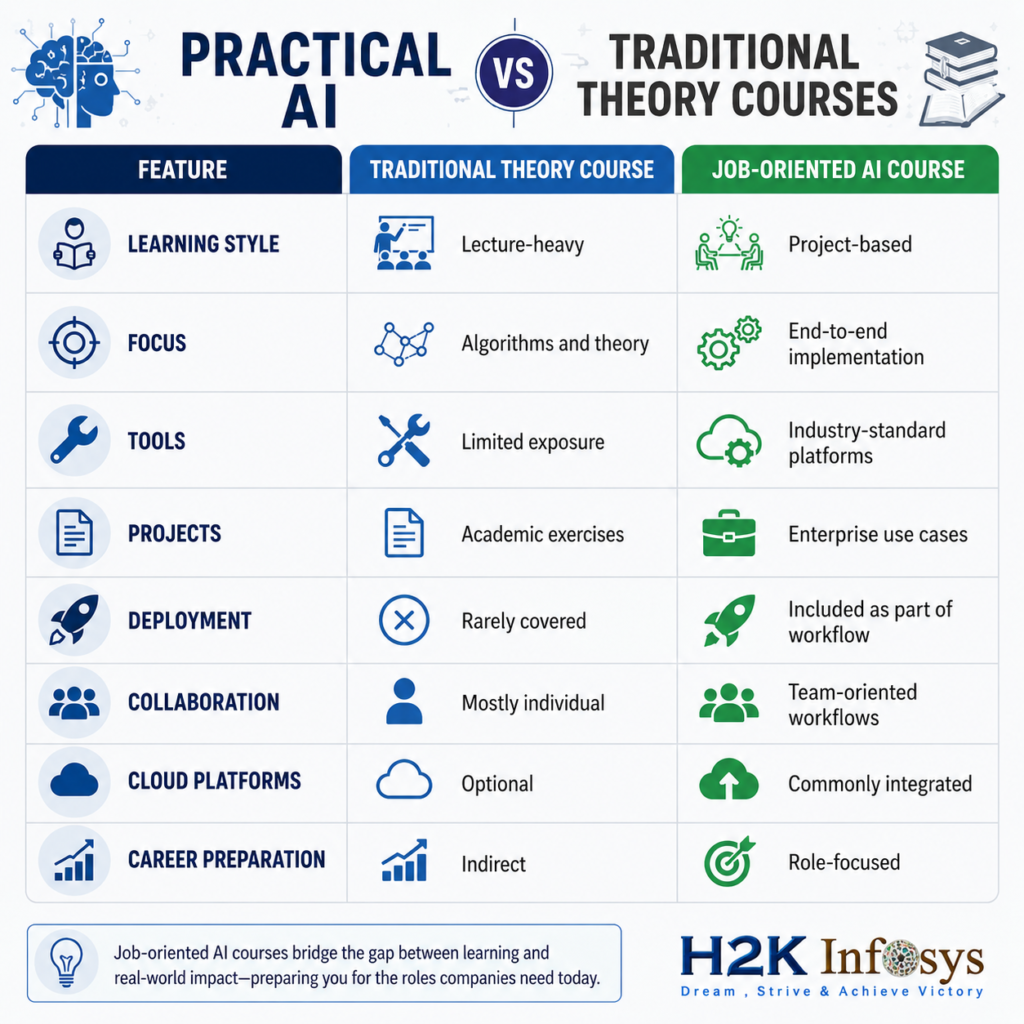
| Feature | Traditional Theory Course | Job-Oriented AI Course |
|---|---|---|
| Learning Style | Lecture-heavy | Project-based |
| Focus | Algorithms and theory | End-to-end implementation |
| Tools | Limited exposure | Industry-standard platforms |
| Projects | Academic exercises | Enterprise use cases |
| Deployment | Rarely covered | Included as part of workflow |
| Collaboration | Mostly individual | Team-oriented workflows |
| Cloud Platforms | Optional | Commonly integrated |
| Career Preparation | Indirect | Role-focused |
Why Practical AI Training Matters for Working Professionals
Most working professionals don’t necessarily need deep research-level AI expertise. What they usually need are skills they can apply immediately in their current or next role.
Companies increasingly expect engineers, analysts, developers, and IT specialists to understand automation, predictive analytics, and AI-assisted decision-making. Even teams that aren’t “AI teams” are now interacting with machine learning systems in some form.
Practical AI training can help professionals:
- Automate repetitive workflows
- Improve data-driven decision making
- Build predictive systems
- Understand enterprise AI architecture
- Collaborate with AI development teams
- Integrate machine learning into applications
- Support business intelligence initiatives
And honestly, being able to communicate effectively with data teams is becoming a valuable skill on its own.
Common Enterprise Challenges AI Professionals Should Understand
Real-world AI projects rarely operate in clean, perfect conditions. A realistic course should expose learners to operational issues such as:
- Poor data quality
- Missing or incomplete datasets
- Model bias
- Infrastructure limitations
- Security and compliance concerns
- Scalability bottlenecks
- Model drift over time
- Integration complexity
These are the kinds of problems teams spend actual time solving in production systems.
How AI Works in Real Enterprise Projects
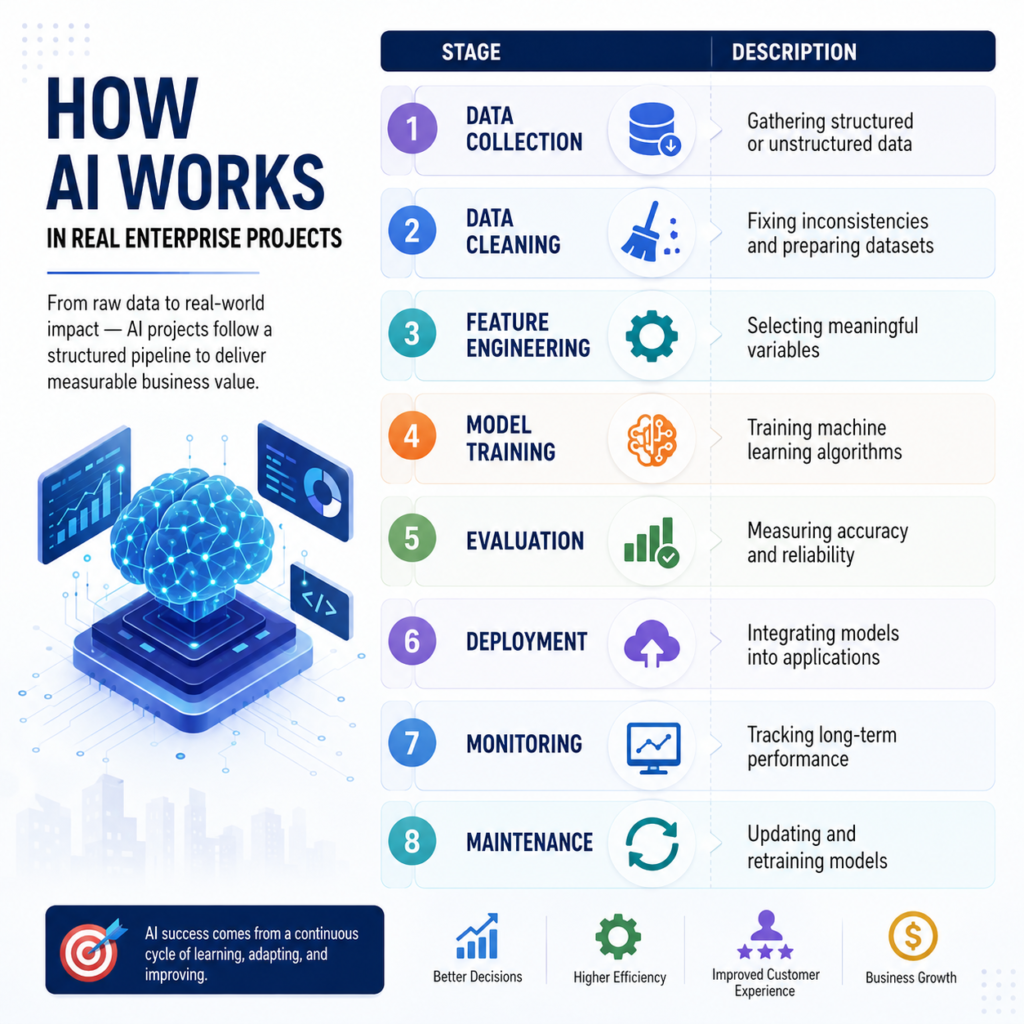
In most enterprise environments, AI systems follow a fairly structured workflow that goes beyond just training models.
| Stage | Description |
|---|---|
| Data Collection | Gathering structured or unstructured data |
| Data Cleaning | Fixing inconsistencies and preparing datasets |
| Feature Engineering | Selecting meaningful variables |
| Model Training | Training machine learning algorithms |
| Evaluation | Measuring accuracy and reliability |
| Deployment | Integrating models into applications |
| Monitoring | Tracking long-term performance |
| Maintenance | Updating and retraining models |
A lot of beginners are surprised by how much time goes into data preparation compared to actual model training.
Example: Customer Support Automation Project
A practical AI course might include a project involving customer support automation using NLP.
Typical workflow:
- Collect customer service tickets
- Preprocess text data
- Train a classification model
- Evaluate prediction accuracy
- Deploy an API endpoint
- Integrate with helpdesk software
- Monitor prediction quality over time
Projects like this teach both the AI concepts and the operational side of implementation, which is usually where the real learning happens.
What Skills Are Needed to Learn AI?
A beginner-friendly AI course should introduce technical concepts gradually without assuming advanced mathematical or research experience.
Programming Knowledge
Most AI and machine learning courses rely heavily on Python because it’s readable, flexible, and has a huge ecosystem.
Common Python libraries include:
- NumPy
- Pandas
- Matplotlib
- Scikit-learn
- TensorFlow
- PyTorch
Mathematics Fundamentals
It helps to understand:
- Linear algebra
- Probability
- Statistics
- Basic calculus
- Optimization concepts
That said, many practical courses focus more on implementation than deep mathematical derivations. For many learners, that’s actually a better starting point.
Data Handling Skills
Learners should become comfortable with:
- CSV and JSON formats
- SQL queries
- Data preprocessing
- Visualization techniques
- Exploratory data analysis
Cloud and Deployment Awareness
Modern AI systems often run in cloud environments.
Popular platforms include:
- Amazon Web Services
- Microsoft Azure
- Google Cloud
Practical programs may also introduce cloud notebooks, model hosting, APIs, and containerization basics.
What Topics Should a Practical AI Course Cover?
A strong curriculum should balance foundational knowledge with applied skills.
| Topic | Practical Relevance |
|---|---|
| Python Programming | Automation and scripting |
| Data Analysis | Business data processing |
| Machine Learning | Predictive systems |
| Deep Learning | NLP and computer vision |
| NLP | Chatbots and text analytics |
| Computer Vision | Image recognition systems |
| Model Deployment | Production implementation |
| MLOps | AI lifecycle management |
| Cloud AI Services | Enterprise scalability |
Important Machine Learning Algorithms
A useful course should explain when and why different algorithms are used—not just how they work mathematically.
Examples include:
- Linear regression
- Logistic regression
- Decision trees
- Random forests
- Support vector machines
- Neural networks
- Clustering algorithms
In practice, implementation and interpretation usually matter more than memorizing formulas.
How AI Is Used Across Industries
AI adoption is growing because organizations want better automation, analytics, personalization, and operational efficiency.
| Industry | AI Application |
|---|---|
| Healthcare | Diagnostic support systems |
| Finance | Fraud detection |
| Retail | Recommendation engines |
| Manufacturing | Predictive maintenance |
| Cybersecurity | Threat detection |
| Human Resources | Resume screening |
| Logistics | Route optimization |
| Customer Service | AI chatbots |
Enterprise AI Architecture Components
Real-world AI systems commonly include:
- Data pipelines
- APIs
- Cloud infrastructure
- Monitoring dashboards
- Logging systems
- Model registries
- Security controls
Understanding how these components connect together is important for anyone planning to work in enterprise AI environments.
Why Hands-On AI Learning Works Better
Hands-on learning tends to improve retention because learners actively solve problems instead of passively consuming information.
Real Dataset Exposure
Learners should work with:
- Structured datasets
- Semi-structured datasets
- Unstructured text and image data
Debugging Experience
Practical development almost always involves troubleshooting:
- Data inconsistencies
- Training failures
- Overfitting
- Memory limitations
- API integration issues
That debugging process is frustrating sometimes, sure but it’s also where real skill-building happens.
Deployment Practice
Many theoretical programs stop after model training. Practical courses continue into:
- REST API deployment
- Docker containers
- Cloud hosting
- CI/CD workflows
- Monitoring pipelines
That extra layer makes a major difference for job readiness.
Common AI Development Tools
| Tool | Primary Use |
|---|---|
| Python | Core programming |
| Jupyter Notebook | Experimentation |
| Scikit-learn | Machine learning |
| TensorFlow | Deep learning |
| PyTorch | Neural networks |
| Git | Version control |
| Docker | Containerization |
| MLflow | Model tracking |
| Apache Spark | Large-scale data processing |
Example of a Real AI Workflow
A practical enterprise workflow might look something like this:
- Writing preprocessing scripts in Python
- Managing code in Git repositories
- Training models in Jupyter Notebook
- Packaging applications with Docker
- Deploying APIs to cloud platforms
- Monitoring models using logging tools
This mirrors how many engineering teams actually operate.
Job Roles That Use AI Skills
AI knowledge is now relevant across a surprisingly wide range of technical and business positions.
| Job Role | AI Responsibilities |
|---|---|
| Data Analyst | Reporting and insights |
| Machine Learning Engineer | Model development |
| Data Scientist | Predictive analytics |
| AI Engineer | AI system integration |
| BI Analyst | Trend analysis |
| Software Developer | AI-enabled applications |
| DevOps Engineer | AI infrastructure support |
| NLP Engineer | Text analytics systems |
AI projects also involve collaboration among developers, analysts, cloud architects, security teams, and product managers. Good training should reflect that reality instead of treating AI as isolated work.
Career Paths After Learning AI
Beginners often move into roles such as:
- Junior data analyst
- AI support engineer
- Machine learning intern
- Python developer
- BI analyst
With more experience, professionals may transition into:
- Machine learning engineering
- Data science
- AI architecture
- MLOps engineering
- AI consulting
Employers often value:
- Practical project experience
- GitHub portfolios
- Cloud exposure
- SQL proficiency
- API integration skills
- Deployment experience
- Problem-solving ability
How Beginners Should Evaluate an AI Course
Not every AI course provides practical industry preparation. Some sound impressive but remain overly theoretical.
A few things worth checking:
Does the Course Include Real Projects?
Look for projects involving:
- Prediction systems
- NLP workflows
- Deployment pipelines
- Dashboard integration
- Cloud implementation
Are Industry Tools Included?
Exposure to modern tools matters more than many learners realize early on.
Is Deployment Covered?
Deployment is essential in enterprise AI workflows. Skipping it leaves a major skill gap.
Does the Curriculum Include MLOps?
Modern AI systems require lifecycle management, monitoring, and retraining practices.
Are Cloud Platforms Introduced?
Most enterprise AI systems now rely on cloud infrastructure in some form.
Suggested AI Learning Roadmap
| Stage | Learning Focus |
|---|---|
| Stage 1 | Python fundamentals |
| Stage 2 | Data analysis |
| Stage 3 | Machine learning basics |
| Stage 4 | Deep learning |
| Stage 5 | NLP and computer vision |
| Stage 6 | APIs and deployment |
| Stage 7 | Cloud and MLOps |
| Stage 8 | Capstone projects |
Recommended Project Progression
Beginner Projects
- Sales prediction
- Spam detection
- Basic chatbot
- Customer segmentation
Intermediate Projects
- Recommendation systems
- Image classification
- Sentiment analysis
- Fraud detection
Advanced Practical Projects
- AI pipelines
- Real-time analytics
- Scalable inference APIs
- Cloud-native AI applications
How Enterprise Teams Deploy AI Systems
Deployment is one of the most overlooked—but most important—parts of practical AI learning.
| Component | Purpose |
|---|---|
| Data Pipeline | Supplies training data |
| Feature Store | Centralized feature management |
| Model Registry | Stores trained models |
| API Layer | Serves predictions |
| Monitoring Tools | Tracks performance |
| Logging Systems | Captures operational data |
Common Deployment Challenges
Enterprise teams frequently deal with:
- Latency optimization
- Infrastructure costs
- Security compliance
- Scaling problems
- Version compatibility issues
- Monitoring complexity
A realistic course should expose learners to these operational considerations instead of only focusing on notebooks and theory.
Common Mistakes Beginners Make
Over-Focusing on Theory
Some learners spend months studying algorithms without building projects.
Ignoring Data Quality
In real-world AI, poor data can ruin model performance fast.
Skipping Deployment Skills
Training a model is only one step in a much larger workflow.
Learning Too Many Tools at Once
A structured progression usually works better than trying to master everything immediately.
Neglecting Version Control
Git and collaboration practices are essential in professional environments.
FAQ: Artificial Intelligence Course for Beginners
Is coding mandatory for learning AI?
Basic programming knowledge is extremely helpful since most AI workflows rely on Python for automation, data processing, and model development.
Can non-technical professionals learn AI?
Yes. Many beginner-oriented courses start with programming and data fundamentals before introducing advanced topics.
What programming language is most commonly used in AI?
Python remains the most widely used language because of its flexibility and massive ecosystem.
How long does it take to learn practical AI skills?
That depends on consistency, background, and learning approach. Many professionals spend several months building foundational and project-based skills.
What’s the difference between AI and machine learning?
Machine learning is a subset of AI focused on systems that learn from data. AI also includes broader concepts like reasoning, automation, and decision-making systems.
Are cloud platforms important?
Absolutely. Many enterprise AI systems run on cloud infrastructure for scalability and operational efficiency.
What projects should beginners build?
Useful beginner projects include:
- Chatbots
- Recommendation systems
- Sentiment analysis tools
- Prediction models
- Image classification applications
Do practical AI courses include deployment training?
Strong job-oriented programs usually include APIs, deployment workflows, cloud hosting, and monitoring concepts.
Key Takeaways
A job-oriented Ai Training Courses focuses on practical implementation rather than theory alone. The strongest AI and machine learning programs combine projects, deployment workflows, enterprise tools, and real-world problem solving.
Hands-on experience with Python, machine learning libraries, cloud platforms, APIs, and MLOps practices is increasingly important for industry readiness. Enterprise AI systems involve far more than model training—they require deployment, monitoring, scalability, collaboration, and operational maintenance.
For beginners, structured project-based learning tends to be far more effective than purely theoretical study. Building real systems, troubleshooting issues, and understanding enterprise workflows usually creates deeper technical confidence over time.
Explore hands-on AI and machine learning courses at H2K Infosys to build practical technical skills through guided projects and enterprise-focused learning workflows.