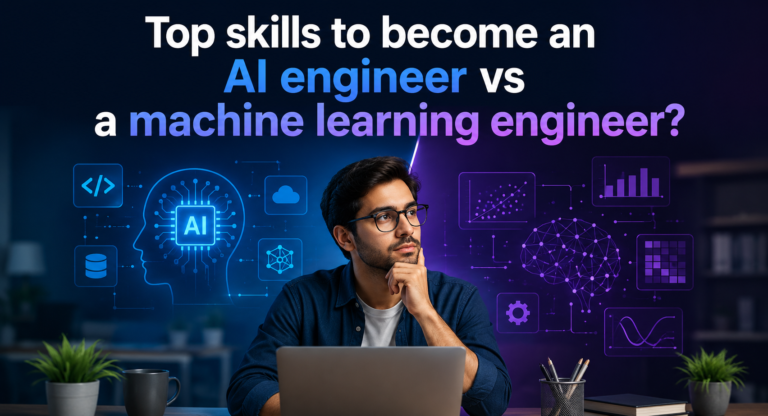
AI engineer vs a machine learning engineer: Becoming an AI engineer is often the broader path, whereas a machine learning engineer will focus more deeply on building, training, and optimising ML models. The right move depends on whether you enjoy building AI-powered products or working behind the scenes with algorithms and data. If you want to build intelligent applications, automate business processes, or work with modern AI systems, then becoming an AI engineer is usually the broader path.
The mix-up between the two roles is real. Many beginners look for an AI engineer roadmap or AI engineer vs a machine learning engineer and are presented with a long list of tools, programming languages, and courses, but aren’t sure what the real job is like.
Having seen what the industry has become with generative AI, large language models and automation, one thing is clear: companies don’t just need people who know theory. They need engineers who can take an idea and build an AI solution and make that happen in the real world.
That’s where it matters knowing the difference.
What is the difference between an AI engineer vs a machine learning engineer?
Think of an AI engineer as a creator of complete AI-powered solutions.
For instance:
- A bot that responds to customer questions
- An AI assistant that summarises papers
- An in-app recommendation system
- Manufacturing defect detection with a computer vision system
AI engineer builds useful products by working with existing AI models, APIs, cloud platforms and development frameworks.
The machine learning engineer is more concerned with the intelligence behind the system:
- Training ML-Models
- Improving accuracy.
- Preparing data set (large)
- Algorithm enhancements
- Machine learning pipelines creation
A simple way to think about it:
Machine learning engineer → builds and improve the brain
AI engineer → creates the entire product that utilises the brain
There is an overlap between both roles, and companies use job titles differently. An AI engineer could be someone working on ML models most of the time at a startup, but at a large tech company might be a different role altogether.
Skills Required to Become an AI Engineer
The modern AI engineer has expanded rapidly. A few years ago, it was mostly about ML knowledge. Today it’s generative AI, cloud deployment, APIs, automation, and product thinking.
These are the main skills.
1. Dive Deep into Python Programming
Python remains the foundation for AI development.
You should be comfortable with:
- Basics of Python
- Object orientated programming .
- Structures of data
- Using APIs
- Clean, readable, and maintainable code
In real projects, AI engineers spend a lot of time connecting different systems together, not only writing model code.
For instance, building an AI customer support assistant could mean:
- A front-end interface
- Backend APIs
- Database integration
- Connecting AI models Deployment
Python is the glue that holds everything together.
2. Understanding the Basics of Machine Learning
You could be an AI engineer but you can’t avoid ML basics.
What you need to know:
- Supervised learning
- Unsupervised learning
- Evaluation of model
- Feature engineering Overfitting and underfitting Neural networks
You don’t have to be a research scientist, but you have to know why a model is doing what it’s doing.”
3. Generative AI and Large Language Models (LLMs)
That’s where AI engineering has shifted dramatically.
Today’s AI engineers build upon technologies such as:
- Big language models
- Prompt engineering
- Retrieval Augmented Generation (RAG)
- AI Bots
- Vector databases
For example, many companies are developing internal AI assistants that can search through company documents and answer questions from employees. Building these systems is about more than just knowing a model name it’s about knowing data flow, security, evaluation, and deployment.
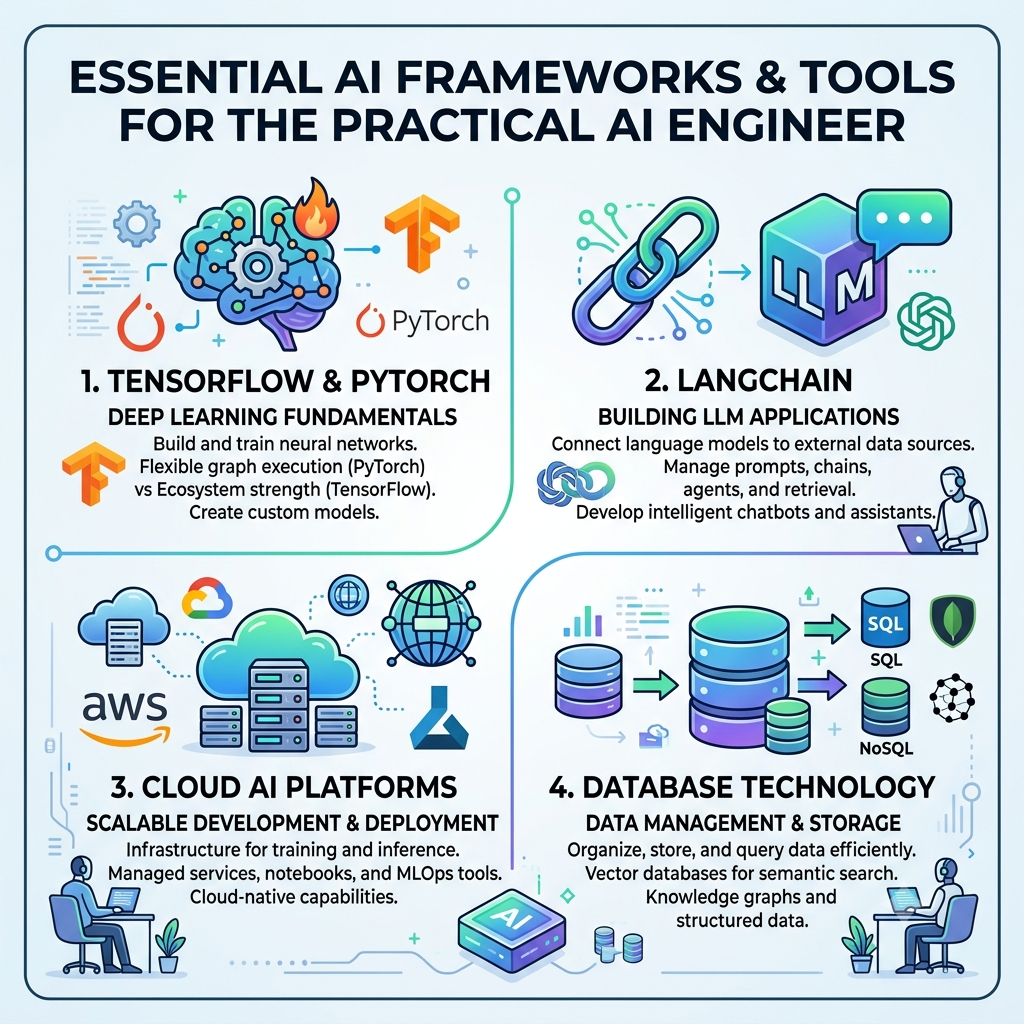
4. AI Frameworks and Tools
A practical AI engineer should know tools like:
- Tensorflow PyTorch
- LangChain
- Cloud AI platforms
- Database technology
“The tools will keep changing.” The most important skill is to learn how to use new technology fast.
5. Cloud and Deployment Skills
One of the common mistakes of beginners is to learn only how to make a model in a laptop.
The companies need engineers who can deploy AI solutions.
Critical areas:
- APIs
- Docker
- Online platforms
- Deployment of models Monitoring
AI project is not done when the model is working. It is finished when users can actually use it.
What Skills Do You Need to Become a Machine Learning Engineer
Machine learning engineering is a deeper dive, more technical.
1. Mathematics & Statistics
Machine learning engineers should be comfortable with:
Linear algebra Probability theory Statistics Optimization concepts
You don’t have to memorise all the equations, but you should know what’s going on inside the model.
2. Data Management Skills
Data is very important in machine learning.
You need to know:
- Data cleaning.
- Data pre-processing
- Feature selection Data visualisation SQL
A lot of the work in ML is not glamorous. Sometimes, the biggest gains are no change to the algorithm, but cleaning up the data.
3.Deep Learning
For advanced ML roles, familiarity with:
- Neural Networks CNNs Transformers
- Natural language processing
is precious.
The field has changed a lot since the advent of transformer-based models. These ideas form the basis of the technologies behind many modern AI systems such as conversational AI and content-generation tools.
4.Model Management and MLOps
A machine learning engineer needs to know how models will live in production.
This comprises:
- Control version
- Experiment tracking
- Model monitoring automation pipelines
Now, building a model is one thing. Another challenge is reliability after millions of users interacting with it.
AI Engineer Roadmap: A Hands-On Learning Guide
If I were doing this from scratch today, I would not collect random certificates, but try to build skills in an orderly fashion.
Here’s what a realistic AI engineer roadmap would look like:
Program (a)
Begin with:
Python Git Basic software development skills
Step 2: Data & ML 101
Know:
Numpy Panda
Concepts of Machine Learning
Data Analytics
Step 3: Study AI Development
Move into
Generative AI basics Deep learning basics LLM use cases
AI APIs
Step 4: Build Actual Projects
For examples;
- AI Resume Extractor
- Doc chatbot
- Recommendation engine
- Automation tool, powered by AI
Watching dozens of tutorials teaches you less than doing projects.
Step 5: Learn to Deploy
Realise:
Cloud APIs Containers Production workflows
This is where a lot of learners separate themselves from the beginners.
What To Look For In AI Engineer Courses?
With hundreds of AI engineer courses available, it can be hard to narrow it down.
A good course is more than just teaching concepts. It should contain:
- Hands-on projects
- Real Datasets Industry tools
- Deployment experience Career counselling
Many students spend months learning theory but stumble when asked, “Can you build an AI app from scratch?”
A good program will give you the confidence to answer that question.
If you are a learner who wants structured training, then platforms like H2K Infosys focus on practical and industry-aligned training on the subjects of AI, machine learning, cloud technologies, and software skills. Their approach is to help learners understand concepts and apply them using projects, rather than preparing learners for exams.
What Job Is Better for Opportunities in 2026?
Both roles are in demand and on the rise.
There is a lot of demand for AI engineers vs a machine learning engineers, especially as companies are looking for people who can rapidly build AI into products.
For instance:
- AI assistants are being used by healthcare companies for documentation.
- Companies are using automation in customer support.
- Developers are building AI features into everyday applications.
- Generative AI is helping companies build internal knowledge systems.
Machine learning engineering is still very valuable, especially in companies that are working on:
- Search engines
- Recommendation systems
- Self-driving technology
- Big AI platforms
Really, the future is not AI engineer vs a machine learning engineer. The best pros know both.
Conclusion: AI Engineer or Machine Learning Engineer?
If you love creating products, experimenting with new AI tools, and making solutions that users love, AI engineering may be a better fit.
If you like mathematics, algorithms, data and improving model performance, machine learning engineering might be for you.
For many new learners today, it is good to start with an AI engineer roadmap, as it introduces them to software development, ML, and modern generative AI. Later you can go more deeply into machine learning engineering.
The point isn’t to track down every new AI tool that’s released. Make real projects Learn how AI solves real problems Build strong fundamentals
That blend is what companies are looking for in 2026.