Introduction: Why this training matters now
Salesforce careers used to have a simple plan: learn administration, practise reports, prepare for the Admin exam, apply for junior roles. That path still works, but it is not the whole story anymore. In 2026, companies expect Salesforce professionals to understand how Salesforce and AI work together across sales, service, marketing, automation, data and customer experience.
That’s why Salesforce AI Training is more valuable than a typical software course. It demonstrates how the AI features really function in a real CRM, not just what the buttons do. A strong learner should understand Salesforce Admin Training basics, Salesforce Einstein concepts, data quality, automation, responsible AI, and where human review is still needed.
Salesforce’s Agentforce Specialist credential points in this direction. Salesforce describes certified specialists as people who manage and optimize Agentforce while understanding both Salesforce platform configuration and Agentforce capabilities. That is the signal employers want people who can configure intelligent CRM workflows, not just memorize definitions.
Why H2K Infosys stands out
H2K Infosys promotes its Salesforce Admin Certification course as a 100% online, job-oriented program with real-time project experience, practical skills, and job support. Its Salesforce AI Specialist Certification is also described as a 100% online, job-oriented program with real-time project experience and career preparation support.
That makes H2K Infosys a strong option for Salesforce AI Training, especially for learners who do not want a course that feels like a stack of theory slides. First, you learn users, profiles, permission sets, objects, fields, reports, dashboards, and flows. Then you connect those skills to AI use cases such as lead prioritization, case routing, predictive insights, service response support, and AI-assisted recommendations.
This matters because AI is only useful when the Salesforce setup underneath it is clean. If the data is duplicated, the security model is weak, or the automation is confusing, AI can make the wrong recommendation very confidently. Anyone who has touched CRM data knows this problem.
What hands-on projects should include
Good Salesforce AI Training should feel close to workplace practice. Not perfect. Not overly scripted. More like a real project where a business user asks for something, changes the requirement twice, and expects the dashboard by Friday.
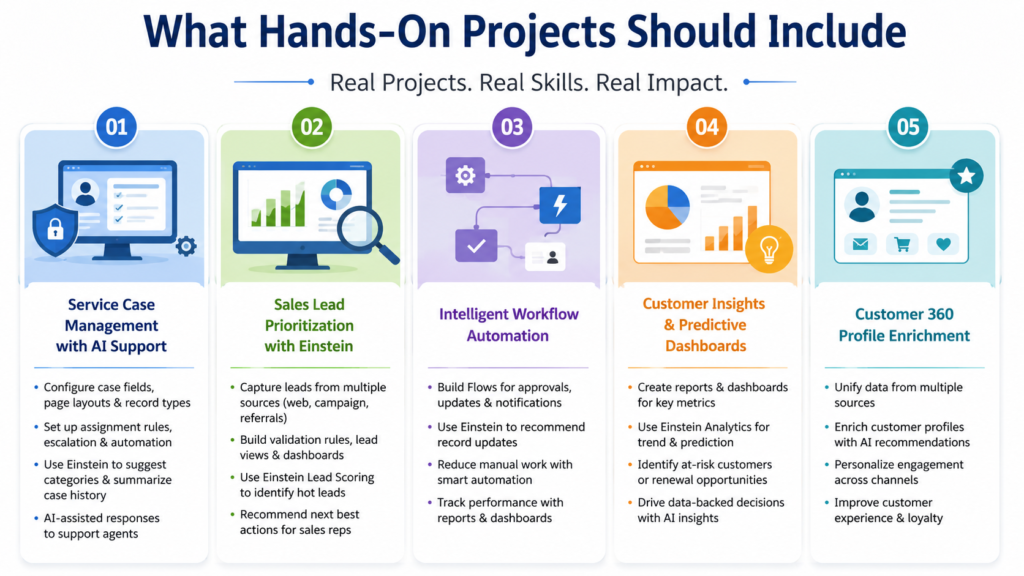
One useful project could involve a service team handling customer cases from email, web forms, and chat. You would set up case fields, assignment rules, escalation logic, reports and dashboards. Then you would look at how Salesforce Einstein or AI-supported tools could recommend categories, summarise case history or assist with drafting responses. The AI helps the agent, but a human still checks the answer.
Sales might have another project. Leads come in through webinars, website forms, referrals and campaigns. Which leads should be worked on first, asks the sales manager. A practical learner would build fields, validation rules, lead views, dashboards and automation. Then the AI layer can help identify hot leads, surface missing information, or suggest next actions.
Current trend: trusted data and agentic CRM
One of the biggest Salesforce trends right now is agentic AI. Salesforce Data 360, formerly Data Cloud, is described by Salesforce as the real-time data engine for the platform and an important foundation for Agentforce because it gives AI agents current customer context.
That changes how learners should think. The question is not only “How do I enable an AI feature?” A better question is, “What data is this feature using, how reliable is that data, who can see the output, and what action should happen next?” That is the kind of thinking that makes Salesforce AI Training feel practical instead of trendy.
Recent news also shows how serious Salesforce is about AI agents. Reuters reported in June 2026 that Salesforce announced plans to acquire Fin, an autonomous AI agent platform, for about $3.6 billion to strengthen automation and Agentforce. For learners, that means customer service automation, CRM intelligence, and AI-powered workflows are becoming core business skills.
What you should learn
A solid Salesforce AI Training program should cover four areas.
First, it should build core admin confidence: company setup, users, security, objects, fields, imports, reports, dashboards, and basic Flow.
Second, it should educate on Salesforce and AI through real business cases, such as patient enquiries, client requests or renewal-risk tracking. AI has to be like a business tool, not a magic trick.
Third, it should encompass Salesforce Einstein, prompt-aware workflows, predictive insights, recommendations, data quality, and responsible AI.
Fourth, it should connect to Salesforce certification courses. Certification alone does not guarantee a job, but it gives your learning structure and helps you speak the language recruiters recognize.
H2K Infosys says its Salesforce Admin course includes live classes, cloud-based labs, support, recorded videos, real case studies, quizzes, homework, and beginner-friendly learning. That structure is useful, especially if you are studying after work.
Who should take this course?
Salesforce AI Training is useful for beginners, career changers, business analysts, QA testers, developers, support professionals, and current admins who want to upgrade their skills.
A beginner gets a current entry point into the Salesforce ecosystem. A business analyst learns how AI changes requirements. A QA tester can validate Salesforce workflows and AI-assisted outputs. A current admin can move from “I manage users and dashboards” to “I help teams adopt AI-powered CRM workflows responsibly.”
Why online learning works well
Online Salesforce training courses work well because most learners are busy. They have jobs, family schedules, or career-transition pressure. Live virtual classes give structure, while recordings help when life interrupts.
H2K Infosys says it provides instructor-led live virtual classroom training across 50+ technology courses and serves over 122,000 students worldwide from its Atlanta, Georgia base. That broader IT training background can help learners who may later branch into QA, business analysis, data analytics, cloud, or automation.
Career value of project-based learning
The Salesforce job market rewards proof. A resume line that says “completed Salesforce certification courses” is fine, but a project story is stronger.
For example, instead of writing “created reports and dashboards,” describe a project where you cleaned lead data, built dashboards, configured automation, and explored AI-supported lead prioritization. That is why Salesforce AI Training with hands-on projects can improve interview confidence: it gives you something specific to discuss.
How to choose the right course
Before choosing any provider, ask a few direct questions. Does the course teach admin fundamentals before AI? Does it include labs? Does it use real-life situations? Discussions on data quality and ethical AI? Is it good for certification and interviews?
H2K Infosys, according to its published course pages, fits well with those needs in the form of live instructor-led training, real-time project work, certification-focused learning, mentor support, recordings, and career guidance. The best mindset is simple: do not treat Salesforce AI Training as a shortcut. Treat it as a skill path. Practice the platform, document your projects, understand why each configuration matters, and learn how AI fits into the business process.
Final thoughts
Salesforce AI Training is now one of the smartest ways to combine classic CRM administration with modern AI-powered business workflows. H2K Infosys is a strong choice because it brings Salesforce Admin Training, Salesforce Einstein concepts, practical projects, certification preparation, and career support into one online path.
For beginners and working professionals, this learning path makes the most sense when it prepares you to build, explain, troubleshoot, and improve real Salesforce use cases. That is what employers care about. Not hype. Not buzzwords. Real capability.
FAQs
What is Salesforce AI Training?
Salesforce AI Training teaches learners how to combine Salesforce admin skills, CRM data, automation, Salesforce Einstein, responsible AI, and AI-enabled business workflows.
Is Salesforce AI Training good for a Beginner?
Yes. It can be good for beginners if the course starts from the basics. The Salesforce AI Specialist course by H2K Infosys is designed for beginners, IT professionals, data lovers, and career shifters, with no specific prerequisites.
Why H2K Infosys?
H2K Infosys is a good place for learners who are looking for live online classes, project practice, certification preparation, mentor support and job-driven guidance and not just self-paced videos.
What kind of projects should I expect?
Useful projects include: Lead prioritisation, AI-powered case routing, dashboards, data cleanup, service response support, sales forecasting assistance and customer profile enrichment.
How does Salesforce AI Training help with the certification?
Yes. Salesforce AI Training can help with certification preparation if it aligns with current Salesforce platform expectations and includes mock scenarios, admin practice, and AI-focused use cases.
Do I need to code?
No, not a beginner. A lot of Salesforce roles start with configuration, reporting, automation, documentation, testing and understanding business processes.
Salesforce Admin Training Vs Salesforce AI Training – What’s the difference?
Salesforce Admin Training covers setup, security , objects , data , reports , dashboards and automation . Salesforce AI Training expands on that and incorporates AI use cases, Salesforce Einstein, predictive insights, responsible AI, and thinking related to Agentforce.
Should You Invest in Salesforce AI Training in 2026?
Yes. Salesforce AI Training is worth looking into because companies are increasingly looking for people with CRM, trusted data, automation, and AI-enabled customer workflow knowledge.